Business Intelligence
Querio beats thoughtspot, julius on best AI native data analytics tool
Transparent, real-time AI analytics with live warehouse queries, centralized metrics, SQL/Python visibility, and fixed pricing.

Querio is redefining AI-powered data analytics by prioritizing accuracy, transparency, and real-time insights. It connects directly to modern warehouse-native data analysis tools like Snowflake and BigQuery, allowing users to ask questions in plain English and receive precise answers backed by SQL or Python code. Unlike competitors ThoughtSpot and Julius, Querio ensures consistent metrics through a centralized context layer and offers unlimited user access with fixed pricing.
Key Highlights:
- Natural Language Queries: Ask questions in plain English; see and edit the generated SQL or Python for full transparency.
- Centralized Context Layer: Guarantees consistent metric definitions across teams.
- Real-Time Insights: Directly connects to live data warehouses without replication or delays.
- Cost-Effective: Fixed annual pricing includes unlimited viewers, avoiding per-user fees.
Querio outshines ThoughtSpot with better handling of complex queries and Julius by eliminating reliance on file uploads or opaque processes. It’s a top choice for teams needing fast, accurate, and governed analytics.
Quick Comparison:
| Feature | Querio | ThoughtSpot | Julius |
|---|---|---|---|
| Natural Language | Conversational SQL Agent | Search-driven SpotIQ | Limited code visibility |
| Data Connections | Live warehouse (Snowflake, etc.) | Broad connectors & Liveboards | File uploads (CSV/Excel) |
| Governance | Centralized context layer | Less centralized control | Temporary session data |
| Transparency | Full SQL/Python visibility | Limited modification | Black-box AI, Python/R code |
| Pricing | Fixed annual, unlimited viewers | User-based licensing | Individual focus |
Querio empowers businesses to make faster, data-driven decisions without sacrificing control or consistency.
::: @figure 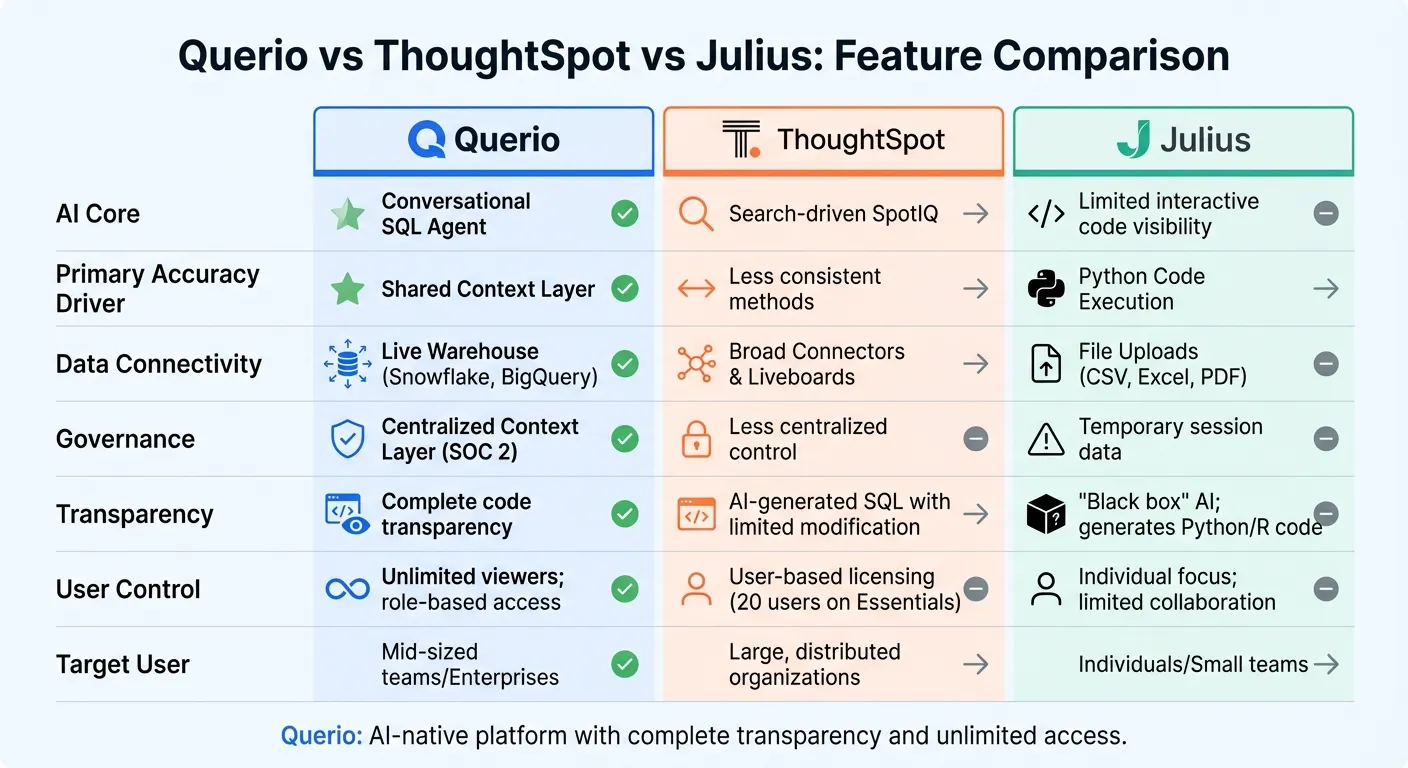 {Querio vs ThoughtSpot vs Julius: AI Analytics Platform Comparison}
:::
{Querio vs ThoughtSpot vs Julius: AI Analytics Platform Comparison}
:::
How Querio's AI-Driven Analytics Works
Querio's AI-driven analytics combines natural language accessibility, standardized business logic, and direct data connectivity to make analytics simple to use while maintaining technical accuracy.
Ask Questions in Plain English
With Querio, you can ask questions like, "What was our revenue last quarter?" or "Which customers churned in February?" The AI translates these into real SQL or Python code. The best part? You can see the generated code right away, offering complete transparency. This visibility eliminates the typical "black-box" issue found in many AI tools. If the results need tweaking, you can either adjust the code yourself or rephrase your question. It’s a win-win: non-technical users get fast answers, and technical teams retain full control over the process.
The next step ensures everyone’s on the same page with a unified context layer.
Shared Context Layer for Consistent Results
Querio’s shared context layer ensures that metrics - like gross revenue, net revenue, or ARR - are calculated consistently across the board. This means the right formulas, joins, and filters are applied automatically, avoiding the frustrating situation where different teams report conflicting numbers. It also helps clarify vague queries and keeps dashboards, notebooks, and ad-hoc analyses aligned, ensuring everyone works with the same definitions and results.
Finally, Querio’s direct connections to your data ensure real-time insights without extra hassle.
Direct Warehouse Connections
Querio connects directly to Snowflake, BigQuery, Amazon Redshift, ClickHouse, PostgreSQL, and other modern data warehouses using secure, read-only credentials. This allows queries to run on live data, delivering real-time insights. The setup is quick - around 15 minutes - and there’s no need to move data into a separate platform. By working natively with your existing infrastructure, Querio keeps costs predictable, eliminating per-user fees or data duplication charges.
sbb-itb-284a532
Querio vs ThoughtSpot: Better Accuracy and Ease of Use
ThoughtSpot has long been recognized for its traditional approach to analytics. However, it often struggles with more complex multi-table queries. Querio, on the other hand, is built from the ground up as an AI-native platform tailored for modern data teams. Its ability to handle intricate, multi-table queries with precision makes it stand out, consistently delivering accurate results.
More accurate natural language queries
ThoughtSpot's Sage search is effective for simple questions but tends to fall short when faced with queries involving multiple joins or nested calculations. Querio takes a different approach. Its AI agent uses a schema linking method combined with a centralized context layer that fully understands your data model. This setup ensures that even the most detailed queries are processed with accuracy and efficiency.
One of Querio's standout features is its full SQL transparency. By providing clear visibility into the query process, it removes guesswork and builds confidence in the analytics results.
Designed for Modern Data Warehouses
Querio connects directly to your data warehouse using read-only credentials, enabling real-time queries without the need for data replication. This "warehouse-first" design ensures that you're always working with up-to-date data as it exists in your source systems.
Scaling analytics is also straightforward with Querio. It offers unlimited viewer access and fixed annual pricing, keeping costs predictable as your team expands. This eliminates the headaches of user-based licensing and allows teams to grow without added complexity. These seamless integrations with data warehouses make scaling analytics not only possible but simple.
Querio vs Julius: Transparency and Control
Julius relies on a chat interface where users must upload files (like CSV or Excel) to get answers. This setup lacks clarity and makes it hard to reproduce results.
See and Edit the Code Behind Every Query
Querio takes a completely different route. Each natural language query you make generates real SQL or Python code that you can fully inspect, tweak, and reuse. This gives analysts and data teams complete control. If the query isn't quite right, you can quickly adjust it and save the changes. This transparency builds confidence, ensuring that every result is based on logic you can verify, not some hidden algorithm.
Simplified Analytics with Built-In Governance
Julius uses session-based security, which can lead to inconsistent metric definitions. This inconsistency makes it tough to ensure everyone is working with the same data standards. Querio addresses this issue with a centralized semantic layer that defines joins, metrics, and business terms in one place. Once data teams set the rules, they automatically apply across all queries, dashboards, and AI-powered embedded analytics. This "define once, apply everywhere" approach allows non-technical users to confidently ask questions and trust the answers, knowing they're aligned with company-wide standards. Querio’s approach ensures faster, more reliable decisions by keeping everyone on the same page.
Feature Comparison: Querio vs ThoughtSpot vs Julius
Querio stands out with its strong architecture and centralized governance, offering features that cater to modern analytics needs. Here's how it compares to ThoughtSpot and Julius:
| Feature | Querio | ThoughtSpot | Julius |
|---|---|---|---|
| AI Core | Conversational SQL Agent | Search-driven SpotIQ | Limited interactive code visibility |
| Primary Accuracy Driver | Shared Context Layer | Less consistent methods | Python Code Execution |
| Data Connectivity | Live Warehouse (Snowflake, BigQuery) | Broad Connectors & Liveboards | File Uploads (CSV, Excel, PDF) |
| Governance | Centralized Context Layer (SOC 2 certified) | Less centralized control | Temporary session data |
| Transparency | Complete code transparency | AI-generated SQL with limited modification | "Black box" AI; generates Python/R code |
| User Control | Unlimited viewers; role-based security | User-based licensing (20 users on Essentials) | Individual focus; limited collaboration |
| Target User | Mid-sized teams/Enterprises | Large, distributed organizations | Individuals/Small teams |
Querio takes a different approach by leveraging a centralized context layer, ensuring consistent, ready-to-use insights. Unlike other platforms, it provides complete code transparency, giving users full visibility and control over the analytics process.
With its robust governance model and user-friendly design, Querio is tailored for mid-sized teams and enterprises, offering a scalable solution that balances transparency, control, and ease of use. This makes it a standout choice in the world of AI-powered analytics.
How Companies Use Querio to Make Faster Decisions
Querio helps companies make decisions in minutes instead of weeks. By combining AI-powered natural language queries with live connections to data warehouses, teams can quickly access the latest data - no need for engineering support or learning SQL. Let’s explore how this plays out in Fintech and e-Commerce.
Case Study: Automated KPI Tracking for Fintech
Fintech teams often track metrics like revenue, transaction volumes, customer acquisition costs, and fraud rates. Traditionally, they’ve relied on static dashboards that required manual updates or help from engineers. Querio changes this by standardizing metric definitions through its shared semantic layer. Now, teams can ask questions like, “What was our transaction success rate yesterday?” and get instant, accurate answers directly from live data. This eliminates the need for back-and-forth communication, enabling finance and operations leaders to monitor KPIs in real time.
Case Study: Self-Service Analytics for E-Commerce
By May 2024, Pipp’s 40-person team faced a common challenge: only three employees had access to analytics, creating delays. After adopting Querio, the number of users with data access jumped from 3 to 20. Reporting times shrank from 3 weeks to just 30 minutes, and every user reported making more data-driven decisions[4].
"I've been really surprised with how well Querio works. The team is a lot more self-sufficient... Querio changed how we work with our data and each other!" – Moe, CTO, Pipp[4]
Querio also provides complete code transparency, letting users view the SQL behind every answer. This builds trust while maintaining governance. Marketing teams can easily analyze campaign performance, operations can track inventory, and customer success teams can monitor retention - all without needing engineering support.
Why Querio Leads in AI-Native Analytics
Querio sets itself apart by being built from the ground up as one of the top AI-native business intelligence tools, specifically designed for enterprise-level analytics on live data. Unlike older systems that have AI features added on later, Querio is purpose-built to seamlessly integrate AI into its core functionality.
One of Querio's standout features is its combination of AI-powered natural language queries with full code transparency. Users can inspect SQL and Python code behind the insights, ensuring that teams can verify the logic and maintain confidence in consistent metric definitions.
The platform's governance model allows data teams to define joins, metrics, and business logic just once. This centralized setup means that anyone in the organization can ask questions in plain English - without needing engineering support. The result? Faster answers and more dependable decision-making, all while staying aligned with established business logic.
Querio has earned high praise on G2 for its AI-driven predictive insights and real-time recommendations[3]. Users frequently highlight its intuitive data exploration tools, robust reporting features, and seamless integration with essential business platforms[2]. By providing instant, detailed analytics across various functions[1], Querio ensures that teams can act quickly and confidently on data.
Another key advantage is Querio's pricing model. With unlimited viewers included under a fixed annual fee, the platform eliminates per-seat licensing costs, making it easier for entire organizations to access enterprise-grade analytics. This approach not only reduces reporting times but also makes data-driven decisions more practical and efficient for businesses of all sizes.
FAQs
::: faq
How does the context layer keep metrics consistent?
The context layer plays a key role in making metrics consistent by pre-calculating and storing KPIs for easy and quick access. It takes raw data and dynamically converts it into terms that are more aligned with business needs, ensuring that definitions remain uniform across all teams. This method not only provides faster insights but also strengthens data governance. :::
::: faq
What permissions does Querio need to query my warehouse?
Querio requires direct access to your data warehouse - whether it's Snowflake, BigQuery, or Postgres - to function effectively. By granting the necessary permissions, Querio can query and analyze the data stored within these platforms. This ensures smooth integration and enables it to deliver precise insights tailored to your needs. :::
::: faq
How do teams validate and reuse the SQL or Python it generates?
Teams can store generated SQL or Python in the platform’s secure, centralized context layer, making it easy to validate and reuse. This layer serves as a hub for defining business rules and metrics, ensuring analyses are interpreted consistently. By referencing and modifying existing queries, users can maintain accuracy while streamlining ongoing data analysis. :::