Business Intelligence
Why Governed Context Beats Black-Box AI in Business Intelligence
Governed context prevents KPI drift: one metric definition, traceable lineage, and permission-aware queries for auditable BI.

If AI can’t show where a KPI came from, I wouldn’t use it for BI.
Here’s the short version: I trust governed context more than black-box AI because it keeps every answer tied to one metric definition, one data path, and the same access rules. That cuts down on metric drift, makes dashboard answers easier to check, and helps keep finance, product, and leadership looking at the same numbers.
In plain English, this article comes down to three points:
- Black-box AI can change the logic behind the same question, so MRR, ARR, NRR, or retention may not match from one session to the next.
- Governed context keeps BI tied to set definitions, lineage, and permissions, so answers can be checked back to source tables and approved business logic.
- For small SaaS data teams, this matters most in KPI reviews, dashboard Q&A, root-cause work, and compliance-heavy reporting.
A few points stand out:
- In many teams, even a 1 KPI mismatch can derail a board deck or monthly review.
- Access controls like row-level security and role-based permissions matter when BI touches revenue or customer data.
- Inspectable outputs - like SQL or Python you can review - matter more than polished AI answers that hide the logic.
What's new in Looker: Empowering business users in the governed agentic era
::: @iframe https://www.youtube.com/embed/u72ZSc8jLg4 :::
sbb-itb-284a532
Quick Comparison
| Area | Black-Box AI BI | Governed-Context AI BI |
|---|---|---|
| Metric logic | Can shift across sessions | Stays tied to set definitions |
| Source tracing | Hard to verify | Traceable to tables and logic |
| Dashboard Q&A | May sound right but be off | Easier to check and defend |
| Access control | May skip set data rules | Uses the same warehouse controls |
| Audit trail | Limited or hidden | Logged and reviewable |
| Best fit | Low-stakes questions | KPI reviews, finance, product, and compliance work |
If you use Snowflake, BigQuery, Redshift, or Postgres, the takeaway is simple: Governance-first AI BI works better because it runs inside your data rules, not around them.
The BI problems black-box AI creates
::: @figure 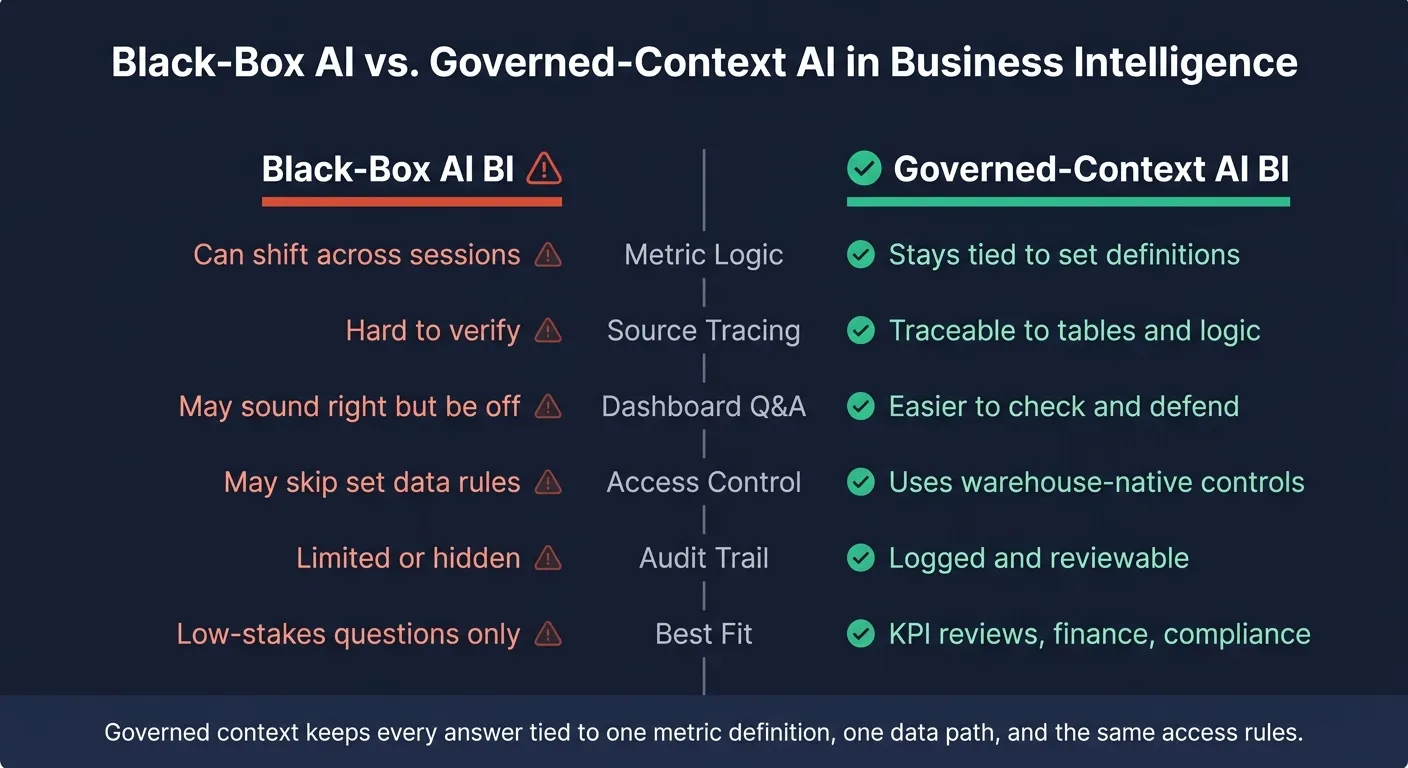 {Black-Box AI vs. Governed-Context AI in Business Intelligence}
:::
{Black-Box AI vs. Governed-Context AI in Business Intelligence}
:::
Black-box AI doesn't fail loudly. It fails quietly. You usually see it in the numbers first, then in the explanations, and then in who can access what.
KPI analysis breaks when metric definitions drift
Ask a black-box AI, "What's our MRR this month?" and you may get one answer now and a different answer later. Why? Because the system is guessing joins, filters, and attribution instead of using a governed metric definition. It isn't using your dbt models or metric catalog, so the same question can lead to different logic.
For finance close or board prep, that's not a small annoyance. It's a credibility problem. Once metric definitions drift, dashboard Q&A starts drifting too.
Dashboard Q&A and root-cause analysis become unreliable
Picture a revenue dashboard showing a dip. A sales leader asks, "Why did revenue drop last month?" A black-box AI can produce a story that sounds right on the surface.
But sounding right and being right are not the same thing.
Without governed context, the system can miss key definitions like active customer, revenue recognition, and pipeline stage. That means analysts still need to go back to the warehouse and check the answer by hand.
Audit, permissions, and compliance gaps create compliance risk
The last problem is governance. When a black-box AI writes SQL or generates a KPI narrative, the output often doesn't show a clear path back to the source table, row-level filter, or permission check. In Snowflake, BigQuery, and Redshift, row-level security and role-based access controls exist to keep sensitive data inside set boundaries. Black-box AI tools that skip those controls can create data exposure risks [2].
The table below shows how this plays out across the areas that matter most to small data teams:
| Dimension | Black-Box AI BI | Governed-Context AI BI |
|---|---|---|
| Metric consistency | High drift risk; logic is inferred and can vary across sessions [1] | Stable; tied to explicit semantic definitions and deterministic parsing [1] |
| Permissions | Often lacks row-level security or SSO integration, creating exposure risk [2] | Permission-aware; respects warehouse-native access controls [2] |
| Auditability | Hidden logic; answers can't be traced to source tables [1] | Connections are traceable and can be labeled EXTRACTED or INFERRED [1] |
For SOC 2-focused SaaS teams, that audit-trail gap alone can make black-box AI a poor fit for workflows tied to revenue, compensation, or customer data [2]. You can't explain to an auditor how a number was calculated if the system that produced it can't show its work.
How governed context improves reliability, auditability, and trust
Governed context makes BI more dependable because AI works from approved metric definitions, lineage, and access rules. That means answers stay repeatable, traceable, and defensible. In KPI reviews, dashboard Q&A, and root-cause analysis, that kind of consistency helps close the reliability gaps that often show up in day-to-day BI work.
| Governance Component | BI Risk Reduced | What It Adds |
|---|---|---|
| Metric catalogs / semantic models | Metric drift | One governed metric definition across every dashboard and query [1] |
| Lineage and path tracing | Unreliable root-cause analysis | Traces an answer back to source tables and business logic [1] |
| Trace labels | Hallucinated logic | Shows whether a relationship is explicit in source or resolved by AI [1] |
| Permission-aware access (SSO and zero data retention) | Data exposure | Keeps restricted data out of self-serve workflows and supports SOC 2 controls [2] |
| Documentation and design notes | Defensibility gaps | Links rationale directly to data definitions [1] |
Semantic models and metric catalogs create one governed metric definition
Define a metric once in a governed semantic layer or metric catalog, and every dashboard, notebook, and natural-language answer uses that same logic. That's how teams avoid drift in daily BI use. Versioned metadata also helps keep definitions in sync as they change over time.
This matters in practice. If a live dashboard answer doesn't match what finance or product sees in review meetings, trust drops fast. A single governed definition keeps those numbers lined up.
Lineage, documentation, and query auditing make answers defensible
When an AI-generated query runs, a governed system logs it and ties it back to the metric definition and source table it used [1]. So instead of getting a number with no paper trail, analysts can inspect where it came from and how it was built.
They can see both the answer and the reasoning behind the field definition. That's a big deal when someone asks, "Why did this number change?" or "Which table drove this result?" You're not left guessing.
Permission-aware access keeps self-serve analytics safe
When a finance or operations analyst asks a natural-language question, the system still applies the same row-level and role-based access controls that are already in place. It doesn't skip past them [2].
SSO and zero data retention add another layer of control. They help keep self-serve analytics compliant and reduce the chance that restricted data gets exposed to business users [2]. With those guardrails in place, teams can open up self-serve analytics without giving up warehouse governance.
How governed context works in real BI workflows and where Querio fits
Governed context matters most in day-to-day BI work, where the same metric logic and permissions need to stay in place for every question. You see the payoff in live workflows, not just in metadata. It shows up in executive reviews, dashboard Q&A, and notebook analysis.
Executive KPI reviews with live warehouse data
Board reporting is one of the fastest places for metric drift to cause problems. If the same metric is defined in more than one place, the numbers can split before the deck is even done.
A governed setup defines each metric once in a semantic layer and pulls it live from Snowflake, BigQuery, or Redshift at query time. That means every dashboard and notebook points to the same logic. So the ARR number in the executive summary matches what finance sees in its own view.
Querio connects straight to your warehouse with encrypted, read-only credentials and applies the same context to every query. If someone asks, What's our NRR trend over the last six months?, that question runs against the same governed metric definition used in the scheduled board report, not a separate calculation that might drift.
That same query logic also needs to stay in place when people ask follow-up questions inside the dashboard.
Conversational dashboard questions without hidden logic
Natural-language BI can speed up analysis. But when the logic stays hidden, people have a hard time trusting the answer.
In Querio, every answer is backed by real SQL or Python that analysts can inspect and edit. If a product manager asks, Which customer segment had the lowest retention last quarter?, the system generates a query based on the same retention formula used across governed dashboards. Then the analyst can open that query, check the joins, and confirm the result before anyone shares it. That kind of inspectability makes conversational BI usable for non-technical teams without giving up control over definitions.
When a question turns into a deeper investigation, the same context should carry into the notebook without extra work.
Root-cause investigation with governed notebook drill-downs
When a top-line KPI drops, the investigation often starts in a dashboard and ends in a notebook. Moving between tools can force teams to redefine metrics and lose the governed context behind the original dashboard number.
Querio's notebook updates automatically when filters change. An analyst can start with a governed KPI - say, a sudden drop in weekly active users - and drill into segments, cohorts, or product behavior straight from live warehouse data, without re-entering metric definitions or exporting work into a separate tool. Change a filter or time range, and the full analysis recalculates automatically, while the root-cause answer stays tied to the original KPI definition.
How to roll out governed context in a small data team
Once governed context is working in day-to-day BI, roll it out in layers.
Most small data teams don't need a full semantic layer on day one. They need it for the core metrics people argue about the most.
Start with a narrow semantic layer for core SaaS metrics
Start with the core SaaS metrics that spark the most reporting questions. Define them in dbt close to the warehouse, where the logic is version-controlled and easy to inspect.
Once those definitions are stable in Snowflake, BigQuery, or Redshift, every dashboard and AI query that uses those metrics pulls from the same source of truth. That matters more than it sounds. If marketing, finance, and product all look at the same metric through the same logic, a lot of back-and-forth simply goes away.
Use trace labels so reviewers can see what is sourced and what is inferred.
After the metric layer is stable, add review and permission controls before opening up broad access.
Add review workflows, permissions, and audit logs early
Assign one owner to each governed metric before exposing it outside the data team. That way, when a definition changes, everyone knows who is on the hook for it.
Use Git-based pull request reviews for any definition change so there's a clear record of who changed what and why. Set warehouse-level and semantic-layer permissions at the same time. The same restrictions should apply whether someone is running a dashboard, asking a natural-language question, or opening a notebook.
Log every query from the start. Audit logs are a pain to bolt on later, and by then you've usually lost the history you wish you had.
With those controls in place, expand access gradually instead of flipping the switch for everyone at once.
Expand governed self-serve access as trust increases
Once metric disputes drop and outputs are stable, open governed self-serve access in stages.
A simple rollout can look like this:
- Start with read-only access to governed dashboards
- Then expand to conversational access backed by inspectable SQL
- Review query logs as access grows and watch for misuse
This step-by-step approach gives people room to build trust in the system before they rely on it more heavily.
FAQs
::: faq
How is governed context different from a semantic layer?
Governed context goes beyond a semantic layer.
A semantic layer standardizes business logic and metrics. Governed context adds the oversight, security, and audit trail that make people trust what they’re looking at.
Put simply, the semantic layer defines the data’s what and how. Governed context adds the who and why through documentation, process, audit logs, role-based access controls, and version-controlled decision rationales. :::
::: faq
When do BI teams need inspectable SQL or Python?
BI teams need SQL and Python they can inspect. That matters when they have to verify AI-generated insights, audit the logic behind high-stakes business decisions, or fine-tune queries that involve messy edge cases.
With black-box systems, you're stuck trusting the output. Transparent code changes that. Teams can review joins and metric calculations, check results against business logic, and keep reporting consistent across the company - while still getting the speed AI brings. :::
::: faq
What should a small SaaS data team govern first?
Start small so the team doesn’t get buried in too many numbers at once. Pick 3 to 5 key KPIs, then write down exactly what each one means with leaders in Sales, Marketing, and Finance.
Next, put those metrics in a semantic layer so the same definitions show up across the organization. Think of it as a lighthouse for the team: one clear point of reference that helps you test the data model and governance process on a single use case before rolling it out more broadly. :::