Business Intelligence
Embedded Analytics Overview: Trends, Tools, and Implementation Guide for 2025
Explore how embedded analytics is transforming business operations in 2025 with AI-powered insights and seamless integration.

Embedded analytics is reshaping how businesses work with data in 2025. Instead of relying on separate dashboards or reports, it integrates insights directly into the tools people use every day. This approach saves time, simplifies workflows, and empowers teams to make faster decisions.
Key highlights:
- What it is: Embedding data visualizations, reports, and insights into existing software.
- Why it matters: Speeds up decision-making and reduces dependency on standalone platforms.
- Trends: AI-powered analytics, real-time insights, and cloud-native solutions are driving adoption.
- Industries using it: SaaS, healthcare, finance, manufacturing, and e-commerce.
- Embedded analytics tools to know: Querio offers AI-driven analytics with no SQL needed, with a free plan and an Embedded add-on from $1,500/month.
- Implementation steps: Define goals, choose integration methods (SDKs, APIs, or white-labeling) within a scalable architecture, ensure security, and plan for user adoption.
Key Trends Shaping Embedded Analytics in 2025
The world of embedded analytics is undergoing a transformation, driven by advancements in technology and evolving business demands. Three key trends are redefining how organizations integrate and analyze data, paving the way for the next generation of embedded analytics tools and applications.
AI and Generative Analytics
Artificial intelligence is no longer just a supporting player - it’s now at the forefront of embedded analytics. With AI-powered predictive tools and generative insights, businesses are moving beyond basic data visualizations to intelligent recommendations and automated decision-making.
Modern platforms equipped with natural language processing (NLP) allow users to interact with data effortlessly. You can ask questions in plain English and get instant, context-specific answers. For example, instead of combing through complex dashboards, users can type, “What were last quarter’s top-performing products?” and receive immediate, easy-to-understand insights.
Embedded machine learning is also making waves by enabling precise forecasting. It can predict inventory needs, flag potential customer churn, or detect equipment issues - all integrated directly into user dashboards. Imagine a manufacturing dashboard that not only alerts you when production efficiency dips but also pinpoints possible causes and suggests solutions in real time.
Generative AI is another game-changer. These systems can automatically create executive summaries, craft data-driven narratives, and even recommend next steps based on trends. This means raw data is transformed into actionable insights without requiring manual analysis, saving time and boosting efficiency.
Real-Time and Self-Service Analytics
In today’s fast-paced environment, businesses need insights instantly. Real-time data processing has become a standard feature, giving organizations the ability to act on up-to-the-minute information.
Streaming analytics is leading this shift, enabling platforms to process data as it flows in rather than waiting for batch updates. This capability lets applications display live metrics, send instant alerts, and continuously update visualizations. For instance, financial trading platforms can showcase live market movements and portfolio changes without any delay.
The rise of self-service analytics has empowered non-technical users to take control of their data. With intuitive tools like drag-and-drop interfaces, smart filters, and guided workflows, even those without a technical background can generate reports and explore data independently. Features like automated data preparation, smart chart suggestions, and contextual help make the process even easier.
The trend toward mobile accessibility is also reshaping how professionals interact with analytics. Mobile-first designs ensure that dashboards and reports are optimized for smartphones and tablets, offering seamless functionality on the go. Whether you’re at a client meeting or traveling, insights are now just a tap away.
Cloud-Native and Scalable Solutions
The shift to cloud-native architectures has revolutionized embedded analytics, offering unmatched scalability, flexibility, and cost management. Cloud infrastructure supports the growing demand for real-time capabilities while making these tools more accessible.
With microservices architecture, platforms can scale individual components based on demand, ensuring efficient performance. Technologies like container-based deployment (using tools like Docker and Kubernetes) simplify integration, while edge computing processes data closer to its source for faster results, all while maintaining centralized management.
Businesses are also adopting multi-cloud strategies to avoid being tied to a single vendor and to optimize costs. Modern platforms now support deployment across multiple cloud providers, giving organizations the freedom to choose the infrastructure that best fits their needs.
Serverless computing is another major development, significantly reducing operational overhead. These platforms automatically scale with usage, eliminating the need for capacity planning and offering cost savings for businesses with fluctuating workloads.
Finally, the API-first approach has become standard, enabling seamless integration with existing systems. Comprehensive APIs allow developers to customize everything from data ingestion to visualization, creating tailored analytics experiences. Combined with pay-as-you-go models and automatic scaling, cloud-native solutions make embedded analytics more accessible and budget-friendly than ever before.
Tools for Embedded Analytics
Embedded analytics tools bring data insights directly into everyday applications, making analytics a natural part of the workflow. This eliminates the hassle of switching between standalone systems and creates a more seamless user experience. These tools form the backbone of embedded analytics, which we'll delve into further through integration and customization options.
Overview of Querio for Embedded Analytics
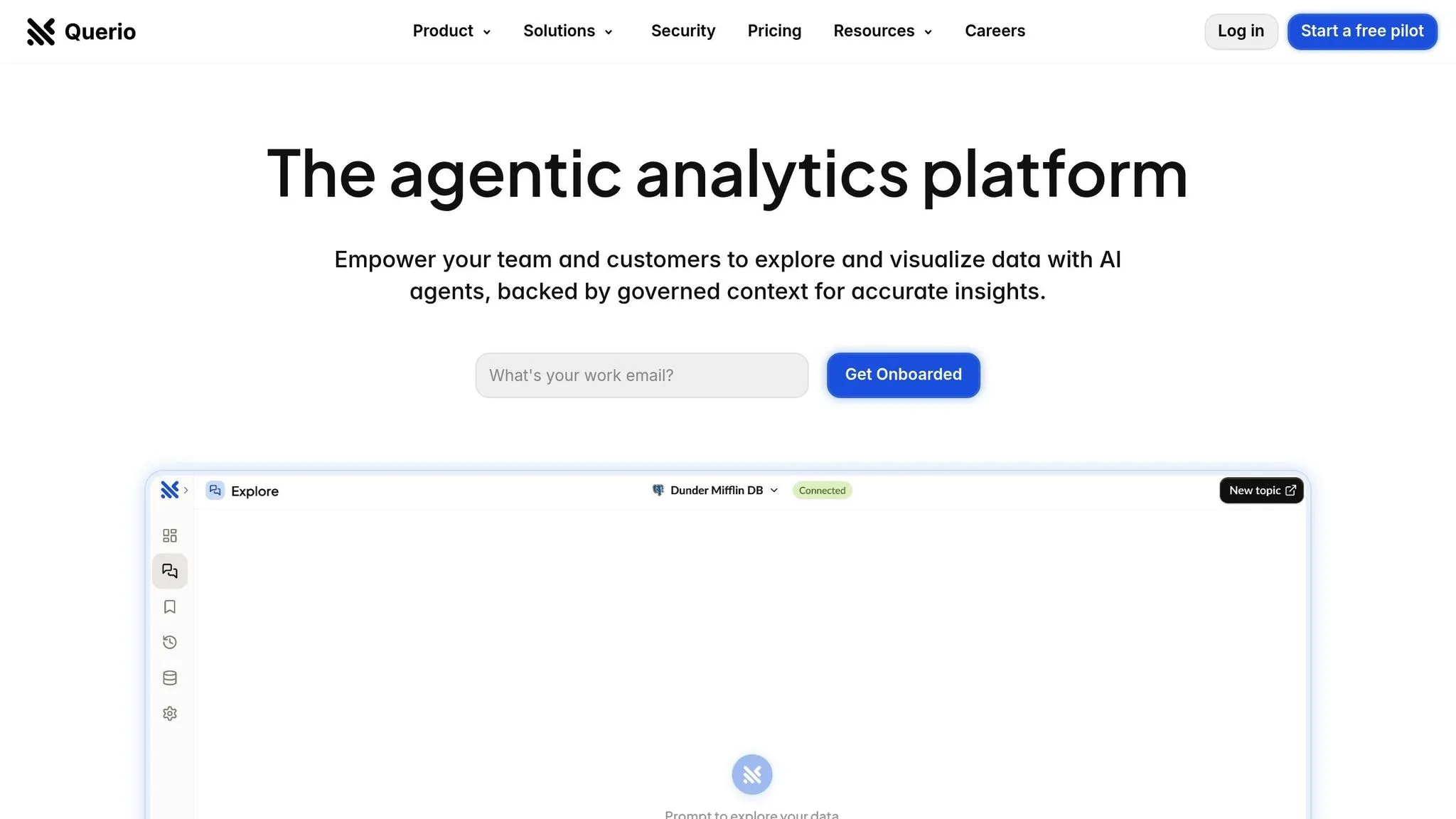
Querio takes embedded analytics to the next level by directly connecting to data warehouses like Snowflake, BigQuery, and Postgres - no data replication needed. With Querio, users can simply type questions in plain English and receive instant, accurate charts, completely bypassing the need for SQL expertise. Teams can establish a governed data layer by defining joins, metrics, and business rules just once, ensuring consistent analytics across the board.
Querio also offers intuitive drag-and-drop dashboards and scheduled reporting, making it easy to provide executive-level insights. Its embedded analytics features extend this AI-powered experience to end users within existing applications. With SOC 2 Type II compliance and a 99.9% uptime SLA, Querio ensures reliability and security. Querio has a free plan, and the Embedded add-on starts at $1,500 a month with 7,500 AI credits a month. Users are unlimited on every plan, which makes it a scalable choice for organizations aiming to expand analytics access efficiently.
Integration Methods: SDKs, APIs, and White-Labeling
Embedded analytics platforms provide various integration methods to suit different technical needs and business goals:
-
SDKs: These come with pre-built components like charts and dashboards that developers can embed directly into applications. This option speeds up deployment and reduces the effort of building visualizations from scratch, though it may limit customization and increase the application's overall size.
-
APIs: Using REST or GraphQL endpoints, APIs offer developers the flexibility to retrieve raw data and create custom visualizations tailored to their application's design. While this approach allows for a highly personalized implementation and keeps the application lightweight, it does require more development effort.
-
White-labeling: This method provides fully customizable analytics interfaces that align with your company’s branding. It’s an excellent way to maintain brand consistency while delivering powerful analytics capabilities. Many platforms also support hybrid approaches, combining these methods to meet a variety of use cases.
Each integration method offers unique advantages, and the right choice often depends on the specific needs of your application and users.
Key Features to Look for in Embedded Analytics Tools
When selecting an embedded analytics tool, customization and branding options are critical. The platform should allow for extensive configuration, including custom color schemes, branding, and flexible layouts. These features ensure your analytics seamlessly blend with your application's design, delivering a unified and polished user experience.
How to Implement Embedded Analytics
Embedding analytics into your workflow isn't just about adding dashboards or reports; it’s about creating a seamless and functional integration that aligns with your business goals. To make it work, you need a well-thought-out plan that addresses technical integration, security, and user adoption.
Step-by-Step Implementation Guide
Start by defining your scope and audience. Executives typically need high-level dashboards for strategic insights, operational teams require detailed reports to track performance, and consumer-facing apps benefit from self-service analytics options that empower users to explore data on their own [1].
Next, choose the embedding method that fits your needs. If you need deep customization and control over the user experience, Software Development Kits (SDKs) are a great option. For developers looking to create tailored visualizations that align with their app’s design, APIs offer the flexibility to build exactly what you need [1][2].
If your application involves multiple users, plan for multitenancy. This means designing the system to handle multiple user roles with appropriate permissions. Decide whether shared or isolated data models work best for your use case [1].
Performance is key, so build with scalability in mind. Use tools like Continuous Integration/Continuous Deployment (CI/CD), performance monitoring, regression testing, and version control to ensure your system can grow and adapt seamlessly [1].
Finally, focus on integrating with your existing systems. This involves unifying data sources, resolving schema mismatches, and implementing strong data governance practices to ensure consistency and accuracy [3].
Best Practices for Integration
A successful implementation isn’t just about technical execution - it’s about creating a great user experience. Your embedded analytics should feel like a natural part of your application. Match the visual design, navigation, and interaction patterns of your app to create a seamless and intuitive interface.
Keep your business goals front and center. Whether you’re aiming to improve customer retention, boost operational efficiency, or enable faster decision-making, tie your analytics implementation to these objectives. This alignment ensures that your efforts directly support measurable outcomes.
User adoption is another critical factor. From the start, provide clear documentation, intuitive interfaces, and training materials that help both internal teams and external users understand how to use the new analytics tools effectively.
Security and Compliance Requirements
Security is a big deal in embedded analytics, especially when you consider that 29% of cybersecurity breaches involve third-party vendors, with the average cost of a data breach reaching $4.88 million [2]. Your analytics solution must integrate seamlessly with your existing security setup while offering robust user authorization options.
Encrypting data both in transit (using HTTPS) and at rest is non-negotiable. Implement role-based access controls (RBAC) to ensure users only see the data they’re authorized to access. Strong authentication methods like OAuth, SAML-based single sign-on (SSO), and token-based authentication enhance security without complicating the user experience.
Compliance is another layer to consider. Depending on your industry and location, you’ll need to meet specific standards. Look for platforms with certifications like SOC 2 Type II, GDPR (for European data), CCPA (for California residents), or HIPAA (for healthcare applications). These certifications show that the platform adheres to established security and privacy protocols.
Establishing a solid data governance framework is essential for long-term security and compliance. Define clear policies for data ownership, lineage tracking, and role-based permissions. Implement auditing and monitoring tools to track user activity and maintain data integrity, ensuring you have a reliable audit trail for compliance reporting or security investigations.
For advanced analytics, consider techniques like data minimization and differential privacy. These methods protect user privacy while still delivering meaningful insights, striking a balance between security and functionality that meets modern privacy expectations.
Measuring the Success of Embedded Analytics
Once embedded analytics is in place, it’s important to evaluate its success from two angles: technical performance and the business impact it generates. To do this effectively, you’ll need to track a mix of engagement metrics, system functionality, and responsiveness.
Key Metrics for Success
- User Adoption: Keep an eye on daily and monthly active users to gauge how widely the analytics features are being used.
- Feature Utilization: Identify which dashboards and self-service analytics tools are most popular. This helps spotlight features that deliver value and highlights areas that might need improvement.
- Time-to-Insight: Measure how quickly users can go from posing a question to getting actionable answers. Compare this to the time required with traditional reporting methods.
- Query Accuracy: Ensure that natural language analytics is delivering precise and actionable results users can trust.
- System Responsiveness: Track dashboard load times and overall system performance to maintain a smooth, frustration-free experience.
These metrics form the backbone for understanding how well the solution is working and where it can be fine-tuned.
Demonstrating ROI and Business Value
Technical performance is just part of the story - showing the business impact is equally critical. Proving the return on investment (ROI) of embedded analytics often involves highlighting both cost savings and gains in efficiency.
For instance, faster access to insights can save time across teams by cutting down on manual reporting and freeing up IT resources. Quicker, data-driven decision-making can streamline operations and help teams address issues proactively. In customer-facing applications, better self-service tools can lead to higher customer satisfaction and loyalty.
Conclusion and Key Takeaways
The world of embedded analytics in 2025 is all about AI-driven, self-service data tools that make insights more accessible than ever. By embracing these advancements, organizations can position themselves to make quicker decisions, streamline operations, and enhance the overall experience for their customers.
Recap of Key Trends, Tools, and Strategies
Three major trends are shaping embedded analytics in 2025: AI-powered natural language queries, embedded self-service insights, and cloud-native scalability. These innovations simplify data exploration by removing the need for SQL expertise, empowering users to uncover insights independently, and ensuring systems grow seamlessly alongside business demands.
To succeed with embedded analytics, having a clear strategy is critical. Start with well-defined objectives and choose the right integration approach - whether through SDKs, APIs, or white-label solutions. Security and compliance should be prioritized from the outset, ensuring the system is both safe and scalable.
A standout example of this evolution is Querio, which integrates AI-native features directly with warehouse-native data analysis tools like Snowflake, BigQuery, and Postgres. Its ability to transform plain-English queries into instant, visually rich insights demonstrates how embedded analytics can drive adoption and deliver measurable value.
Next Steps for Adopting Embedded Analytics
To turn these insights into action, start by assessing your current analytics setup and identifying where users face challenges accessing data. Think about how much time your teams spend waiting for reports or navigating complicated tools - these pain points highlight areas where embedded analytics can make an immediate difference.
Begin with a small pilot project focused on a specific use case or team. This phased approach lets you test integration methods, collect user feedback, and refine your strategy before rolling it out across the organization. Keep an eye on metrics like user adoption rates, time-to-insight improvements, and overall system performance to measure success.
It’s important to remember that embedding analytics isn’t just about the technology - it’s about helping people use it effectively. Invest in training and support to ensure your teams are comfortable with self-service tools. Continuously monitor how users interact with the system and refine it based on real-world feedback rather than assumptions.
The organizations that will thrive in 2025 and beyond are those that make data accessibility a priority, embedding it into their operations as a core capability rather than an optional feature. By doing so, they’ll stay ahead in an increasingly data-driven world.
FAQs
How do AI and generative analytics improve decision-making in embedded analytics for 2025?
AI and generative analytics are transforming embedded analytics by uncovering patterns, predicting outcomes, and offering actionable insights directly within business applications. This combination allows organizations to automate complex data analysis, leading to quicker and more precise decision-making, along with tailored recommendations.
Looking ahead to 2025, generative AI is expected to enable businesses to produce dynamic, personalized reports and visualizations in real-time. This capability will simplify workflows and boost operational efficiency. By integrating these tools seamlessly, teams can shift their focus from tedious data processing to strategic priorities, delivering stronger outcomes across various industries.
What are the essential steps and key factors to consider when implementing embedded analytics in your organization?
To make embedded analytics work effectively in your organization, it's essential to ensure the solution blends smoothly with your current systems and workflows. Look for a platform that can be tailored to reflect your branding and can handle increased demands as your business grows.
Keep data security and compliance at the forefront to safeguard sensitive information and adhere to regulatory standards. It's also worth seeking tools that offer advanced visualizations and AI-powered features to uncover predictive insights. Finally, give your team the tools they need with self-service options, so they can make quicker, smarter decisions based on data.
How can businesses evaluate the success and ROI of using embedded analytics?
Businesses can measure the impact and return on investment (ROI) of embedded analytics by keeping an eye on critical metrics like revenue growth, user adoption rates, and productivity gains. For instance, many organizations notice improved efficiency and quicker decision-making once these tools are implemented.
Other valuable metrics to track include reductions in operating costs, enhanced customer satisfaction, and how often decisions are based on data insights. By consistently reviewing these indicators, companies can fine-tune their analytics strategies and ensure they’re getting the most out of their investment.