Business Intelligence
The 2026 Guide to Sales and Marketing Performance Metrics: KPIs, Dashboards, and AI Insights
Explore how KPIs, dashboards, and AI insights are transforming sales and marketing strategies for measurable growth in 2026.

In 2026, sales and marketing success depends on data-driven metrics, real-time dashboards, and AI-powered analytics. Companies that focus on the right Key Performance Indicators (KPIs) and integrate AI tools can predict trends, improve decision-making, and align teams for better results. Here's what matters most:
- KPIs: Metrics like Monthly Recurring Revenue (MRR), Customer Acquisition Cost (CAC), and Customer Lifetime Value (CLV) help measure performance and guide decisions.
- Dashboards: Well-designed dashboards simplify data visualization, highlight trends, and provide real-time updates for quick action.
- AI Insights: Predictive analytics, anomaly detection, and lead scoring tools enable faster, smarter decisions and personalized customer experiences.
The key takeaway? Combining KPIs, dashboards, and AI creates a system where insights drive actions, leading to measurable growth and efficiency. Read on to explore how these tools can transform your sales and marketing strategies.
Key Performance Indicators (KPIs) for Sales and Marketing
What Are KPIs and Why They Matter
Key Performance Indicators (KPIs) are measurable values directly tied to essential goals like revenue growth, market share expansion, and customer retention [1]. Unlike generic metrics that simply track activity, KPIs evaluate whether your efforts are driving real progress toward your business objectives. For example, while metrics might show how many people visited your website or opened an email, KPIs answer the deeper question: "Is this activity contributing to our strategic goals?"
Here’s why they matter: organizations that rely on data are 6% more profitable, and those actively tracking campaign metrics are 2.3 times more likely to exceed revenue targets [1]. To make KPIs effective, it’s crucial to move beyond "vanity metrics" like page views or follower counts, which may lack strategic value. Instead, focus on indicators that highlight efficiency, impact, and growth potential [1][2]. The ultimate aim? Build a system that not only tracks performance but also guides smarter decision-making.
Let’s break down the essential KPIs that drive sales and marketing success.
Core Sales KPIs
For sales teams, KPIs need to connect daily activities directly to revenue outcomes. Here are some key ones:
-
Monthly Recurring Revenue (MRR): This KPI provides a clear view of predictable income streams, particularly for subscription-based businesses.
-
Pipeline Velocity: By factoring in deal size, win rate, and sales cycle length, this metric measures how quickly prospects move through your sales process. A higher pipeline velocity indicates greater efficiency and effectiveness in generating revenue.
-
Customer Churn Rate: This percentage reflects how many customers stop using your service over a given time. When tracked alongside acquisition metrics, it offers insights into retention efficiency.
-
Sales Cycle Length: Measuring the time from initial contact to closing a deal, this KPI reveals how streamlined your sales process is. Shorter cycles often point to better lead qualification and strong product-market alignment.
-
Lead Response Time: In today’s fast-paced environment, speed matters. Responding to a lead within one minute can increase conversion rates by an astonishing 391% [3].
-
Lead Scoring ROI: Companies using lead scoring can achieve up to a 70% improvement in lead generation ROI [3].
Core Marketing KPIs
While sales KPIs focus on revenue, marketing KPIs assess campaign performance and audience engagement. Here are the ones that matter most:
-
Customer Acquisition Cost (CAC): This measures the total cost of acquiring a new customer, including ad spend, content creation, and salaries. It helps marketing teams allocate budgets more effectively across channels.
-
Return on Ad Spend (ROAS): This KPI evaluates how much revenue is generated for every dollar spent on advertising. As privacy regulations evolve, accurate ROAS requires attribution models that account for multi-touch customer journeys [2].
-
Lead-to-Customer Ratio: This metric bridges the gap between marketing and sales by showing how effectively leads generated by marketing convert into paying customers. It highlights which campaigns and lead sources bring in high-quality prospects.
-
Customer Lifetime Value (CLV): Representing the total revenue a customer is likely to generate over their relationship with your business, CLV is crucial when compared to CAC. Together, they help determine sustainable acquisition strategies while maintaining profitability.
-
Attribution Accuracy: With privacy changes and cookie deprecation, traditional attribution methods like last-click models are no longer enough. Marketing teams need advanced attribution models to capture the true impact of every customer touchpoint [2].
It’s worth noting that 83% of marketers say proving ROI remains their biggest challenge [1].
Tracking these KPIs not only helps evaluate current performance but also lays the groundwork for dynamic dashboards and AI-driven strategies, which we’ll explore in upcoming sections.
Building and Using Dashboards for Better Insights
Once you've identified your KPIs, the next step is creating dashboards that turn raw data into meaningful insights. A well-crafted dashboard does more than just present numbers - it provides a clear narrative about your business performance and helps guide real-time decision-making.
Dashboard Design Best Practices
With your KPIs in place, the goal of dashboard design is to make data easy to interpret and act on. Start with an executive summary panel at the top, showcasing your most critical metrics at a glance. This could include key figures like monthly recurring revenue, customer acquisition cost, or pipeline velocity - metrics that directly influence your bottom line.
To keep your data relevant, ensure real-time updates. Dashboards should refresh automatically, so decision-makers always have the latest information without needing to manually pull reports.
Customizable layouts are essential for catering to different roles within your organization. For instance, sales reps might focus on lead response times, while marketing executives prioritize campaign performance metrics.
Clarity is key: users should be able to grasp the most important insights within five seconds. Use white space thoughtfully and limit the number of widgets on each screen to avoid overwhelming users with too much information.
How to Display KPIs Clearly
Choosing the right visual format for your KPIs can make all the difference:
- Charts and graphs are ideal for spotting trends. Line charts work well for tracking performance over time, bar charts for comparing categories, and pie charts (used sparingly) for showing proportions.
- Tables are perfect for detailed comparisons. For example, a table displaying campaign performance - complete with columns for spend, impressions, clicks, and conversions - allows marketers to quickly see what's working and what isn't.
- Heatmaps provide a quick visual overview of complex data. They’re especially useful for identifying patterns, like geographic performance or time-based trends. For example, a heatmap showing lead conversion rates by source and time of day can highlight optimization opportunities.
When using color coding, stick to intuitive patterns: green for positive results, red for areas needing attention, and yellow for metrics that require monitoring. Limit your color palette to three main indicators to maintain clarity.
To keep dashboards clean and focused, use progressive disclosure. Present high-level data upfront, with the option to dive into more detailed breakdowns when needed.
Querio's Dashboard Features
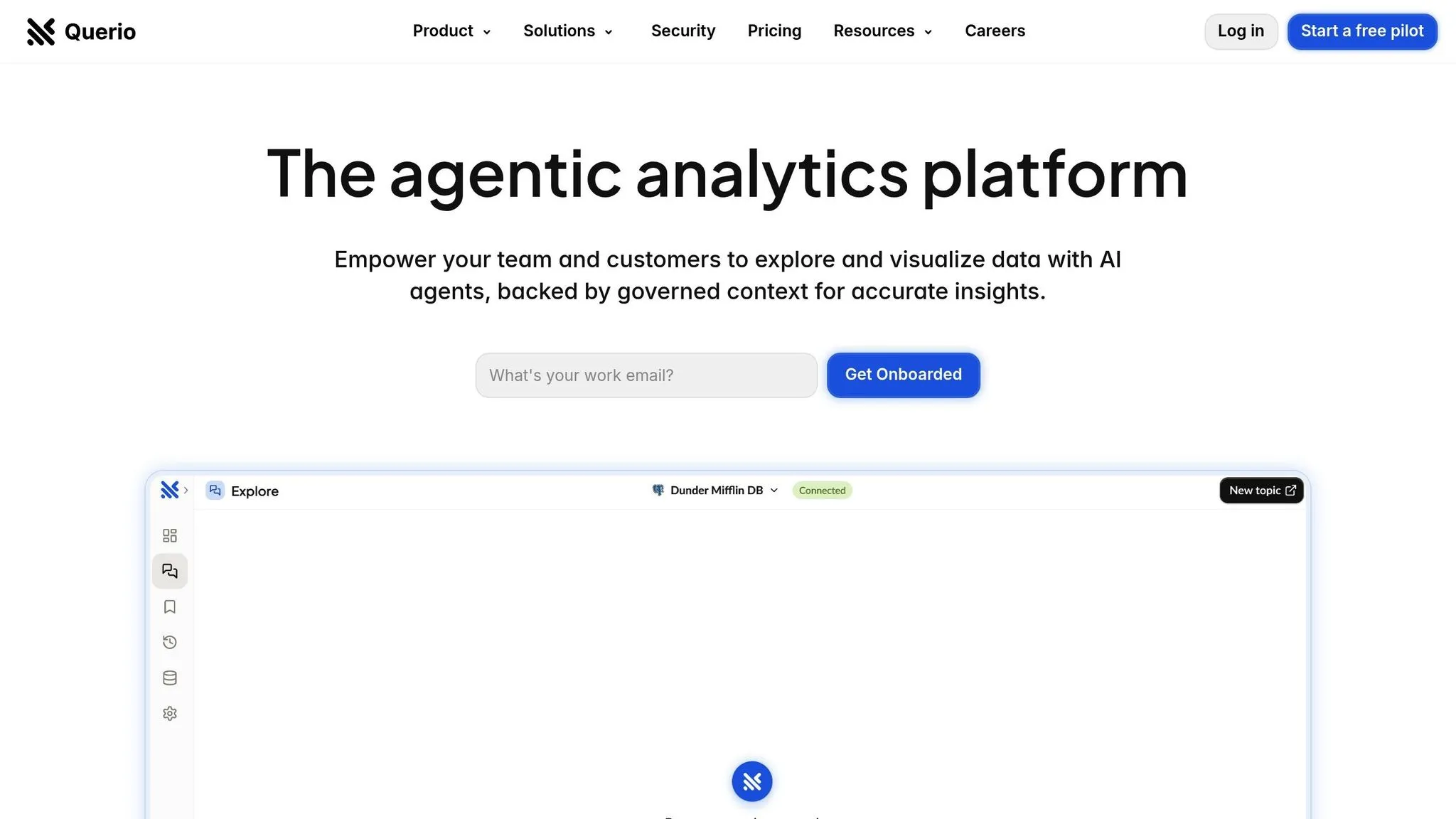
Querio takes dashboard creation to the next level with features designed to simplify and enhance data visualization.
The drag-and-drop dashboard builder eliminates technical hurdles, allowing users to arrange widgets, tweak layouts, and customize views without needing SQL expertise or developer assistance. This makes data accessible to everyone, from sales teams to marketing leads.
With live data connections to platforms like Snowflake, BigQuery, and Postgres, Querio ensures your dashboards always reflect the latest business performance. Unlike traditional BI tools that rely on data copies or lengthy refresh cycles, Querio connects directly to your data warehouse, offering real-time insights through secure, encrypted connections.
Querio also introduces natural language querying, enabling users to interact with data in plain English. Instead of dealing with complex menus or writing queries, you can simply ask, "What’s our customer acquisition cost by channel this quarter?" and instantly receive a clear visualization. This makes data exploration more intuitive for everyone.
The context layer feature ensures consistency across your dashboards. By defining business rules, table relationships, and metric definitions in one place, Querio eliminates confusion caused by different teams using varying interpretations of the same metrics.
For keeping stakeholders informed, scheduled reports are a game-changer. Automated weekly summaries or daily updates can be sent directly to decision-makers, ensuring they stay in the loop without needing to check dashboards constantly.
Querio's embedded analytics feature is particularly valuable for organizations serving multiple clients or business units. It allows you to integrate customized dashboards directly into your applications, making performance insights a seamless part of your product offering - especially beneficial for SaaS companies.
With these capabilities in place, Querio sets a strong foundation for integrating AI tools to further enhance decision-making. By optimizing your dashboards, you empower teams to predict trends and refine strategies with greater precision.
Using AI to Improve Sales and Marketing Performance
Artificial intelligence is changing the game for sales and marketing teams, helping them analyze data, predict outcomes, and make decisions faster than ever before. Tasks that once took hours of manual effort can now be completed in seconds, thanks to automated insights powered by AI.
How AI Transforms Sales and Marketing Analytics
One of the biggest benefits AI brings to sales and marketing is speed and ease of use. In the past, analyzing data required technical skills, but now AI allows teams to interact with data using natural language.
With predictive analytics, AI helps teams stay ahead by forecasting customer behavior, sales performance, and even spotting potential churn risks before they escalate. Machine learning dives into historical data to predict which leads are most likely to convert, when customers might upgrade, and which marketing strategies will deliver the best return on investment.
Another standout feature is anomaly detection. AI continuously watches your metrics and flags anything unusual with real-time anomaly detection - like a sudden drop in conversion rates, a spike in customer acquisition costs, or unexpected website traffic patterns. This means you can address problems as they happen, rather than discovering them weeks later in a report.
AI also excels at pattern recognition across massive amounts of data. While a human analyst might spot trends in hundreds of data points, AI can uncover connections and insights hidden in millions of records, revealing opportunities that might otherwise go unnoticed.
Real-time personalization is another game-changer. AI can process customer data on the fly to create highly tailored experiences, using details like purchase history, behavior, and engagement to deliver marketing that feels personal and relevant.
These capabilities form the foundation for the advanced tools offered by Querio.
Querio's AI-Powered Tools
Querio is designed to break down the traditional barriers between business users and their data. Its AI tools allow users to ask questions in plain English and get instant, accurate visualizations.
For example, Querio’s AI can understand business-related questions like, "What’s our customer lifetime value by acquisition channel over the past six months?" and quickly generate a clear visualization of the data. This eliminates the need to wait for technical teams to pull reports, speeding up decision-making.
With instant charting, Querio’s AI automatically picks the best chart type for your data - whether it’s a line graph for trends, a bar chart for comparisons, or a heatmap for complex relationships.
Querio also includes a context layer to ensure consistency across your organization. By defining business rules and metrics upfront, every AI query uses the same standards, avoiding confusion caused by teams interpreting data differently.
For advanced users, Querio offers AI Python notebooks, which allow data teams to dive deeper into analysis. They can build predictive models, run statistical calculations, and explore data in detail - all while ensuring alignment with the same governed data that powers dashboards.
With these tools, Querio equips teams to uncover insights that directly inform strategy.
Real-World AI Applications for Sales and Marketing
Querio’s AI tools aren’t just theoretical - they’re designed to solve real-world challenges in sales and marketing.
-
Lead scoring and prioritization: AI goes beyond basic demographic scoring by analyzing hundreds of behavioral signals, such as email engagement, website activity, and social media interactions. This helps sales teams focus on the leads most likely to convert, saving time and boosting success rates.
-
Dynamic pricing optimization: AI analyzes competitor pricing, customer behavior, and market demand to suggest pricing strategies. It can recommend adjustments for different customer segments, suggest discounts to close deals, or identify upsell opportunities based on product usage.
-
Campaign performance optimization: Instead of relying solely on A/B testing, AI evaluates thousands of variables - like audience segments, send times, and creative elements - to recommend the best combination for maximum engagement and conversions.
-
Customer churn prediction: By analyzing factors like usage patterns, support tickets, and payment delays, AI can identify customers at risk of leaving well in advance. This allows teams to launch targeted retention campaigns before it’s too late.
-
Content personalization: AI makes it possible to deliver tailored content at scale. It analyzes customer preferences and engagement history to recommend the most relevant materials - whether it’s a case study, whitepaper, or product demo - based on factors like industry or previous interactions.
-
Sales forecasting accuracy: AI doesn’t just look at past sales data; it also considers external factors like economic trends, seasonality, and competitive activity. This comprehensive approach leads to more accurate revenue predictions, helping businesses plan and allocate resources effectively.
Proven Strategies for Sales and Marketing Success
Having the right metrics and AI tools is just the starting point. The real challenge - and opportunity - lies in transforming those insights into actions that result in measurable growth. Top-performing sales and marketing teams don’t stop at tracking KPIs; they focus on improving them with strategic, data-driven decisions.
How to Improve Your KPI Performance
-
Refine lead qualification: Use clear scoring criteria that highlight behavioral indicators like email engagement, content downloads, or session duration. This helps prioritize leads that are more likely to convert.
-
Segment customers effectively: Instead of sorting customers by industry or company size, group them by factors like purchase frequency, deal size, or engagement levels. This approach allows for more personalized messaging and smarter resource allocation.
-
Lower customer acquisition costs (CAC): Analyze which marketing channels attract customers with higher lifetime value. Look beyond upfront costs and consider CAC payback periods to maximize long-term gains.
-
Streamline the sales cycle: Identify bottlenecks in your pipeline by mapping out each sales stage and analyzing how long deals typically stay in each one. This can help you refine your processes and improve sales enablement.
-
Boost customer retention: Use engagement and usage data to set up early warning systems. Proactively reach out to customers showing signs of disengagement to address problems before they escalate.
Each of these steps builds a foundation for smarter, more strategic growth.
Using Querio to Execute Your Strategy
Once your KPIs are optimized, the next step is to turn those insights into action - and that’s where Querio comes in.
Querio’s governed data layer ensures seamless alignment between sales and marketing, simplifying lead handoffs and improving collaboration. Its natural language querying feature lets you get answers to strategic questions - like “Which marketing channels drove the most revenue in Q4?” - instantly, without waiting for help from the data team.
The platform’s live data capabilities allow you to track KPIs in real time, making it easier to adjust time-sensitive campaigns. Plus, with unlimited viewer access, you can share data across your organization without worrying about per-seat costs. This means teams like customer success, product, and finance can all access the same metrics, naturally enhancing cross-functional collaboration.
Querio also offers enterprise-grade reliability, with SOC 2 Type II compliance and a 99.9% uptime SLA. This ensures your team has access to secure, accurate, and dependable insights for building critical business processes.
Tracking Progress and Making Adjustments
Executing your strategy is just the beginning. To maintain momentum, you’ll need to continuously monitor your progress and make adjustments along the way.
-
Schedule regular reviews: Check leading indicators like pipeline velocity and campaign engagement weekly, and review lagging indicators like revenue trends and customer lifetime value monthly.
-
Set threshold alerts: Use alerts to flag deviations in key metrics, so you can investigate and make adjustments quickly.
-
Focus on relationships between metrics: Metrics are more meaningful when analyzed together. For example, customer acquisition cost becomes more insightful when paired with customer lifetime value, and email open rates are more useful when linked to pipeline generation.
-
Document changes: Keep track of every strategic adjustment to ensure continuous improvement and to onboard new team members more efficiently.
-
Use cohort analysis: This helps you evaluate the long-term impact of changes on different customer segments. For instance, while a pricing change might increase short-term revenue, cohort analysis can reveal its effect on customer retention over time.
Treat your metrics as part of a continuous feedback loop. This mindset will help you refine your strategy and stay ahead in a competitive market.
Conclusion: Turning Metrics into Results
The key to success lies in transforming raw data into meaningful insights that lead to impactful results. As we progress through 2026, the organizations that excel will be those that skillfully combine KPIs, dashboards, and AI-driven analytics into their strategies.
KPIs serve as the foundation, offering a clear focus on critical metrics that shape data-driven decision-making. They’re not just numbers to track - they’re tools to guide teams toward measurable growth. The most successful organizations actively engage with these metrics, using them to refine strategies and experiment with data-driven solutions.
Dashboards take these metrics and turn them into easy-to-digest visuals. When crafted thoughtfully, they remove uncertainty from decision-making and ensure consistency across all levels of the organization. From sales teams to executives, everyone can access reliable, actionable information. The trick is to prioritize metrics that genuinely influence outcomes rather than getting distracted by surface-level stats that don’t drive change.
Querio's AI tools add another layer of efficiency by providing instant answers to complex questions. Imagine marketing managers immediately identifying which campaigns generate the most qualified leads or sales directors pinpointing pipeline bottlenecks - all through simple, plain-language queries. This speed and accessibility empower teams to act decisively without waiting on lengthy reporting processes.
The real magic happens when KPIs, dashboards, and AI insights work together seamlessly. Live dashboards and AI-powered analytics create a feedback loop where insights lead to actions, which in turn generate new data for further refinement. This synergy forms the backbone of a forward-thinking, results-driven strategy.
FAQs
How do AI-powered tools make sales and marketing dashboards more effective?
AI-powered tools transform sales and marketing dashboards by offering real-time insights, predictive analytics, and automated recommendations. These features empower teams to make quicker, informed decisions and adjust strategies to keep pace with shifting market dynamics.
By processing massive amounts of data, AI uncovers patterns, pinpoints opportunities, and predicts future trends. This enables businesses to zero in on critical areas, allocate resources more effectively, and boost overall performance. On top of that, AI breaks down complex data, making dashboards easier to understand and actionable for users across all experience levels.
How can I choose and display KPIs on a dashboard to ensure they provide actionable insights?
To make your KPIs truly effective, focus on choosing metrics that directly align with your business objectives and ensure they provide clear, actionable insights for your teams. Opt for custom KPIs that are specifically designed to match your strategies and highlight meaningful trends or key performance indicators. Your dashboards should include features like real-time data updates, detailed filtering options, and role-specific views to ensure each user sees the information most relevant to their role.
Keep the dashboard design straightforward and easy to navigate by avoiding unnecessary clutter and highlighting the most critical metrics. It's also crucial to track performance across multiple channels to get a complete picture of your sales and marketing efforts. This unified view helps decision-makers quickly spot opportunities and address challenges, paving the way for smarter, data-driven strategies that improve results.
How does Querio's natural language querying make data easier to access for non-technical team members?
Querio makes accessing data incredibly straightforward with its natural language querying feature. Instead of wrestling with complicated code or technical terms, users can simply type out their questions in plain English. For example, you could ask, "What were our total sales last quarter?" or "Which marketing campaigns performed best this month?" and get the insights you need in moments.
By eliminating the technical hurdles, Querio ensures that even non-technical team members can quickly access valuable data. This not only speeds up decision-making but also encourages collaboration, making it easier for everyone to use data to drive smarter strategies.