
Querio vs Sigma Computing: editing metrics as code
A side-by-side look at Querio and Sigma Computing. We keep our reviews honest and fair so you can make an informed decision.
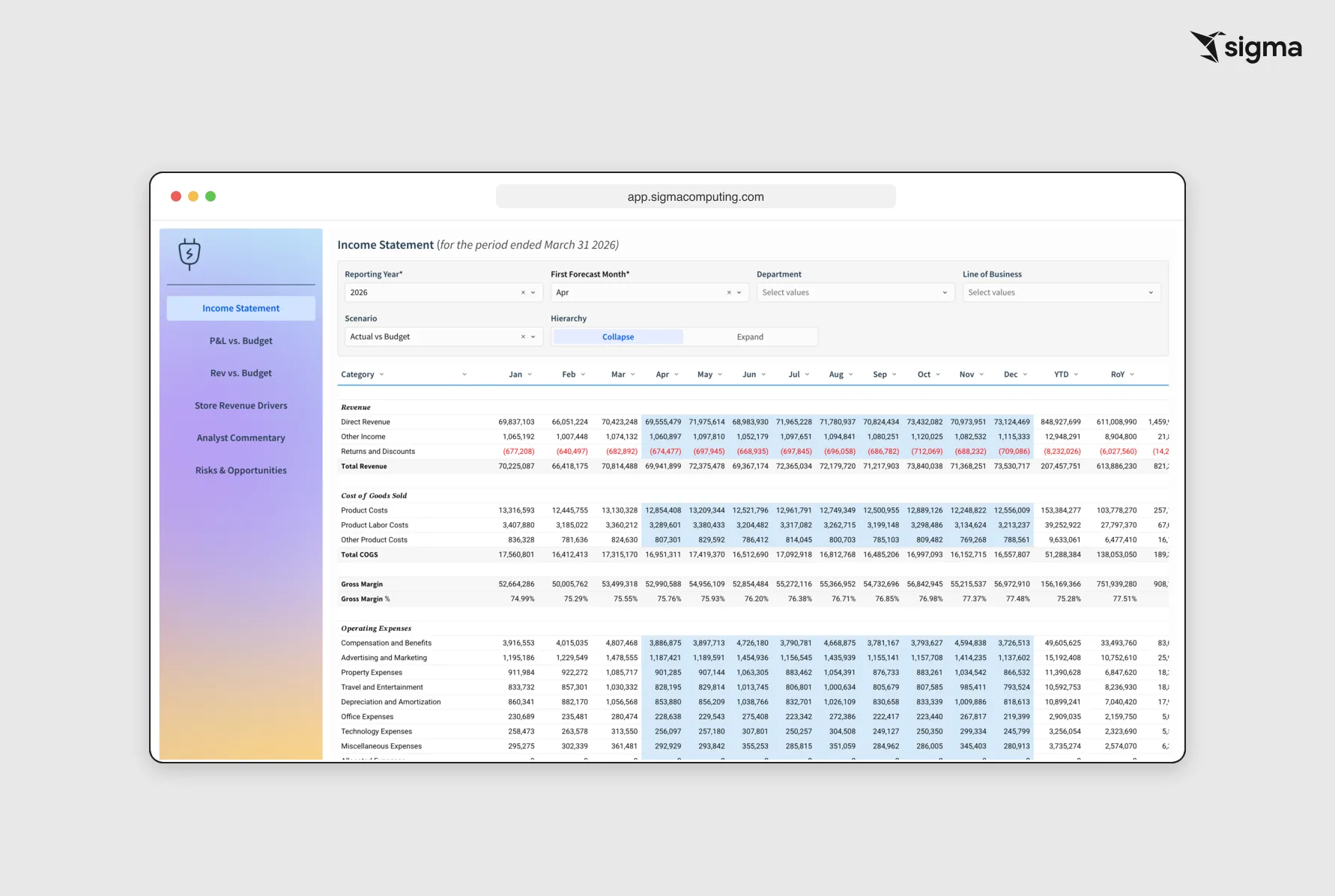
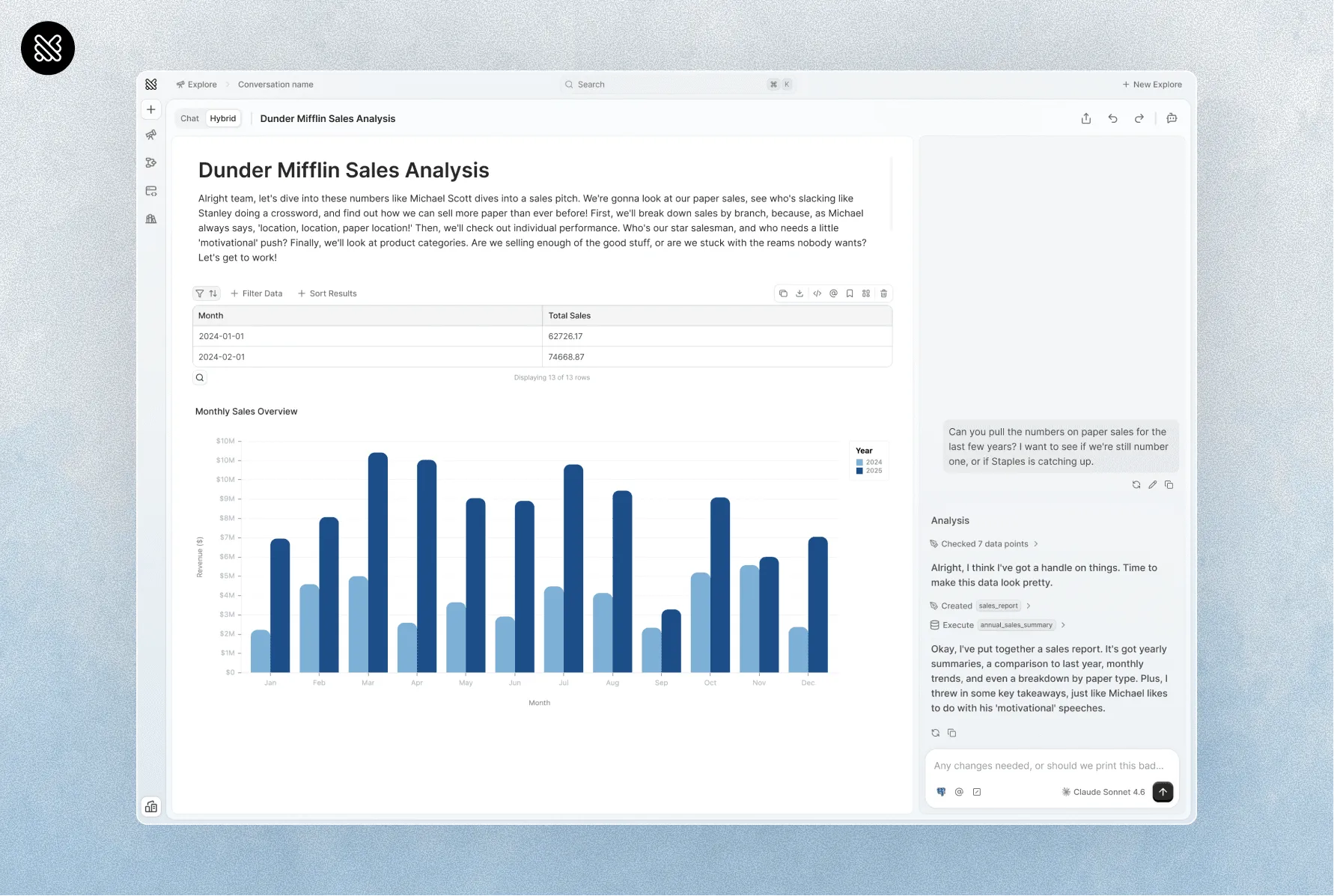
‹ QuerioDrag to compareSigma Computing ›
If you manage your Sigma data models from code, or plan to, know this first: to change one metric, you send Sigma the whole data model. Unless your pipeline sends the model's version number, the last write wins, even when it started from an old copy. In Querio, a metric lives in a knowledge file, and you change that file, not the whole model.
What happens when you change one Sigma metric from code?
Sigma's January 2026 release added data models as code, so teams can "version control, automate deployment, and programmatically generate data models". You get a model as JSON or YAML from one endpoint and send it back to another.
That update "replaces a data model with the contents defined in a code representation", says Sigma's API reference. "Partial updates are not supported." If you include documentVersion, the update fails when someone changed the model since that version. "If omitted, the update preserves last-write-wins behavior."
A metric doesn't get an endpoint of its own. None of the 309 operations in Sigma's REST API spec reads or writes one. A metric is an entry in a table's metrics array inside the model, written in Sigma's formula language, like "formula": "Sum([Price])".
Say an analyst fixes a metric in Sigma on Tuesday. On Wednesday your pipeline sends its older copy of the model, with no version number. Sigma keeps Wednesday's copy, and the fix is gone. We found nothing in Sigma's docs or API that keeps a repo copy in step with edits made in Sigma, and no native Git integration: "git" doesn't appear in the API spec or the docs index. Sigma's own QuickStart says "It doesn't teach Git" and calls Git "assumed knowledge."
dbt doesn't change this. Sigma's dbt package builds the model's JSON when dbt compiles, and doesn't send it to Sigma. Its README says the only way to learn the IDs Sigma really uses is "a round trip against the live API".
Can Claude edit a Sigma metric?
Yes, through Sigma's REST API and the same whole-model update. Sigma's own data-model skill for coding agents needs curl, jq and Sigma API credentials, and it sends the edited model back through that endpoint. So an agent hits the same last-write-wins problem a pipeline does.
Sigma also has an official MCP server, announced in April 2026. Claude, ChatGPT, Codex, Cortex Code and Cursor can use it "to search, describe, and query data in Sigma, and to build workbooks", over OAuth, with your Sigma permissions applied. Its docs list no tool that writes a data model or a metric. So in Sigma, asking Claude about a metric and having Claude change it are two separate setups.
What does changing a metric look like in Querio?
Each data source in Querio has a kb/ folder of knowledge entries: SQL, Python and Markdown files that define metrics, rules and business logic, as described in Querio's docs. Changing a metric means changing the file that defines it, not resending everything around it.
Agents connect through Querio's MCP server, on every plan, Free included. An agent uploads the context files someone deliberately selected, and an existing file is only overwritten when the request says so. "The signed-in user's existing permissions govern every API operation."
That's how we think definitions should work: written once, reviewed like code, and the same for every person and every agent that reads them.
What do Sigma and Querio cost?
| Sigma | Querio | |
|---|---|---|
| How you start | A free 7-day trial | The Free plan, $0, no end date |
| Published price | None. Sigma's docs say to contact your Account Executive | Core is $2,499 a month or $25,000 a year |
| Users | Licenses set by account type: View, Act, Analyze or Build | Unlimited users on every plan |
| AI usage | An admin connects an AI provider or the warehouse's own models | Monthly AI credits on every plan, billed per credit past the allowance |
There's more on Sigma's costs in our Sigma pricing guide, and Querio's plans are on the pricing page. Still weighing more than two tools? Our list of Sigma Computing alternatives covers six.
FAQ
Does Sigma use the metrics in your dbt project?
Sigma reads dbt Semantic Layer metrics, on dbt Cloud only. "The dbt Semantic Layer is not available for dbt Core integrations." You query those metrics with custom SQL in Sigma. Querio imports your dbt models, and your dbt models and Querio's context change together in one PR. More in our dbt Semantic Layer guide.
Which warehouses do Sigma and Querio both connect to?
Snowflake, BigQuery, Databricks, Redshift, PostgreSQL, MySQL and SQL Server are on Sigma's list and on Querio's. ClickHouse is on Querio's list, and Sigma has a ClickHouse connection marked Beta. Querio also connects to MotherDuck, Amazon Athena and Trino.
Free and open source
Leaving Sigma Computing? Take everything with you.
unshackle moves your metrics, dashboards and permissions out of Sigma Computing and into files in a Git repo you own. Nothing changes in the tool you're leaving.
Works with







- and more

- your-analytics-repo
- semantic
- notebooks
- catalog
- policies
- knowledge
- migration
- report.md