Pattern Recognition Software: Algorithms & Use Cases
Unlock growth with pattern recognition software. Explore core algorithms, business use cases, and analysis on your data warehouse.
https://www.youtube.com/watch?v=Xqg5BcCJJGM
published
Outrank AI
pattern recognition software, machine learning, data analytics, business intelligence, anomaly detection
983f5302-ac9c-4535-957a-a2ba9098ae00

A lot of teams are in the same spot right now. Their warehouse is full of product events, CRM updates, support tickets, billing history, and experimentation data, but the questions that matter still take too long to answer. Which user behaviors predict expansion? Which accounts are drifting toward churn? Which signals are noise, and which ones deserve a playbook?
That's where pattern recognition software becomes practical, not theoretical. It helps teams detect repeatable behaviors, hidden segments, anomalies, and sequences that standard dashboard slices often miss. The big shift is architectural. The value no longer comes from exporting data into another isolated tool and waiting for batch outputs. It comes from running recognition logic as close to the source of truth as possible, directly on the warehouse where the business already stores its operational data.
Table of Contents
What Is Pattern Recognition Software Really
A growth team usually doesn't need another definition. It needs help answering a messy question like this: why do some users activate fast, adopt a second feature, and stay, while others look active for a week and disappear? Traditional BI can show counts, trends, and segments. It struggles when the job is to identify recurring behavioral shapes across large volumes of noisy data.
Pattern recognition software is the layer that finds signal in that noise. It detects regularities in data and turns them into something operational. That might mean recognizing the sequence of actions that correlates with retention, flagging a session that looks fraudulent, or grouping accounts whose usage patterns resemble a high-value cohort.
This didn't start as a warehouse-era idea. Arm's overview of pattern recognition notes that the field emerged as a formal discipline in the 1950s, with the 1957 development of the Perceptron. The same source says modern deep learning systems such as TensorFlow achieve over 99.5% accuracy in image classification on ImageNet, and that over 92% of Fortune 500 companies now deploy pattern recognition tools for data-driven decision-making. That arc matters. It tells you this is no longer a niche research topic. It's part of operating a modern company.
Why it matters to business teams
Pattern recognition software becomes valuable when a company outgrows simple metrics.
A product manager wants to know more than daily active users. They want to know which early actions predict habit formation. A sales leader doesn't just want lead volume. They want signals that distinguish a serious buyer from a casual evaluator. A support leader wants to catch issue clusters before they become an escalation wave.
Practical rule: If the question involves repeated behaviors, hidden groupings, or unusual deviations, a static dashboard usually won't be enough.
A lot of these systems sit on top of familiar algorithm families, which is why it helps to understand the types of algorithm used in modern analytics. The important point isn't the academic taxonomy. It's that different business questions need different recognition approaches.
What it is not
It's not magic classification dust. It won't rescue a vague business question or compensate for a broken data model. It also isn't limited to computer vision or fraud use cases.
In practice, pattern recognition software is best treated as a decision-support capability. It helps teams move from “what happened” to “what pattern are we seeing, and what should we do next?”
The Core Algorithms Driving Pattern Recognition
Most pattern recognition systems rely on a small set of algorithmic approaches. The differences matter because each one answers a different kind of business question. Choosing the wrong approach usually creates confusion before it creates insights.

From labels to predictions
Supervised learning works like teaching with flashcards. You show the model examples where the answer is already known, then ask it to recognize similar cases in new data.
If you have historical accounts labeled as churned or retained, the model can learn which features tend to separate those groups. In product analytics, those features might include activation steps, usage frequency, time between sessions, or support interactions. In revenue operations, they might include deal stage movement, buying committee activity, and contract changes.
This approach works well when:
You already know the target outcome: churn, upgrade, fraud, conversion, renewal.
You have a clean training set: labeled examples matter more than sheer volume.
You need operational outputs: scores, classifications, and ranked risks.
It fails when labels are weak, inconsistent, or created after the fact by guesswork.
From raw activity to hidden structure
Unsupervised learning is the detective model. You hand it a pile of evidence with no predetermined answer and ask it to find structure. Instead of predicting a label, it discovers clusters, similarities, and latent groupings.
That's useful when teams say things like, “We think there are different user types in this feature, but we can't define them yet.” Unsupervised methods can separate explorers from habitual users, heavy collaborators from solo users, or healthy accounts from those drifting into unusual usage territory.
A common implementation path is clustering. If you want a practical breakdown of trade-offs between methods, this guide to the comparison of clustering algorithms is useful because the right algorithm depends on whether your data has clear boundaries, irregular density, or noisy outliers.
Unsupervised methods often produce the first useful segmentation a company actually trusts, because they start from behavior instead of org-chart assumptions.
From events to journeys
Sequence analysis looks at order, not just occurrence. That distinction is easy to underestimate. Many product questions are not about whether users did A, B, and C. They're about whether they did them in the order and timing that creates momentum.
Sequence-based pattern recognition helps answer questions like:
Business question | Pattern to inspect |
|---|---|
Why do some trial users convert? | Early action sequence leading to setup completion |
Why do some accounts expand? | Feature adoption order across teams |
Where do checkout flows fail? | Repeated paths that end in abandonment |
Which sessions look suspicious? | Event chains that deviate from normal behavior |
This is also where anomaly detection belongs. Instead of classifying a known category, anomaly methods identify behavior that departs from established norms. In product systems, that might be bot traffic, abuse, sudden engagement drops, or unexplained billing events.
Modern pattern recognition software increasingly combines all three approaches. It might cluster users first, score churn risk next, and then inspect event sequences inside the riskiest segment. That layered approach usually performs better than forcing one algorithm to answer every question.
Real Business Use Cases in Product and Growth
The business case for pattern recognition software gets clearer when you stop talking about models and start talking about operating decisions. Product and growth teams don't buy algorithms. They invest in faster, better responses to user behavior.
Finding the behaviors that create power users
Teams can often identify their best customers after the fact. Fewer can isolate the behavior pattern that created those customers early enough to shape onboarding.
Pattern recognition helps by comparing retained, expanding, or highly engaged users against everyone else and surfacing the combinations that repeat. Sometimes it's not one action. It's a bundle. Invite a teammate in the first week, connect a key integration, then return within a short interval. That sequence can become the basis for lifecycle messaging, onboarding prompts, and sales-assist workflows.
A useful adjacent signal often lives outside product telemetry. Teams that analyze support conversations and review text can also detect intent or frustration themes. That's where techniques like sentiment analysis on reviews can complement behavioral pattern recognition rather than replace it.
Spotting churn before the cancellation arrives
Churn rarely begins on the cancellation page. It shows up earlier as subtle behavioral drift. Session intervals widen. Feature depth narrows. Admin activity declines. Support interactions change tone or urgency.
A strong pattern recognition system catches that drift as a shape, not as a single threshold breach. That matters because many at-risk accounts still look healthy in top-line dashboards until late in the cycle.
This is also where benchmark discipline matters. Recognito's summary of NIST face-recognition testing says top systems can exceed 99% accuracy in controlled settings. The practical lesson isn't that business models will hit the same number. It's that well-tuned recognition systems can be highly reliable when the conditions, data quality, and evaluation framework are tight. In messy production environments, teams should expect more variance and design for it.
The best churn models don't just rank risk. They identify the specific behavior pattern that gives customer success a reason to act.
For founders building a discipline around solving the decision problem with data, that distinction is important. A score without an intervention path usually creates dashboards. A score tied to recognizable behavior magnifies operational outcomes.
Improving funnels by analyzing paths, not pages
Funnel analytics often flatten journeys into stage counts. That's useful, but incomplete. Two users can both drop before purchase for completely different reasons. One may be price-sensitive. Another may hit setup confusion. A third may arrive with low intent from the start.
Pattern recognition software can separate those path types by analyzing ordered event streams. Teams then redesign the flow around observed patterns instead of arguing from instinct.
That changes growth work in practical ways:
Acquisition teams can compare traffic cohorts by downstream behavior, not just signup volume.
Product teams can identify successful feature discovery paths and make them easier to repeat.
Lifecycle teams can trigger interventions based on journey shape, not only elapsed time.
When this works well, pattern recognition becomes part of growth mechanics. It tells you which user paths deserve amplification and which ones need intervention before revenue or retention degrades.
The Modern Architecture for In-Warehouse Analytics
The old pattern was simple. Export data from the warehouse, move it into a separate analytics or machine learning environment, build a model, send results back somewhere else, then hope the business still trusts the output by the time it arrives. That pattern creates lag, extra governance work, and too many chances for logic drift.
Modern pattern recognition needs a tighter loop.

Why exporting data breaks the loop
Export-heavy architectures fail for reasons that are operational, not philosophical.
First, every extraction creates another version of the truth. A model trained on copied data often diverges from the metrics teams see in Snowflake, BigQuery, or Redshift. Second, movement introduces delays. Even a good model loses value if the feature table or event stream arrives too late. Third, copied environments create governance overhead. Security teams now have more surfaces to monitor, and data teams have more pipelines to maintain.
The pressure is increasing because ArrowCore's discussion of advanced pattern recognition emphasizes the shift toward real-time, high-stakes anomaly detection in industrial and enterprise operations. The same source notes that streaming, sensor-driven use cases require real-time pipelines and analysis on live data, which traditional offline training setups are poorly suited for. Product and commercial systems are moving in the same direction. Waiting for yesterday's export is often too slow.
What in-warehouse pattern recognition looks like
Running recognition logic directly on the warehouse doesn't mean every model must be fully trained inside SQL. It means the analytic workflow stays anchored to warehouse-native data.
That usually includes:
Feature creation in the warehouse: sessionization, cohort windows, rolling usage summaries, account-level aggregations.
Model scoring close to source data: either through warehouse-native functions, connected notebook workflows, or orchestrated jobs that read and write directly against warehouse tables.
Activation from governed outputs: pushing risk scores, segments, and anomaly flags into CRM, support tooling, product messaging, or internal apps.
A practical reference point is modern data warehouse architectures, because warehouse design determines whether pattern recognition feels native or painful. Partitioning strategy, semantic consistency, workload isolation, and event model quality all show up later as model reliability problems.
Keep the data where your governance, lineage, and business logic already live. Move compute thoughtfully. Don't move trust.
In-warehouse analytics does create its own trade-offs. Complex SQL can become unreadable. Heavy jobs can compete with core reporting workloads. Non-technical users may understand the question but not the mechanics. Still, for most growing companies, those are better problems than fragmented copies, stale outputs, and a data team acting as a ticket queue between the warehouse and every insight request.
Accelerating Insights with AI Agents and Notebooks
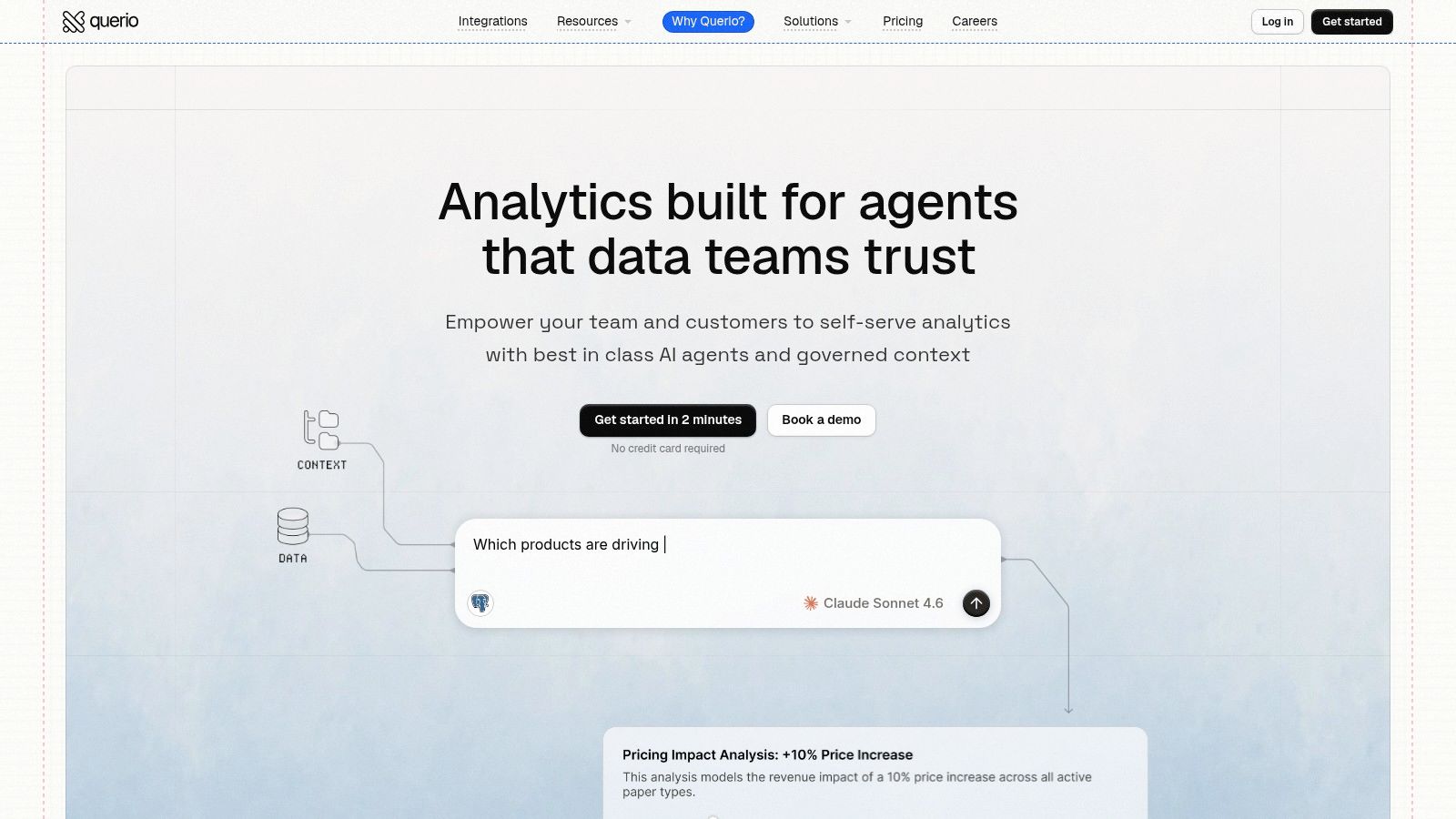
The bottleneck in pattern recognition usually isn't raw compute. It's translation. Business teams know what they want to ask, but they can't consistently turn those questions into efficient, reproducible warehouse logic. Data teams can, but they get buried under requests, edge cases, and one-off follow-ups.
That's where AI agents and notebook workflows can change the operating model.
Why natural language alone is not enough
A chat box is useful for ad hoc questions, but pattern recognition work rarely ends with one prompt. Teams need to inspect assumptions, edit feature definitions, compare cohorts, rerun logic, and preserve the sequence of analysis.
AI coding agents are most helpful when they do more than translate plain English into SQL. They need to help users:
Generate warehouse-aware queries that respect existing schemas and business logic
Iterate on intermediate outputs instead of restarting from scratch
Compose analysis across SQL and Python when the task moves beyond a simple query
Save work in reusable artifacts so another analyst or operator can audit and extend it later
Without that structure, “self-serve analytics” becomes a pile of disconnected prompts and screenshots.
Where notebooks change the workflow
A notebook-based system gives pattern recognition work a place to live. That sounds mundane, but it solves several practical problems at once. Analysts can combine narrative, SQL, Python, charts, assumptions, and outputs in one artifact. Product managers can review the logic behind a segment definition instead of only seeing the final number. Engineers can productionize the parts that prove useful.
This matters for pattern recognition because the workflow is naturally iterative. You start with a hypothesis about activation, realize one feature is leaking future information, rewrite the cohort logic, test a different window, compare two segmentations, and only then decide what belongs in production.
A file-system approach also changes collaboration. Teams can organize analyses as assets rather than ephemeral dashboard tabs. Shared folders for churn, expansion, onboarding, fraud, or anomaly detection become part of the analytics infrastructure.
A short walkthrough makes the workflow easier to picture:
The biggest payoff is not convenience. It's cycle time. When a product leader can ask a complex behavioral question in natural language, inspect the generated logic, refine it in a notebook, and run it directly against warehouse data, the team spends less time coordinating handoffs and more time deciding what action to take.
That's the promise of AI-assisted pattern recognition. It lowers the friction between question, computation, and decision without forcing companies back into rigid BI workflows.
Best Practices for Successful Implementation
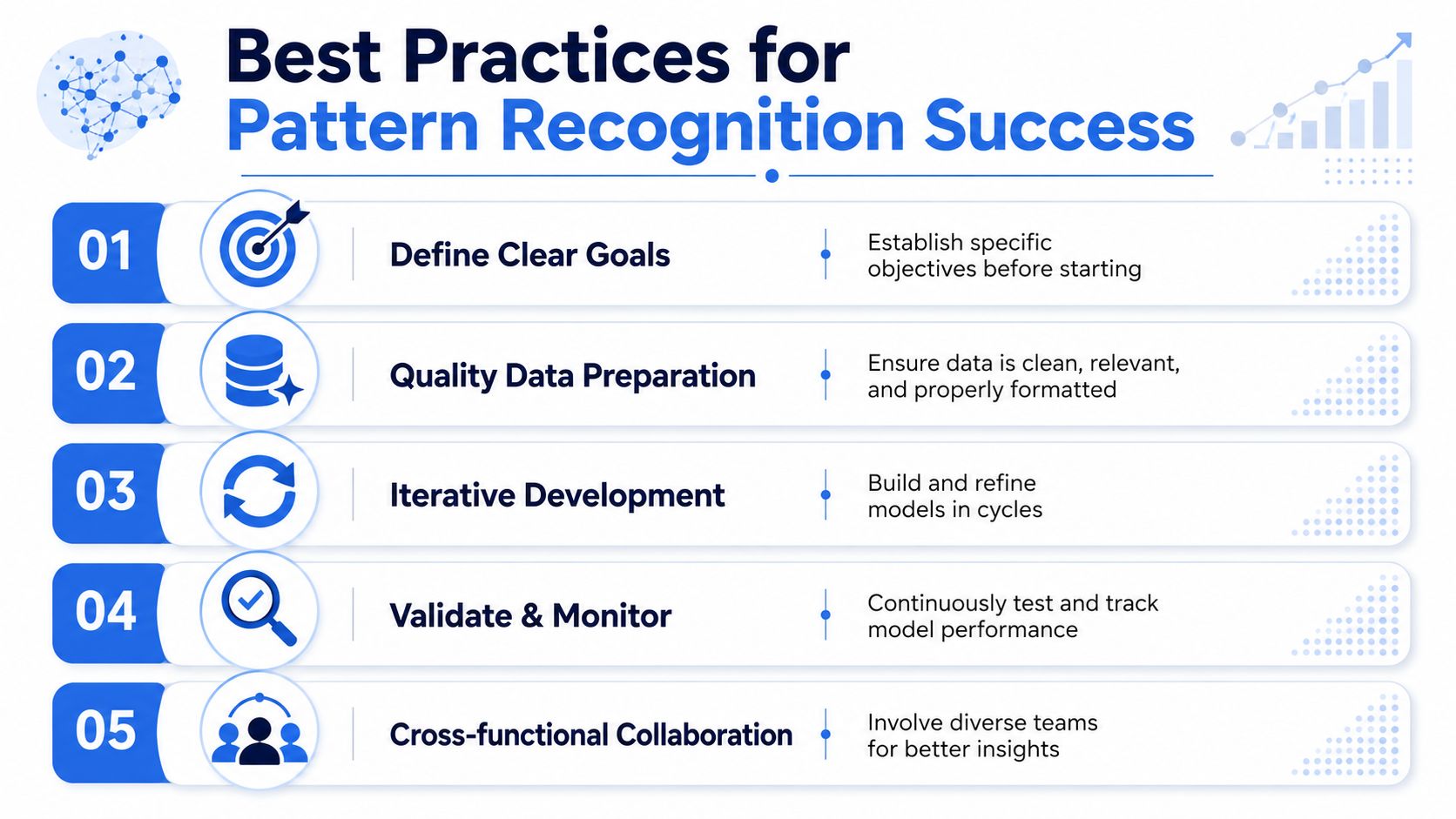
Most pattern recognition failures don't come from picking the wrong buzzword. They come from weak setup. Teams rush to modeling before they define the business decision, clean the data, or decide how they'll evaluate success.
Start with the business decision
A useful project begins with a concrete action. Should customer success intervene? Should onboarding branch differently? Should finance review this account? If the answer to a model output is unclear, the project usually becomes an interesting report and nothing more.
A short checklist helps:
Name the decision owner: product, sales, support, operations, or risk.
Define the intervention: message, workflow, prioritization, or escalation.
Set the observation window: early lifecycle, renewal period, session-level, or account-level.
Treat preprocessing as core work
Label Your Data's overview of pattern recognition points out that the biggest technical failure modes are poor preprocessing and weak feature quality. The same source notes that noisy inputs, inconsistent normalization, and insufficient augmentation increase variance and lead to unreliable models. That matches what teams see in practice. Broken event names, missing timestamps, inconsistent entity IDs, and leaky labels ruin projects faster than algorithm choice.
Clean feature logic beats clever modeling on messy data almost every time.
That means teams should audit event quality, standardize definitions, document transformations, and test features for leakage before chasing model sophistication.
Measure models in business language
Executives don't need a lecture on every metric, but they do need enough to avoid bad decisions.
Use these in plain terms:
Metric | Simple meaning | Why it matters |
|---|---|---|
Precision | Of the cases flagged, how many were actually correct | Important when false alarms waste team time |
Recall | Of the true cases that existed, how many the model caught | Important when missing a problem is costly |
F1-score | A balance between precision and recall | Useful when both trade-offs matter |
Then add operational checks:
Monitor drift: yesterday's reliable pattern can decay as user behavior changes.
Compare against a baseline: a simple rule can outperform a fragile complex model.
Review edge cases manually: especially for anomaly detection and churn flags.
A disciplined implementation is less glamorous than model demos. It's also what separates a dependable pattern recognition system from an expensive experiment.
The Future of Analytics and Your Next Steps
The next phase of analytics looks less like static dashboard consumption and more like continuous exploration on top of governed warehouse data. Traditional BI tools still have a place for fixed reporting. They're weaker when the question is open-ended, sequence-based, or dependent on iterative feature engineering.
Pattern recognition software pushes teams toward a more flexible operating model. Data lives in the warehouse. Logic stays close to that data. Analysts and operators work in reusable, inspectable artifacts. AI helps translate intent into computation, but the company still controls the data model, the evaluation rules, and the actions that follow.
For many teams, the path forward is straightforward.
Start with one high-value decision such as churn risk, onboarding success, or funnel drop-off diagnosis. Build the features directly on warehouse data. Use a method that matches the question instead of forcing every problem into a classifier. Keep the outputs tied to a real workflow. Then make the analysis reusable so the next question doesn't begin from zero.
That's how pattern recognition becomes a growth capability instead of a side project. The companies that benefit most won't be the ones with the flashiest model demos. They'll be the ones that make signal detection part of everyday decision-making.
If your team wants to run warehouse-native analysis without turning the data team into a human API, Querio is worth a look. It deploys AI coding agents directly on your data warehouse and gives teams a notebook-based, file-system workflow for exploring data, writing logic, and building self-serve analytics that can support pattern recognition use cases at production speed.