Guide
Natural Language Programming Guide for Data Teams
Discover how natural language programming transforms data and product teams with core concepts, implementation patterns, real use cases, and common pitfalls.
Your analysts already know the pattern. A product manager pings for a funnel breakdown, sales wants a fresh segment view, and a founder wants an answer before the next meeting starts. The request is simple in English, but the work behind it is still a chain of SQL, notebook edits, validation checks, and follow-up questions that can stretch for hours or days.
That gap is where natural language programming matters. It lets people express intent in everyday language and turn that intent into something executable, whether that means a query, a transformation, or a software module. In practice, it changes the conversation from “who can write the code?” to “what exactly do we want the system to do?”
The idea has a longer history than commonly understood, and the modern version is far more useful than the buzzword version. It sits between human language and machine logic, which means teams have to care about meaning, context, and verification, not just generation. For a practical overview of the broader language-to-data shift, this natural language processing primer is a useful companion.
Table of Contents
- Introduction to Natural Language Programming
- Evolution and History of Natural Language Programming
- How Natural Language Programming Works
- Implementation Patterns and Best Practices
- Use Cases for Data Teams and Product Leaders
- Example Prompts Snippets and Pitfalls to Avoid
- Conclusion and Next Steps
Introduction to Natural Language Programming
A good way to think about natural language programming is as a shortcut through the usual technical bottleneck. Instead of asking a stakeholder to file a ticket, wait for an analyst, and translate business intent into code, the stakeholder describes the goal in plain English and the system turns that into an action. That might be a SQL query, a report draft, a notebook step, or an API call, depending on the environment.
That does not mean the computer “understands” language the way a person does. It means the system is built to map phrases like “show weekly revenue by region” into structured operations that a machine can run. The value for data teams is obvious, fewer handoffs, faster exploratory work, and less time spent converting business language into technical syntax.
Why teams reach for it
The strongest demand usually comes from teams that live inside a queue. Data leaders want analysts focused on deeper work, not repetitive reporting. Product leaders want faster answers on feature usage, retention, or experiment results without waiting for a custom pull. In both cases, natural language programming gives people a more direct path from question to result.
Practical rule: if a recurring request can be described clearly in one or two sentences, it's a candidate for a natural language workflow.
The catch is that convenience and correctness are not the same thing. A user can ask for something ambiguous, and the system can still produce an answer that looks clean but reflects the wrong assumption. That's why this topic matters to production teams, not just experimenters. The fundamental question is whether the workflow can stay understandable, inspectable, and reliable after the first demo.
Evolution and History of Natural Language Programming
A chatbot that answers a question, a query tool that turns plain English into a database request, or a documentation assistant that drafts text from a short prompt all depend on the same broad idea. The field grew from early attempts to make machines handle language in a way people could inspect, refine, and trust in real workflows.
The roots go back to 1950, when Alan Turing published Computing Machinery and Intelligence and proposed the Turing Test, originally called the Imitation Game, as a way to judge machine intelligence through conversation historical timeline of NLP milestones. That idea gave the field a clear target. A machine should be able to participate in natural language interaction convincingly enough to matter, even if the result was still a long way from human understanding.
From symbolic structure to statistical learning
In 1957, Noam Chomsky introduced generative grammar in Syntactic Structures, which helped researchers formalize how language could be modeled computationally historical timeline of NLP milestones. For early machine translation and computational linguistics, that mattered because teams needed structure they could encode and test, not just a broad ambition to “understand language.” Rule-based systems followed that logic. They were readable, but they broke easily when language drifted outside the patterns someone had hand written.
The field then lost momentum in 1966, when the ALPAC Report concluded that machine translation had failed to meet expectations and the U.S. government halted federal funding for NLP and machine translation research historical timeline of NLP milestones. That led to the first AI winter. Progress did not disappear, but it slowed enough to change how researchers framed the problem, especially around evaluation and practical usefulness.
The revival came in the 1980s through statistical and probabilistic approaches, which shifted the field away from rigid hand-built systems and toward learning from language data historical timeline of NLP milestones. For data teams, that shift is still easy to recognize. A rule engine says, “If the text matches this pattern, do that.” A statistical model says, “Here are the patterns we have seen often enough to generalize from.” That difference made systems better at handling variation, and it laid the groundwork for the prompt-driven workflows and validation layers teams now use in production. It also helps explain why implementation guides that focus only on model quality miss part of the story, the harder work is often in how the system checks intent and handles edge cases, including workflows such as using Claude Cursor ChatGPT for documentation.
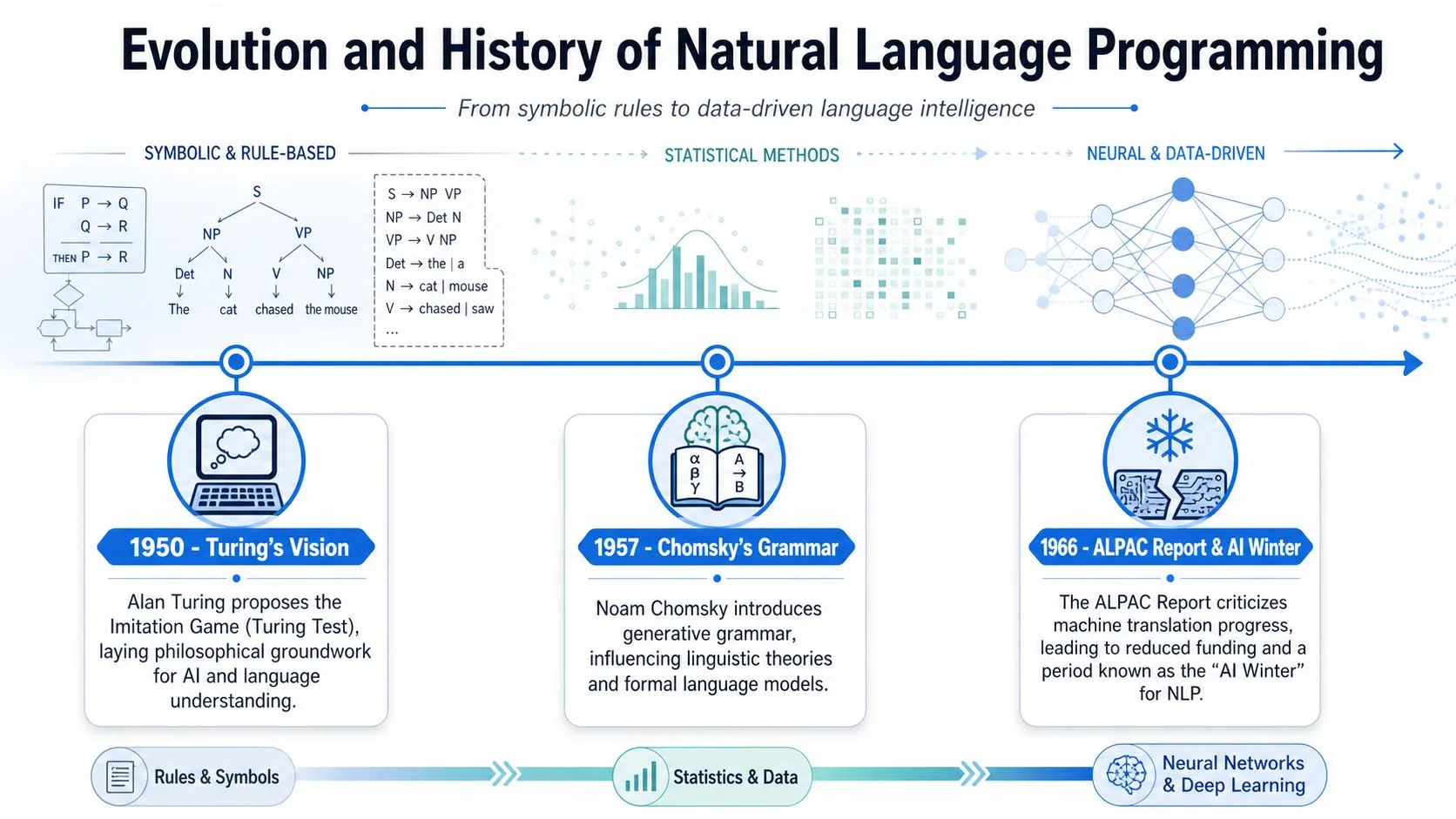
The next shift is easier to understand if you compare it to moving from a paper form to a configurable system. Paper forms force every answer into a fixed path. A configurable system still needs structure, but it can adapt when the input changes shape. Natural language programming followed that same arc, from rigid rules to models that could infer more from context and data. For teams evaluating tools like text-to-SQL workflows, the practical lesson is that language handling improved because systems learned patterns, while production reliability still depends on clear validation, schema awareness, and controlled outputs.
Why this history still shapes production systems
The rule-based era still explains why structure matters so much. Teams that work on production NLP systems keep asking for traceability, reproducibility, and checks on output quality because earlier systems failed when those pieces were missing. That concern did not vanish as models improved, it moved into the design of prompts, review steps, and guardrails.
For data teams and product leaders, the history points to a simple lesson. Systems become more useful when they can learn from language at scale, but they stay dependable only when someone can inspect what they produced and why.
How Natural Language Programming Works
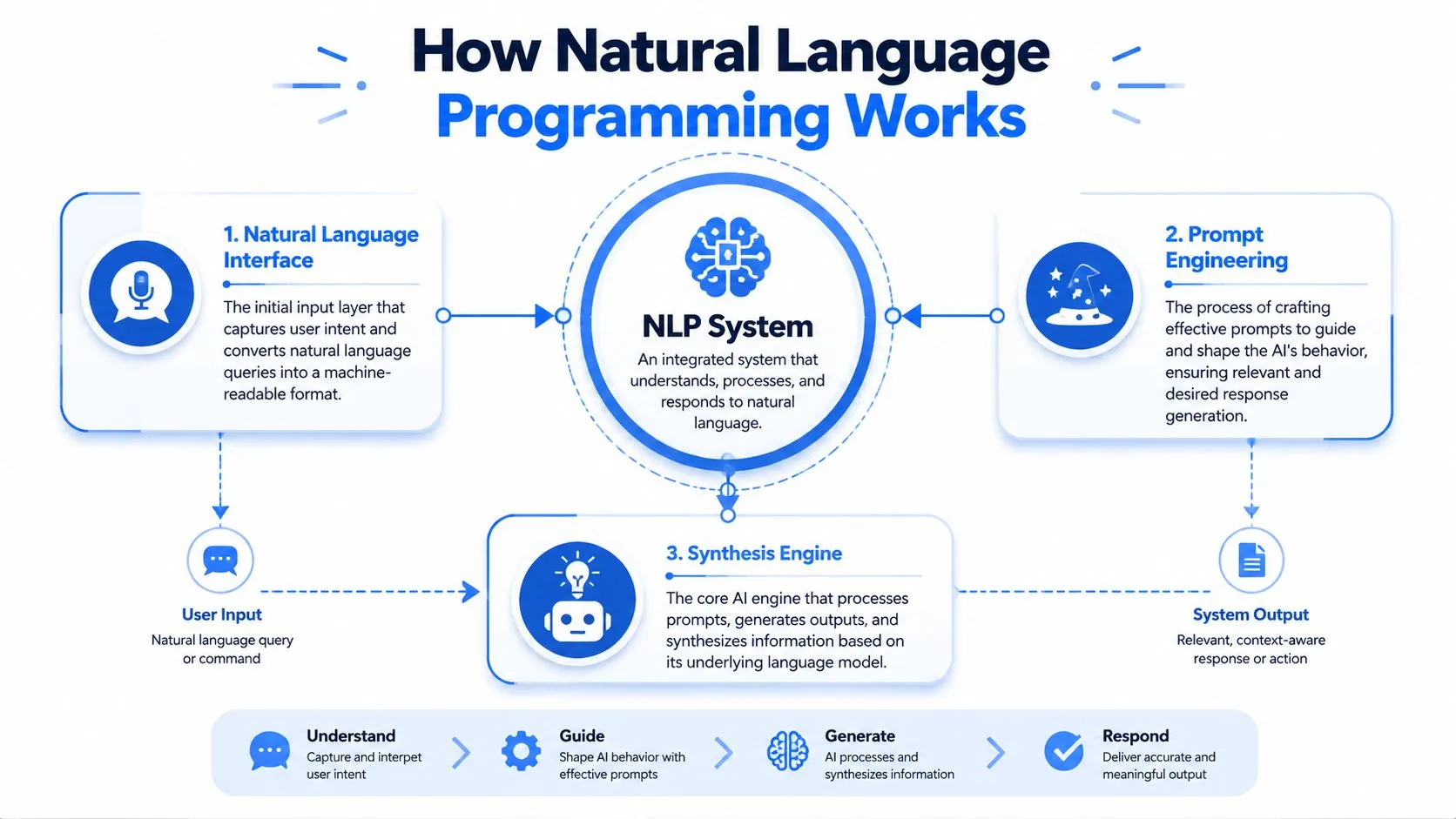
Natural language programming starts as a translation pipeline. A user states intent in plain language, the system turns that intent into a structured representation, and an output layer produces executable code or another machine-actionable result. A useful way to read it is as bilingual translation, except one language is human goals and the other is software behavior.
A simple scenario makes the flow easier to see. A product leader asks, “compare March signups to April signups by channel,” and the system has to decide what “signups,” “March,” “April,” and “channel” mean in the context of the data model before it can do anything useful.
The input layer captures intent
The first layer is the natural language interface, where the request is captured and normalized into a form the system can process. In stronger setups, that interface is connected to schema metadata, business definitions, and prior context, so the system does not guess blindly when a phrase has more than one possible meaning.
The architecture described in natural language-oriented programming separates the interface from code generation. An NLI component translates raw language into structured commands, and an AI-CG component produces executable modules ProcessGPT and NLOP architecture. That division matches how production teams work. One person frames the intent, another system turns it into an artifact, and a review step checks whether the artifact matches the goal.
Prompting shapes the output before code exists
The next layer is prompt engineering. It is not decorative wording. It is the set of constraints that steer the model toward the right schema, join logic, transformation style, or reporting format. Better prompts cut ambiguity by narrowing the range of valid answers.
In practice, the prompt acts like a spec sheet. It tells the model what sources it may use, how the result should be formatted, and what checks it should perform before producing output. Transformer-based systems such as ProcessGPT show how optimized prompts and model semantics can produce executable code modules from programming data ProcessGPT and NLOP architecture. For practitioners, the important point is the workflow shape, not the model name.
If your team is trying to keep generated artifacts readable, the guide on using Claude Cursor ChatGPT for documentation shows how prompt-driven workflows can stay inspectable instead of turning into a black box.
Natural language programming works best when the prompt behaves like a contract. A casual request leaves too much room for interpretation, while a clear prompt gives the system a defined target and gives reviewers something concrete to check.
For a data-workflow example, text to SQL follows the same pattern. The user states an analytical intent, the system maps that intent to table-aware logic, and the result is executable rather than only conversational.
Implementation Patterns and Best Practices
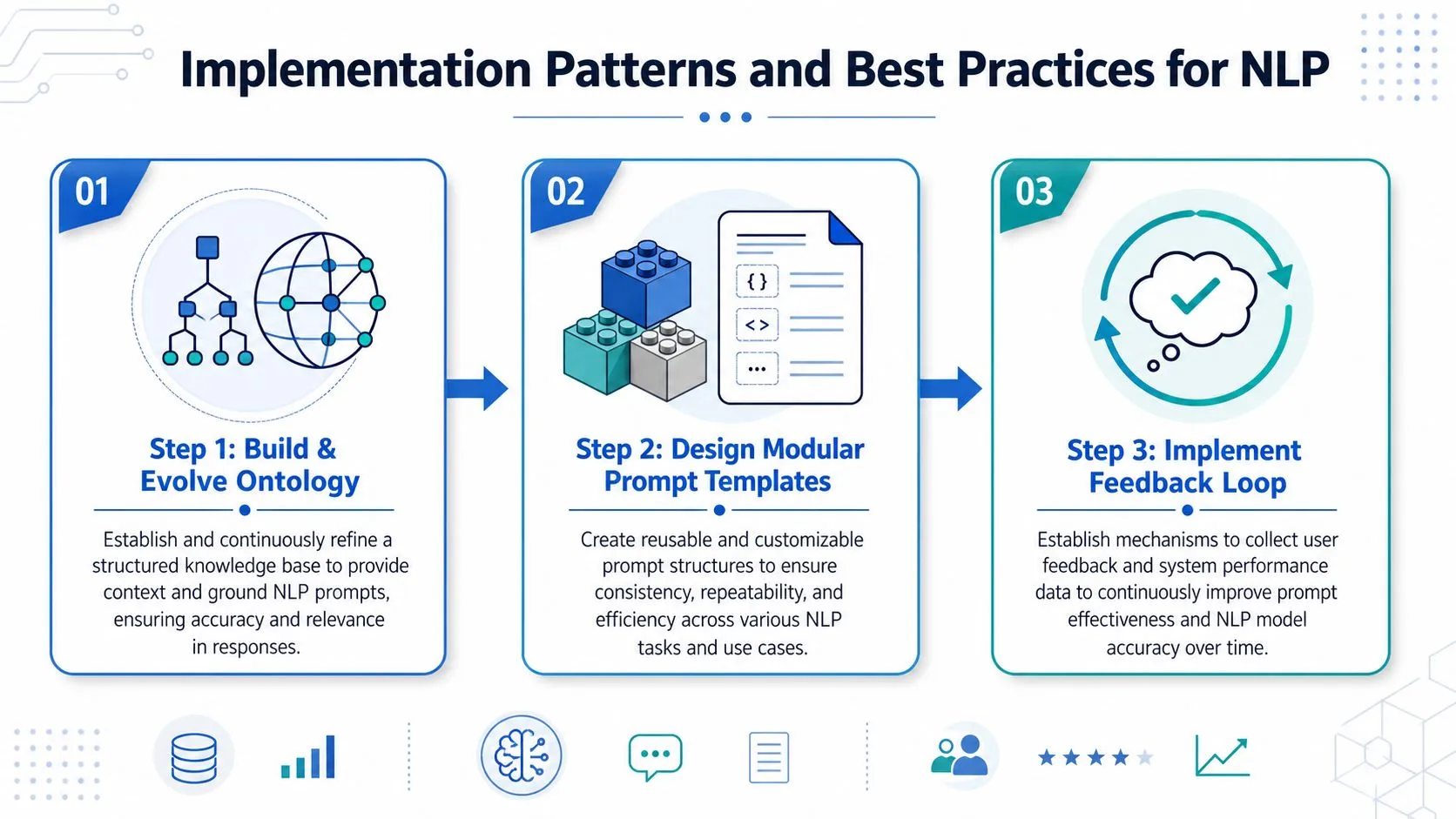
Teams that make natural language programming usable in production usually do the same few things well. They ground language in a shared ontology, they standardize prompt patterns, and they add a verification layer before anyone trusts the output. Without those pieces, the workflow becomes a clever demo that breaks under routine variation.
Build a shared ontology first
A useful ontology is a controlled map of the concepts your team uses. That includes business entities, metric definitions, table names, and the relationships between them. When the system knows that “customer,” “account,” and “subscriber” are not interchangeable in your warehouse, it stops treating language like a free-for-all.
A practical approach is to keep the ontology alive, not frozen. As models, schemas, and business definitions change, the ontology should change with them. That makes prompts more stable because the language is anchored to definitions instead of intuition.
Make prompts modular and inspectable
Reusable prompt templates are easier to maintain than one-off prompt blobs. A modular prompt usually contains a role, a task, the allowed data sources, the output format, and a validation instruction. That structure makes reviews easier because teammates can see what the system was asked to do.
For a broader implementation lens, the Databricks consulting analysis from DataEngineeringCompanies.com is worth reading if your team is already standardizing on warehouse-native workflows. The point is not the platform itself, it's the discipline of fitting AI behavior into existing data governance and execution patterns.
Put validation into the workflow
The biggest production mistake is treating output generation as the finish line. In data systems, the output needs to be checked against schema, row counts, business logic, and versioned definitions before it can be trusted. That is why inspectable code and strict versioning matter so much for reproducibility in pipelines, because natural language can be interpreted in more than one way ambiguous natural language and reproducibility.
For analytics teams, the right pattern is usually simple, prompt, generate, validate, then publish only if the checks pass. If you want a workflow-oriented view of this inside analytics stacks, integrating AI into your analytics workflow provides a useful frame. Querio is one option in this category, since it deploys AI coding agents directly on the warehouse and lets teams query and build without sending every request through an analyst.
Use Cases for Data Teams and Product Leaders
The clearest wins show up where teams keep asking the same kinds of questions in slightly different forms. A data team doesn't need a novel interface for every request. It needs a reliable way to turn repeated intent into safe, usable output without forcing every stakeholder through the same technical bottleneck.
Where the workflow saves time
Ad-hoc exploration is the most obvious use case. A founder can ask for a segment comparison, a product manager can ask for feature usage, and a data analyst can refine the request instead of starting from scratch. That changes the shape of the conversation, because the analyst becomes a reviewer and explainer instead of a human query compiler.
Report generation is another strong fit. Teams can use natural language prompts to draft recurring summaries, then let humans validate definitions and exceptions. Product leaders get faster insight cycles, and analysts spend less time rewriting familiar reports.
Use it where the question changes more often than the structure. That's where language interfaces usually beat rigid dashboards.
Where product teams feel the difference
For product leaders, the value is not only speed, it's flexibility. Feature tracking, experiment review, and release monitoring all depend on asking follow-up questions after the first answer comes back. A natural language workflow keeps that loop open without forcing a new ticket for every angle of the analysis.
The practical advantage is that users can stay in the same mental model while moving between summary, drill-down, and validation. Traditional BI still matters when definitions are fixed and visual consistency is the priority. Natural language systems are stronger when the user's intent changes quickly and the data team wants to keep control of the underlying logic.
For a tighter list of deployment opportunities, top use cases for AI agents in data analytics is a good reference point. The recurring pattern is the same across the board, fewer back-and-forths, more self-service, and less time spent waiting on the next query.
Example Prompts Snippets and Pitfalls to Avoid
The easiest way to understand the failure modes is to look at the prompt itself. A clean-looking answer can still hide a bad assumption, a missing join key, or a metric definition that doesn't match the business. That's why the prompt, the generated output, and the validation step all need to be treated as one unit.
Simple query prompt
Prompt, “Show weekly active users by platform for the last quarter.”
A reasonable output might look like this:
SELECT
  date_trunc('week', event_date) AS week,
  platform,
  COUNT(DISTINCT user_id) AS wau
FROM events
WHERE event_date >= current_date - interval '3 months'
GROUP BY 1, 2
ORDER BY 1, 2;
The risk here is not syntax. The risk is whether weekly active users means event-based activity, login-based activity, or some other internal definition. If the model picks one without asking, the result can look valid and still be wrong.
Multi-step transformation prompt
Prompt, “Take the orders table, remove cancelled orders, join customer tier, and calculate revenue by tier.”
A model might return something like:
WITH filtered_orders AS (
  SELECT *
  FROM orders
  WHERE status <> 'cancelled'
)
SELECT
  c.tier,
  SUM(o.amount) AS revenue
FROM filtered_orders o
JOIN customers c ON o.customer_id = c.customer_id
GROUP BY 1;
The obvious failure mode is missing context. If status values vary, if amount includes tax, or if customer tier changes over time, this query can produce a neat answer with the wrong business meaning. That's why the strongest teams add validation prompts that ask the system to restate assumptions before execution.
Dashboard spec prompt
Prompt, “Create a dashboard for pipeline health and adoption trends.”
This often fails because the request is broad. A system may invent KPIs, choose arbitrary date windows, or surface metrics that are visually tidy but operationally useless. The correction is to split the task into smaller prompts, first define the exact metrics, then define the filters, then define the display.
Agentic systems in complex multi-step workflows can fail without strong validation and state management, and the cited analysis places that failure rate in the 30 to 40 percent range agentic NLP failure rate and validation needs. That's a serious reminder for production teams. A polished answer is not the same thing as a verified one.
For teams trying to improve prompt quality, crafting effective AI prompts is a useful external reference because it emphasizes how small wording changes can affect output quality. The right habit is to prompt for assumptions, not just answers.
Conclusion and Next Steps
Natural language programming is most useful when teams treat it as a controlled interface, not a magic trick. The history explains why language systems needed structure, the architecture explains why prompts and validation matter, and the practical examples show where the workflow helps most. The production lesson is simple, the closer the task is to repeatable intent, the more value language-driven workflows can create.
A sensible rollout starts small. Pick one recurring analytics request, define the ontology around it, build a prompt template, and force a validation step before anyone publishes the result. From there, teams can expand the library, version the prompts, and fold the workflow into existing data operations.
For founders, product leaders, and data teams, the key question is not whether language will matter. It's whether your system can turn language into something inspectable enough to trust. If you're evaluating that path, start with one workflow, measure the handoffs it removes, and decide whether the output stays reliable when the request gets messy.
A CTA for Querio.