Guide
Metadata Management: A Guide for Data & Product Leaders
Unlock your data's true value. This guide to metadata management covers core components, best practices, and a roadmap for data and product teams.
You're in the meeting when someone asks a simple question, and the room goes quiet because the dashboard in front of you doesn't match the one finance sent last week. Product says one thing, ops says another, and engineering is asked to stop real work so everyone can argue about which number is “right.” That's usually the moment leaders realize the problem isn't a missing report. It's missing context.
Metadata management is how teams give that context to data so people can find it, trust it, and use it without pulling half the company into a Slack thread. Like a library card catalog for modern data estates, it tells you what an asset is, where it came from, who owns it, how it moves, and whether it should be used at all. The urgency is real, too, the enterprise metadata management market was valued at USD 3.50 billion in 2025, is projected to reach USD 3.99 billion in 2026, and is forecast to grow to USD 14.94 billion by 2036 at a 14.1% CAGR according to Future Market Insights.
If you've ever watched teams spend more time searching for data than using it, this internal guide on why manually cleaning data is hard will feel familiar. The core issue is the same, data work slows down when the context around the data is fragmented.
Table of Contents
- The Hidden Cost of Data Chaos
- Why Metadata Management Is a Business Multiplier
- The Four Core Components of Metadata Management
- Practical Examples of Metadata in Action
- An Actionable Roadmap for Implementation
- Choosing Your Solution and Measuring Success
- From Data Janitor to Data Activator
The Hidden Cost of Data Chaos
A product leader walks into a review meeting ready to discuss retention. The team pulls up one chart, finance has another, and engineering says both are technically “correct” because each one uses a different table, a different filter, and a different definition of active user. Nobody is lying. Everyone is working with incomplete context.
That's the hidden tax of poor metadata management. The data exists, but the organization can't explain it cleanly enough for people to use it with confidence. In practice, that means analysts spend time hunting for the right dataset, engineers answer the same questions repeatedly, and product decisions get delayed because no one wants to act on a number that might unravel later.
Metadata is the context layer, not the document pile
A good mental model is a library. Books aren't useful because they're stacked in a room, they're useful because the catalog tells you title, author, subject, and location. Metadata does the same for data assets. It gives business meaning, technical structure, ownership, and usage context so teams can answer basic questions before they make decisions.
That's why the market signal matters. The enterprise metadata management market is already growing from USD 3.50 billion in 2025 to a projected USD 14.94 billion by 2036 per Future Market Insights. Companies aren't buying cataloging for decoration. They're buying it because every hour spent translating data is an hour not spent shipping product.
One useful example of the operational pain shows up in distributed systems and scalability work, where hidden context gaps become expensive very quickly. A practical case study is the Xr Voyage scalability case study, which shows how data management challenges become business constraints when systems grow faster than the surrounding structure.
Why mid-market teams feel it first
Mid-market companies usually don't have the luxury of large data governance teams, but they still need trustworthy reporting, self-service access, and fast decisions. That's where metadata becomes strategic. It reduces the time leaders spend questioning numbers and increases the time teams spend acting on them.
Practical rule: if a person has to ask the same “which table do I use?” question twice, the metadata layer is already costing you velocity.
The true cost isn't just inefficiency. It's the cultural habit that forms when people stop trusting shared dashboards and start building shadow spreadsheets. Once that happens, data stops being a company asset and becomes a series of private opinions.
Why Metadata Management Is a Business Multiplier
The reason metadata matters to a product leader is simple. It changes the shape of work. Instead of waiting on a specialist every time a question comes up, teams can find the answer, understand the definition, and move on.
Faster decisions start with less searching
When metadata is organized, the first win is not sophistication. It's speed. People spend less time searching through warehouse schemas, asking Slack for links, or reverse-engineering someone else's logic. That reduces the bottleneck between a question and a decision.
The best data teams I've worked with treat metadata as a discovery layer, not an afterthought. They want people to answer, “What does this dataset mean?” before the conversation gets derailed by definitions. That means product managers can move from hypothesis to test faster, and leadership can make calls with less second-guessing.
Trust improves when definitions stop drifting
The bigger win is consistency. If one dashboard treats “active” one way and another dashboard treats it differently, every meeting turns into a semantic debate. Metadata management brings those definitions into the open so business terms, technical fields, and usage context line up.
That's why self-service analytics succeeds only when the definitions behind the charts are visible. Querio's data democratization strategy is relevant here because access alone doesn't create self-service. People also need enough context to interpret what they find.
Data teams don't become more valuable by answering every question personally. They become more valuable when they make those answers reusable.
Self-service analytics only works with context
Self-service fails when users can see tables but can't understand them. A name like orders_v3_final doesn't help a product manager decide whether a metric is safe to use. A certified description, clear ownership, and lineage give that manager enough confidence to move without escalating every request.
The same logic applies to team morale. When analysts spend less time translating and more time analyzing, they do the work they were hired to do. That's not a soft benefit. It directly changes throughput across the data org and the product org.
The Four Core Components of Metadata Management
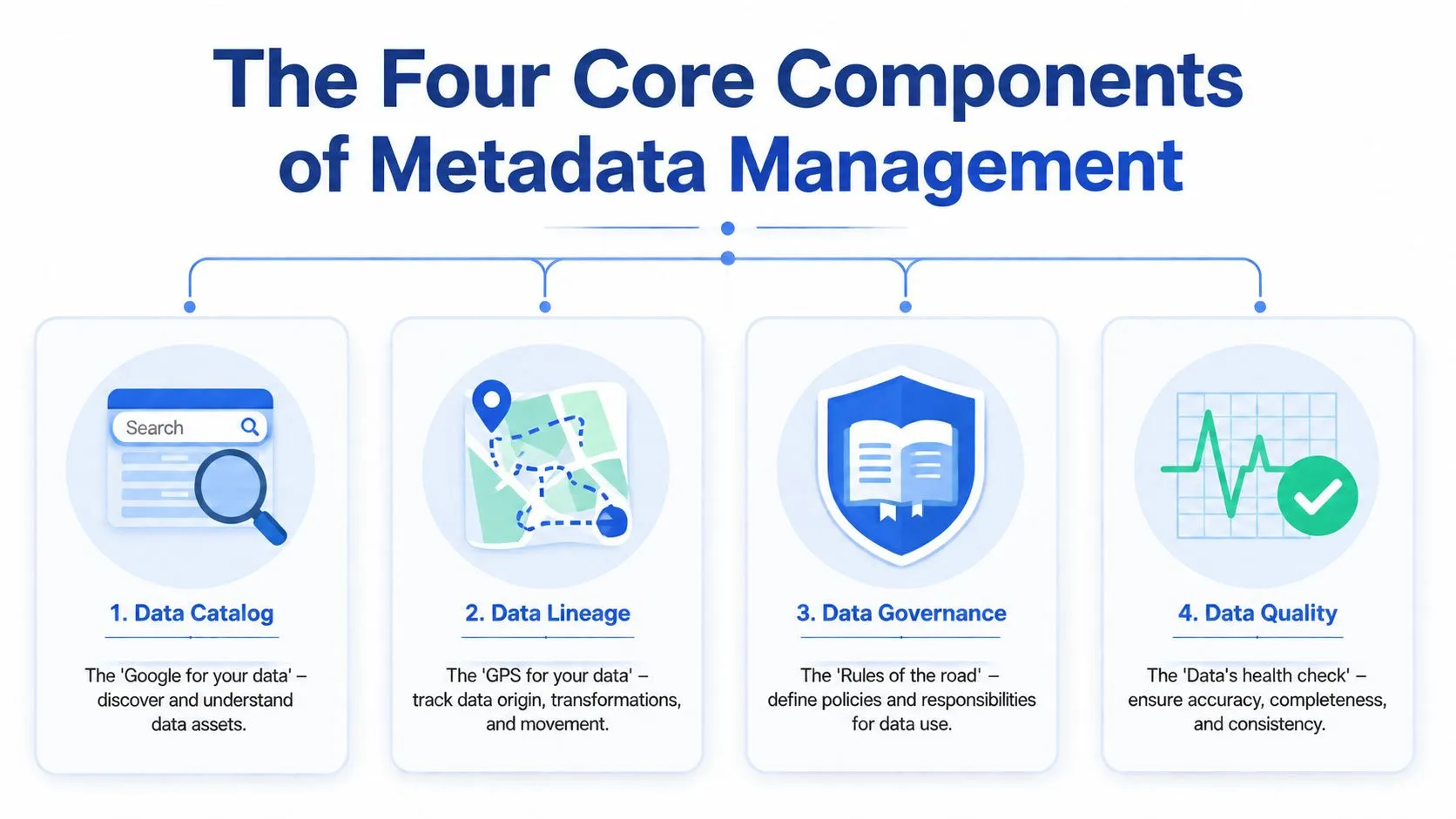
Think of metadata management as a library system with four working parts. If one is missing, the rest still function, but the user experience gets worse fast. If all four work together, data becomes searchable, explainable, governable, and trustworthy.
A practical video walkthrough can help teams see how these parts connect in real usage.
Data catalog and lineage work together
The data catalog is the search layer. It helps people discover assets, read descriptions, and find the certified version of a table or metric. The lineage layer is the map. It shows where the data came from, what happened to it, and where it ended up.
In business terms, the catalog answers “what is this?” and lineage answers “can I trust how it got here?” Together, they cut down the ambiguity that slows down product analysis, reporting, and audit questions.
Governance gives the rules of the road
Data governance defines ownership, access, and acceptable use. That matters because a well-documented asset can still be misused if nobody knows who is accountable for it. Governance is what keeps metadata from becoming a static directory that nobody maintains.
The best governance programs don't try to police every move. They make the right action obvious. A product team can see whether a dataset is approved, who owns it, and what policy applies before it creates a mess downstream.
Quality tells you whether the asset is fit for use
Data quality is the trust signal. If a dataset is incomplete, stale, or inconsistent, the metadata should make that visible instead of hiding it. That's how teams avoid using a table that looks clean but is operationally unsafe.
The different metadata domains hold significant importance. As noted by DataGalaxy, business, technical, and social/usage metadata each serve a different control point, from schema discovery to KPI alignment as explained in their metadata management guide. In other words, a good system doesn't just describe the data, it tells people how to use it in context.
The right metadata stack doesn't add bureaucracy, it removes guesswork.
For teams that need a semantic layer to sit between raw tables and business users, semantic layers 101 is a useful companion read because it shows how meaning gets standardized before it reaches the dashboard.
Practical Examples of Metadata in Action
A product manager wants to understand retention after a new onboarding change. Before metadata management, she spends days trying to find the right table, then another round of Slack messages asking whether the retention metric includes trial users, canceled users, or only paid accounts. Every answer introduces another risk.
With a strong catalog, she finds a certified table quickly. With lineage, she confirms it comes from the right event stream and transformation logic. With a business glossary, she can check the definition of the metric before she puts it into a deck. The difference isn't cosmetic. It's the difference between analysis that moves and analysis that stalls.
The product manager case
The core gain is confidence. She doesn't need to memorize warehouse naming patterns or wait for engineering to validate every field. The metadata gives her enough context to use the data responsibly and fast enough to keep up with the business.
That's what self-service should look like. It's not “go figure it out alone.” It's “the company has already documented enough context that you can move without getting blocked.”
The data engineer case
A data engineer gets paged because an executive dashboard is showing blanks. Without lineage, he starts at the surface and works backward by trial and error. That means checking downstream models, then upstream jobs, then the original source, hoping the failure is obvious.
With lineage in place, the path is visible. He can trace the broken flow upstream, identify the transformation step that changed, and repair the root cause instead of guessing. That shortens the debug loop and reduces downtime for everyone who depends on that dashboard.
What changes when metadata is visible
The biggest shift is organizational, not technical. Product, engineering, and analytics stop treating data problems as isolated fires. They start treating them as shared infrastructure issues with clear ownership and visible history.
That also reduces the emotional cost of data work. Fewer debates, fewer surprises, less blame. Teams can focus on what the data says, not on whether the data can be believed.
An Actionable Roadmap for Implementation
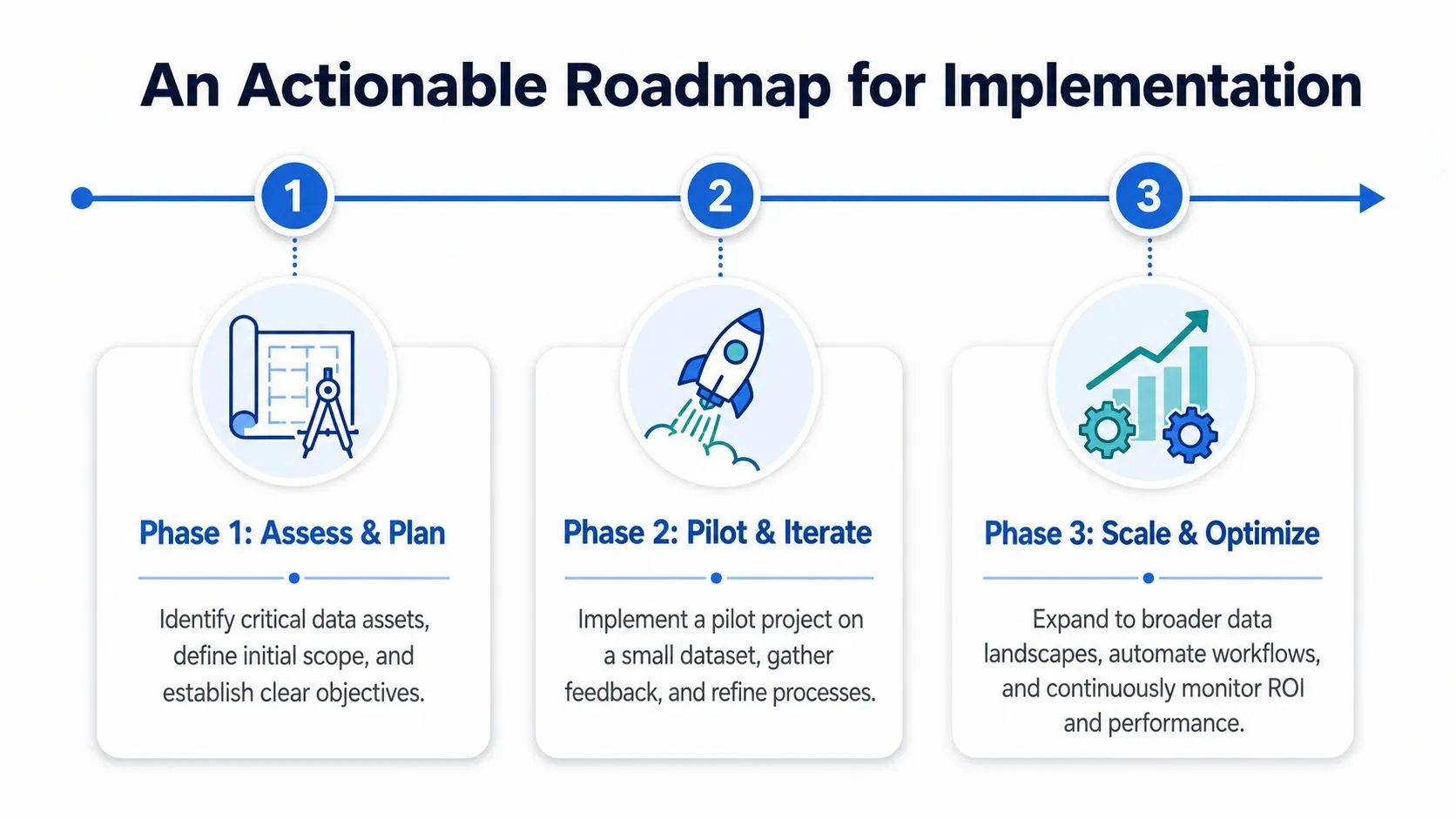
Metadata management works best when it starts small and proves value quickly. Mid-market teams usually don't need a giant program on day one. They need a first use case that matters, a standard everyone can agree on, and enough momentum to expand without chaos.
Start with the highest-friction assets
Begin by identifying the datasets that create the most repeated questions. Product analytics, revenue reporting, and executive dashboards are usually the first candidates because they affect multiple teams and get used often. If a dataset already causes confusion, it's a strong sign that metadata needs attention there first.
The point of this first pass is not completeness. It's about impact. You want one domain where better metadata will noticeably reduce friction.
Define standards before you scale noise
Once the scope is clear, define naming conventions, owners, and definitions for that one domain. Keep the standard tight enough that people can follow it. Loose standards produce the illusion of governance without the behavior change.
Many programs often fail. They try to document everything, which means they finish nothing. A better approach is to document the assets the business depends on most and make those the model for everything else.
Pilot, then expand with proof
A pilot gives you a controlled environment to test adoption. Roll out a catalog for one team, watch which assets get used, and ask where the definitions still confuse people. Then refine before you extend to finance, operations, or customer success.
Practical rule: if the first pilot doesn't change daily behavior, it's too broad or too abstract.
That iterative approach also creates internal champions. Once a product or analytics team experiences faster discovery and fewer escalations, they usually become the strongest advocates for broader rollout.
Choosing Your Solution and Measuring Success
The tool matters, but not as much as the fit. A metadata platform should make it easier for people to find, understand, and govern data inside the stack you already run. If it creates another silo, it's solving the wrong problem.
What to look for in a solution
Start with integration. A good platform should connect to your warehouse, transformation tools, BI layer, and collaboration stack without forcing your team into a separate workflow. If people have to leave their normal tools to maintain metadata, adoption will lag.
Then look at usability. Non-technical users need a clean interface for search, definitions, ownership, and approval status. The whole point is to let product leaders and analysts work with enough confidence that they don't have to escalate every question.
AI support matters too, especially as metadata work expands into newer workflows. A key emerging area is LLM/AI metadata governance, which includes corpus-level metadata such as source, sensitivity, and copyright, plus interaction metadata like prompts and tools. That shifts metadata's role from human discovery support to AI trust infrastructure as described by Alation. I've also seen teams evaluate platforms such as Querio for warehouse-native analysis workflows, where context is carried closer to the data rather than trapped in a separate BI layer.
How to measure whether it's working
The simplest success measures are behavioral. Look for fewer data-related support tickets, more reuse of certified assets, and shorter time between a new question and the first credible answer. Those signals tell you whether the metadata layer is changing how people work.
You can also watch compliance and quality outcomes through policy adherence and clearer ownership. If the team can answer who owns a dataset, what it means, and where it came from, the system is doing real work. If not, the catalog is just another directory.
A tool is successful when people stop asking for the same explanation twice.
The smartest teams treat metadata as an operating system for analytics, not a cleanup task. That's why the right solution needs to support discovery, trust, and future AI workflows in the same place.
From Data Janitor to Data Activator
Metadata management isn't defensive work. It's the infrastructure that lets a company move faster without breaking trust. When the context around data is clear, the data team stops acting like a janitor cleaning up after confusion and starts acting like an activator that enables self-service for the rest of the business.
That shift matters most in growing companies. You can't scale by answering every question manually, and you can't scale on dashboards that nobody trusts. The organizations that win are the ones that make meaning visible, ownership obvious, and data reusable.
If you're trying to build that kind of operating model, start with the assets that slow people down today, not the ones that look impressive in a slide deck. Then use metadata to make the next decision faster than the last one.
A CTA for Querio.