Guide
Big Data Analytics and Hadoop: Practical Guide for 2026
Big data analytics and Hadoop explained: architecture, ecosystem, real use cases, and modernization paths for startup data teams.

181 zettabytes by 2025 is the kind of forecast that changes architecture, not just budgets, and it's why big data analytics stopped being a niche capability and became a daily operational requirement for serious data teams. One cited estimate also puts data creation at 24.4 billion devices generating more than 400 million terabytes each day, with the same pressure pushing the big data analytics market into the hundreds of billions depending on how the category is defined (industry data overview). That is the backdrop for Hadoop, because Hadoop was built for the problem of too much data, too many sources, and too little tolerance for downtime.
For startup teams, the question isn't whether Hadoop was important. It's whether it still belongs in the stack, and if it does, what role it should play beside lakehouses, cloud warehouses, and streaming systems. The answer depends on workload shape, latency needs, and how much operational burden you can realistically carry.
Table of Contents
- Big Data Analytics and Hadoop in 2026
- Hadoop Architecture and Distributed Storage
- Hadoop Ecosystem Components and Workflows
- Strengths and Limitations of Hadoop Batch Processing
- Real World Hadoop Use Cases
- Modernization Paths for Startup Data Teams
- Key Takeaways for Data Leaders
Big Data Analytics and Hadoop in 2026
Data growth is still the clearest reason Hadoop entered the stack in the first place. The broader market keeps expanding, but the exact figures depend on how vendors define categories and how analysts slice the market, so the practical takeaway matters more than the headline number. Data volume grew beyond what single-node systems and traditional databases could comfortably absorb, and that pressure is still visible in current analytics planning.
Why the original Hadoop model made sense
Hadoop came out of a practical need, not a fashionable one. It became the open-source answer to distributed storage and batch processing when social, mobile, and web data started breaking conventional systems, and its design borrowed from the ideas behind Google's MapReduce and file-system approach (Hadoop history and adoption). The architecture normalized the idea that storage and compute could live across a cluster of commodity machines instead of inside one expensive box.
That mattered because early analytics teams needed a way to process large datasets without buying specialized hardware. Hadoop made that possible through a combination of HDFS for storage and MapReduce for batch computation, which is why so many enterprise stacks still trace their lineage to it (Hadoop architecture overview). The model is older now, but the problem it solved is still alive inside modern pipelines.
For a public reference point on how high-performance and big data environments are organized, the ICSC HPC research center shows how compute-heavy analytics systems are framed in practice.
Practical rule: If the data estate is growing faster than the team can move it, distributed storage stops being an optimization and becomes a requirement.
Where the modern conversation starts
Today, most startup teams are not asking whether distributed processing is useful. They are asking which layer should own it. That is why modern stack discussions now focus on the trade-off between Hadoop's batch heritage and lakehouse or cloud-native systems that cut operations overhead. The more useful lens is workload fit, not platform nostalgia. Hadoop still belongs in the conversation, but it is no longer the automatic default.
For teams comparing older and newer patterns, the modern data stack overview is a useful way to frame the shift from monolithic platform thinking to layered, service-based architecture. That framing matters because the right answer often looks hybrid, not absolute.
Hadoop Architecture and Distributed Storage
Hadoop's storage model makes sense fastest under pressure. I've seen it hold up when teams had too much raw data for a single machine, too little budget for premium storage, and a need to keep old files queryable without constant reshuffling. In that situation, HDFS gives you distributed storage, and MapReduce gives you batch compute close to the data.
What HDFS does
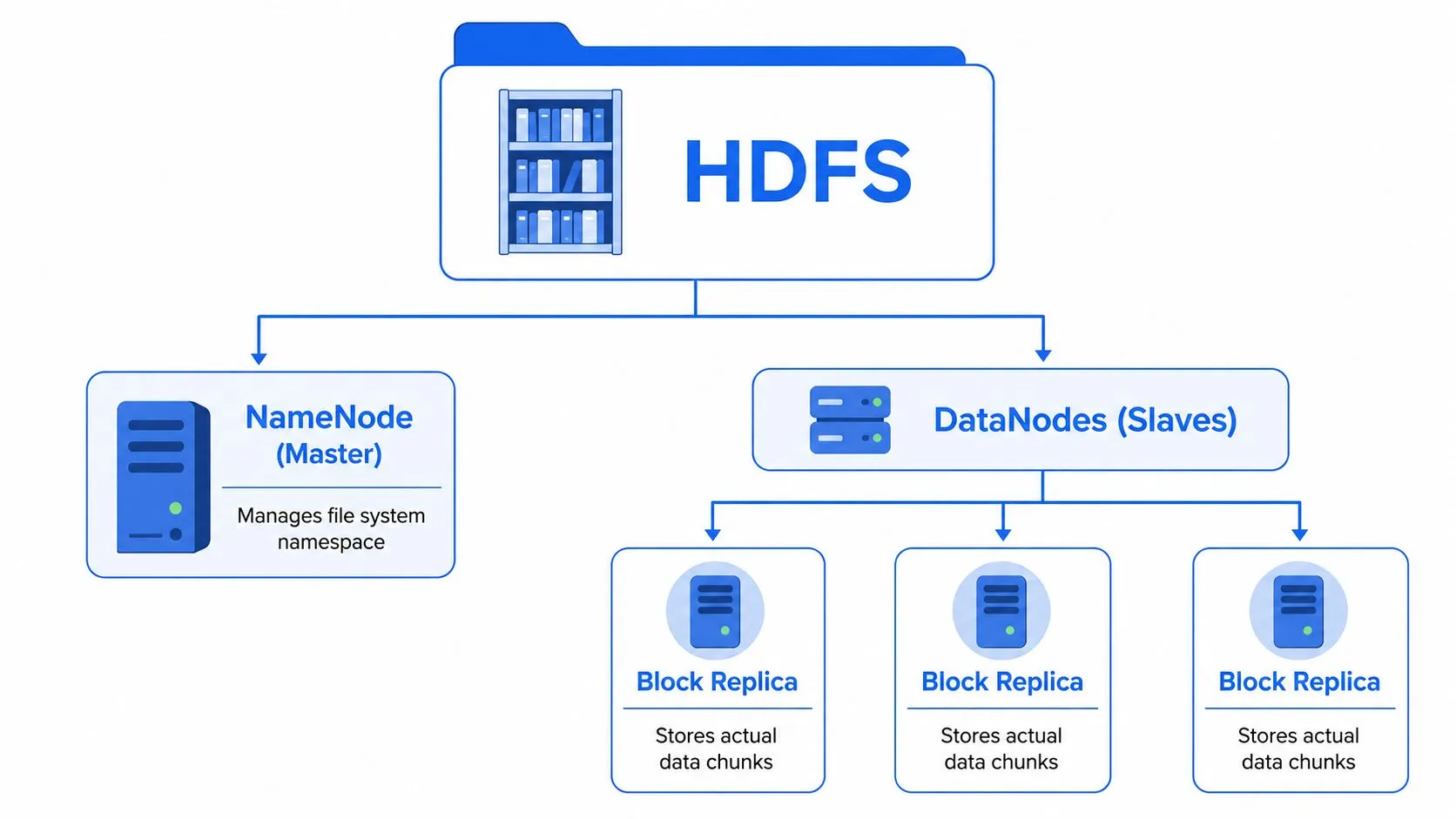
HDFS stores files by splitting them into blocks and placing those blocks across multiple nodes with replication for fault tolerance. That design is what lets a cluster keep serving data after a node failure, instead of losing the dataset with the failed machine. It also explains why Hadoop appealed to analytics teams that preferred commodity hardware over tightly managed storage arrays.
The NameNode keeps the file-system namespace, so it tracks where blocks live and how they fit together. The DataNodes store the actual data chunks. That split keeps metadata centralized enough to manage while letting storage scale horizontally as the cluster grows.
Operationally, the trade-off is easy to see. If one node goes down, the cluster does not stop being useful. If the dataset grows, you add nodes instead of reworking the whole storage layer. That is why Hadoop became a practical fit for large batch analytics, especially when teams cared more about durable storage and throughput than fast interactive reads.
How MapReduce fits the storage layer
MapReduce follows the same design principle. It breaks work into smaller tasks that run in parallel near the data, which cuts network traffic and makes failure recovery easier than single-node processing. That locality-first approach is one reason Hadoop handled large, messy, batch-heavy jobs well.
HDFS reduces the amount of data movement needed just to compute on it, which is often the hidden cost inside “simple” analytics work.
A lot of teams new to Hadoop mix up the storage layer and the compute layer. That leads to bad design choices. HDFS is durable distributed storage, while MapReduce is batch execution, and those are separate problems that happen to live in the same stack.
For a practical comparison of how storage systems differ from warehouse and lake patterns, the database, warehouse, and lake guide is a useful companion piece.
A note on where the old model breaks down
The same design that makes Hadoop resilient also makes it slower to adapt to interactive work. Replication, disk-based execution, and batch scheduling are a good fit when throughput matters most. They are a weaker fit when the team needs low-latency answers inside a product workflow. That line matters for startup data teams deciding whether to keep Hadoop in the core path, or reserve it for cold storage and batch jobs.
For teams still hiring around this stack or building hybrid platforms, you can browse blockchain engineering roles to see how distributed data infrastructure work is described in practice.
Hadoop Ecosystem Components and Workflows
Hadoop rarely runs alone in a real stack. In practice, it's the storage and batch engine at the center of a wider ecosystem that includes query tools, processing engines, and ingestion layers. The job of the data team is to move raw inputs through that stack without turning every pipeline into a bespoke one-off.
The tools that usually sit around Hadoop
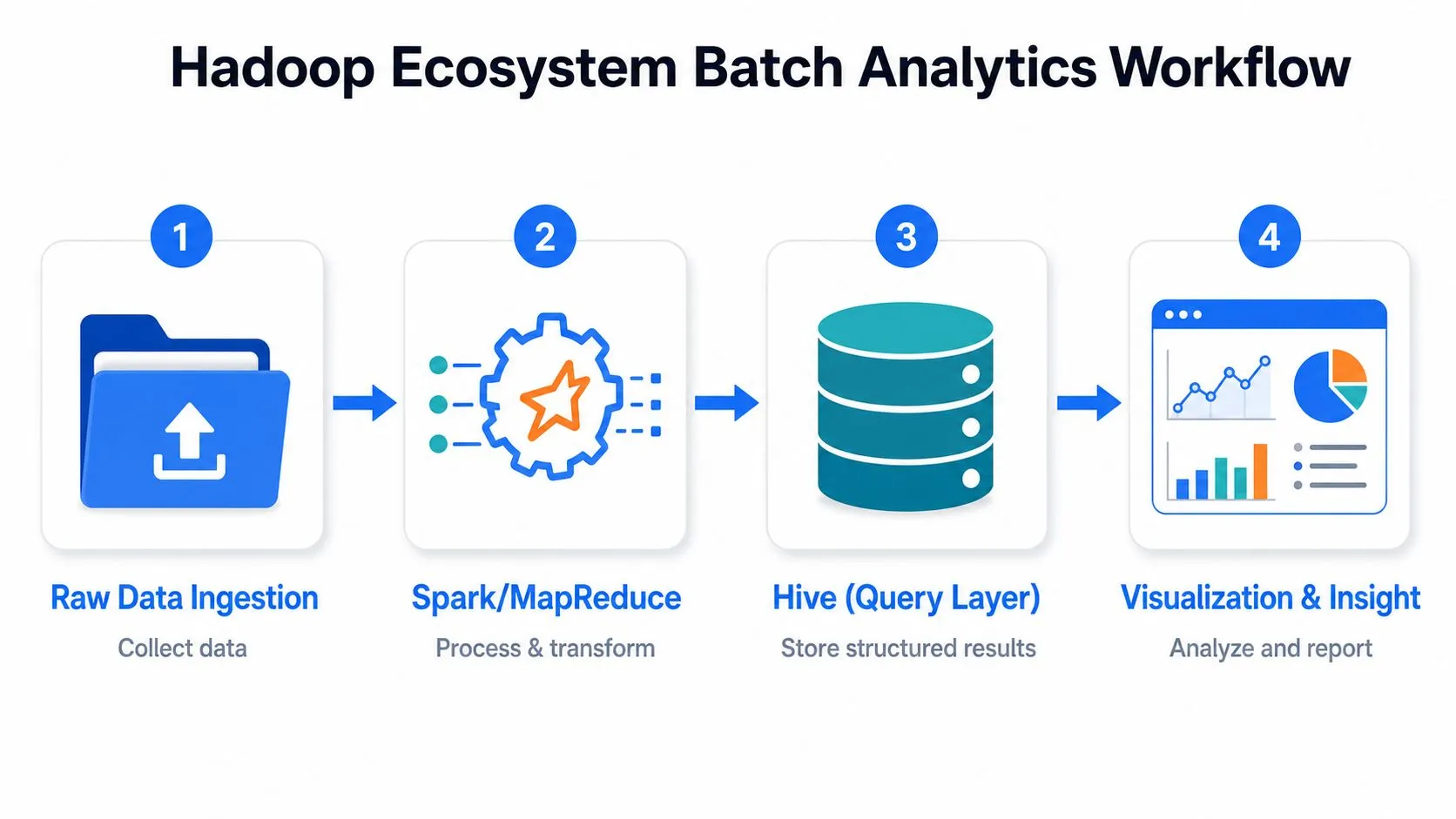
Historically, Hive gave teams a SQL-like query layer on top of Hadoop data, which made analytical access much easier for people who didn't want to write raw MapReduce. Pig offered another higher-level way to express data flows, while Spark increasingly became the faster processing layer for iterative and mixed workloads. In a modern stack, Hadoop often acts as the durable back-end store while other tools handle user-facing analytics and transformation.
The important part is not memorizing every tool. It's understanding the division of labor. Hadoop keeps the large batch substrate stable, and the surrounding engines let teams interact with that substrate in more usable ways. That separation is especially useful for startups that need to keep raw data cheaply stored while still giving analysts a productive path to query it.
For teams mapping out ingestion and transformation choices, the data pipeline tools guide helps place Hadoop in the broader workflow instead of treating it like a standalone island.
A practical batch workflow
A typical batch flow starts with raw ingestion from application logs, product events, partner feeds, or exported operational tables. The data lands in distributed storage, then a processing engine like Spark or MapReduce cleans, joins, and aggregates it. The structured output goes into a queryable layer such as Hive, and the final results feed dashboards, reports, or downstream systems.
That workflow works because it delays expensive structure until after the data is safely stored. Startup teams often need that flexibility early on, especially when product instrumentation changes quickly and the schema isn't stable. The batch pattern gives you room to collect first and model later.
Operational insight: The cleanest Hadoop pipelines are the ones that keep raw data immutable, transformation logic versioned, and exports narrow enough to be reused.
Why the ecosystem matters more than the core
Hadoop on its own is not the full answer to analytics. The ecosystem is what turns storage into usable information. Hive, Spark, and the ingestion tools around them are the difference between “we have data somewhere” and “we can answer questions reliably.” That's also why many teams end up with hybrid architecture, since not every query belongs in the batch layer.
Strengths and Limitations of Hadoop Batch Processing
Hadoop is still strong where the workload is large, repetitive, and tolerant of delay. It's a good fit for overnight processing, long-term archival storage, and batch jobs that need to chew through hundreds of terabytes on commodity infrastructure (industry comparison of Hadoop and Spark). That is the sweet spot. Outside it, the trade-offs become much sharper.
Where Hadoop earns its keep
Hadoop's biggest advantage is economic and architectural rather than glamorous. It handles distributed storage and batch execution on modest hardware, and it was built to survive the loss of individual nodes without taking down the whole cluster (Hadoop technical overview). For teams sitting on a large historical dataset that doesn't need minute-by-minute refresh, that durability matters.
It's also useful as a cold back-end for data that must be retained but doesn't need constant interaction. You can land, archive, and process data in a way that keeps the operational cost profile under control. That's why Hadoop still shows up in mature enterprises and in startups that inherited old pipelines.
Where the model falls short
The limitation is latency. Hadoop's classic MapReduce approach is batch-only, which makes it a poor fit for interactive analytics and iterative machine learning workloads. Independent guidance in the brief notes that Spark is often the technology of choice for iterative ML and real-time analytics, while Hadoop/MapReduce remains centered on batch execution (technical guidance on workload fit).
A separate comparison in the brief says Spark can be up to 100x faster than Hadoop MapReduce for in-memory iterative jobs, and up to 10x faster when the data exceeds RAM (performance comparison). That doesn't mean Hadoop is obsolete. It means the wrong workload makes Hadoop look worse than it is.
Hadoop MapReduce vs Spark Performance
| Processing Type | Hadoop MapReduce | Spark |
|---|---|---|
| High-volume overnight batch | Strong fit for disk-based batch jobs | Strong fit if memory and cluster resources are available |
| Iterative machine learning | Poor fit for repeated passes over data | Better fit for iterative workloads |
| Interactive analytics | Limited, because MapReduce is batch-only | Better support for batch and real-time patterns |
| Large archival processing | Useful on commodity infrastructure | Also usable, but often chosen for speed and flexibility |
The cleanest decision rule is simple. If the job is big, scheduled, and slow is acceptable, Hadoop still has a place. If the job is interactive, iterative, or product-facing, the team usually wants something faster and more flexible.
Real World Hadoop Use Cases
The most realistic Hadoop deployments I've seen don't try to make Hadoop do everything. They use it as the heavy back end while other systems handle live product behavior. That split keeps the architecture sane and lets each layer do the work it's good at.
Retail and commerce patterns
A retail team might ingest clickstream, purchase history, and catalog feeds into a Hadoop-backed batch layer overnight. The batch jobs can consolidate those inputs into trend tables, segment-level summaries, and campaign inputs without forcing the product experience to wait. Live inventory, cart state, and recommendation lookups can sit in a faster operational store or search system.
That pattern works because the business needs two speeds at once. The product needs immediate response, but the analysts need full-history computation. Hadoop handles the larger, slower analytical view without becoming the API layer for the app.
Finance and telecom patterns
The same hybrid logic shows up in financial services and telecom. Batch systems can process large historical datasets for compliance, pattern detection, or customer analysis while separate services handle real-time event evaluation. The research notes that Spark plus HBase is often used where teams need both speed and reliable access to large data sets, which is a good reminder that Hadoop-era architectures often evolve into mixed-engine stacks rather than pure Hadoop installs.
A healthy Hadoop deployment is usually invisible to the user. It should produce tables, summaries, and archives, not become the thing every product query depends on.
What startup teams should notice
The lesson for startups is not that Hadoop is “old” and therefore irrelevant. The lesson is that Hadoop belongs in the layer where delay is acceptable and scale matters more than immediacy. If a team tries to force dashboards, live features, and rapid ML experimentation through the batch layer, the architecture starts fighting the product.
That's why the best use cases are usually backstage. Hadoop processes the bulk work, and another system serves the front line. The stack stays simpler when each layer has a single job.
Modernization Paths for Startup Data Teams
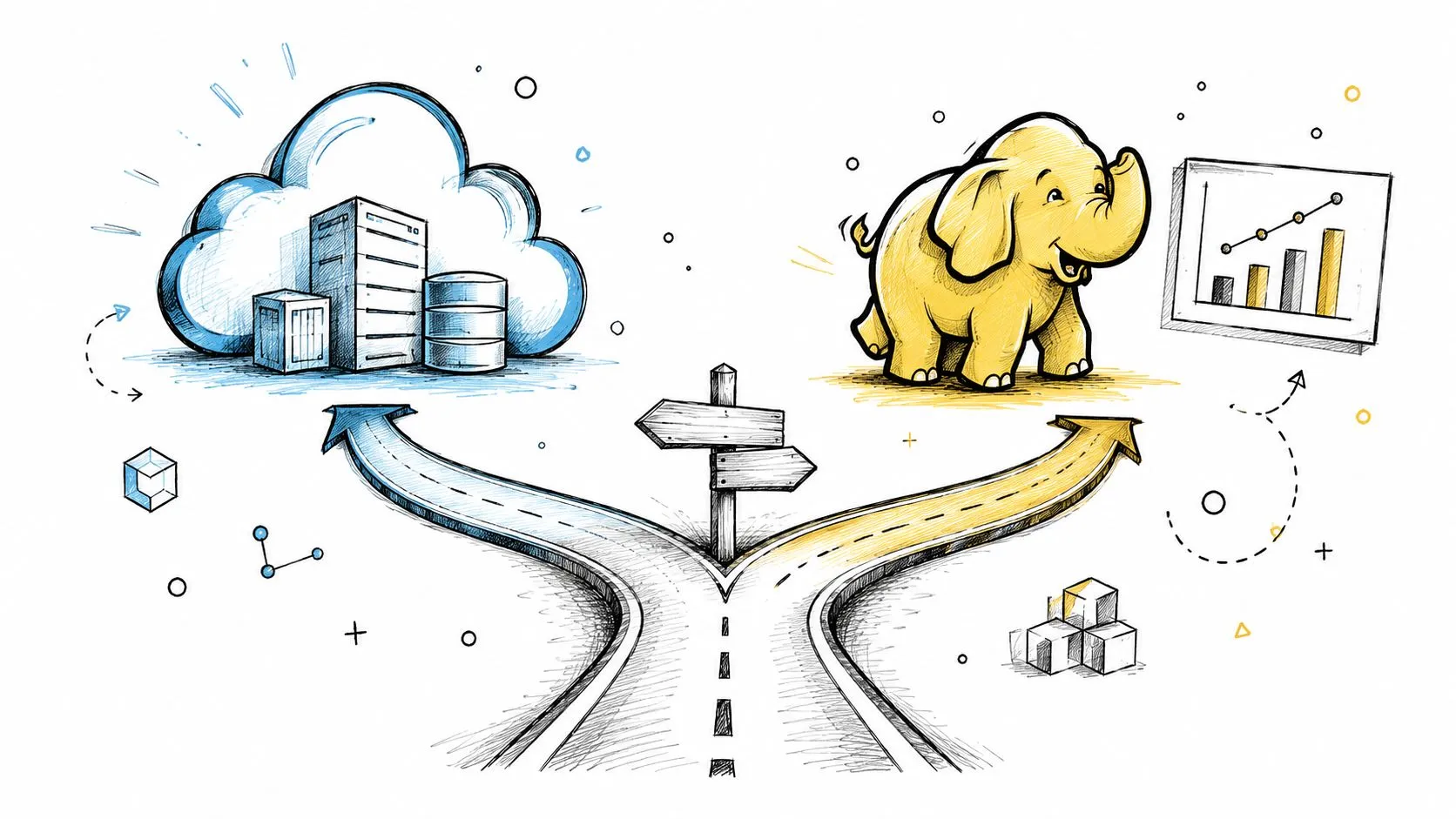
The best modernization move is usually not a dramatic rewrite. It's deciding which data responsibilities still justify Hadoop and which ones should move to a lakehouse, a cloud warehouse, or a managed processing service. For most startups, the default should not be “keep Hadoop because we've always had Hadoop.” It should be “keep only the parts that still earn their cost.”
Where Hadoop still makes sense
Hadoop still has a case when the team has large historical data, cheap storage needs, and predictable batch jobs. It also makes sense when the organization already has stable operational patterns built around HDFS, Hive, or similar distributed workflows. In those cases, replacing it just for fashion would be expensive and unnecessary.
The bigger point is that Hadoop can remain the back end of a hybrid system. A warehouse or lakehouse can handle higher-touch analytics, while Hadoop keeps the archival and bulk processing layer stable. That split is often cleaner than trying to rebuild the entire estate in one sprint.
Where newer stacks win
For latency-sensitive analytics, iterative ML, and self-serve access, Hadoop is usually not the best default. The brief's guidance is blunt on that point, Spark and modern query layers have moved the center of gravity away from classic MapReduce for many teams (technical guidance on workload fit). Cloud-managed warehouses and lakehouse platforms also remove a lot of the operational pain that used to make Hadoop feel unavoidable.
That's the startup advantage. A smaller team can get more done when it spends less time administering clusters and more time shaping data access. For teams deciding how to bring BI online before a full data platform hire, the startup BI setup guide is a useful lens for what “good enough now” looks like.
How to think about migration
The best modernization plan is workload-led. Keep the batch substrate if it's still paying for itself. Move user-facing analytics, ad hoc exploration, and ML-heavy work to systems that are built for those patterns. If you need a reference point for broader legacy renewal choices, the legacy system modernization guide is a solid complement to this decision.
Rule of thumb: Don't migrate Hadoop because it's old. Migrate it when another system clearly does the same job with less operational drag.
Startup data teams usually win by shrinking the number of platforms they must babysit, not by multiplying them. A managed lakehouse or cloud warehouse often reduces toil immediately, while Hadoop stays only where its distributed batch strengths still matter.
Key Takeaways for Data Leaders
For startup data teams, the key question is not whether Hadoop is “good” in the abstract. The question is whether it still wins on the workload in front of you. Hadoop's distributed storage and batch compute model solved a genuine scale problem, and it still makes sense when the job is large, scheduled, and tolerant of delayed results. It stops making sense when the team needs fast iteration, interactive analysis, or product-facing data behavior.
A practical decision starts with workload fit and operational cost. If your data is mostly historical, your pipelines run on a schedule, and your team already knows how to support a cluster, Hadoop can still carry part of the load. If analysts need quick follow-up queries, if engineers are iterating on models, or if product teams expect near-real-time answers, a warehouse, lakehouse, or managed Spark stack usually fits better. That trade-off shows up fast in practice. Hadoop often performs well on heavy batch processing and large scans, while modern cloud systems usually give startup teams better speed for ad hoc access and less time spent on maintenance.
The most useful checklist is blunt.
- Do we need durable storage for large historical data at low cost? Hadoop can still fit that role.
- Are the pipelines mostly scheduled batch jobs? That is the area where Hadoop remains strongest.
- Do analysts need fast interactive queries? A warehouse or lakehouse is usually the better fit.
- Are we doing iterative ML or near-real-time analytics? Spark or a managed modern stack is usually a better match.
- Are we spending too much time on cluster operations? That usually points to modernization, not more Hadoop tooling.
Hybrid patterns are often the right answer. Keep Hadoop where it is already paying for itself, usually in the batch layer or cold storage, and move interactive analytics, self-serve BI, and latency-sensitive workloads to systems built for those needs. That approach avoids a forced rewrite and lets a small team reduce toil without giving up the parts of Hadoop that still work.
The goal is not to preserve Hadoop out of habit, and it is not to replace it everywhere just to look modern. The goal is to keep the smallest stack that supports current workloads and leaves room for the next product decision. For many startup teams, that means a narrower Hadoop footprint, a managed warehouse or lakehouse for faster access, and a clear line between the jobs each platform should own.