Guide
Data Pipeline Tools: Choose the Right Stack for 2026
Find the best data pipeline tools for your team in 2026. Learn how to evaluate options and select the ideal stack to optimize your data workflows and analytics.
Most advice about data pipeline tools starts with the wrong question. Teams don't usually fail because they picked a tool with too few connectors, they fail because they picked a stack they can't operate, can't trust, or can't explain to the people who rely on it.
The market makes that mistake easy. One major estimate puts the global market at USD 12.0866 billion in 2024, with a projection to USD 48.3317 billion by 2030 at a 26% CAGR from 2025 to 2030, while another forecasts USD 12.53 billion in 2025 reaching USD 52.53 billion by 2032 at a 22.71% CAGR (Grand View Research). The category is growing because more teams need reliable data movement for AI, IoT, cloud warehousing, and lower latency across analytics workloads.
The practical issue is simpler. A pipeline tool is only good if your team can keep it running, your downstream users can trust the outputs, and your architecture matches the way your warehouse, BI, and product analytics work.
Table of Contents
- Why Most Data Pipeline Tool Comparisons Miss the Point
- How Data Pipeline Tools Evolved Into Distinct Categories
- Core Components of a Modern Data Pipeline Architecture
- Evaluating Data Pipeline Tools by Decision Criteria
- Building Pipeline Reliability That Most Guides Ignore
- The Shift Toward Warehouse-Centric Self-Serve Analytics
- Putting It All Together With a Practical Implementation Path
Why Most Data Pipeline Tool Comparisons Miss the Point
Most comparisons treat data pipeline tools like a shopping list. Connector count, pricing page, cloud logos, and a feature matrix get all the attention, while the operational burden gets buried under “ease of use” language that never survives a production incident.
The wrong comparison starts with features
A team can buy a tool with beautiful marketing and still end up with broken dashboards, slow backfills, and a support queue full of silent failures. Connector breadth helps, but it doesn't solve the harder problem, which is whether the team has time to validate data, monitor freshness, and own the pipeline after the launch excitement fades.
Practical rule: if a tool saves an hour on setup but adds recurring work every week, it's a bad fit for a small or stretched team.
That's why the decision should start with operational capacity. If your engineers already split time between ingestion, modeling, alerts, and executive reporting, a “more flexible” tool can become another system to babysit. If your analysts need self-serve access, the wrong pipeline choice creates a second bottleneck, this time in the warehouse instead of the source systems.
Fit matters more than connector count
The question isn't whether a tool can connect to your CRM, ad platform, and product events. It's whether the resulting data is reliable enough for the next person to use without a Slack thread. That's especially true in teams where the warehouse feeds dashboards, forecasting, and customer-facing analytics at the same time.
Reliability also beats raw functionality when the data stack is still small. A lean setup with one ingestion tool, one transformation layer, and clear ownership often outperforms a sprawling stack with half-used features and no one accountable for freshness. The winning stack is usually the one that matches your downstream analytics model and your team's maintenance budget, not the one with the longest logo list.
How Data Pipeline Tools Evolved Into Distinct Categories
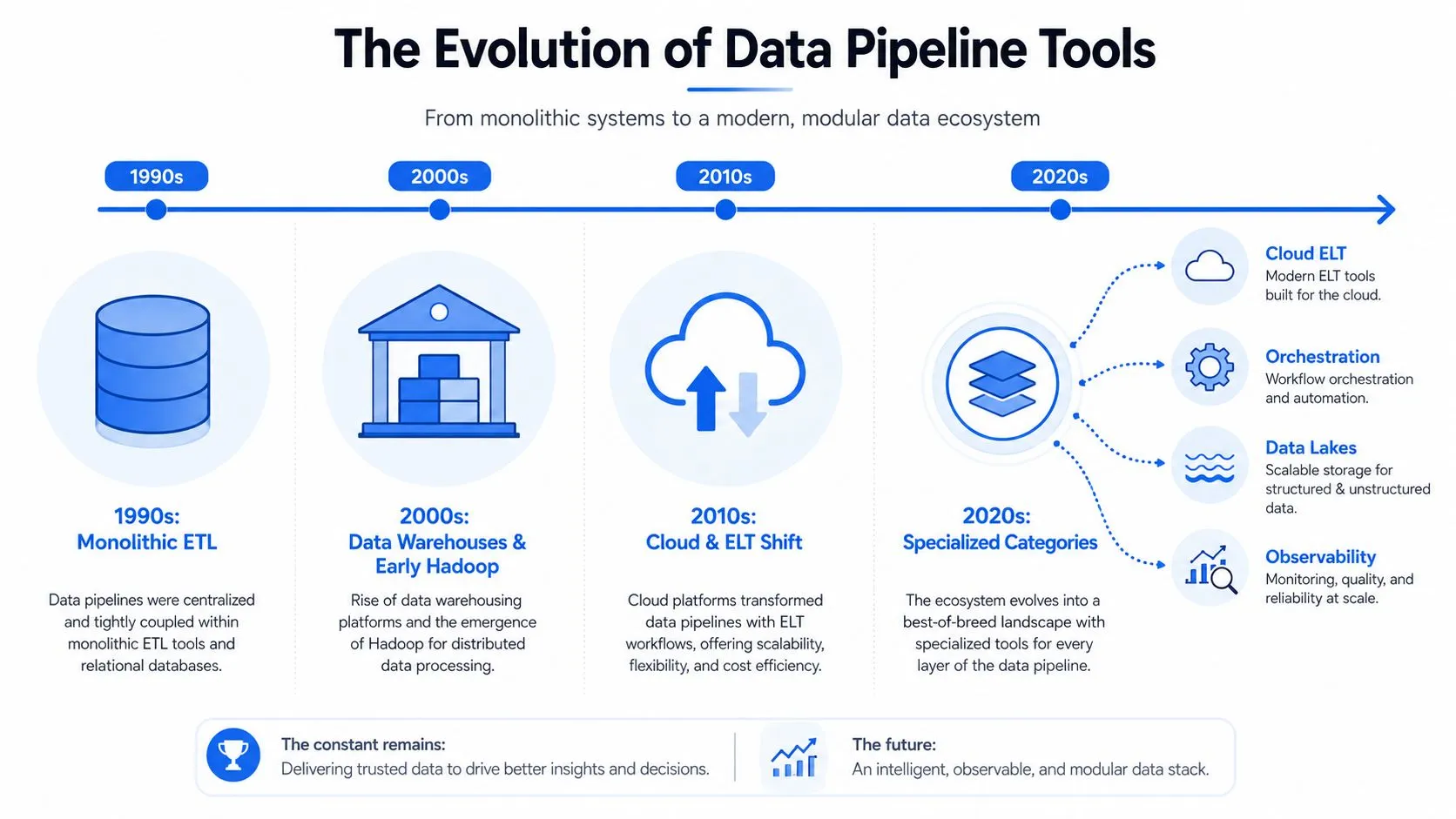
The old ETL mental model treated pipeline software as one broad category. That made sense when the main job was moving data from transactional systems into a warehouse, but it breaks down once teams need real-time events, warehouse-native transforms, pipeline health checks, and clear ownership boundaries.
The shift from monoliths to functions
Modern data pipeline tools are increasingly grouped by function, not by one universal ETL pattern. The major buckets are batch ETL and ELT, stream processing, observability, and orchestration, and the split matters because each class solves a different bottleneck (Expanso). A batch ELT tool is good when scale and schema handling matter more than sub-minute latency. A stream processor is a better fit when the business can't tolerate delayed movement. Orchestration exists to coordinate work, not to do the heavy lifting itself.
Apache Airflow is a good example of this separation. It's widely used as a workflow orchestration layer, not a data-movement engine. It lets teams author, schedule, and monitor pipelines as DAGs in Python, which is useful when dependencies, retries, and task ordering matter more than raw throughput (Airflow paper).
Why latency shapes the stack
Latency requirements drive architecture choice. Real-time event streaming and transformation engines make sense when fresh data has business value immediately. Managed ELT tools and orchestrators fit better when the harder problem is schema drift, scale, and dependency management.
That's why trying to find one universal platform usually wastes time. Teams that need both low-latency operational feeds and warehouse-centric analytics often end up with separate tools for ingestion, transformation, and coordination. The smart move is not to fight the category split. It's to map each job to the right tool class and keep the stack as small as possible.
For teams building around a modern analytics warehouse, this separation lines up with the broader stack choices described in the modern analytics stack.
Core Components of a Modern Data Pipeline Architecture
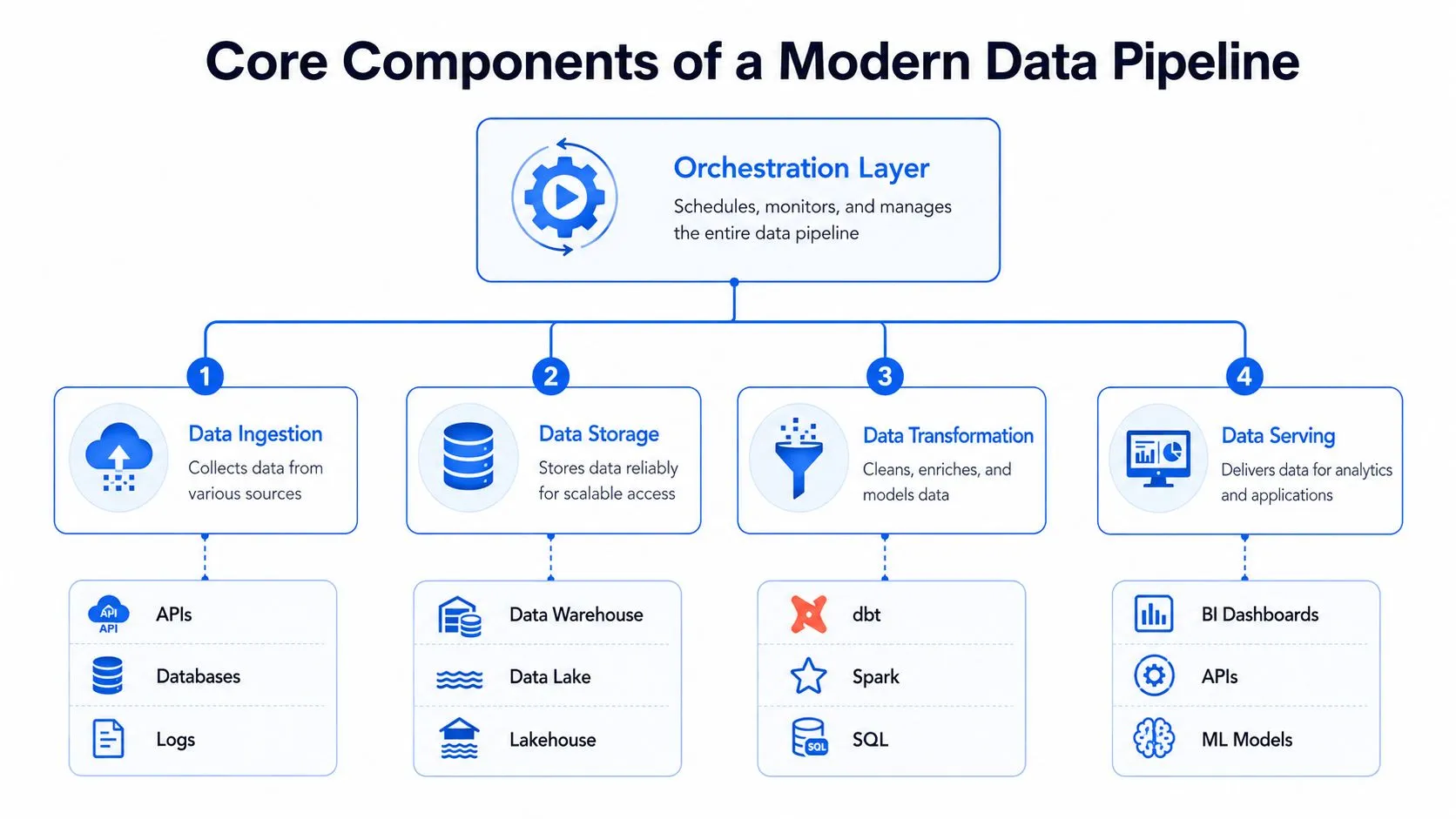
A production pipeline has a simple shape on paper and a messy shape in practice. Data arrives from APIs, databases, logs, and SaaS apps, gets moved into storage, gets transformed, then gets served to dashboards, models, or other systems. The challenge is that each layer introduces its own failure mode, and the person building the stack has to decide where to put complexity.
Ingestion, storage, transformation, and serving
Ingestion is the first mile. It pulls data out of APIs, databases, and SaaS systems, usually on a schedule or through change capture. In a healthy stack, ingestion should be boring. If every new source requires custom code, your team will spend more time maintaining connectors than using the data.
Storage is where the warehouse, lake, or lakehouse comes in. Storage choice affects everything downstream because it shapes query patterns, governance, and how easily self-serve users can work without engineering help. The architecture of the warehouse matters enough that it's worth reading a guide to data warehouse architectures before overbuilding the rest of the stack.
Transformation is where raw data becomes useful. SQL, dbt, Spark, and similar tools clean, join, and reshape data so it can answer actual business questions. Transformation gets expensive when it's layered across too many places, especially when no one knows which job owns the canonical metric.
Orchestration is the air traffic controller, not the airplane.
That analogy holds up in production. Orchestration coordinates when jobs run, what depends on what, and what should retry. It doesn't fix bad source data, and it doesn't magically make downstream reports trustworthy.
Where orchestration and observability fit
Observability catches what orchestration can't. It surfaces freshness gaps, schema breaks, row-count anomalies, and missing loads before someone notices a broken executive dashboard. That's why observability belongs in the architecture, not as an afterthought when the first incident postmortem lands.
A strong operating model usually separates these responsibilities. Engineering owns ingestion and orchestration, analytics engineering owns transformations, and data platform or analytics leadership owns freshness, lineage, and user trust. For a deeper operational perspective, the guide for data engineering leaders is useful because it treats reliability and governance as design constraints, not cleanup work.
Evaluating Data Pipeline Tools by Decision Criteria
The best way to compare data pipeline tools is by the work they remove, and the work they create. A tool that looks cheap on paper can get expensive once a team starts paying for maintenance, retries, monitoring, and the time it takes new engineers to learn the system.
| Tool Category | Primary Function | Best For | Key Trade-off | Team Skill Required |
|---|---|---|---|---|
| Ingestion tools | Move data from sources into warehouses or lakes | Teams that want fast source onboarding | Simplicity can hide ongoing sync costs | Low to moderate |
| Orchestration platforms | Schedule and coordinate dependent jobs | Complex pipelines with retries and dependencies | Powerful control usually means more setup and upkeep | Moderate to high |
| Transformation engines | Clean, model, and reshape data | Warehouses with SQL-heavy analytics teams | More modular logic can mean more moving parts | Moderate |
| Observability tools | Detect breakage, drift, and freshness issues | Teams that need trust in dashboards and models | Adds another layer to maintain if the stack is tiny | Moderate |
| End-to-end platforms | Bundle several pipeline functions in one product | Smaller teams that want fewer vendors | Convenience can limit flexibility later | Low to moderate |
What actually matters in mid-market teams
Time to first working pipeline matters, but only if the result stays alive. Managed ingestion tools usually win when the goal is quick setup and fewer source-side headaches. Open-source orchestration often wins when the team wants control, but that control comes with real operational overhead.
Pricing predictability also matters more than many buyers expect. Consumption models can look attractive during evaluation, then drift once data volumes rise or refresh frequency increases. Integration with the warehouse matters too, because teams now want pipelines to feed a warehouse-centric analytics layer rather than a separate reporting silo.
Matching tool class to team capacity
If your team has one or two engineers supporting analytics, reliability, and ad hoc requests, a lighter stack usually wins. If you have dedicated platform ownership, a more modular setup can pay off because the team has time to manage orchestration, observability, and transformations separately.
Querio fits this decision frame as one option in the warehouse-centric category because it deploys AI coding agents directly on the warehouse and supports notebook-based work for both technical and non-technical users. That matters less as a product pitch than as a stack design signal, because the fewer handoffs you create between warehouse and analysis, the easier it is to maintain trust in the outputs.
Building Pipeline Reliability That Most Guides Ignore
Most pipeline writeups stop at ingestion and orchestration. Production doesn't stop there. Pipelines fail when schemas change, source freshness slips, backfills rerun badly, or no one notices that a metric definition changed three weeks ago.
The checks that prevent silent breakage
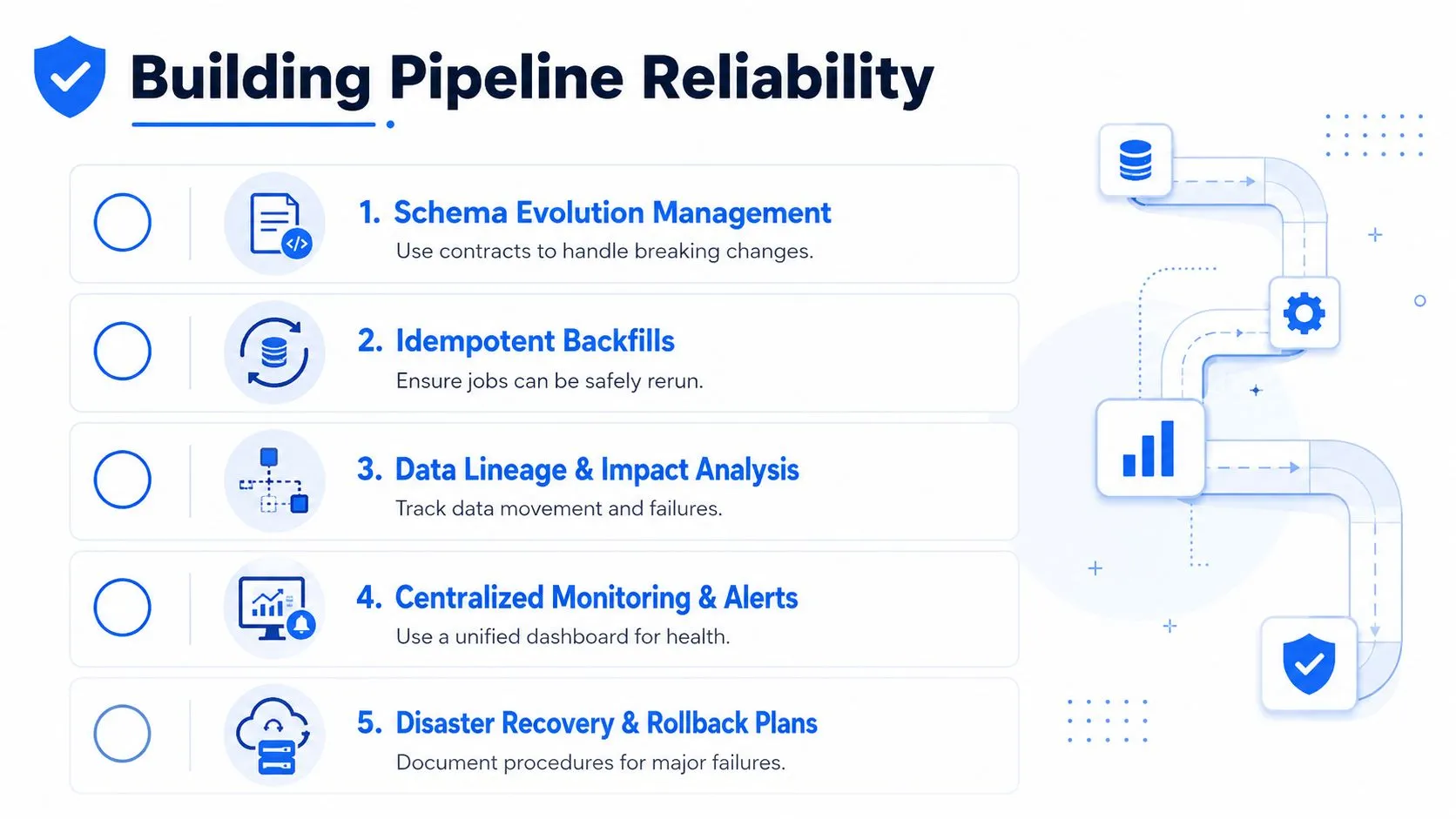
Start with schema evolution management. If upstream systems add or rename fields without contracts or checks, downstream models can break in ways that don't trigger obvious job failures. Pair that with data validation and freshness tests so the team sees bad data before business users do.
Idempotent backfills matter just as much. A backfill that can't be safely rerun turns a recovery task into a manual cleanup exercise, which is exactly the kind of work that drains a small team. Lineage and impact analysis help you trace where a bad value came from and which dashboards or models it touched.
Pipelines are as fragile as they are powerful.
That line from practitioner guidance is accurate because most failures aren't dramatic. They're quiet. A job still runs, but a source field goes null, a metric definition shifts, or a warehouse table stops refreshing on time.
Ownership is part of reliability
Reliable pipelines need a clear owner for each layer. Someone should own source contracts, someone should own transformation logic, and someone should be responsible for alert triage. Without that structure, alerts get ignored, documentation goes stale, and every incident becomes a group project.
Centralized monitoring helps, but only if alerts are tied to action. A noisy alerting system trains people to dismiss warnings, which is worse than having none at all. Disaster recovery and rollback plans close the loop, because a team that can't restore a trusted dataset quickly doesn't really control its pipeline.
For teams formalizing these practices, the data warehouse best practices guide is a useful companion because warehouse discipline and pipeline reliability usually fail together, not separately.
The Shift Toward Warehouse-Centric Self-Serve Analytics
The most important change in pipeline design is not a new connector or a new orchestrator. It's the move toward warehouse-centric stacks where the warehouse becomes the center of truth, and the rest of the tooling exists to make data easier to trust and easier to use.
Modern teams are also rethinking whether they need a large BI layer at all. The newer warehouse-first pattern treats the warehouse as the foundation for self-serve analytics, customer-facing data experiences, and internal exploration. Querio's modern data stack overview reflects that shift by framing the stack around warehouse-based access rather than a pile of disconnected tools.
Why warehouse-first changes the tool decision
When the warehouse is the center, pipeline choices stop being purely about ingestion. The question becomes how fast the data can reach the warehouse, how cleanly it can be modeled there, and how easily non-engineers can use it without filing tickets. That changes which tools matter most.
Many mid-market teams overbuild. They add a separate BI layer, a separate transformation layer, and a separate orchestration layer before they've defined what downstream users need. A warehouse-centric approach trims that sprawl and gives analytics teams a more direct path from source data to usable answers.
It also changes the role of the data team. Instead of acting like a human API for every question, the team maintains infrastructure that other people can safely use. That's a healthier model for companies that want faster analysis without growing the headcount linearly.
The practical upside
Warehouse-centric stacks work best when the analytics model is self-serve. That means the warehouse contains modeled, trustworthy data, and the surrounding tools support exploration rather than gatekeeping. Real-time use cases still matter, but they should be added where they create business value, not because the vendor demo looked impressive.
The hidden benefit is team capacity. Fewer tools usually mean fewer places for metrics to drift, permissions to break, and users to get lost. For most mid-market teams, that trade-off is worth more than another layer of abstraction.
Putting It All Together With a Practical Implementation Path
A mid-market team usually doesn't need a grand architecture rewrite. It needs a stack it can run on a normal week. Start with the warehouse you already trust, then add one ingestion tool that handles your most important sources with the least manual upkeep.
From there, keep transformation close to the warehouse unless a workload needs a different compute model. Add a dedicated orchestrator only when dependencies start crossing systems, or when retries, scheduling, and job visibility become hard to manage inside the warehouse alone. Observability should come in once the team has enough pipelines that a silent failure would be expensive, not before.
A lean rollout often looks like this. One source system lands in the warehouse, one model layer turns it into trusted tables, and one monitoring layer watches freshness and schema drift. If the team can't explain who owns each table, it's too early to add another tool.
The goal is not sophistication. The goal is a stack your team can maintain and your users can rely on for self-serve analytics.
If you're trying to simplify a stack that's grown harder to trust than to use, Querio gives data teams a warehouse-centered way to build self-serve analytics without turning every request into engineering work. Visit Querio to see how its AI coding agents and notebook-based workflow can fit into a pipeline strategy built around reliability, not connector count.