Business Intelligence
Zenlytic AI semantic layer natural language query
AI semantic layer turns plain-language questions into governed SQL with consistent metrics, security, and inspectable data lineage.

Zenlytic bridges the gap between technical data structures and everyday business questions, making data insights accessible for non-technical users. By combining a semantic layer with AI, Zenlytic transforms natural language queries into governed, accurate SQL outputs in seconds. This approach eliminates delays, ensures consistent metrics, and reduces repetitive tasks for data teams. Key features include:
- Semantic Layer: Translates complex data models into clear business terms, ensuring consistent answers for metrics like "revenue."
- AI-Powered Clarity Engine: Converts plain questions (e.g., "What was our revenue last quarter?") into precise SQL queries.
- Dynamic Fields: Handles undefined metrics by generating SQL on-the-fly, which can later be added to the semantic layer.
- Governance & Security: Enforces strict data permissions, ensuring users only access authorized data.
- Transparency: Provides data lineage and citations for every result, building trust among users.
Zenlytic reduces ad hoc data requests by 57%, freeing analysts for strategic tasks. Business users and executives gain instant, reliable insights without needing technical expertise. Tools like Zoë, the AI assistant, simplify queries while maintaining data integrity and security. Companies like J.Crew and LOLA have already seen measurable benefits, including reduced churn and significant time savings.
Understanding the Semantic Layer in AI-Driven Data Analytics [GoodTalks]
::: @iframe https://www.youtube.com/embed/vQewaZWY9zo :::
How the Zenlytic Semantic Layer Powers Natural Language Querying
Zenlytic's Clarity Engine is designed to transform natural language queries into governed SQL queries in real time. For example, when someone asks, "What was our revenue last quarter?", the Clarity Engine taps into pre-defined fields and joins to generate accurate SQL queries instantly.
AI-Driven Query Translation
Zenlytic's AI agent, Zoë, operates in two distinct modes. In Default Mode, Zoë focuses on verified fields from the semantic model - marked with a green checkmark - ensuring that the responses are both accurate and reusable. If a query involves a metric that hasn’t been pre-defined, the engine creates Dynamic Fields by generating SQL based on existing logic. This ensures that even dynamically generated metrics remain governed.
For instance, KOIO's marketing team saved 20 hours of weekly Excel reporting by analyzing metrics like inventory and acquisition channels directly through Zenlytic [3]. Additionally, when data teams introduce new metrics into the production branch, Zoë identifies and incorporates them in about 10 seconds [4]. These AI-generated Dynamic Fields can be reviewed and, if valuable, added to the permanent semantic layer - turning one-off analyses into a consistent and governed source of truth. For more advanced investigations, the system provides an Exploratory Mode, which allows users to go beyond the existing semantic structure while still adhering to all security permissions.
This seamless query translation ensures that governance and accuracy remain central to the process.
Data Accuracy and Governance
Zenlytic doesn’t just focus on translating queries; it also prioritizes data security and precision. Through a component accessibility model, the platform ensures that the AI only accesses underlying columns that the user is explicitly allowed to see. This system automatically enforces row-level and column-level security, so users only interact with data they’re authorized to access.
Each result includes detailed information on its data sources and calculations, making it easy for non-technical users to verify the information. Amanda Yan, Head of Data at J.Crew and Madewell, shared:
"We've tried every AI-powered platform out there. But our self-serve users still asked us to verify everything. Zenlytic solves this. Once our end users understand the results, they trust the results."
This approach has delivered tangible results. At LOLA, for example, the platform helped identify patterns driving subscription churn over a 12-month period ending in 2024/2025. Melissa DiNapoli, Director of Omnichannel, used these insights to reduce churn by 10% [3]. Zenlytic empowers teams to perform self-serve analytics while minimizing the need for constant input from data teams.
Benefits of Zenlytic's Governed AI Approach
::: @figure 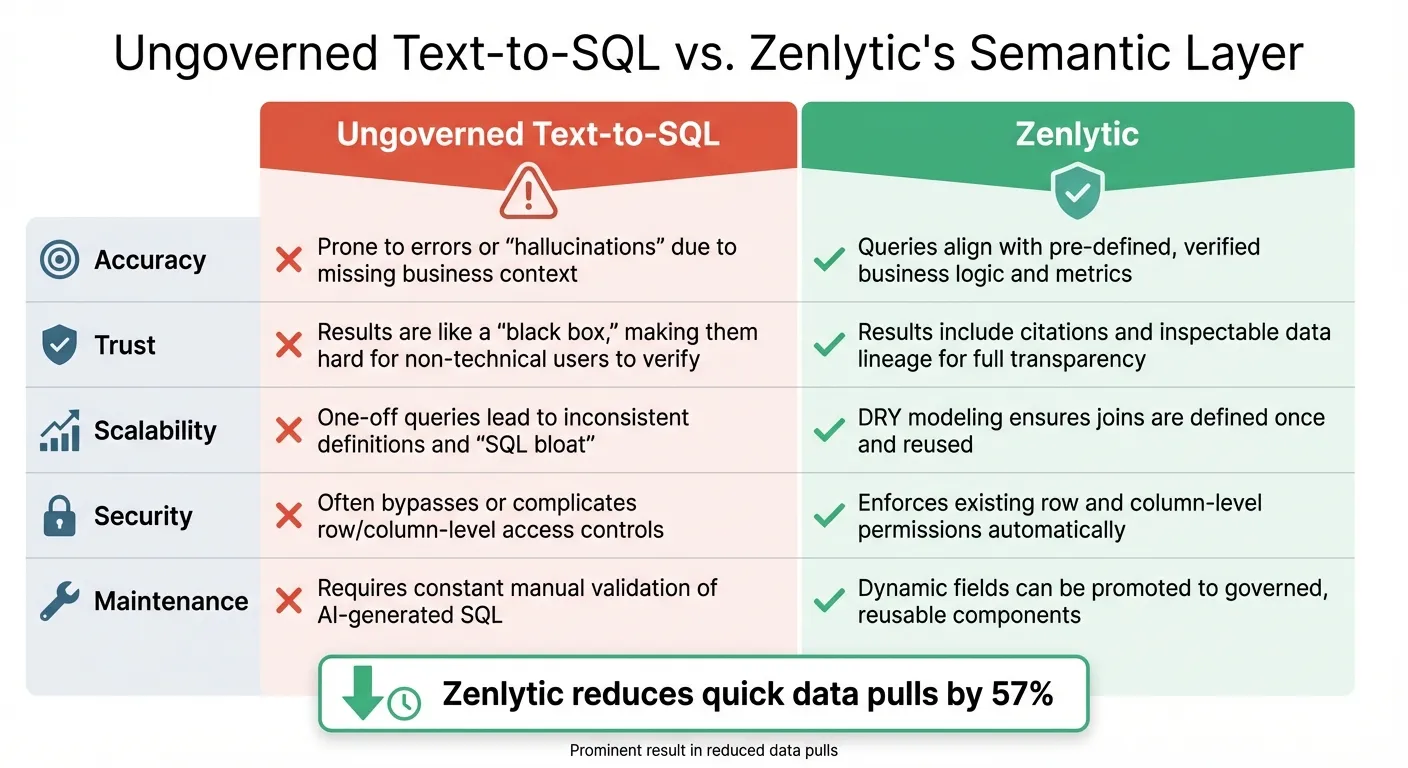 {Ungoverned Text-to-SQL vs Zenlytic's Semantic Layer Comparison}
:::
{Ungoverned Text-to-SQL vs Zenlytic's Semantic Layer Comparison}
:::
Zenlytic's governed semantic layer brings three main benefits: consistent metrics, automated security, and scalable architecture. These strengths come from its metrics-native design, where business logic is defined once in YAML or dbt MetricFlow and reused across all queries [1]. This approach ensures reliability, security, and efficiency throughout the organization.
Single Source of Truth
Zenlytic eliminates data silos, ensuring that metrics remain consistent across the entire company [1]. For example, when a metric like "monthly recurring revenue" is defined in the semantic layer, every department - from marketing to finance - gets the same result when they query it.
The platform relies on DRY (Don't Repeat Yourself) modeling, which allows table joins to be written once and reused automatically. This reduces maintenance efforts while ensuring consistency across teams [1]. Additionally, when Zoë creates Dynamic Fields to explore new questions, data teams can promote valuable fields to the permanent semantic layer. This turns ad-hoc analyses into trusted, reusable components [2][5]. The result? Reliable, AI-powered insights that every team can depend on.
Security and Traceability
Zenlytic doesn't just focus on consistency; it also prioritizes security and transparency. The component accessibility model ensures that users can only access data they are authorized to see, based on their assigned measures and dimensions [2][1].
Every query result comes with citations and data lineage, so users know exactly where the data came from and how it was calculated [5]. Verified fields are marked with green checkmarks, helping users trust the platform's insights. This transparency is a key reason why companies like J.Crew and Madewell have embraced Zenlytic. Amanda Yan, Head of Data at J.Crew and Madewell, shared:
"We've tried every AI-powered platform out there. But our self-serve users still asked us to verify everything. Zenlytic solves this. Once our end users understand the results, they trust the results" [1].
The platform also operates with 256-bit AES encryption and does not store customer data [1]. Data teams retain full control by reviewing queries and managing "memories" (training examples). Admins can even monitor and remove incorrect examples from memory training.
Ungoverned Text-to-SQL vs. Zenlytic's Semantic Layer
A comparison of text-to-SQL tools highlights why Zenlytic's governed approach highlights why Zenlytic stands out:
| Feature | Ungoverned Text-to-SQL | Zenlytic |
|---|---|---|
| Accuracy | Prone to errors or "hallucinations" due to missing business context. | Queries align with pre-defined, verified business logic and metrics [1]. |
| Trust | Results are like a "black box", making them hard for non-technical users to verify. | Results include citations and inspectable data lineage for full transparency [5]. |
| Scalability | One-off queries lead to inconsistent definitions and "SQL bloat." | DRY modeling ensures joins are defined once and reused [1]. |
| Security | Often bypasses or complicates row/column-level access controls. | Enforces existing row and column-level permissions automatically [2][1]. |
| Maintenance | Requires constant manual validation of AI-generated SQL. | Dynamic fields can be promoted to governed, reusable components [2]. |
Matt Griffiths, CTO of Stanley Black & Decker, explained the difference:
"Only Zenlytic can answer the questions dashboards can't. Zoë handles those high-impact questions that would be impossible to ask in traditional data platforms" [1].
Thanks to its governed approach, Zenlytic has reduced quick data pulls for data teams by 57% [1], allowing them to focus on more strategic projects instead of verifying one-off queries.
sbb-itb-284a532
Natural Language Query Examples in Zenlytic
Zenlytic is designed to make data analysis accessible and intuitive for everyone, regardless of technical expertise. Here’s how it simplifies the process while maintaining accuracy and security.
Business Intelligence Query Examples
With Zoë, Zenlytic’s natural language interface, users can transform plain questions into governed SQL queries effortlessly. For example, you can ask, "What was net revenue by marketing channel last month?" or "Show me the number of customers by acquisition channel who spent over $200 in the last three months." Zoë handles both straightforward and complex queries, ensuring they align with your organization’s data definitions.
This functionality eliminates the need for technical know-how, as highlighted by Kelly Murphy, VP of Direct to Consumer & Amazon at LOLA:
"I can type what I need without worrying about that usual learning curve that comes with data tools. Honestly, I start about 80% of my queries with Zoë now."
The tool’s impact is clear - KOIO replaced a manual process that once took over 20 hours a week. Now, their marketing team can interactively explore metrics like inventory and acquisition channels in real-time, saving valuable time and effort.
Zoë doesn’t just execute queries; it also ensures full traceability, so users always know how results are generated.
Inspectable Results for Transparency
Zenlytic takes transparency to the next level by making every result inspectable. Users can click on results to view the underlying SQL, data sources, and specific calculations. Verified fields from the semantic layers in business intelligence are marked with a green checkmark, clearly distinguishing governed metrics from ad-hoc Dynamic Fields.
This clickable insight feature ensures users understand the origins of their data. By revealing how numbers connect to your data warehouse, Zenlytic fosters trust across teams and eliminates uncertainty about the accuracy or source of the metrics.
Use Cases for AI-Driven Insights with Semantic Governance
Zenlytic combines AI with a governed semantic layer to deliver faster, more precise insights across an organization.
Self-Serve Analytics for Non-Technical Teams
With Zenlytic, business users can ask plain language questions without relying on data teams. Zoë, the AI assistant, is available through the Zenlytic interface or familiar workplace tools like Slack, Microsoft Teams, and email.
For example, a DTC digital bank saw major advantages when addressing high default rates. The CEO used Zoë to quickly pinpoint shared characteristics among flagged accounts - insights that surfaced in minutes instead of weeks [3].
At LOLA, a DTC brand, Kelly Murphy, the VP of Direct to Consumer & Amazon, now starts 80% of her data queries with Zoë. This shift has significantly reduced the learning curve typically associated with data tools, making analytics more accessible.
While empowering everyday users, Zenlytic also enhances decision-making at the executive level.
Executive Dashboards with Consistent Metrics
Zenlytic ensures executives see consistent, reliable metrics by defining them once in a governed semantic layer. Dynamic dashboards let leaders explore data - whether it's campaign performance or product categories - without worrying about discrepancies.
Matt Griffiths, CTO of Stanley Black & Decker, explained the impact:
"We already had a dozen tools that could tell us our sales last week. But only Zenlytic can answer the questions dashboards can't. Zoë handles those high-impact questions that would be impossible to ask in traditional data platforms."
This clarity at the top also streamlines operations for data teams.
Reducing Manual Work for Data Teams
Data teams save up to 50% of their workday [3] by cutting down on repetitive ad hoc requests. Instead of pre-building every possible metric, teams use Zoë to create Dynamic Fields, which can easily be added to the permanent semantic layer. This reduces model complexity and makes maintenance simpler compared to traditional tools.
Zenlytic's DRY (Don't Repeat Yourself) modeling method ensures tables are joined just once in the semantic layer, eliminating redundant work. Data teams retain control by reviewing AI-generated queries and managing "Memories", which serve as training examples to improve Zoë's accuracy. Security remains a priority, as all insights respect the row- and column-level permissions set in the semantic layer.
Conclusion
Key Takeaways
Zenlytic is reshaping business intelligence by combining governed accuracy with the ease of natural language queries. The platform delivers answers in seconds, a stark contrast to the hours or even days traditional methods often require [3]. This speed doesn’t compromise reliability - every query is backed by a structured semantic layer, ensuring consistency across users and departments.
The advantages ripple through the entire organization. Data teams save countless hours by reducing ad hoc requests, enabling them to focus on impactful tasks like advanced modeling rather than repetitive data pulls. Executives benefit from consistent metrics that eliminate conflicting dashboards. Zenlytic’s approach to explainable AI builds trust by providing full data lineage for every query, clearly showing the sources, tables, and calculations used. Amanda Yan, Head of Data at J.Crew and Madewell, highlights this trust-building feature:
"We've tried every AI-powered platform out there. But our self-serve users still asked us to verify everything. Zenlytic solves this. Once our end users understand the results, they trust the results" [1][3].
Why Choose Zenlytic?
These points highlight why Zenlytic stands out in the world of business intelligence. Organizations that adopt Zenlytic gain a secure, governed, and scalable solution for AI-powered analytics. The platform enforces strict data permissions automatically, ensuring users only access data they’re authorized to see.
Whether your goal is to empower business users, deliver executives reliable insights, or free up your data team from routine tasks, Zenlytic’s blend of natural language querying and semantic governance provides measurable outcomes while adhering to rigorous data governance standards.
FAQs
::: faq
How does Zenlytic keep natural language queries secure and compliant?
Zenlytic prioritizes security and compliance for natural language queries through its Clarity Engine, which merges the adaptability of SQL with the structured oversight of a semantic model. This setup lets data teams review and approve every query, ensuring that analytics logic remains both consistent and secure.
The platform also pairs semantic layers with advanced AI models to provide precise insights while keeping tight control over data access and query processes. By allowing organizations to monitor and explain queries, Zenlytic helps meet regulatory requirements, safeguard sensitive data, and deliver reliable analytics. :::
::: faq
What are the key benefits of using Zenlytic's AI-powered semantic layer for business intelligence?
Zenlytic's AI-powered semantic layer simplifies business intelligence by letting users ask questions in plain language and get actionable insights in return. This removes the need for advanced technical expertise, making it easier for everyone in an organization to explore and analyze data.
This semantic layer merges the precision of SQL with the simplicity of a semantic model, delivering analytics that are both effective and dependable. It speeds up decision-making by presenting data in a way that's easy to understand, empowering teams to respond swiftly and with confidence. Plus, it supports self-serve analytics, cutting down the reliance on data teams for everyday questions and opening up insights to more users.
With the integration of advanced large language models (LLMs), Zenlytic provides detailed, context-aware answers to even the most complex questions. This creates a seamless self-serve analytics experience, boosting efficiency and enabling smarter, faster decisions throughout the organization. :::
::: faq
How does Zenlytic’s AI assistant, Zoë, handle complex questions and dynamic data fields?
Zenlytic’s AI assistant, Zoë, simplifies tackling complex questions and navigating dynamic data fields with its explicit data indexing and contextual understanding features. One standout aspect is that Zoë only indexes data when you specifically instruct it to, giving you full control over sensitive information. For instance, if you want certain fields, like fulfillment status, to be searchable, you can mark them as searchable:true. This enables Zoë to process queries like, “How many orders are currently in fulfillment and were placed more than seven days ago?” with ease, automatically applying the correct filters.
What sets Zoë apart is its knack for understanding layered, nuanced questions. By using clear naming conventions and descriptive labels for your data, you can guide Zoë to deliver accurate, tailored answers. The best part? You don’t need to know SQL or any technical jargon - just ask your question in plain English, and Zoë will do the heavy lifting. It’s an efficient way to turn your business data into actionable insights, fast. :::