Business Intelligence
ThoughtSpot natural language analytics capabilities limitations vs querio
Compare ThoughtSpot and Querio for natural language analytics: setup time, query transparency, governance, and best-use scenarios.

If you’re comparing ThoughtSpot and Querio for natural language analytics (NLA), here’s the bottom line: ThoughtSpot works well for large enterprises with dedicated data teams, while Querio is designed for agile B2B SaaS teams that prioritize speed, transparency, and consistent metrics.
Key Takeaways:
- ThoughtSpot: Best for large organizations needing a search-driven interface. However, it requires extensive setup, relies on well-structured data models, and offers limited query transparency.
- Querio: Ideal for small-to-mid-sized businesses. It connects to your cloud data warehouse in 15 minutes, ensures consistent metrics, and provides full visibility into SQL and Python queries.
Quick Comparison
| Feature | Querio | ThoughtSpot |
|---|---|---|
| Setup Time | ~15 minutes | Weeks to months |
| Query Transparency | Full SQL/Python visibility | Limited |
| Governance | Git-based version control | UI-based role controls |
| Pricing | Free plan; Core $2,499/mo | $95/user/month, 100-user minimum |
| Best Fit | Small-to-mid B2B SaaS teams | Large enterprises with centralized BI |
For teams that value speed, clarity, and consistent analytics, Querio stands out. ThoughtSpot, while powerful, may not suit teams needing quick deployment or transparency in query logic.
::: @figure 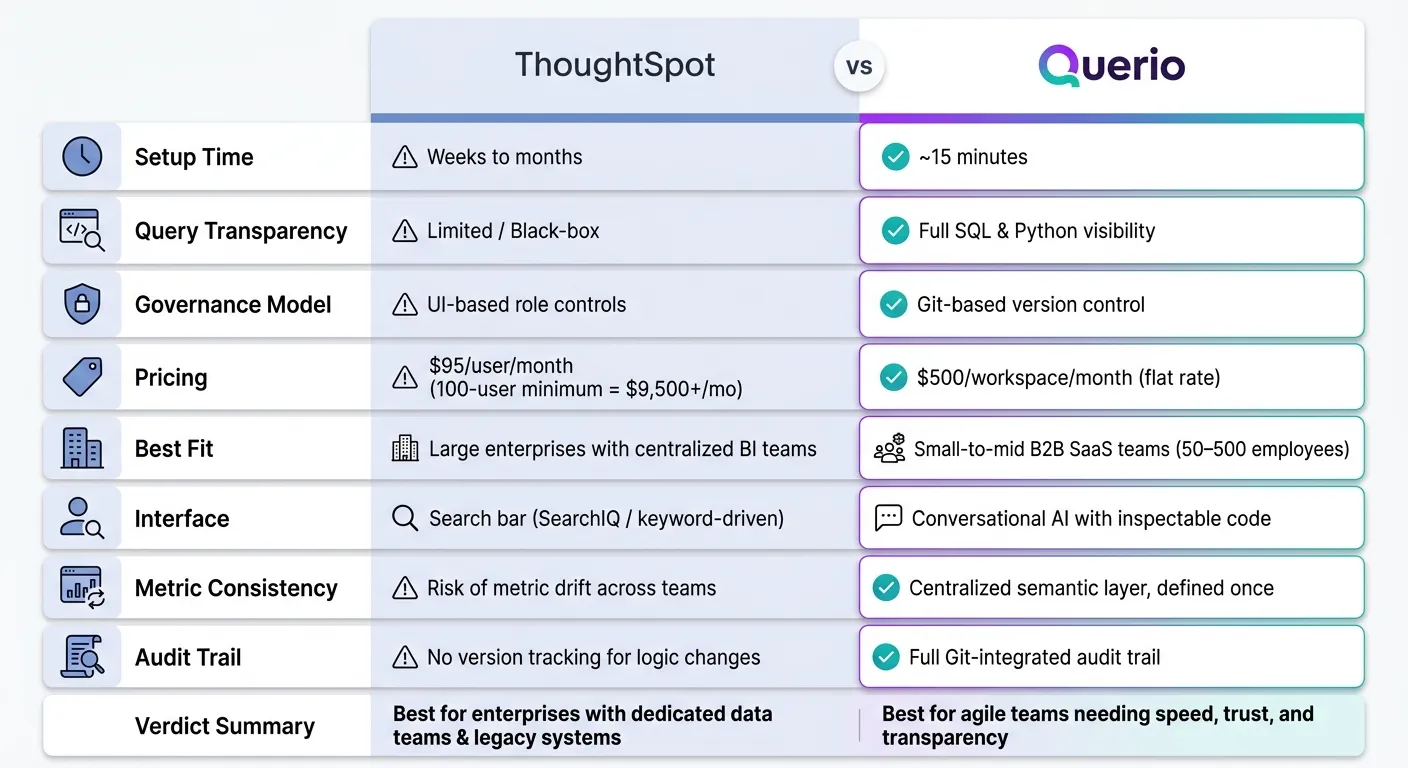 {ThoughtSpot vs Querio: Natural Language Analytics Comparison}
:::
{ThoughtSpot vs Querio: Natural Language Analytics Comparison}
:::
ThoughtSpot: What It Does Well and Where It Falls Short
ThoughtSpot's Strengths in Natural Language Analytics
ThoughtSpot has made a name for itself with its search-driven interface, enabling users to type queries and get instant visual answers. It's particularly effective for handling ad hoc queries, providing quick insights without waiting on analysts. The Sage layer enhances this experience by allowing follow-up questions seamlessly. For instance, users can ask for quarterly sales and then drill down into product-specific breakdowns. Liveboards add another layer of functionality, letting users explore data continuously from a single entry point [1].
For large enterprises, ThoughtSpot's live connection to cloud data warehouses ensures that analyses are always based on the latest information. This is a major advantage for organizations running self-service analytics at scale. However, despite these benefits, the platform has its share of challenges.
Key Limitations of ThoughtSpot
While ThoughtSpot shines in some areas, it also has notable friction points. The accuracy of query results heavily depends on having a well-structured data model. If column names are unclear or the data warehouse is poorly organized, users may end up with confusing or incorrect results [1]. This means that significant data preparation is required upfront to ensure the tool works as intended.
Another hurdle is the setup time. ThoughtSpot often demands weeks, sometimes even months, of data modeling before it’s ready for widespread use across teams [1]. This extended preparation phase can delay the platform's impact, especially for organizations that need quick deployment.
ThoughtSpot in Practice
These strengths and weaknesses play a crucial role in determining how ThoughtSpot performs in real-world scenarios. The platform excels in organizations with dedicated data teams and a high volume of repetitive ad hoc queries, where self-service analytics can save time and resources [1]. However, it struggles with vague or loosely defined queries, especially when used out of the box.
Non-technical users may also find it challenging to understand why certain answers seem off, as the platform doesn’t always provide clear visibility into its processes. This lack of transparency can undermine trust in the data - a serious issue when decisions hinge on accurate and reliable insights.
Querio: Trusted, Reproducible Natural Language Analytics
Querio's Core Natural Language Analytics Features
Querio streamlines the analytics process by connecting directly to your cloud data warehouse in just 15 minutes. Whether you're using Snowflake, BigQuery, Amazon Redshift, ClickHouse, or PostgreSQL, Querio eliminates the need for extra data replication, saving time and effort.
At its core, Querio's natural language analytics is built on three main pillars:
- AI-generated SQL and Python: With Querio, users can ask plain-English questions like, "What was our average order value in California last quarter compared to the same period last year?" The platform interprets the query, maps business terms to predefined definitions, and generates SQL optimized for your database.
- Governed semantic layer: Metrics such as "Net Revenue", "Active Customer", or "Churn Rate" are defined once and reused consistently across all queries, dashboards, and applications. This ensures uniformity and prevents discrepancies.
- Live warehouse connectivity: Unlike static extracts, Querio connects directly to your data warehouse, ensuring that every query reflects the most up-to-date data.
Together, these features ensure accurate, consistent, and well-governed analytics across your organization.
How Querio Keeps Analytics Accurate and Transparent
Querio is designed with transparency in mind. Every natural language query generates a SQL statement that analysts can review, edit, and verify. This eliminates the "black box" problem, where users are unsure how answers are derived.
For example, if one team asks, "How did revenue trend year-over-year?" and another asks, "What were our Q1 2025 bookings?", both queries rely on the same metric definitions. This consistency removes the risk of conflicting spreadsheets or ambiguous results. Additionally, Querio's role-based governance ensures that only authorized individuals can adjust core metric definitions, maintaining control and accuracy.
Querio also integrates with Git, allowing changes to business logic to be versioned, reviewed, and reversed as needed. This creates a clear audit trail, which is invaluable for compliance and debugging. By combining transparency with robust governance, Querio ensures that analytics remain reliable and traceable.
How Querio Works in Practice
Querio's notebook workflows bring together plain-English prompts, code, and visuals into a unified workspace. Analysts can work directly in an in-browser notebook that combines natural language inputs, generated SQL or Python, visual charts, and narrative explanations. This setup makes analyses easy to document, reuse, and share.
Here’s how it works in action: an analyst can pose a question in plain English, let Querio generate the appropriate SQL, and then use Python within the same notebook to run forecasts or build models with libraries like scikit-learn. All this happens without needing to rewrite a single query. The notebook captures both the question (intent) and the process (method), making hand-offs and audits straightforward.
| Capability | What It Does | Why It Matters |
|---|---|---|
| AI-generated SQL & Python | Translates plain-English questions into editable code | Analysts can refine and verify every response |
| Governed semantic layer | Centralizes metric definitions | Prevents conflicting KPI definitions |
| Live warehouse connectivity | Runs queries on fresh data | Ensures access to the most current information |
| Notebook-based workflows | Combines natural language, code, and visuals | Creates reusable and shareable analyses |
| Git-integrated logic | Tracks changes to business definitions | Provides a clear audit trail for compliance |
ThoughtSpot vs. Querio: Side-by-Side Comparison
How Each Platform Handles Natural Language Queries
ThoughtSpot relies on its keyword-driven SearchIQ interface, which performs well for straightforward queries but struggles when faced with more complex, multi-step questions. It depends heavily on a pre-built data model to interpret keywords, meaning its accuracy hinges on how well that model is constructed. Querio, on the other hand, takes a different route with its conversational interface. It generates inspectable SQL or Python for every query, giving analysts full transparency into how results are derived. This inspectable process sets Querio apart, offering faster and more dependable analytics.
Governance and Reproducibility
Governance is another area where these platforms diverge. ThoughtSpot provides role-based security controls and features like Spotter Coach, but it lacks version tracking for changes. Querio adopts a fully code-based governance model, where business logic is version-controlled. This allows for rollbacks, audit trails, and code reviews - features especially valuable for industries with strict regulations or teams that require high levels of data accountability.
Analyst Workflow and Control
Here's a breakdown of key workflow aspects for both platforms:
| Dimension | ThoughtSpot | Querio |
|---|---|---|
| Primary interface | Search bar (SearchIQ) | Conversational AI |
| Setup time | Weeks to months (semantic modeling) | ~15 minutes (context layer) |
| Code visibility | Limited/Inspectable SQL | Full editable SQL and Python |
| Governance model | UI-based RBAC & Spotter Coach | Version-controlled governance |
| Best fit | Centralized BI teams in large enterprises | Agile, decentralized teams in SMBs/mid-market |
| Workflow focus | Model readiness & search tuning | Code-level control & rapid deployment |
sbb-itb-284a532
What is ThoughtSpot and Search-driven Analytics?
::: @iframe https://www.youtube.com/embed/Uuiq2X6qN8s :::
When to Choose Querio Over ThoughtSpot
Based on the earlier comparison, here’s a closer look at when each platform is the right choice for your analytics needs.
When ThoughtSpot May Be a Better Fit
ThoughtSpot is ideal for large enterprises that have dedicated engineering teams and rely on complex legacy systems. Its setup process, which can take several weeks, and pricing model, starting at $95 per user per month with a 100-user minimum, cater to organizations that value a centralized interface. This is especially beneficial for non-technical users who need quick, code-free insights.
When Querio Is the Better Choice
Querio shines for small to mid-sized businesses (50–500 employees) that need a fast and straightforward analytics solution. With a 15-minute setup, a free plan with no per-seat pricing, and full SQL and Python visibility, Querio ensures analysts can trust and verify their data. This makes it an excellent option for teams that prioritize agility and transparency in their analytics processes.
Querio is also the better option when auditability and metric consistency are priorities. Its Context Layer allows teams to define business terms and KPIs once, ensuring consistent definitions like "monthly recurring revenue" across all reports, dashboards, and AI-generated answers. In contrast, ThoughtSpot's decentralized approach can lead to inconsistencies, or "metric drift", across different teams.
Key Factors to Guide Your Decision
The table below highlights common scenarios and which platform aligns best:
| Scenario | Choose Querio | Choose ThoughtSpot |
|---|---|---|
| Budget | Querio has a free plan and no per-seat pricing, with included AI credits and spending caps. | ThoughtSpot suits enterprises with the budget for consumption-based pricing. |
| Analyst workflow | Querio supports teams that need to audit and edit SQL behind AI answers. | ThoughtSpot is better for teams preferring a search-bar interface with AI managing the code. |
| Data maturity | Querio works best with modern cloud warehouses like Snowflake or BigQuery. | ThoughtSpot connects well to complex legacy or on-premises systems. |
| Speed to insight | Querio offers rapid deployment. | ThoughtSpot fits if setup time isn’t a concern. |
| Governance | Querio excels with Git-based query version control. | ThoughtSpot is better for managing permissions via a centralized UI. |
For teams that value transparency, quick setup, and predictable costs, Querio stands out with its streamlined deployment and consistent metric governance. These factors make it a strong choice for achieving reliable and efficient analytics.
Conclusion: Why Querio Comes Out Ahead
One platform might offer fast, search-driven insights for non-technical users, but Querio stands out by providing analytics that are transparent, reproducible, and built for teams to trust and scale. These differences are critical when precision and accountability are non-negotiable.
Key Takeaways
The real distinction lies in what happens after you ask a question. ThoughtSpot might deliver an answer quickly, but its logic often lacks clarity and consistency. Querio, on the other hand, generates clear, editable SQL for every result, so your team always knows exactly where the data comes from. This logic can then be reused consistently across dashboards, reports, and future analyses. Features like these help avoid the common challenges of unclear query logic.
For finance, operations, and product teams, having analytics that hold up under scrutiny is essential. Querio's Context Layer ensures metrics like "active customer" are defined once and applied consistently everywhere. This eliminates the chaos of reconciling conflicting data right before a critical executive meeting.
Governance and reproducibility are no longer optional. Surveys from Gartner and TDWI repeatedly highlight that analytics leaders are most concerned with trust in AI-generated outputs. Querio tackles this head-on by keeping analysts involved with inspectable, version-controlled queries - instead of relying on a black-box process.
How to Get Started with Querio
Want to see how Querio works for yourself? The best way to evaluate it is by testing it with the questions your team already asks. Connect your Snowflake, BigQuery, or Postgres warehouse, try a real query - like tracking a revenue trend or identifying a pipeline shift - and review the SQL it generates. You can set up Querio in just 15 minutes and start on the free plan. Visit querio.ai to request a demo and see how it fits into your data stack today.
FAQs
::: faq
What data prep is needed before using natural language analytics?
To make the most of natural language analytics, start by connecting your data warehouse and sharing schemas. Next, define business terms, table relationships, and metrics to provide essential context. It's also important to maintain data quality by addressing duplicates and inconsistencies. Establish a governance framework and implement access controls to safeguard your data. These steps are key to ensuring accurate query results and trustworthy insights. :::
::: faq
How does Querio prevent KPI definition drift across teams?
Querio tackles the challenge of inconsistent KPI definitions by offering a centralized, governed context layer. This approach ensures that key metrics, rules, and relationships are defined just once and applied uniformly throughout the organization. Features like versioned metrics, role-based access controls, and audit trails add another layer of precision and accountability. By acting as a single source of truth, Querio enables teams to work with consistent KPI definitions, fostering trust and ensuring uniformity in all reporting efforts. :::
::: faq
How can we audit and reproduce an AI-generated answer in Querio?
In Querio, auditing and reproducing AI-generated answers is straightforward. The platform displays the SQL code generated from natural language queries, allowing you to review and even edit it. This transparency gives you full control over the query process.
Querio also includes a centralized context layer that manages business glossaries, table relationships, and metrics. This ensures queries are interpreted consistently across the board. By using these tools, you can confidently verify results and reproduce them accurately, all while maintaining proper governance. :::