Business Intelligence
Seek vs Querio
Compare Seek AI and Querio across architecture, natural-language querying, security, pricing, and ideal use cases for enterprises versus SMBs.
When it comes to AI-powered BI tools, Seek AI and Querio are two leading platforms offering unique solutions for data analysis through natural language queries. Here's a quick summary of their differences:
Seek AI: Focuses on conversational interfaces and autonomous code generation using a multi-agent system. Ideal for large enterprises managing complex datasets, especially those integrated with Snowflake.
Querio: Combines SQL/Python in an AI-native notebook with a centralized business logic layer. Tailored for small-to-medium teams needing scalable, cost-effective analytics with transparent pricing.
Key Differences at a Glance:
Architecture: Seek AI uses a multi-agent system, while Querio employs a native notebook.
Target Users: Seek AI suits large enterprises; Querio is better for SMBs and SaaS companies.
Pricing: Querio starts at $14,000/year with clear tiers; Seek AI requires custom quotes.
Security: Both meet SOC 2 standards, but Querio also complies with GDPR and HIPAA.
Quick Comparison:
Feature | Seek AI | Querio |
|---|---|---|
Core Technology | Multi-agent system | Native notebook (SQL/Python fusion) |
Pricing | Custom quotes | $14,000/year starting price |
Target Audience | Large enterprises | SMBs, SaaS, and mid-sized teams |
Data Handling | Runs within Snowflake environment | Live, read-only connections to warehouses |
Compliance | SOC 2 Type II | SOC 2, GDPR, HIPAA |
If you're a large enterprise with complex data needs, Seek AI might be the better fit. For smaller teams looking for transparent pricing and quick implementation, Querio is an excellent choice.
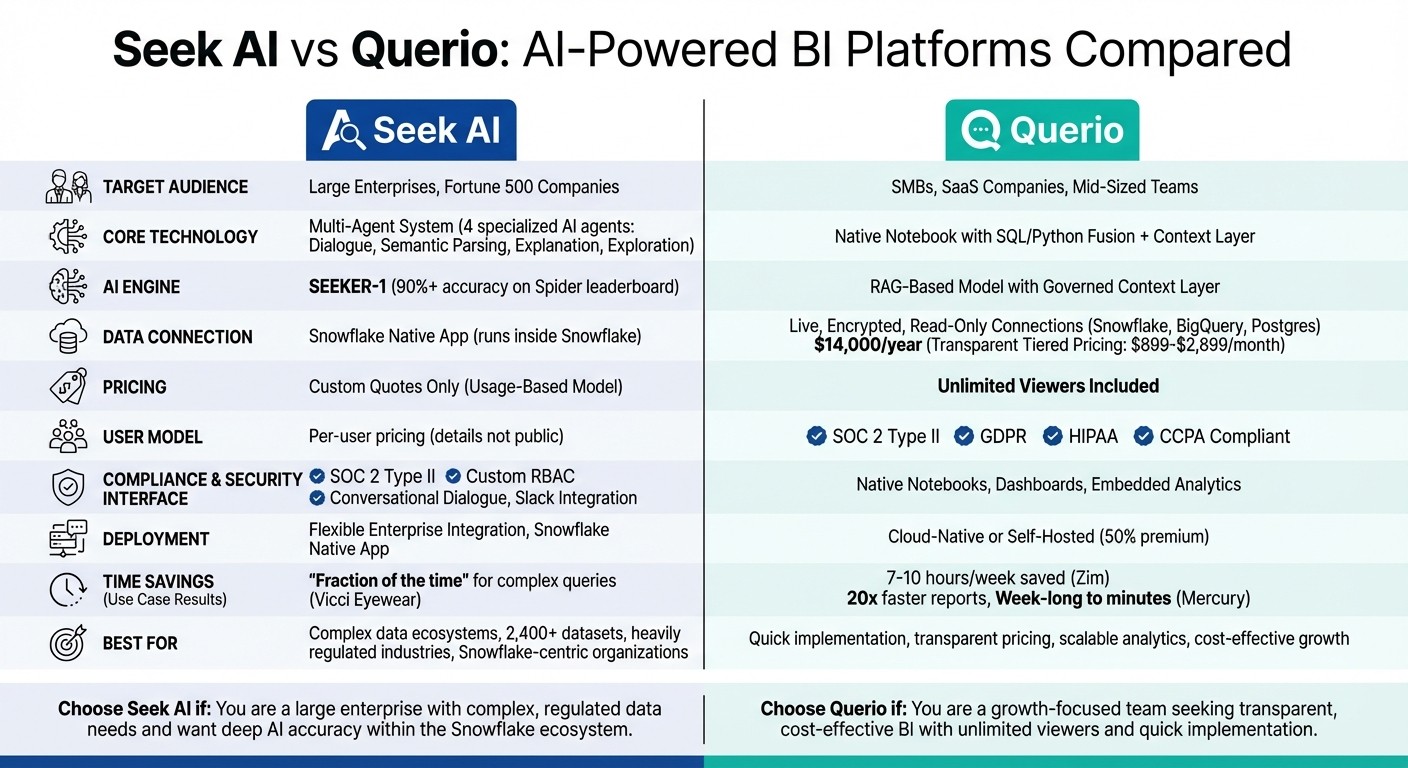
Seek AI vs Querio: Complete Feature and Pricing Comparison
Building an AI Assistant for BI: The Good, the Bad, and the Ugly
Platform Architecture and Core Technology
Seek AI and Querio take distinct paths in their technical architecture, which directly impacts how they deliver AI-driven analytics. Here's a closer look at how each platform approaches its core technology.
Seek AI operates using a multi-agent system powered by its proprietary SEEKER-1 natural-language-to-SQL engine. Impressively, its simplified MiniSeek model achieved over 90% accuracy on the Spider leaderboard [5]. The platform relies on four specialized AI agents to handle different tasks: the Dialogue Agent interprets user queries written in plain English, the Semantic Parsing Agent converts these queries into SQL code, the Explanation Agent translates query results into easy-to-understand summaries, and the Exploration Agent suggests follow-up questions to encourage deeper analysis [3]. Bob Muglia, former CEO of Snowflake, highlighted Seek AI's approach by stating:
"Seek applies deep learning to help companies develop and describe their unique semantic model" [2].
Querio, on the other hand, connects directly to data warehouses like Snowflake, BigQuery, or Postgres through live, encrypted, read-only connections. Instead of relying entirely on conversational agents, Querio provides a native notebook where SQL and Python work together seamlessly. Additionally, it includes a Business Logic Layer, enabling data teams to define key metrics and joins just once. This centralized "source of truth" ensures every query references consistent definitions, while still allowing technical users the freedom to write custom code when needed [4].
These architectural differences define how teams use these platforms. Seek AI focuses on autonomous code generation and conversational interfaces, making it an attractive option for non-technical users [3]. In contrast, Querio blends AI assistance with user control, offering natural language capabilities alongside full SQL and Python support. This makes it ideal for data teams that prefer to inspect, refine, or extend the AI-generated outputs [4].
Feature | Seek AI | Querio |
|---|---|---|
Core Architecture | Multi-agent system (Dialogue, Parsing, Explanation, Exploration) [3] | Native Notebook with Context Layer (SQL/Python) [4] |
Primary AI Engine | SEEKER-1 (Semantic Network) [5] | Proprietary ML/NLP engine |
Data Connection | Snowflake Native App [2] | Live, encrypted, read-only connections |
Technical Interface | Conversational Dialogue Agent [3] | Native Notebook (SQL and Python fusion) [4] |
Semantic Layer | Adaptive deep learning semantic models [2] | Centralized Business Logic Layer (Metrics/Joins) [4] |
Both platforms adhere to SOC 2 Type II standards, but Querio goes a step further by also meeting CCPA, GDPR, and HIPAA compliance requirements.
Natural Language Query Capabilities
Seek's Natural Language Query Features
Seek AI leverages its SEEKER-1 engine, built on a semantic network architecture, to process natural language queries. This system incorporates reinforcement and in-context learning to understand user intent and deliver accurate results. When a user types a question in plain English, four specialized agents step in to handle the process: they interpret the query's intent, generate SQL code, summarize the results, and suggest follow-up questions.
A major milestone for Seek AI came with its MiniSeek model, which achieved over 90% accuracy on the Spider leaderboard for exact matching evaluation - setting a new industry benchmark [5]. Sarah Nagy, Seek AI's Co-founder and CEO, highlighted the platform's dependability:
"Seek's patent-pending workflow prevents hallucinations and ensures that business teams will not get bad data" [6].
Mark Dunn, COO of Prodigy, also praised the platform's impact:
"Ad hoc questions have surged because users are not familiar with data... with the integration of Seek's NLP technology, this platform delivers" [3].
Seek AI employs advanced machine learning techniques, such as online and reinforcement learning, to continuously refine its query processing based on user behavior [2]. For added reliability, data analysts can review or modify the AI-generated SQL using a built-in editor before publishing it to the team-wide "Insights Catalog." This human-in-the-loop approach ensures data accuracy while maintaining flexibility. By comparison, Querio achieves natural language query translation through its governed Context Layer.
Querio's Natural Language Query Features
Querio transforms plain-English queries into SQL or Python using a RAG-based model supported by its governed Context Layer. This layer acts as a business glossary, where data teams define critical elements like table joins, metrics, and terminologies upfront. This ensures that terms such as "revenue" or "last quarter" align with the company’s specific business rules.
For analytics teams, Querio provides full transparency by displaying the underlying SQL or Python code along with detailed audit trails. Meanwhile, business users benefit from instant visualizations, such as charts and plain-language summaries. Querio connects directly to major data warehouses like Snowflake, BigQuery, and Postgres, ensuring that queries run on live data without duplication.
Although setting up the Context Layer requires initial effort - defining joins, metrics, and "golden queries" (pre-verified SQL templates) - this step minimizes the risk of errors in interpreting complex calculations like gross margin or customer lifetime value.
Comparison Table
Here's a breakdown of the key differences between Seek AI and Querio when it comes to natural language query capabilities:
Capability | Seek AI | Querio |
|---|---|---|
Query Translation | Semantic Parsing Agent for SQL generation | Context Layer converts English to SQL/Python |
Accuracy Mechanism | Human-in-the-loop editor & adaptive learning | Predefined joins, metrics, and business glossary |
User Guidance | Exploration Agent suggests follow-up questions | Automatic schema mapping upon connection |
Result Interpretation | Explanation Agent provides plain-language summaries | Instant visualizations (charts/tables) |
Transparency | Insights Catalog with verified code and summaries | Viewable SQL/Python code with audit trails |
Interface | Conversational dialogue, Slack integration, and web app | Dashboards, agentic notebooks, and AI-powered embedded analytics |
Data Security, Governance, and Compliance
Seek's Security and Governance Model
Seek AI integrates directly with enterprise data warehouses like Snowflake, BigQuery, Redshift, Databricks, and Azure Synapse without transferring any data. A standout feature is its Snowflake Native App, which operates entirely within the customer's Snowflake instance using Snowpark Container Services. This ensures that all application code runs securely within the customer’s environment, keeping data within the warehouse boundaries [2].
Chris Child, Senior Director of Product Management at Snowflake, highlighted this approach:
"With the Snowflake Native App Framework and its new support for Snowpark Container Services, partners like Seek AI can bring their complex applications directly to customers, running directly on their secure and governed data inside Snowflake" [2].
Seek AI also offers custom role-based access controls (RBAC) and audit logging as outlined in enterprise agreements. Following its acquisition by IBM, there’s potential for additional security features from IBM’s data governance tools [2].
In comparison, Querio employs a different but equally secure strategy.
Querio's Security and Governance Model
Querio focuses on secure and live connections to data warehouses. It uses encrypted, read-only connections to platforms like Snowflake, BigQuery, and Postgres, with SELECT-only permissions to ensure data stays within the warehouse. No data is ever copied or cached, and Querio is SOC 2 Type II compliant. Querio emphasizes its commitment to security:
"At Querio, we understand the critical importance of data security... Our commitment to safeguarding your data is at the forefront of all our operations" [8].
Querio’s governance framework is built around a centralized semantic layer, where data teams define joins, metrics, and business terms once. These definitions are consistently applied across all user interactions, ensuring uniform calculations and preventing metric drift. The platform enforces strict permissions through RBAC and Row-Level Security (RLS), filtering data based on user context and ensuring filters cannot be bypassed. Importantly, Querio processes only metadata, ensuring no row-level data is sent to large language models [7].
Comparison Table
Here’s a side-by-side look at the security features of Seek AI and Querio:
Security Feature | Seek AI | Querio |
|---|---|---|
Warehouse Integration | Native app runs inside Snowflake; connects to BigQuery, Redshift, Databricks, Azure Synapse | Read-only connections to Snowflake, BigQuery, Postgres |
Data Movement | No data leaves the warehouse (Native App model) | No data copied or cached; queries run live |
Access Control | Custom RBAC with audit logging | RBAC combined with Row-Level Security (RLS) based on user context |
Compliance | Enterprise-specific agreements; potential for enhanced security post-IBM acquisition [2] | SOC 2 Type II certified |
AI Data Handling | Secure processing within a governed Snowflake environment [2] | Metadata-only processing; no row-level data sent to LLMs [7] |
Semantic Governance | Deep learning supports unique semantic model development [2] | Centralized semantic layer enforces consistent metric definitions |
Use Cases and Ideal Customer Profiles
Seek's Use Cases and Target Audience
Seek AI is designed for enterprise-level organizations dealing with massive and intricate data ecosystems. It's particularly effective for teams managing thousands of datasets that demand advanced analytical capabilities far beyond simple queries.
For instance, Battlefy utilized Seek AI to analyze over 2,400 datasets to address customer inquiries. Tim Harrington, CEO of Battlefy, highlighted the platform's strategic value:
"Seek AI played a critical role in our company's strategy because of the edge that it gives us in accessing and analyzing our 2,400+ datasets in response to customer questions." [3]
In the retail and e-commerce sector, Seek AI shines by providing quick access to complex sales and inventory data. Vicci Eyewear leveraged Seek AI to drive its online retail growth. Charlie Vallely, CEO of Recast, emphasized the time efficiency:
"Seek enables us to query complex datasets in a fraction of the time it would take with traditional data tools." [3]
These examples demonstrate how Seek AI supports large enterprises by simplifying the management of extensive data volumes and enabling sophisticated analytics.
Querio's Use Cases and Target Audience
While Seek AI caters to large enterprises, Querio is tailored for small-to-medium-sized teams that need scalable, self-service analytics without breaking the bank. Its unlimited viewer model eliminates per-user fees, making it a cost-effective solution for growing teams.
Querio proves especially useful for departments like Marketing, RevOps, and Finance. For example, Zim automated its data exploration processes, saving 7–10 hours per week. Jennifer Leidich, Co-Founder & CEO of Mercury, shared how Querio transformed their workflow:
"What used to be a week-long process now takes minutes." [1]
Querio also excels in embedded analytics, making it a perfect fit for SaaS companies that integrate customer-facing dashboards into their products. Its agentic notebooks allow teams to drill into data details and create visualizations while ensuring accuracy through governed contexts. Enver Melih Sorkun, Co-founder & CTO of Growdash, highlighted this advantage:
"It's not just about saving time and money, it's about making data accessible." [1]
Organizations using Querio have reported generating reports and analyzing data up to 20 times faster compared to traditional methods. This increased efficiency can translate into potential annual savings of around $45,000 by reducing the need for external analysts.
Pricing and Deployment Models
Seek's Pricing and Deployment
Seek AI operates on a custom quote pricing model, with no publicly available rates. Since its acquisition by IBM, Seek AI's pricing has been integrated into IBM's broader enterprise data and AI offerings. Typically, the pricing is structured around a usage-based model, factoring in data retrieval and hosting costs. This approach aligns with the contract models favored by large enterprises.
For deployment, Seek AI offers flexible enterprise integrations designed to fit into complex IT environments. A standout feature is its deployment through a Snowflake Native App, allowing the platform to operate directly within a customer's Snowflake environment. Chris Child, Senior Director of Product Management at Snowflake, highlighted the security benefits of this approach:
"With the Snowflake Native App Framework... partners like Seek AI can bring their complex applications directly to customers, running directly on their secure and governed data inside Snowflake." [2]
This setup, often described as operating "behind the walled garden", provides enhanced security and performance for organizations heavily invested in the Snowflake ecosystem. [3] On the other hand, Querio takes a different approach with its transparent pricing and deployment options.
Querio's Pricing and Deployment
Querio stands out with its straightforward, published pricing model, offering three main subscription tiers:
Explore: $899/month (billed annually)
Growth: $1,899/month (billed annually)
Business: $2,899/month (billed annually)
The platform's entry-level price of $14,000/year includes unlimited viewer users, eliminating the need for costly per-user fees. Additional database connections are available for $4,000/year each, while dashboard features can be added for $6,000/year. For those opting for monthly billing, a 10% surcharge applies.
As a cloud-native solution, Querio connects directly to popular data warehouses like Snowflake, BigQuery, and Postgres (see why Querio is a top choice for BigQuery) using live, encrypted, read-only connections. For organizations with stringent data residency or security requirements, Querio offers a self-hosted deployment option at a 50% premium, with a minimum commitment of $60,000 in annual recurring revenue. The Business plan also includes VPC Peering to support more complex IT setups. Additionally, Querio's Startup Program provides enterprise-grade analytics at reduced rates for companies that have raised less than $3 million. [9] This pricing and deployment strategy emphasizes Querio's focus on live data connections and accessibility for analytics teams.
Comparison Table
Pricing Element | Querio | Seek AI |
|---|---|---|
Starting Price | $14,000/year | Custom quote only |
Pricing Transparency | Fully published rates | Contact for pricing |
Billing Model | Flat-rate / Tiered subscription | Usage-based (retrieval, hosting) |
User Fees | Unlimited viewers included | Not specified |
Deployment Options | Cloud-native or Self-hosted (50% premium) | Flexible enterprise integrations |
Data Connection | Live, encrypted, read-only | Flexible (unspecified) |
Target Audience | SMBs to Enterprises | Large-scale Enterprises |
Conclusion
This comparison highlights how both platforms bring their own strengths to AI-driven analytics, catering to distinct audiences with different needs. Seek AI is tailored for large enterprises, especially those deeply integrated with Snowflake. Its ability to manage thousands of datasets and meet the demands of Fortune 500 companies operating under strict regulatory environments makes it a solid choice for complex data landscapes. However, its reliance on custom quotes and lack of upfront pricing can be a hurdle for teams needing quick decisions.
On the flip side, Querio focuses on simplicity, cost predictability, and fast implementation - qualities that resonate with growing SaaS, fintech, and e-commerce companies. With pricing starting at $14,000/year, Querio offers unlimited viewer access and secure, live connections to major data warehouses, making it easier for teams to scale analytics without breaking the bank.
For organizations prioritizing governance, Querio’s semantic layer and SOC 2 Type II compliance deliver the trust and consistency essential for scaling analytics across teams. As Jennifer Leidich, Co-Founder & CEO of Mercury, shared:
"What used to be a week-long process now takes minutes." [1]
This blend of transparency, speed, and control positions Querio as a great fit for mid-market companies seeking enterprise-grade analytics without the complexity of traditional enterprise tools.
Ultimately, if your organization relies heavily on Snowflake and operates in a highly regulated environment, Seek AI’s deep integration may justify its custom pricing. But for teams aiming to quickly deliver secure, governed data access, Querio offers a more straightforward and transparent solution - meeting your analytics needs with ease and clarity.
FAQs
How do Seek AI and Querio differ in their architecture and user interface?
Querio connects directly to major data warehouses like Snowflake and BigQuery, offering live, read-only access to ensure data remains secure and up-to-date. This setup supports real-time access to a single, reliable source of truth. Its design emphasizes governed analytics, incorporating tools like knowledge tracking, data lineage, and audit trails to maintain data integrity. Meanwhile, Seek AI takes a different approach, using IBM’s AI ecosystem to integrate with complex, multi-source datasets while catering to enterprise-level scalability.
Querio’s interface is built with simplicity in mind. Users can ask questions in natural language and get visual answers instantly. It also includes searchable knowledge bases and collaboration features, making it a strong choice for self-service analytics. Seek AI, however, leans into AI-driven automation, delivering insights through recommendations and a more technical console suited for enterprise workflows.
How do Seek AI and Querio ensure data security and compliance?
Both platforms emphasize data security and compliance to cater to the needs of modern businesses. Seek AI employs standard encryption methods to safeguard data both during transit and while stored. It also offers administrators the ability to implement customizable, role-based access controls, ensuring internal policies are followed.
Querio goes further with a comprehensive compliance framework. It holds a SOC 2 Type II certification and adheres to major privacy regulations like CCPA and GDPR. The platform includes features such as detailed audit trails, live encrypted read-only connections to data warehouses, and robust security protocols like least-privilege access, strong password requirements, and mandatory multi-factor authentication. Furthermore, all services are hosted on Amazon Web Services (AWS), benefiting from AWS's SOC 3-certified infrastructure for enhanced reliability.
Which platform works best for small and medium-sized businesses?
For small and medium-sized businesses (SMBs), Querio offers a practical and budget-friendly solution. With pricing starting at $14,000 per year, businesses can plan their finances without worrying about hidden fees or custom quotes.
Querio simplifies data analysis with its natural-language query capabilities, allowing teams to access real-time insights from popular data warehouses like Snowflake and BigQuery. The best part? You don’t need a technical background to use it effectively. On top of that, Querio prioritizes security and compliance with features like SOC 2 Type II certification, CCPA/GDPR support, and detailed audit trails, giving businesses peace of mind when it comes to regulatory requirements.
By combining predictable pricing, easy-to-use analytics, and built-in security measures, Querio is a dependable choice for SMBs aiming to make quick, confident decisions based on their data.
Related Blog Posts