Business Intelligence
Julius.ai vs Querio
Compare Julius.ai and Querio: file-based, chat-driven analytics for small teams versus governed, live-warehouse analytics for enterprises.

Looking for the best AI analytics tools? Julius.ai and Querio offer two distinct approaches to data analysis, catering to different user needs. Here's a quick breakdown:
- Julius.ai: Ideal for individuals or small teams working with static files (CSV, Excel, PDFs). It uses conversational AI to clean data, generate visualizations, and perform advanced modeling without coding. Pricing starts at $20/month, making it accessible for smaller budgets.
- Querio: Tailored for enterprises, it connects directly to live data warehouses (Snowflake, BigQuery, Postgres) and translates natural language queries into SQL for real-time insights. It prioritizes governance with a centralized semantic layer and SOC 2 Type II security. It has a free plan, and Core ($2,499/month, or $25,000/yr) is designed for large-scale operations.
Quick Comparison
| Feature | Julius.ai | Querio |
|---|---|---|
| Data Type | Static files (CSV, Excel, PDFs) | Live data from warehouses |
| Query Method | Chat-based, no coding needed | Natural language to SQL |
| Governance | Limited, session-based security | Centralized semantic layer |
| Target Users | Small teams, individual analysts | Enterprises needing real-time data |
| Starting Price | $20/month per user | Free plan; Core $2,499/mo |
Key takeaway: Julius.ai is perfect for quick insights from static files, while Querio excels in enterprise environments requiring live data and strict governance. Your choice depends on your team's size, technical setup, and budget.
::: @figure 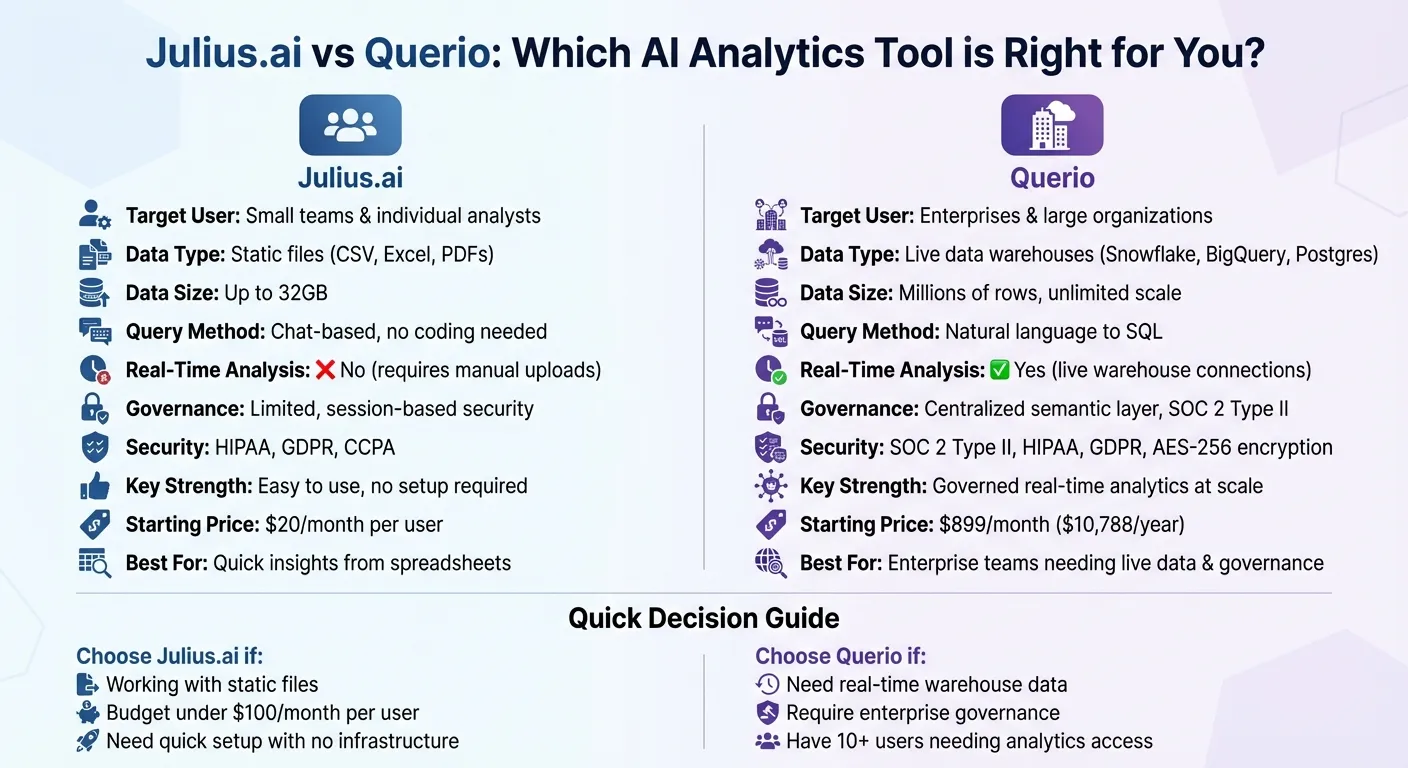 {Julius.ai vs Querio: Feature and Pricing Comparison Chart}
:::
{Julius.ai vs Querio: Feature and Pricing Comparison Chart}
:::
I Tested 53 AI Tools for Data Analysis - THESE 5 ARE THE BEST!
::: @iframe https://www.youtube.com/embed/RYTjU_x6fAQ :::
Julius.ai Features
Julius.ai stands out from standard analytics tools by being a conversational AI analytics tools. Instead of relying on complex SQL queries or Python scripts, users can simply ask questions like, "Predict customer churn from purchase history", and get instant, actionable insights. The platform takes care of all the technical heavy lifting, making advanced analytics easy to use - even for those without a technical background.
AI-Powered Analytics
The true strength of Julius.ai lies in its ability to streamline the entire analytics process. Upload a dataset, and the platform automatically cleans the data - saving analysts as much as 10 hours per week. Beyond that, it can perform advanced statistical modeling without requiring a single line of code.
Julius.ai leverages models from OpenAI, Anthropic, and Google Gemini to provide highly customized insights. This multi-model setup allows it to tackle a variety of tasks, from building predictive forecasting models to generating dynamic visualizations like heat maps and trend lines. The platform even remembers session context, including dataset structures and variable relationships, so follow-up questions feel seamless. Many users highlight its dependability and its knack for suggesting additional analytical approaches, making it a go-to tool for deriving insights from diverse data formats.
Data Connections and Integrations
Julius.ai supports a file-based integration system, accommodating uploads in popular formats such as CSV, Excel (XLSX), JSON, PDF, and Google Sheets. It also integrates with Slack, enabling teams to query data and produce reports directly within their workspace.
Governance and Security
For enterprise users, Julius.ai offers features like SSO and custom integrations to ensure robust access control and security.
Querio Features
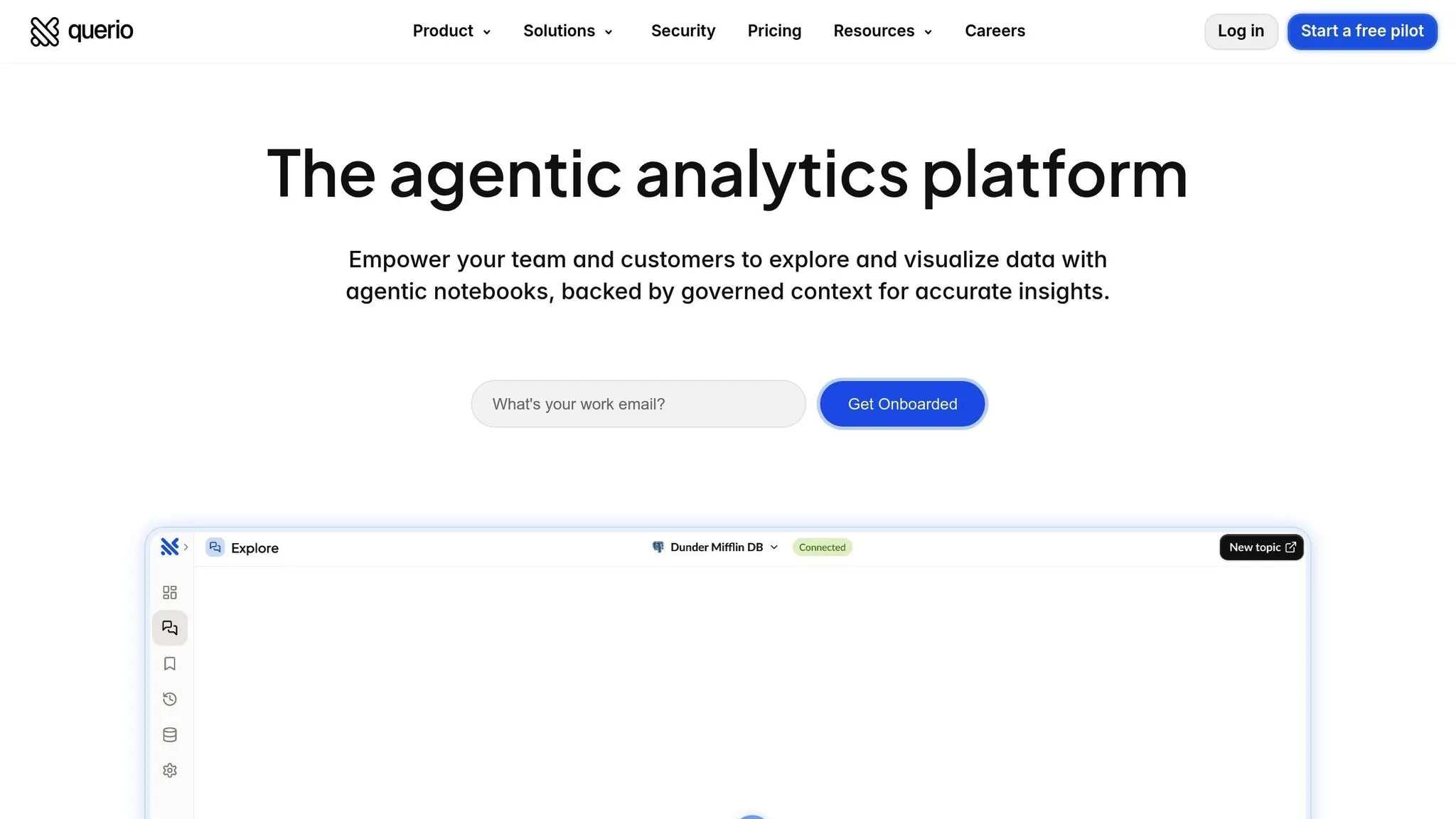
Querio is designed for governed self-service analytics, allowing analytics teams to work directly with their data warehouses - no file uploads, no duplicated data. Instead of relying on outdated snapshots, teams can query live data using plain English. A centralized semantic layer ensures accuracy and consistency, maintaining the governance standards that enterprises require.
Natural Language Analytics
Querio lets you ask questions in plain English and turns them into SQL or Python queries that run directly on your data warehouse. For example, if you ask, "What's our monthly recurring revenue by region?" the platform generates SQL queries based on your organization’s specific business logic. This means every result is traceable, auditable, and grounded in your database operations. Querio’s AI automatically maps your database, understanding how your team defines key metrics like active users, churn rate, or customer acquisition cost. By converting natural language into precise SQL and Python queries, Querio ensures data integrity with secure, real-time connections.
Live Data Connections
With direct, read-only connections to platforms like Snowflake, BigQuery, and Postgres, Querio eliminates the hassle of exporting CSVs or managing duplicate datasets. Real-time updates from your data warehouse instantly refresh queries and dashboards. The read-only setup not only protects against accidental data changes but also guarantees enterprise-level security, meeting SOC 2 Type II and GDPR standards. On top of live data access, Querio builds trust through a unified semantic layer.
Semantic Layer for Consistency
Querio’s semantic layer acts as the single source of truth for metric definitions, table joins, and business terminology. Data teams define metrics like "revenue", "active customer", or "conversion rate" once, and these definitions are applied consistently across all queries, dashboards, and reports. This ensures that everyone - from technical analysts to non-technical users - works with the same approved logic. Non-technical users can ask questions without needing SQL skills, while still benefiting from the governed calculations defined by the data team. This approach guarantees uniformity and accuracy across the organization.
Julius.ai vs Querio: Feature Comparison
Side-by-Side Feature Comparison
Let’s break down how the core design of Julius.ai and Querio impacts their performance and usability.
Julius.ai uses a file-based system where users upload data and interact via a chat interface. In contrast, Querio connects directly to live data sources like Snowflake, BigQuery, or Postgres, transforming natural language questions into SQL queries that run on your production database. This fundamental difference shapes how each platform handles data and delivers results.
For example, Julius.ai supports datasets ranging from 8 GB to 32 GB, making it ideal for analysts working with static data snapshots. Querio, on the other hand, is built for enterprise-level operations. It processes millions of rows and handles thousands of concurrent requests without duplicating data. Querio also reflects updates instantly, while Julius.ai requires manual uploads to refresh data.
| Feature | Julius.ai | Querio |
|---|---|---|
| Data Connectivity | Manual file uploads (CSV, Excel, PDF, Google Sheets) | Live connections to BigQuery, Snowflake, Postgres + 300+ sources |
| Real-Time Analysis | No - requires manual file updates | Yes - queries run on live warehouse data |
| Natural Language Querying | Chat-based Python/R code generation | Plain English to SQL translation with semantic layer |
| Governance & Consistency | Session-based security, limited governance tools | SOC 2 Type II, semantic layer for standardized metrics, role-based access control (RBAC) |
| Security Certifications | HIPAA, GDPR, CCPA compliance | SOC 2 Type II, HIPAA, CCPA, CPRA, AES-256 encryption |
| Collaboration Features | Team plan at $70/month per user | Unlimited viewer access, shared dashboards, embedded analytics |
| Pricing Starting Point | $20/month (Lite plan, 250 messages) | Free plan (500 AI credits/month, unlimited users); Core $2,499/mo |
These differences extend beyond just technical capabilities - they significantly affect user experience and operational workflows. For example, Querio’s semantic layer ensures consistent definitions for metrics like "active customer" or "monthly recurring revenue", which is crucial for organizations aiming for standardized reporting. Julius.ai, however, interprets data session by session, without a centralized business logic layer.
The pricing also reflects their distinct target audiences. Julius.ai is accessible to individuals and smaller teams, with plans ranging from $20 to $70 per month per user. Querio, designed for larger organizations with complex data needs, has a free plan, and Core is $2,499 a month (or $25,000 a year billed annually). Core includes unlimited data connections, 10,000 AI credits a month, and unlimited users, making it suitable for enterprises where multiple departments need shared, governed access to live data.
sbb-itb-284a532
Use Cases and Best Fit Scenarios
Let’s take a closer look at where each platform shines, based on the features discussed earlier.
When to Choose Julius.ai
Julius.ai is a great choice when you're working with static files and need fast insights without relying on a data engineering team. It’s designed for scenarios where your data lives in spreadsheets, PDFs, or CSVs, and you want to perform statistical modeling and forecasting without writing code.
This platform is ideal for individual analysts, startups, and small teams managing datasets up to 32GB. For instance:
- Marketing teams can quickly visualize campaign data from CSVs and identify customer segments without diving into coding.
- Financial analysts can handle budgeting and predictive modeling tasks, even with messy spreadsheets that require automated cleaning.
- Academic researchers can tap into advanced statistical tools powered by Python and R for their studies.
Simply put, Julius.ai is tailored for individuals and smaller teams with moderate data needs.
When to Choose Querio
Querio is built for enterprise analytics, especially when you need governed, real-time access to live data. Its semantic layer ensures consistent metric definitions across your organization, reducing confusion and improving collaboration.
This platform is perfect for scenarios that demand real-time monitoring and compliance. For example:
- Supply chain teams can monitor supplier performance and inventory levels as data updates in real-time.
- Executives can rely on live dashboards that reflect up-to-the-minute KPIs, eliminating the need for manual data exports.
Querio is the go-to solution for scaling analytics in large organizations. Its unlimited viewer access is particularly appealing for businesses where hundreds of non-technical users need to safely query production data without creating duplicates or introducing inconsistencies.
These examples highlight how Julius.ai and Querio cater to different user needs, ensuring the right tool for the job.
Strengths and Limitations
Platform Strengths and Weaknesses
When comparing analytics platforms, it’s clear that every tool has its advantages and downsides. Knowing where each platform shines - and where it struggles - can help you make smarter decisions for your team.
Julius.ai stands out for its ease of use. Its chat-based interface requires no setup, making it perfect for non-technical users who need quick insights from spreadsheets or PDFs. It also supports Python, R, and SQL, catering to both technical analysts and business users. However, Julius.ai has some notable drawbacks for enterprise environments. It doesn’t support live database connections, and its security features are limited to basic, session-based protections. For large teams managing datasets over 32GB or needing real-time monitoring, these limitations might be a dealbreaker.
On the other hand, Querio focuses on enterprise-level security and governance. It offers SOC 2 Type II compliance and a semantic context layer, ensuring consistent metric definitions across the organization - addressing a common pain point for analytics teams. Its live connections to BigQuery, Snowflake, and Postgres enable real-time updates, and it also offers unlimited viewer access, making it a cost-effective option for large organizations. However, Querio comes with its own challenges. It requires an existing data warehouse. Additionally, while its SQL vs. AI-driven data exploration is strong, it doesn’t yet provide the deep Python and R integration that Julius.ai offers.
Here’s a side-by-side breakdown of their strengths and limitations:
| Feature | Julius.ai Strengths | Julius.ai Weaknesses | Querio Strengths | Querio Weaknesses |
|---|---|---|---|---|
| Usability | Chat-based interface | File-based workflow | Natural language to SQL | Requires database configuration |
| Governance | Easy for small teams | Limited security; no context layer | SOC 2 Type II; semantic layer | Higher learning curve for setup |
| Flexibility | Python, R, SQL support | No live data connections | Live warehouse connections | Lacks deep Python/R integration |
| Scalability | Fast for files up to 32GB | Not built for enterprise scale | Handles millions of rows; unlimited viewers | Requires warehouse infrastructure |
| AI Capabilities | Multi-model AI; predictive modeling | Basic governance for AI outputs | Context-aware SQL generation | Less flexibility for statistical modeling |
Ultimately, the best platform for you depends on your specific needs. Julius.ai is ideal for small, agile teams working with static files, while Querio is better suited for larger organizations that require real-time, governed access to production data. Each platform plays to its strengths, but choosing the right one hinges on your team’s size, technical setup, and governance priorities.
Pricing Comparison
Cost Considerations
After exploring features and use cases, let’s dive into pricing to see how these tools fit different organizational needs. Pricing structures can have a big impact on your budget, especially as your team grows.
Julius.ai uses a per-user subscription model, starting at $20/month for the Lite plan, which includes 250 messages per month. If you need unlimited messages and 32GB of memory, the Standard plan costs $45/month per user. For premium support and direct CEO access, the Pro plan is priced at $60/month per user. Teams can opt for centralized billing at $70/month per member. While this model works well for individual analysts or small teams managing static files, costs can rise quickly as team size increases. For example, a team of 20 analysts on the Standard plan would cost $900/month (or $10,800/year), with additional fees for support or training services.
Querio, in contrast, offers plan-based pricing with unlimited users on every plan. The Free plan costs $0 and includes unlimited data connections, 500 AI credits a month, dashboards, and a shared context layer that works as a metrics or semantic layer. Core costs $2,499/month (or $25,000/year billed annually) and adds 10,000 AI credits a month, SSO, API access, SSH tunneling and VPN, unlimited automations with Slack delivery, and a guided 4-week pilot. Enterprise pricing is custom and adds single-tenant hosting, on-prem and GovCloud deployment add-ons, and a dedicated solutions engineer. AI usage past the included credits costs $0.50 a credit on Free and $0.25 on Core, and admins can set a spending cap.
For SaaS and fintech companies, analyzing costs versus benefits is key. If you’re sharing analytics with a large group - like executives, department heads, or customer success teams - Querio’s unlimited viewer model can save significant costs compared to per-seat pricing. For instance, while 5 analysts on Julius.ai’s Standard plan cost $225/month (plus fees for 30 additional viewers), Querio’s Free plan gives all 35 users access without per-seat charges, and Core at $2,499/month covers them all too. Additionally, for e-commerce businesses needing live tracking for inventory or sales, Querio’s real-time database connections are a better fit than Julius.ai’s manual file upload approach.
Julius.ai’s per-user pricing is ideal for smaller teams since costs scale directly with headcount. On the other hand, Querio’s plan-based pricing is better suited for larger organizations, eliminating per-seat fees. Pre-Series A startups can also apply to Querio’s Startup Program, a strong option for early-stage companies looking to grow.
Final Verdict: Julius.ai vs Querio
Breaking down the key differences between Julius.ai and Querio reveals how each platform caters to distinct needs and audiences.
Key Takeaways
Julius.ai is tailored for individual analysts and smaller teams working with static files. Priced at $20/month, it offers an accessible, no-code solution. However, it falls short when it comes to enterprise-level governance, live data connections, and advanced security features.
On the other hand, Querio targets mid-sized to large organizations that need real-time, governed analytics at scale. By eliminating manual uploads and ensuring data stays up-to-date, Querio provides a more seamless experience. While Julius’s per-user plans get costly for growing teams, Querio’s unlimited users on every plan make it a practical choice for larger operations.
One standout difference is governance. Querio’s semantic layer ensures consistency by standardizing business definitions - like "active user" or "revenue" - across all queries. It also meets SOC 2 Type II compliance standards and uses encrypted, read-only credentials for enhanced security. In contrast, Julius.ai relies on simpler session-based security and basic keyword matching, which limits its ability to handle complex governance needs.
These distinctions highlight why Querio is positioned as a more robust solution for organizations with advanced analytics requirements.
Why Querio Stands Out
Querio excels in areas where governance and scalability are critical. Its platform allows users to query data in plain English while data teams maintain control through a centralized context layer. This layer defines joins, metrics, and business terms once, ensuring consistency across the entire organization. By doing so, Querio helps teams avoid the common pitfalls of managing disconnected spreadsheets and one-off analyses.
The platform’s architecture is designed for reliability and growth. It generates verifiable SQL and Python outputs, making every result transparent and auditable - unlike black-box AI systems. For teams ready to move beyond spreadsheets and seeking a unified analytics solution, Querio provides the governance, security, and real-time connectivity that Julius.ai cannot offer. It’s a complete analytics workspace built to scale with your organization’s needs.
FAQs
::: faq
How does Querio handle data differently compared to Julius.ai?
Julius.ai operates using file-based uploads, supporting formats like CSV, Excel, and Google Sheets, with a maximum dataset size of 30 GB. However, it doesn't offer live database connections, which means users need to manually re-upload files whenever data changes. Its security measures are fairly basic, offering only fundamental protections.
Querio, in contrast, is built for live, direct connections to enterprise data warehouses like BigQuery and Snowflake. This allows for real-time data streaming into AI-powered dashboards, seamless handling of large-scale analytics, and automatic updates. It also features advanced security protocols, including SOC 2 Type II compliance and encryption. With unlimited viewer access, Querio stands out as a great choice for collaborative and well-governed analytics. :::
::: faq
How does Querio protect enterprise data and ensure compliance?
Querio takes enterprise data protection seriously, implementing a strong security and governance framework that aligns with top industry standards. The platform holds a SOC 2 Type II certification, confirming that its security, availability, confidentiality, and privacy measures have undergone rigorous audits. Built on Amazon Web Services (AWS), Querio leverages AWS’s secure infrastructure and encryption technologies to protect data both during transmission and while stored.
To ensure consistent security, Querio conducts regular internal vulnerability assessments, employs automated monitoring systems, and enforces strict access controls. A dedicated response team is always ready to address any potential risks promptly. Moreover, Querio adheres to privacy regulations such as GDPR and CCPA, offering clear insights into data handling practices and sub-processors to build trust and maintain compliance. :::
::: faq
How do the pricing models differ for small teams and large enterprises using these platforms?
For smaller teams, Julius.ai provides a straightforward pricing model based on the number of users. Plans begin at $20 per user per month (or $16.66 per user per month with annual billing). There's also a free tier that allows up to 15 messages per month. For instance, if a team has 5 users on the Lite plan, the monthly cost would be about $100. A 10-person team on the Standard plan would spend roughly $450 per month. This setup works well for smaller groups working with limited budgets.
On the other hand, Querio focuses on larger enterprises with no per-seat pricing and unlimited users on every plan. The Free plan costs $0 and includes 500 AI credits a month, unlimited data connections, and the AI agent, notebooks, and dashboards. Core is $2,499 per month (or $25,000 a year billed annually) and adds 10,000 AI credits a month, SSO, API access, unlimited automations, and private Slack support. For organizations with specific needs like on-prem deployment or single-tenant hosting, Enterprise pricing is custom. This pricing model is tailored for companies that need advanced governance and scalability. :::