Business Intelligence
The Rise of No Code AI Data Analytics Platforms
No-code AI platforms enable nontechnical teams to get instant, accurate insights using natural language queries, unified metrics, and enterprise-grade security.

No-code AI data analytics platforms are reshaping how businesses work with data. These tools let anyone - regardless of technical skills - analyze data, ask questions in plain English, and get instant insights. By replacing complex coding with drag-and-drop interfaces and natural language processing, they give employees direct access to powerful analytics tools.
Key takeaways:
- 70% of new apps will use low-code/no-code platforms by 2025.
- The self-service analytics platforms market is set to grow from $7B to $23B by 2034.
- Companies using these platforms report 40% lower costs and faster decision-making.
- Citizen developers are expected to outnumber professional developers 4:1 by 2026.
Platforms like Querio stand out by generating inspectable SQL/Python code, ensuring transparency while remaining user-friendly. These tools simplify processes, reduce reliance on data teams, and help businesses make faster, data-driven decisions - all while maintaining strict security and governance standards.
::: @figure 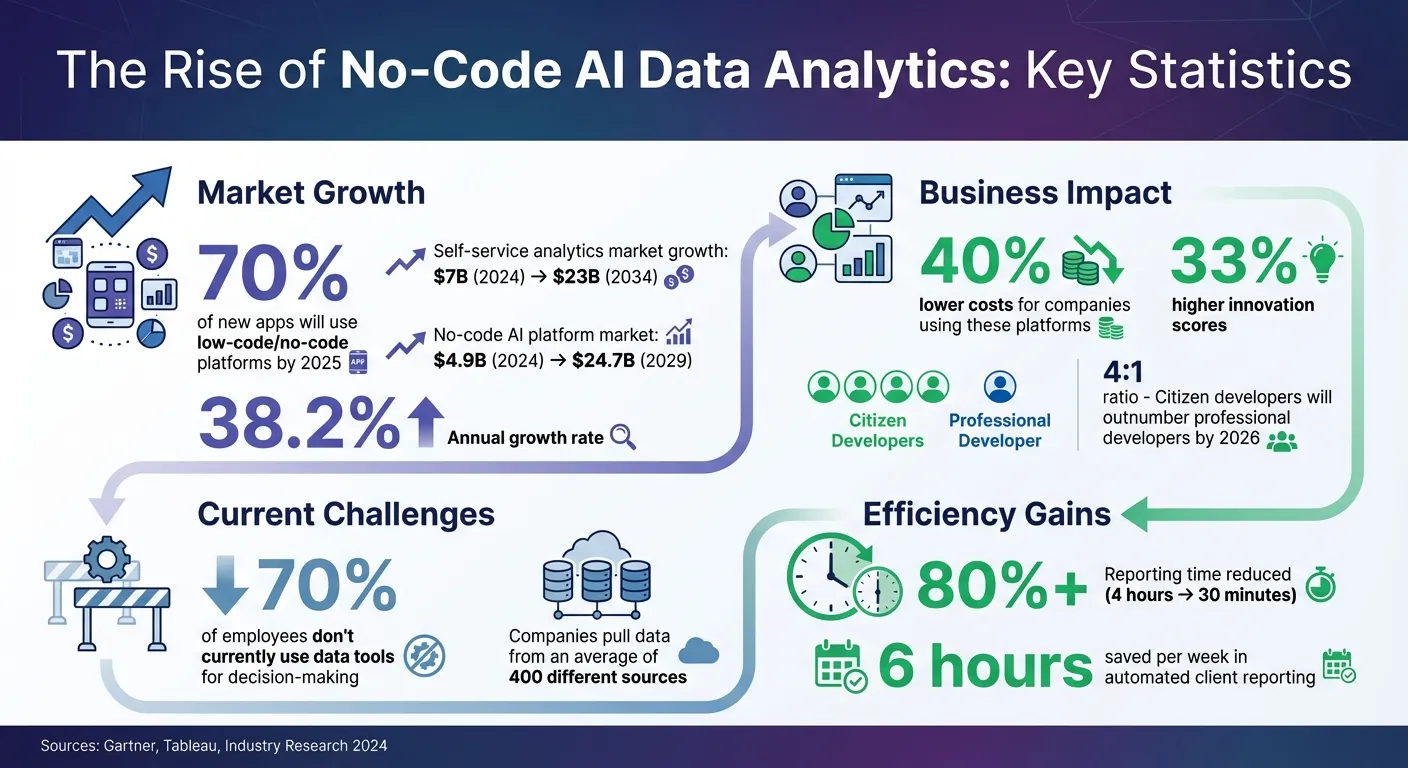 {No-Code AI Data Analytics Market Growth Statistics 2024-2034}
:::
{No-Code AI Data Analytics Market Growth Statistics 2024-2034}
:::
No-Code AI: Perform Natural Language Data Analysis with Emergence’s Platform! #shorts
::: @iframe https://www.youtube.com/embed/BqnD_3p4IBY :::
Why No-Code AI Platforms Are Growing
The surge in no-code AI platforms builds on the success of no-code analytics, reshaping how businesses handle traditional processes by introducing self-service tools powered by AI.
The Shift to Self-Serve Analytics
Gone are the days when IT teams were gatekeepers for every data request. The old model often caused frustrating delays, slowing down decision-making. Self-service analytics flips this script, giving employees direct access to the tools they need to analyze data themselves.
Currently, nearly 70% of employees don't use data tools to guide their decisions [6]. However, that's changing as companies adopt platforms that eliminate the need for coding expertise. For instance, a sales manager can now use drag-and-drop interfaces to connect directly to a data warehouse, bypassing the need for technical support. This shift doesn't just streamline processes - it creates a competitive edge.
"The performance gap between organizations who successfully use data and those that don't is poised to grow exponentially. Those who can't capitalize on their data will be left behind - perhaps faster than anticipated." – Tableau [6]
This growing accessibility to analytics sets the stage for the integration of AI, making data-driven insights even more powerful.
How AI Powers No-Code Analytics
The real game-changer isn't just the absence of coding - it's how AI takes over complex tasks that once required specialized skills. No-code platforms now handle data pre-processing, algorithm selection, feature engineering, and hyperparameter tuning [2]. These tasks, which used to take data scientists days or even weeks to complete, are now automated.
AI also simplifies user interaction through natural language processing. Instead of mastering query languages, users can use natural language interfaces to ask questions in plain English - like "What were our top-selling products last quarter?" - and get instant, easy-to-understand answers. With companies pulling data from an average of 400 different sources [5], AI becomes indispensable for breaking down silos and uncovering trends. This makes fast and reliable decision-making not just feasible but essential.
The Need for Fast and Accurate Decisions
In today’s fast-paced environment, businesses can't afford to wait for monthly reports while market conditions shift daily. Tom Thomas, Vice President of Data Strategy, Analytics & Business Intelligence at FordDirect, highlighted this need for speed:
"We test new ideas and gauge their value before scaling. DataRobot helps us deploy AI solutions to market in half the time we used to do it before." [4]
But speed alone isn't enough - accuracy is just as critical. Modern no-code platforms address this by using shared logic layers, which establish centralized definitions for key metrics. For example, if marketing and finance calculate "customer acquisition cost" differently, it can lead to conflicting data and poor decisions. By defining metrics once and applying them consistently across teams, these platforms ensure data integrity. This consistency doesn’t just improve reliability - it also boosts innovation scores by 33% [6][3].
No-code AI platforms are proving to be a powerful tool for businesses that need to act quickly and decisively while maintaining accuracy and consistency in their data.
What No-Code AI Data Analytics Platforms Do
No-code AI platforms break down technical barriers, making it possible for anyone in an organization to ask questions and get answers within seconds. These tools are the backbone of democratized business intelligence, allowing data-driven decisions to happen at every level. Their core strengths lie in three areas: natural language queries, direct data warehouse connections, and a unified semantic layer.
Natural Language Queries with Transparent Results
With natural language processing, employees can type straightforward questions like, "What were our top-performing products last month?" The platform then translates these questions into code, delivering visualizations and actionable insights. Hrvoje Smolic, Founder of Graphite Note, highlights the advantage:
"Machine learning can help answer questions like 'What is my revenue forecast?' with a level of accuracy that traditional business intelligence tools simply cannot match" [7].
This approach eliminates the need for technical expertise, making advanced analytics accessible to everyone.
Direct Connections to Data Warehouses
No-code platforms integrate directly with data warehouses like Snowflake, BigQuery, and Redshift, enabling real-time data analysis without the need for extensive ETL processes. This method - called in-place querying - ensures that insights are always based on the latest data, not outdated extracts. As a result, teams can trust that their analysis reflects the most current information available.
Unified Semantic Layer for Consistent Metrics
Consistency in metrics is just as important as real-time access to data. A semantic layer ensures that all teams are working with the same definitions for key performance indicators (KPIs) and metrics. Without this, departments may calculate figures differently, leading to confusion and misaligned decisions. The semantic layer serves as a single source of truth, eliminating discrepancies. Andrew Brust, Founder and CEO of Blue Badge Insights, explains:
"A semantic layer is not just about standardizing metrics - it's about making data truly accessible. By abstracting away the complexity of underlying data platforms, business users can interact with information in a way that's intuitive" [8].
This level of consistency allows teams to focus on taking action rather than debating definitions or reconciling conflicting reports, speeding up decision-making and reducing errors.
Querio: A Modern No-Code AI Analytics Platform
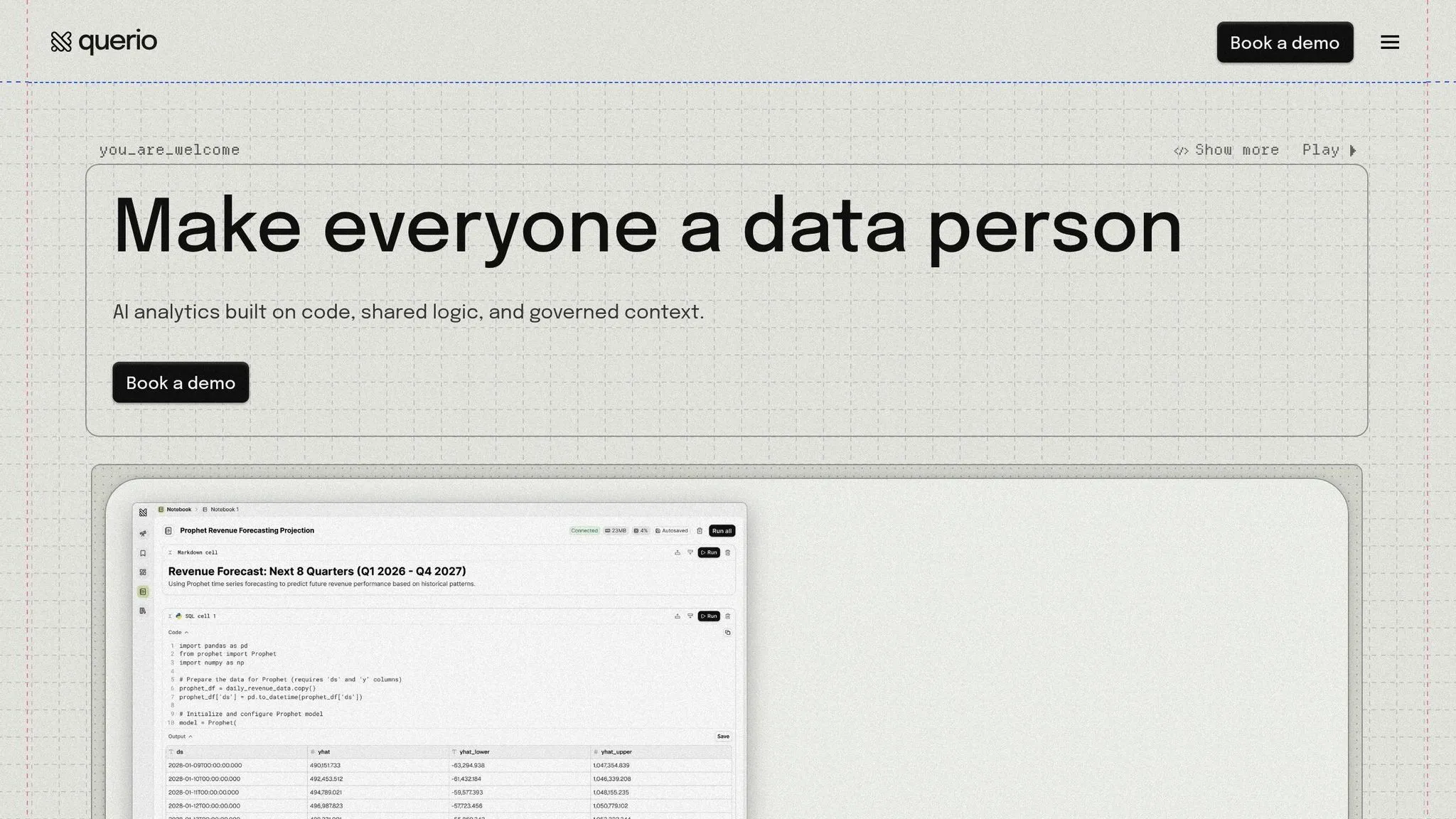
Querio takes the challenges of traditional business intelligence (BI) tools and flips the script by being built as an AI-first platform. Unlike older BI systems that added AI as an afterthought, Querio was created from the ground up to let users ask questions in plain English and get answers powered by real SQL and Python code. This design bridges the gap between simplicity for non-technical users and the transparency that data teams need. It’s a natural progression toward making data accessible to everyone.
What Sets Querio Apart
One of Querio’s most notable features is its ability to generate inspectable code. For example, when a user asks, “What were our top revenue drivers last quarter?”, Querio not only provides a clear visualization but also includes the exact SQL or Python code it used. This means technical teams can review and validate the logic, while non-technical users get quick, actionable insights. Shayna Tyler, an Analyst at Signal Theory Inc., highlighted the platform’s impact:
"Reports that used to take hours now only take about 30 minutes. We're reporting for significantly more clients, even though it is only being handled by a single person." [9]
Querio also features reactive notebooks, which allow teams to interact with live data in real time. On top of that, it offers robust security, with enterprise-grade measures like SOC 2 Type II compliance, Single Sign-On (SSO), and role-based access controls.
How Querio Stands Out from Traditional BI Tools
Querio’s features shine when compared to traditional BI platforms. Here’s a closer look at how they differ:
| Aspect | Traditional BI Tools | Querio |
|---|---|---|
| Query Method | SQL, DAX, or complex formulas | Natural language (plain English) |
| Time to Insight | Days of manual setup and analyst dependency | Instant AI-generated answers with inspectable code |
| User Accessibility | Requires technical skills (SQL/Python) | Built for users with no coding experience |
| Data Handling | Often involves data sampling or manual adjustments | Handles large datasets in real time through direct connections to data warehouses |
| Logic Consistency | Disjointed across multiple reports | Shared semantic and metrics layers ensure consistent metrics |
| Governance | Often fragmented across spreadsheets | Integrated role-based access controls and encrypted connections |
Organizations using Querio for AI-driven analytics have seen impressive improvements in efficiency. For instance, performance marketing agencies report saving up to six hours per week by automating client reporting [9]. In some cases, teams have reduced reporting time by more than 80%, turning a four-hour manual process into a streamlined 30-minute task [9].
sbb-itb-284a532
Security and Governance in No-Code Platforms
No-code platforms make data access easier for everyone, but that doesn’t mean they skimp on security. These platforms are designed to meet enterprise-level security standards while staying user-friendly. This balance is essential for organizations aiming to provide broader access to data without compromising sensitive information or running afoul of compliance rules. Strong security measures are the backbone of these platforms, enabling precise access controls and ensuring compliance.
Access Controls and Activity Tracking
With role-based security (RBAC), administrators can tailor access to match users' roles. For example, a sales manager might only see specific dashboards, while a data scientist has full query access. This approach follows the principle of minimal necessary access, ensuring employees only interact with the data relevant to their tasks.
To keep things secure, no-code platforms use automated audit trails to log every user action and query. These logs help detect unusual activity and meet regulatory requirements. Alongside this, data encryption at rest and in transit, using protocols like TLS 1.3, ensures data stays protected from unauthorized access.
Another layer of protection comes from read-only connections to data warehouses like Snowflake, BigQuery, or Postgres. This setup ensures that users can’t accidentally modify or delete source data, safeguarding the integrity of production systems.
SOC 2 Compliance and Single Sign-On
On top of access controls, SOC 2 Type II compliance offers third-party verification that a platform adheres to strict security and privacy standards. For IT and compliance teams, this means the platform has undergone independent audits and meets established industry benchmarks for protecting customer data.
Single Sign-On (SSO) integration streamlines access management by allowing employees to log in with their existing corporate credentials through protocols like SAML or OIDC. Paired with Multi-Factor Authentication (MFA), which adds an additional layer of identity verification, SSO centralizes control and makes it easy to revoke access when necessary.
Together, these features create a scalable governance framework that grows with the organization. In 2023 alone, data breaches affected over 353 million people globally, with the average cost of a breach reaching $4.45 million. For companies managing sensitive customer or financial data, these security measures aren’t just nice to have - they’re essential for protecting both the business and its stakeholders.
How No-Code Platforms Are Changing Business Intelligence
No-code platforms are reshaping the way businesses approach intelligence and data-driven decisions. Traditionally, business intelligence (BI) workflows involved lengthy processes, often requiring weeks or even months of collaboration between analysts and IT teams. Today, no-code AI platforms are flipping this script, putting real-time analytics directly into the hands of everyday business users. According to Gartner, by 2025, 70% of new applications will be created using low-code or no-code technologies [3]. This shift is fundamentally broadening access to data and empowering more people to take action.
Moving from Static Reports to Live Dashboards
In the past, BI relied heavily on static reports and scheduled data extracts. By the time these reports were delivered, the information was often outdated. Modern platforms now connect directly to live data warehouses, offering teams real-time insights. Instead of analyzing what happened last week, businesses can now monitor what’s happening right now and adjust strategies on the fly.
This evolution from reactive to proactive reporting allows teams to model outcomes and test assumptions in real time. Dashboards update automatically as new data flows in, and users can explore specifics using natural language queries - no need to master SQL or DAX syntax. Organizations embracing these platforms have seen a 33% higher innovation score compared to those lagging behind [3].
This leap forward in real-time data access isn’t just a technical upgrade - it’s driving a fundamental cultural shift in how businesses interact with data.
Giving Non-Technical Teams Access to Data
The most profound change brought by no-code platforms isn’t just in the technology - it’s in how they redefine roles within an organization. Teams that once relied on data specialists can now handle their own analytics. Marketing managers, HR leaders, and operations teams can answer their own questions without waiting for assistance from a data team.
A great example comes from eBay, where a team member without a data science background used Alteryx Machine Learning to build a model that automatically classifies the tax status of products.
"One of the people in our team who doesn't have a data science background built a model with Alteryx Machine Learning to automatically classify the tax status of products."
- Jacqui Van der Leij - Greyling, Global Head of Tax Technology, eBay [1]
This kind of democratization of analytics reduces bottlenecks and speeds up decision-making across departments. With visual interfaces and natural language processing, tools become easier to use, while automated data preparation and unified metrics ensure decisions are based on reliable, consistent information.
Conclusion
No-code AI data analytics platforms are reshaping how businesses approach intelligence and decision-making. What once required specialized technical skills is now available to anyone on the team, thanks to these user-friendly tools. The market for no-code AI platforms is on a steep growth trajectory, expected to rise from $4.9 billion in 2024 to $24.7 billion by 2029 - a staggering annual growth rate of 38.2% [10]. This rapid expansion highlights the growing demand for platforms like Querio, which exemplify the push for fast and accessible insights.
Querio stands out by addressing the long-standing challenges of traditional data workflows. Its design eliminates bottlenecks, speeds up analytics, and gives businesses a competitive edge by enabling quicker decisions. With Querio, teams can ask questions in plain English, receive answers powered by real SQL and Python, and ensure that everyone operates from consistent data definitions. This streamlined approach makes analytics not just faster but also more transparent and reliable.
As self-serve analytics becomes the norm, the importance of secure and scalable solutions grows. Companies now have the tools to expand analytics access across teams without compromising data integrity, thanks to robust security and governance measures. The future of business intelligence is all about being fast, accurate, and accessible - empowering organizations to make smarter decisions at every level.
FAQs
::: faq
How do no-code AI platforms protect data and ensure compliance with security standards?
No-code AI platforms take data security and governance seriously by incorporating features like encryption, role-based access controls, and audit trails. These tools work together to protect sensitive information, prevent unauthorized access, and ensure secure data management.
On top of that, many platforms offer governance frameworks that strike a balance between user-friendly functionality and strict compliance requirements. This allows organizations to maintain control over their data while enabling non-technical users to conduct advanced analytics. Features such as real-time monitoring and automated compliance checks help safeguard data integrity and ensure adherence to company policies.
By embedding security and governance into their design, no-code AI platforms give businesses the confidence to use their data for decision-making while staying aligned with privacy and compliance standards. :::
::: faq
What are the advantages of using natural language processing (NLP) in no-code analytics platforms?
Natural language processing (NLP) in no-code analytics platforms brings a game-changing edge, especially for those who aren't tech-savvy but need to handle large volumes of text-based data. With NLP, tasks like sentiment analysis, entity recognition, and text classification are automated, saving time and helping organizations extract actionable insights from messy, unstructured data. By allowing users to interact with data through plain language commands or even conversational interfaces, NLP makes high-level analytics more approachable and intuitive.
This technology goes a step further by turning raw text into structured, meaningful insights. Businesses can effortlessly track trends, analyze customer feedback, and keep tabs on their brand reputation. It simplifies working with complex datasets, encourages collaboration across teams, and enhances decision-making processes. In short, NLP in no-code platforms lets organizations tap into the full potential of their text data - no programming skills required - while streamlining workflows and enabling quicker, smarter decisions. :::
::: faq
How does Querio make advanced data analysis easier for both technical and non-technical users?
Querio bridges the gap between technical and non-technical users, making advanced data analysis easier and more transparent. For those without a technical background, Querio enables insights through simple English prompts. These prompts are automatically translated into SQL or Python code, eliminating the need for coding skills. This not only speeds up decision-making but also reduces dependence on technical teams.
For technical users, Querio offers fully inspectable code, giving them the ability to review, tweak, and fine-tune queries as needed. This level of transparency builds trust in the results and encourages collaboration between technical experts and non-technical team members. By combining simplicity with precision, Querio helps organizations optimize workflows and get the most out of their data. :::