Business Intelligence
BlazeSQL vs Querio.ai
Explore the differences between two leading AI-powered business intelligence tools, focusing on their unique features and target audiences.

Looking for a smarter way to analyze data? BlazeSQL and Querio.ai are AI-powered business intelligence tools designed to simplify data analysis for businesses. Both platforms allow users to query data in plain English, generate visualizations, and improve decision-making. But they differ in focus and features.
-
BlazeSQL: Focuses on speed and efficiency, cutting SQL query time by up to 85%. It integrates with popular databases like MySQL, Snowflake, and PostgreSQL, offers AI-generated dashboards, and prioritizes privacy by only accessing metadata. Pricing starts at $39/month.
-
Querio.ai: Built for collaboration, it connects directly to live data warehouses like Snowflake and BigQuery. It includes governance tools, no per-seat pricing (unlimited users on every plan), and SOC 2 compliance. It has a free plan, and Core is $2,499/month.
Quick Comparison
| Feature | BlazeSQL | Querio.ai |
|---|---|---|
| Primary Focus | SQL query speed | Collaboration & governance |
| Natural Language | Yes | Yes |
| Database Support | MySQL, Snowflake, PostgreSQL, etc. | Snowflake, BigQuery, Postgres |
| Security | Metadata-only privacy | SOC 2 compliance, encryption |
| Deployment | Cloud-only | Cloud; on-prem as an Enterprise add-on |
| Pricing | Starts at $39/month | Free plan; Core $2,499/mo |
BlazeSQL is ideal for teams needing fast query generation, while Querio.ai suits businesses prioritizing collaboration and governance. Choose based on your business needs.
BlazeSQL Overview
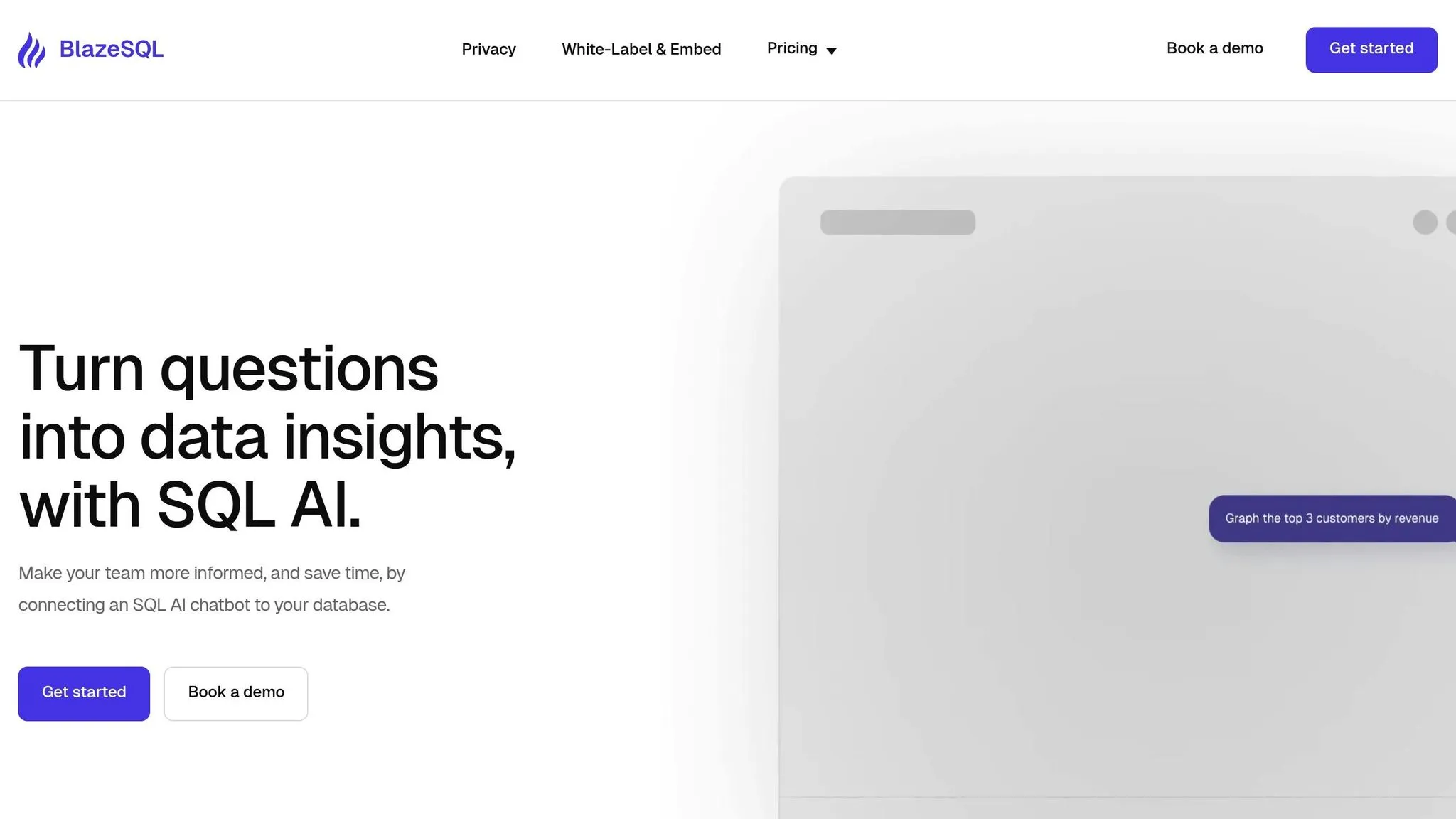
BlazeSQL is an AI-driven business intelligence platform designed to simplify data analysis. At its core is an AI Data Analyst that allows users to ask questions in plain English and receive instant, actionable insights - no SQL expertise required.
The platform has already made waves in the business intelligence world, generating over 120,000 insights to date [2]. This highlights a growing need for tools that make data analysis accessible to everyone. Let’s dive into its standout features, practical applications, and benefits tailored for U.S. businesses.
BlazeSQL Core Features
BlazeSQL is packed with features that address a wide range of business intelligence needs. Its natural language query functionality lets users ask questions in everyday language, with the AI converting these into optimized SQL queries. This can cut the time spent on writing and troubleshooting SQL by up to 85% [5].
The platform integrates seamlessly with popular databases like MySQL, BigQuery, Redshift, PostgreSQL, SQL Server, and Snowflake [1]. This compatibility means businesses can adopt BlazeSQL without overhauling their existing data systems.
BlazeSQL also offers AI-powered dashboards and visualizations that recommend the best chart or graph for the data at hand. These interactive dashboards allow users to explore trends and drill down into specific data points dynamically, making reporting and presentations a breeze [1].
When it comes to security, BlazeSQL is built with enterprise-grade safeguards. The platform only accesses metadata - like table and column names - ensuring sensitive data stays private [1]. For added peace of mind, the desktop version keeps all query results local, addressing common security concerns for U.S.-based businesses.
Automation is another strength. The platform generates weekly email reports and action blocks that can trigger emails, REST APIs, or webhooks [1]. It even integrates with Slack, where users can tag @Blaze in any channel to pull up instant insights, complete with interactive charts [1].
BlazeSQL Use Cases
BlazeSQL is built for a wide range of users, from business analysts who need quick insights to data scientists looking to streamline their workflows. Its versatility is evident in how industry leaders are leveraging it:
Brady Caspar, CTO of hoo.be, shared:
"Blaze saves our team hours of manual work each week by automating the process of writing the queries we use to analyze our business. It unlocks a new level of analysis, filling in our SQL knowledge gaps and writing complex queries that enable us to dig deeper into our data than ever before." [2]
Thibaut Nguyen, CTO of Poppy Mobility, highlighted its accessibility:
"Almost half our employees (including non-tech) use BlazeSQL now... It's incredible how anyone can now ask any question and create dashboards that took a solid BI or SQL savvy dev before." [2]
Sej Sander Thorsen, Chief Product Officer at Klarpris, emphasized its impact on decision-making:
"With BlazeSQL, we have gotten a fast-track to data-driven insights. Blaze enables us to better understand our customers and make data-driven decisions. We can quickly test a hypothesis, without involving engineering." [2]
BlazeSQL U.S. Market Features
BlazeSQL’s pricing is designed with U.S. businesses in mind. Plans start at $39 per month for the Pro version and go up to $499 per month for the Team Advanced plan, which includes three users (additional users cost $75 each) [4]. For larger organizations, custom enterprise pricing is available, ensuring flexibility for businesses of all sizes.
The platform also prioritizes U.S. regulatory compliance. Its privacy-first architecture processes data locally on user devices, keeping sensitive information secure from external threats [3]. BlazeSQL’s perfect 5.0/5 data privacy and security rating underscores its focus on meeting strict security standards [5]. Features like role-based access, data masking, and audit logging further enhance its suitability for enterprises [6].
To help businesses evaluate its capabilities, BlazeSQL offers a 14-day free trial [1]. Combined with its tiered pricing, this trial allows organizations to explore the platform and find a plan that fits their needs and budgets.
Querio.ai Overview
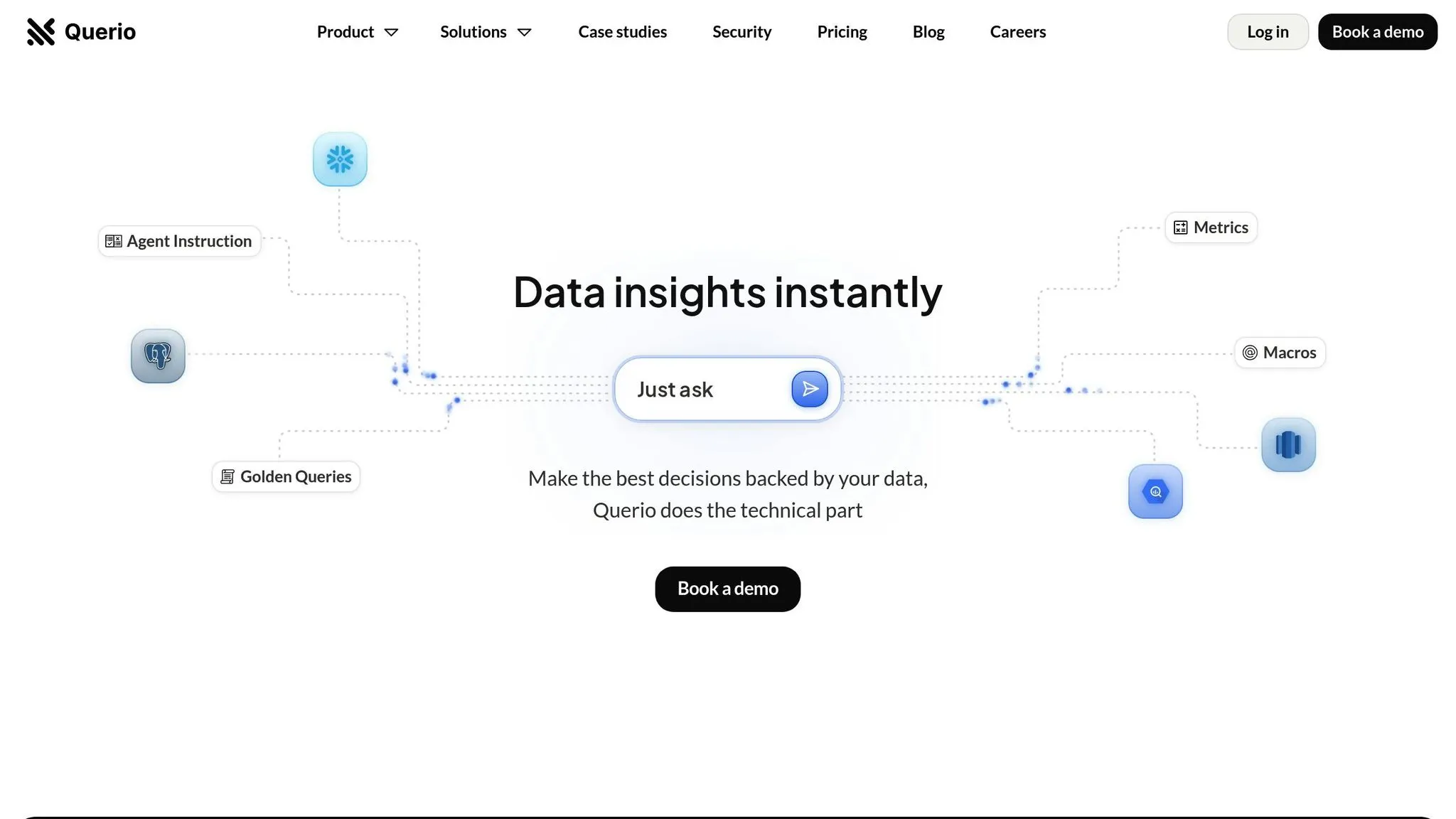
Querio.ai is a modern business intelligence workspace built with AI at its core, changing the way teams interact with data. Unlike older BI tools that often need technical know-how, Querio.ai makes it easy for anyone - from product managers to finance teams - to query live data warehouses and get clear, visual answers in seconds.
The platform directly connects to major data warehouses like Snowflake, BigQuery, and Postgres, ensuring users always have access to the most up-to-date information. This real-time connection helps organizations make decisions faster, giving them an edge in time-sensitive situations.
Jennifer Leidich, Co-Founder & CEO, highlighted the platform’s impact:
"Querio has revolutionized how we handle data. What used to be a weeks-long process now takes minutes, and our teams feel empowered to make data-driven decisions on their own. The impact on our efficiency and accuracy is unparalleled." [8]
Her company reported saving $45,000 annually by cutting down on external analyst costs and speeding up decision-making [8]. Research also shows that businesses using AI-driven BI tools can make decisions nearly five times faster than those relying on traditional methods [9].
These benefits stem from Querio.ai’s thoughtful design and advanced technical features.
Querio.ai Core Features
Querio.ai’s standout features include an AI that translates plain English questions into SQL queries. This removes the technical barriers that often prevent non-technical users from accessing valuable insights. Users simply type their questions, and the AI handles the heavy lifting in the background.
The platform’s live data connections enable real-time analytics. Unlike systems that rely on exporting data or scheduled updates, Querio.ai connects directly to warehouses with encrypted, read-only credentials, ensuring both speed and security.
Its natural language analytics and self-service dashboards allow users to create custom visualizations without writing code. Teams can quickly prototype and refine reports as their needs evolve.
A unique aspect of Querio.ai is its context layer for governance. Data teams can define table joins, business terms, and glossaries once, ensuring consistent data usage and interpretation across the organization. This also helps maintain compliance and access control.
Collaboration is another strong suit. Querio.ai promotes teamwork between business and data teams through shared dashboards and automated reports. Executives stay informed without needing extra tools or manual updates.
These features make Querio.ai a versatile tool for teams across various departments.
Querio.ai Use Cases
Querio.ai helps different roles within an organization work smarter with data. Business analysts, for example, can independently explore customer behavior, sales trends, or operational metrics without waiting for technical support.
Executives benefit from real-time dashboards that provide instant access to critical KPIs. With its natural language interface, leaders can drill down into specific areas of interest without needing a data expert to assist.
Finance teams particularly appreciate Querio.ai’s collaborative tools. They can work together on forecasts, revenue analysis, and financial reports, using shared visualizations and live data to align on strategies. The platform’s robust governance features ensure financial data stays secure and compliant with company policies.
Querio.ai also encourages widespread adoption by having no per-seat pricing. Teams can share insights freely without worrying about per-user licensing fees, fostering a data-driven mindset across the company.
Querio.ai U.S. Market Benefits
Querio.ai is tailored for U.S. businesses, offering pricing in U.S. dollars for straightforward budgeting. Querio.ai has a free plan, and Core is $2,499 per month ($25,000 a year billed annually), with unlimited users, unlimited data connections, dashboards and 10,000 AI credits a month.
The platform meets SOC 2 Type II compliance standards, ensuring high levels of data security and privacy - critical for U.S. companies managing sensitive information. This compliance helps businesses meet regulatory demands and build trust with stakeholders.
Querio.ai also supports U.S. formatting for dates, numbers, and currency, making it easy for domestic teams to use. With a 99.9% uptime SLA, the platform ensures reliable access to its features.
For businesses needing more control, Querio.ai offers on-prem deployment as an Enterprise add-on, giving companies the flexibility to meet specific security or operational needs while still enjoying the platform's full capabilities.
BlazeSQL vs Querio.ai Feature Comparison
BlazeSQL and Querio.ai take different approaches to AI-driven business intelligence, each offering unique solutions to simplify data analysis through natural language querying. While both platforms aim to make data more accessible, their methods and strengths cater to different organizational needs. Here's a closer look at how they compare.
BlazeSQL prioritizes speed and efficiency in SQL query generation, boasting the ability to cut time spent on writing and debugging SQL queries by up to 85% [5]. It generates complex queries in seconds and operates around the clock, making it a go-to option for teams that need fast and reliable database access.
On the other hand, Querio.ai emphasizes collaboration between technical and non-technical users. Beyond just generating queries, it helps users explore the reasoning behind data trends - not just the surface-level insights [8].
Security and Privacy
The platforms also take distinct approaches to security. BlazeSQL ensures privacy by accessing only metadata, such as table and column names [1]. Querio.ai, however, meets SOC 2 Type II compliance standards and uses encrypted, read-only database credentials. Both align with U.S. regulatory requirements, but BlazeSQL’s metadata-only approach appeals to privacy-conscious teams, while Querio.ai’s compliance certifications cater to organizations with stringent security needs.
"Querio has transformed our approach to data. It's not just about saving time and money; it's about making data accessible and actionable for every team member."
– Enver, Co-founder & CTO [8]
Strengths and Deployment Options
BlazeSQL shines in scenarios where rapid SQL generation and role-based data insights are essential. Meanwhile, Querio.ai is better suited for cross-functional collaboration, offering governance tools that let data teams define business terms and table relationships for consistent use across departments. Its lack of per-seat pricing also eliminates per-user licensing concerns, encouraging broader adoption.
Both platforms support API integration, but their deployment models differ. BlazeSQL operates exclusively in the cloud, while Querio.ai offers cloud hosting plus on-prem deployment as an Enterprise add-on, catering to organizations with specific operational or security requirements.
Feature Comparison Table
| Feature | BlazeSQL | Querio.ai |
|---|---|---|
| Natural Language Querying | Yes, focuses on SQL query generation | Yes, translates natural language into commands |
| Primary Focus | SQL query generation speed | Data access simplification & collaboration |
| Security Approach | Metadata only, privacy-first | SOC 2 Type II, encrypted, read-only credentials |
| Database Support | Popular SQL databases and warehouses | Snowflake, BigQuery, Postgres |
| Collaboration Features | Supports collaborative workflows | Shared workspaces, activity tracking, no per-seat pricing |
| API Access | Yes | Yes (Core and Enterprise) |
| Deployment Options | Cloud-only | Cloud; on-prem as an Enterprise add-on |
| Pricing Model | Not specified | Free plan; Core $2,499/mo |
| User Reviews | No verified reviews available | Limited reviews (1 rating) |
| Unique Strengths | 85% reduction in SQL writing time, 24/7 availability | Governance tools, no per-seat pricing (unlimited users on every plan) |
Both BlazeSQL and Querio.ai offer powerful tools for businesses, but the choice between them ultimately depends on whether speed or collaboration is the top priority.
sbb-itb-284a532
User Workflows and Results
Common Workflows
In the U.S., teams often focus on three primary workflows: data querying, KPI dashboard creation, and automated reporting. Both BlazeSQL and Querio.ai aim to make data more accessible, empowering non-technical users to uncover insights without needing deep SQL expertise [7].
Data Querying and Analysis stands out as the most frequent use case. Users can ask questions in plain English and receive instant, data-backed results. BlazeSQL excels in connecting to SQL databases and generating complex queries in seconds, reportedly cutting SQL writing and debugging time by up to 85% [5]. Querio.ai, on the other hand, offers a native notebook that integrates SQL and Python, providing a unified BI environment [2].
KPI Dashboard Creation is the second most popular workflow. Both platforms simplify this process, but their methods differ. BlazeSQL offers no-code tools for data visualization and proactive insights. Querio.ai provides drag-and-drop dashboards (on every plan), making it easier for teams to build dashboards that previously required BI or SQL developers.
Automated Report Generation rounds out the core workflows. Teams can schedule regular reports for executives and stakeholders without needing extra tools. Querio.ai enhances this process with a governance layer that defines business terms and table relationships, ensuring clarity and consistency in reports.
These workflows collectively enable faster and more informed decision-making across organizations.
Decision-Making Results
Building on these workflows, both platforms significantly enhance the speed and accuracy of decision-making for U.S. businesses. BlazeSQL focuses on improving technical efficiency, freeing up technical staff to concentrate on strategic initiatives rather than ad-hoc data requests [2]. Querio.ai positions itself as a personal data analyst, assisting with everything from answering queries to creating data frameworks and dashboards [10].
Speed improvements are one of the most notable benefits. BlazeSQL’s AI-powered engine can generate complex SQL queries in seconds, leading to significant time savings for teams. Sej Sander Thorsen, Chief Product Officer at Klarpris, highlights this impact:
"With BlazeSQL, we have gotten a fast-track to data-driven insights. Blaze enables us to better understand our customers and make data driven decisions. We can quickly test a hypothesis, without involving engineering." [2][11]
Accessibility gains are another major outcome. Non-technical team members can now directly access and analyze data, reducing bottlenecks and enabling quicker hypothesis testing. Thibaut Nguyen from Poppy Mobility explains:
"Sometimes, you just need a quick answer from your data that is not so obvious to query or you need a starting point for a deeper BI analysis. That is to me the gap filled by BlazeSQL and it saves our team quite some time." [2][11]
Both platforms also prioritize data security and compliance, ensuring that U.S. standards are met while maintaining data integrity. These combined capabilities allow teams to confidently accelerate their analysis workflows without compromising on security or reliability.
Conclusion
BlazeSQL and Querio.ai both bring powerful AI-driven business intelligence to the table, but their strengths align with different organizational priorities. BlazeSQL shines with its rapid query optimization, advanced error detection, and local data processing capabilities, making it a solid choice for organizations with strict compliance requirements like HIPAA-ready data analysis or SOC 2 [12].
On the other hand, Querio.ai focuses on simplicity and accessibility. It has a free plan, Core is $2,499 per month, and every plan includes AI credits and spending caps, with no per-seat pricing (unlimited users on every plan), offering predictable costs for growing businesses. With direct integration to major data warehouses, enterprise-grade security, and a 99.9% uptime SLA, Querio.ai ensures reliability without overcomplicating the user experience.
Ultimately, the choice depends on the organization's needs. Large enterprises with intricate infrastructures may lean toward BlazeSQL for its advanced capabilities and local deployment options. Meanwhile, small to mid-sized, cloud-centric businesses will likely appreciate Querio.ai's straightforward and scalable approach.
FAQs
::: faq
How do BlazeSQL and Querio.ai differ in their focus and features?
BlazeSQL and Querio.ai each bring their own strengths to the table, tailored to different user needs.
BlazeSQL focuses on making data analysis quick and accessible. It allows users to effortlessly convert natural language into SQL queries, enhances queries with automated optimization, and provides data visualization tools. Its simplicity and offline functionality make it a great choice for those who need fast and secure insights without a steep learning curve.
Meanwhile, Querio.ai zeroes in on SQL performance. It excels at monitoring and improving query efficiency, while also integrating smoothly with business intelligence tools. This makes it a solid option for businesses aiming to refine their query management and make data-driven decisions on an ongoing basis.
Both platforms serve distinct purposes in the realm of AI-driven analytics, so the right choice depends on your specific goals and priorities. :::
::: faq
How does BlazeSQL protect sensitive data while delivering AI-powered insights?
BlazeSQL puts data privacy and security front and center. The platform employs cutting-edge security protocols to keep sensitive information safe at every step of the data analysis process. With features like encrypted data handling and strict access controls, your information stays protected from unauthorized access.
On top of that, BlazeSQL regularly updates its security measures to address new and evolving threats. This proactive approach creates a secure space for businesses to generate AI-driven insights, giving them peace of mind about the safety of their data. :::
::: faq
How does Querio.ai support team collaboration for data analysis?
Querio.ai is built to simplify team-based data analysis, making it more efficient and collaborative. With its real-time dashboard and report-sharing capabilities, it ensures everyone on the team stays updated with the most current insights. By breaking down barriers between departments, it helps teams share data effortlessly, leading to more informed and unified decision-making.
On top of that, Querio.ai integrates shared access to analytics tools, streamlining workflows and encouraging better communication around strategies driven by data. These features make it a strong choice for organizations aiming to improve teamwork and get the most out of their data. :::