

Querio vs Omni
A side-by-side look at Querio and Omni. We keep our reviews honest and fair so you can make an informed decision.
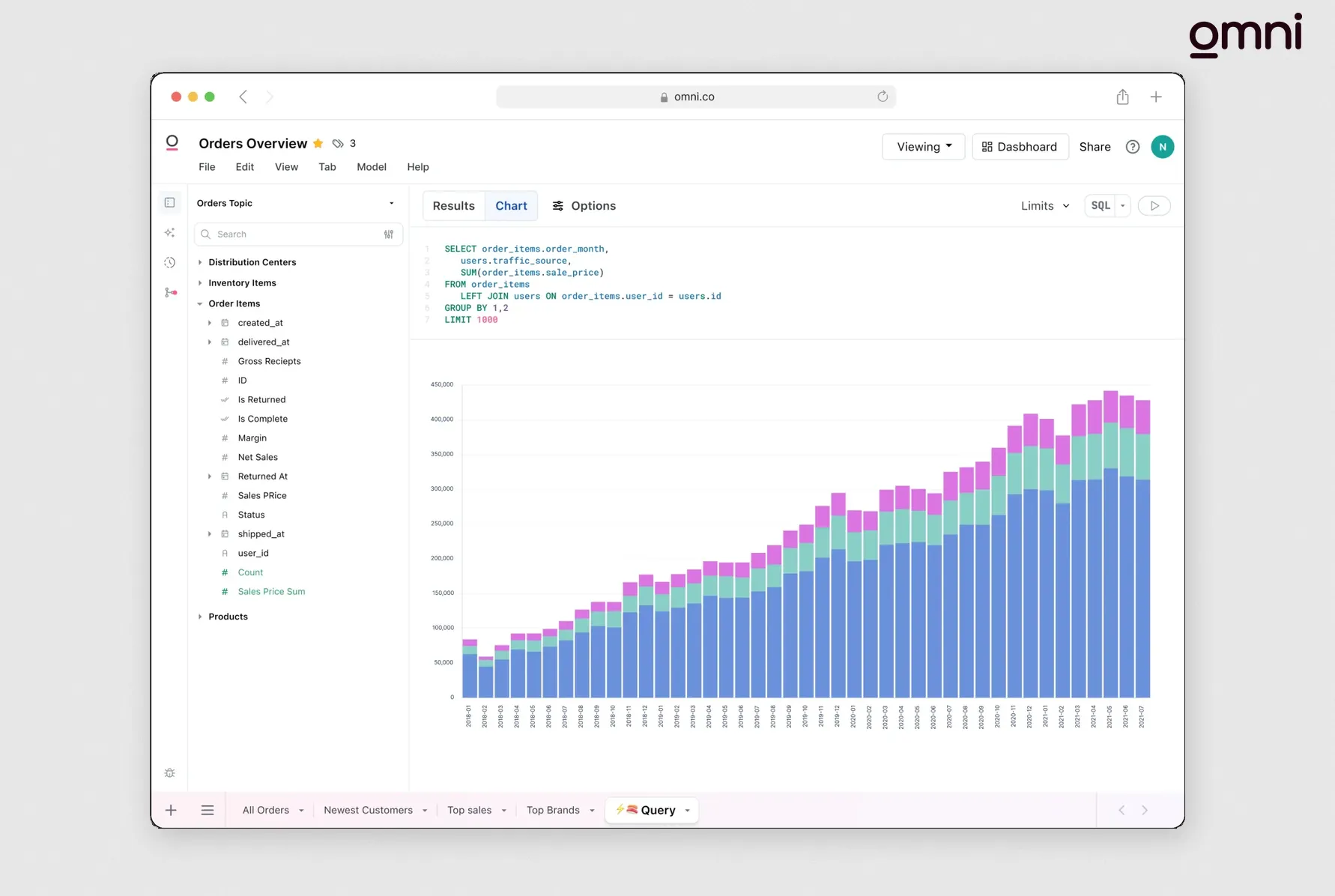
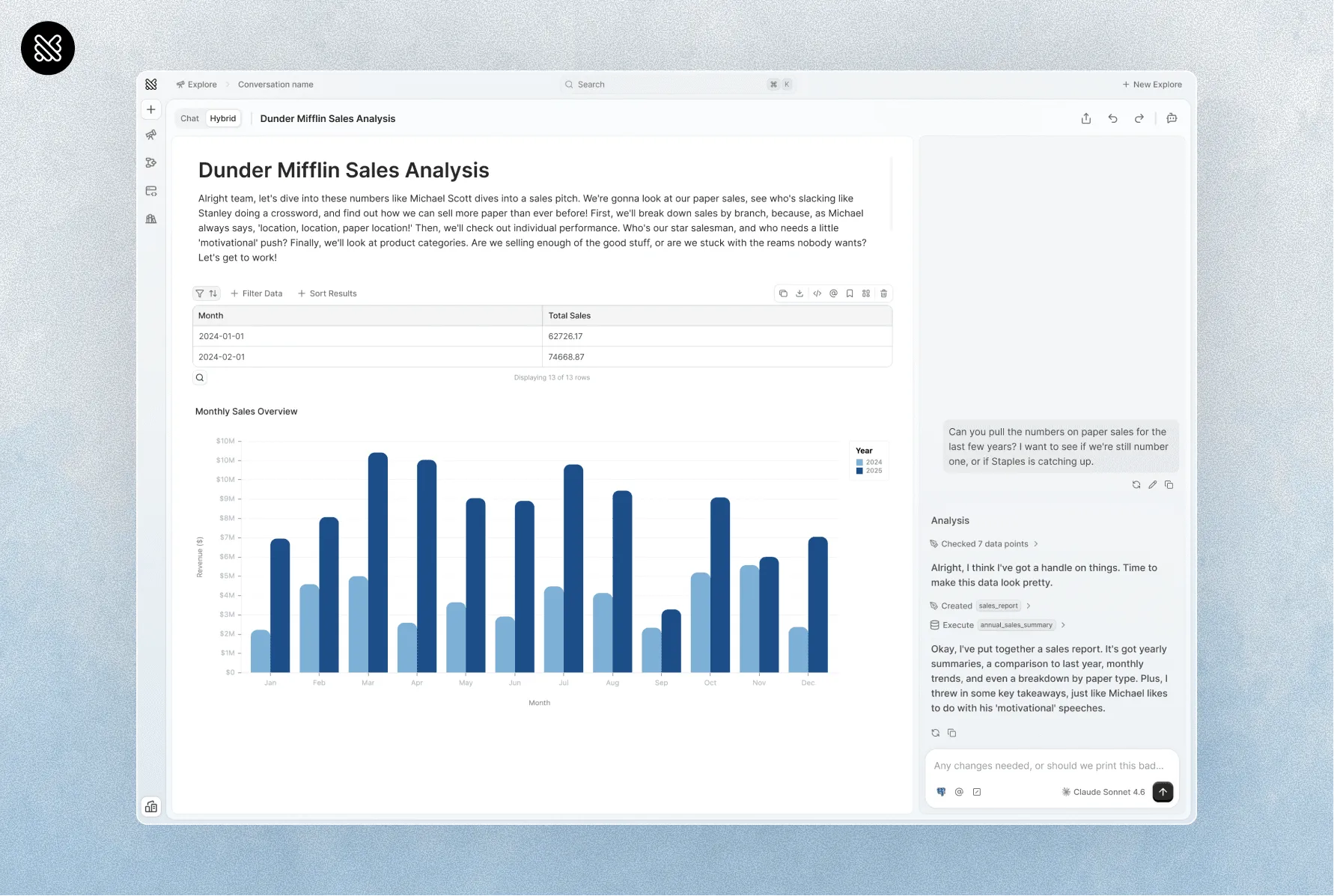
‹ QuerioDrag to compareOmni ›
Your agent asks Omni. In Querio, your agent does the work.
Connect Claude Code or Cursor to Omni's MCP server and your agent asks Omni. Either Omni's own agent answers, or a query built from Omni's model runs. Connect the same agent to Querio and it does the work itself. It writes the SQL, the Python and the definition files.
If agents are why you're looking for an Omni alternative, test that difference first. Querio's MCP server is on the Free plan.
What happens when you connect Claude or Cursor to Omni?
Omni is a BI tool built around a semantic model and a spreadsheet-style workbook, and its MCP server starts with the model. Your agent picks a model, then a topic inside it, and every query stays inside the model and runs with the signed-in user's permissions. Sign-in is OAuth 2.1 or an API key.
From there the agent has two routes. It can send the question to Omni's own agent with askOmni, which can query, build dashboards and save model edits to a branch. Or, if an admin turns on single-shot query generation (it's off by default), it can run structured queries against the model with getData and runQuery. runQuery refuses raw SQL: keys "that would cause the query to run raw SQL against the connection will be refused." Asking through the MCP server uses Omni AI credits.
To change the model by hand, you work in Omni's model IDE, its CLI or its REST API.
What can the same agent do in Querio?
Querio's MCP server lives at /mcp on your Querio app. Your agent signs in with OAuth, works with that user's existing permissions, and works directly in the workspace:
| What your agent wants to do | Omni's MCP server | Querio's MCP server |
|---|---|---|
| Answer a question | Asks Omni's agent (askOmni), or runs a structured query (getData, runQuery, off by default) |
Writes notebook cells and runs them (code_exec, sessions_execute) |
| Run its own SQL | runQuery refuses raw SQL keys |
Yes, in a notebook cell |
| Run Python | Not in the tool list | Yes, in a notebook cell |
| Find the right tables | Picks a model and a topic (pickModel, pickTopic) |
Lists live schemas and tables, fills the catalog (datasources_tables, datasources_introspect) |
| Change a definition | Omni's agent saves model edits to a branch | Writes the context file itself (files_write) |
| See what changed | Lists model branches (listBranches) |
changes_status, changes_diff |
Omni's definitions are a YAML model of topics, views, dimensions and joins, synced to a git repo per model if you turn that on. Querio's are files. Each datasource has a catalog.json and a folder of knowledge entries in SQL, Python or Markdown that define metrics, rules and business logic, each with a name, a description and a setting for whether it's always in the agent's context. Git integration comes on every plan: GitHub on Free, plus Bitbucket and GitLab on Core and Enterprise.
As our CTO Javier Bonilla put it: "The same way Claude Code doesn't call GitHub's API to write a file, it just writes one, an analytics agent shouldn't call a BI tool's API to update a metric. It should write the file."
How does each one work with dbt?
Omni reads your dbt project from its git repo, maps the metrics you defined in dbt's Semantic Layer into the Omni model, can turn an Omni query into a dbt model, and writes descriptions back to your schema.yml.
Querio leaves your models in dbt. You update them and Querio's context together, in one PR.
What do Querio and Omni cost?
Querio publishes its prices. Free is $0 with unlimited users, 500 AI credits a month, SQL and Python notebooks, dashboards, the Slack agent, the MCP server and the CLI. Core is $2,499 a month, or $25,000 a year billed annually, with 10,000 credits a month. Enterprise is custom. A credit is one AI model call. Extra credits cost $0.50 on Free and $0.25 on Core, and dashboard refreshes and automations use none.
Omni has no pricing page. omni.co sends you to a demo or a free trial. Vendr's buyer data puts the median at $27,976 a year across 37 purchases, from $23,000 to $54,079. Omni's AI credits are LLM tokens counted as credits, so the same question costs more on a more capable model, a higher thinking level or a larger data model. Past the included amount, Omni bills $1.00 a credit once overage billing is on.
Don't compare the per-credit prices. A Querio credit and an Omni credit aren't the same unit.
Who should switch from Omni to Querio?
Switch if you're a data team that wants Claude, Cursor or your own agents working in the same notebooks and files as your analysts, with the definitions in a repo you own. To read more about Omni, see Omni vs Lightdash, Omni's pricing and AI credits and the best Omni alternatives, or see how Querio compares with Hex.