What Is Data Infrastructure: Your Essential 2026 Guide
Learn what is data infrastructure, why it's crucial for growth, its components & benefits, and how to build one for your team.
https://www.youtube.com/watch?v=Am9WwybfL44
published
Outrank AI
what is data infrastructure, data infrastructure, data analytics, business intelligence, data stack
28d9e288-55fc-4316-b2af-8e09b1dc4b0f

Your startup probably already has “a lot of data.” Product events stream in from your app. Stripe has billing records. HubSpot or Salesforce has pipeline history. Support tickets live somewhere else. Marketing performance sits in ad platforms, spreadsheets, and dashboards no one fully trusts.
Yet when a product leader asks a basic question like “Which onboarding step predicts retention?” the answer still takes days. Someone files a request. An analyst interrupts planned work. Definitions get debated. A CSV appears. By then, the sprint decision has already been made.
That's the problem behind the phrase what is data infrastructure. It isn't an abstract architecture topic. It's the difference between a company that can answer operational questions quickly and one that keeps guessing. Good infrastructure turns data from scattered exhaust into a usable operating system for decisions.
The market's investment pattern shows how central this has become. The global data center infrastructure market is valued at USD 4.29 billion in 2026 and projected to reach USD 16.65 billion by 2034, with a CAGR of 18.46%, while North America held a 37.9% share in 2025, according to Fortune Business Insights on the data center infrastructure market. Companies don't pour capital into this layer because it's fashionable. They do it because the foundation determines how fast analytics, AI, and product decisions can move.
If you've been treating data infrastructure as a backend cost center, it helps to reframe it as business plumbing. When the pipes are unreliable, every team waits with a bucket. When the system is designed well, everyone gets what they need on demand. That's also why the connection between data infrastructure and analytics matters so much to startup teams trying to move faster without hiring an army of analysts.
Table of Contents
Introduction From Data Chaos to Business Clarity
A familiar pattern shows up in young companies right after growth starts working. Data volume rises before data discipline does. Product, sales, and marketing each adopt tools that solve immediate problems, but nobody designs how information should move between them.
Soon, the company has dashboards everywhere and clarity nowhere.
One product manager checks Mixpanel. Finance trusts Stripe exports. Sales swears by CRM reports. Leadership asks for “one number” in the board deck and gets three versions. This isn't because people are careless. It's because the organization has data systems, but not a coherent data infrastructure.
Practical rule: If every important metric requires a person to manually reconcile systems, you don't have self-service analytics yet. You have data heroics.
Data infrastructure is the foundational layer of tools and technology used to store, process, and manage data across structured and unstructured sources. Industry analysis also frames it as a critical missing link for successful AI adoption, especially when companies want proprietary data to connect cleanly to AI systems. In that same analysis, global data center investment topped $580 billion in 2025, described as the largest single-year deployment of digital infrastructure capital in history, and 80.9 percent of companies pursuing AI strategies had migrated from on-premises to cloud-based data platforms according to this industry analysis on AI adoption and data infrastructure.
For a new product leader, the practical takeaway is simple. Data infrastructure is not just where data sits. It's the system that decides whether your team can answer product questions in hours instead of days, whether AI projects can access trusted internal context, and whether business users stay dependent on specialists for every query.
Consider a city. Roads move people. Pipes move water. Power lines deliver electricity. A business needs the same invisible utility layer for data. Without it, teams still operate, but slowly, expensively, and with constant friction.
The Core Components of Modern Data Infrastructure
Modern data infrastructure has five jobs: bring data in, store it, shape it, govern it, and make it usable. If any one of those jobs is weak, product teams feel it fast. Questions sit in backlog. Metrics drift between teams. A founder asks for a retention cut by segment, and the answer depends on which analyst had time to patch data together.
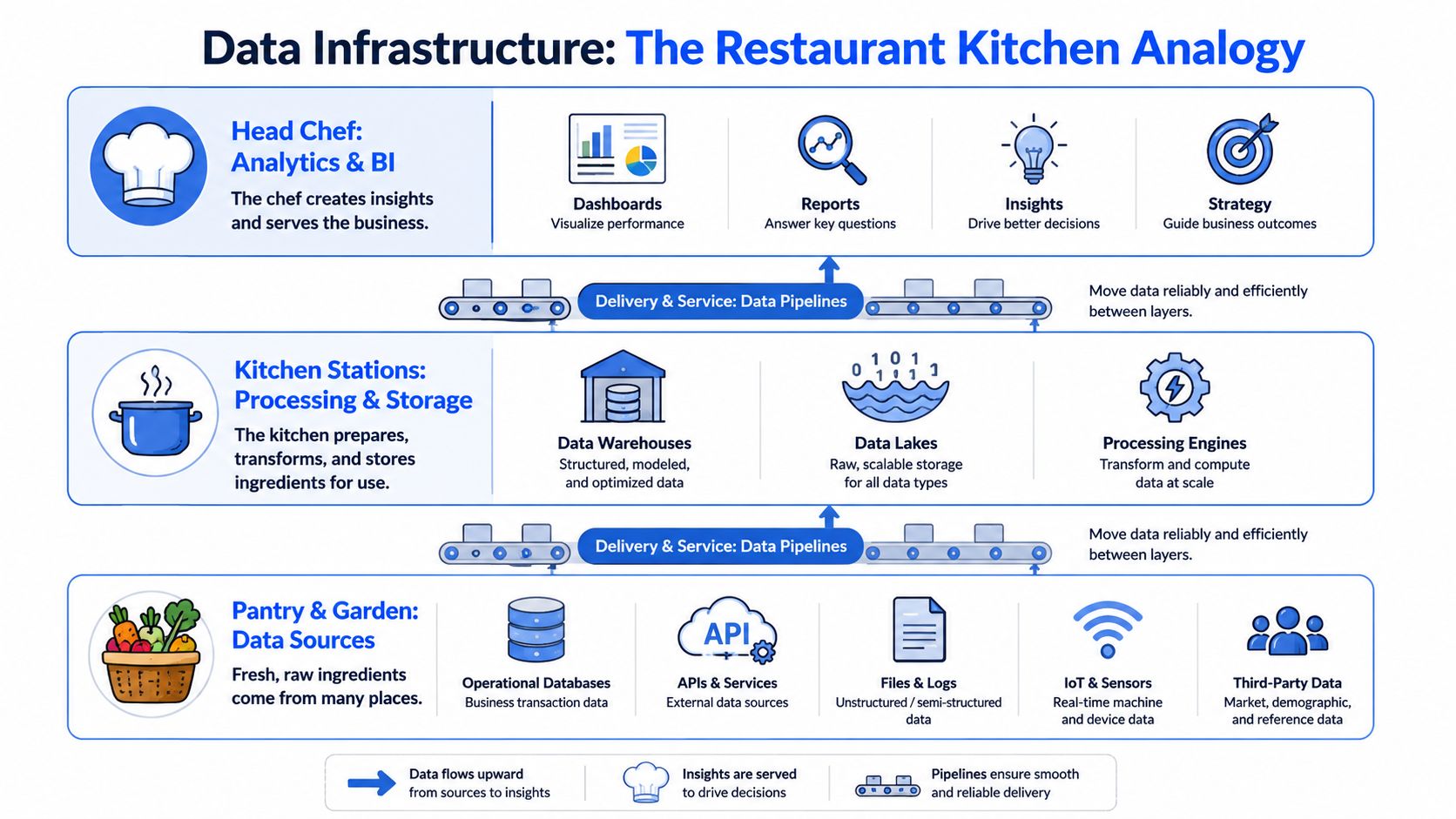
The practical point is simple. These components are not just technical layers. They determine whether a startup can give product managers and operators self-service access to trusted answers, or keep relying on a small group of specialists to translate raw data into decisions.
Ingestion collects data from the systems that run the business
Every company creates data in fragments. Product events live in one place, billing records in another, CRM activity somewhere else, and support data in yet another tool. Ingestion is the system that gathers those fragments and moves them into an environment where they can be analyzed together.
That can happen in batches, streams, or a mix of both. The choice should follow the business need. A daily sync may be enough for board reporting. It is often too slow for a growth team watching onboarding drop-off or a product team trying to spot failed checkouts before revenue slips. As described in Striim's overview of modern data infrastructure, modern setups are increasingly designed to move data across cloud, on-premises, and edge environments with very low latency.
For a product leader, ingestion answers a basic question. How long do we wait between customer behavior and business response?
Storage gives the company a shared memory
Once data arrives, it needs a place to live. That usually means a data warehouse, a data lake, or both, depending on how much raw data you want to keep and how quickly teams need query-ready information.
The business tradeoff matters more than the label. Well-structured storage makes it possible for teams to work from a shared source of truth. Poorly structured storage creates a scavenger hunt across tools, tables, and exports. Startups often feel this pain early. A metric exists somewhere, but nobody knows which version to trust.
Storage is the difference between "we have the data" and "we can use the data this afternoon."
Processing turns raw records into business definitions
Raw data rarely matches how the business thinks. Product logs track events. Billing tools track invoices. CRM systems track accounts and owners. Processing joins those pieces, cleans errors, standardizes formats, and turns source data into concepts people can act on, such as active workspace, qualified signup, expansion account, or retained user.
This layer deserves more attention from product teams than it usually gets. It is where company definitions become operational. If marketing, product, and finance each calculate conversion differently, the issue is not reporting polish. The issue is that the business logic was never consistently defined upstream.
That is also why the components of infrastructure and the tools in a stack get confused. A useful companion read is this guide to the modern data stack, which shows how these layers are often assembled in practice.
For founders thinking beyond this quarter, investors also pay attention to this layer because it affects reporting quality, AI readiness, and operating speed. If you are mapping the market or trying to find IT infrastructure investors, you will see that the systems beneath analytics matter as much as the applications built on top.
Governance keeps speed from turning into confusion
As more teams get access to data, governance becomes a scaling tool. Without it, self-service turns into self-service guesswork.
A usable governance layer usually includes:
Data quality checks that catch broken pipelines, missing fields, and malformed records before they reach dashboards
Role-based access controls that limit sensitive data to the right people
Lineage tracking that shows where a metric came from and how it changed
Metadata and shared definitions that help teams use the same language for the same business concepts
This is how autonomy becomes safe. Product managers can answer their own questions because the system already carries rules, context, and guardrails.
Access is where infrastructure becomes visible to the business
Access includes dashboards, notebooks, semantic layers, BI tools, and query interfaces. This is the part people see first, but it only works well when the earlier layers are doing their job.
A polished dashboard on top of inconsistent inputs creates fast confusion. A good access layer does the opposite. It lets teams explore governed data, answer common product and growth questions without writing complex SQL, and reuse trusted analyses instead of rebuilding reports from scratch.
For startups trying to reach self-service analytics, this final layer changes how teams work day to day. Fewer requests wait on the data team. Product squads test ideas faster. Leadership spends less time debating whose metric is right, and more time deciding what to do next.
Data Infrastructure vs Data Platform vs Data Stack
These terms get mixed together because they describe nearby parts of the same system. In planning meetings, that confusion shows up fast. A founder approves budget for a “platform,” the data team starts discussing infrastructure upgrades, and the product lead is waiting for self-service reporting that still does not exist.
The distinction matters because each term points to a different business decision. If you name the wrong problem, you usually buy the wrong solution.
A practical way to separate the terms
A city is a better comparison here than a kitchen.
Data infrastructure covers the underlying utilities. Storage, compute, networking, ingestion, orchestration, security, and governance all live here. Product teams rarely interact with these layers directly, but they feel the effect every day. Query speed, reliability, access control, and data freshness all start here.
A data platform sits one level higher. It packages infrastructure into an operating environment with rules, workflows, and managed services. That usually means teams get a clearer way to ingest data, transform it, govern it, and serve it to the business without stitching every piece together by hand.
A data stack is the actual set of products you choose. It is the collection of vendors and tools assembled to create your environment.
Here is the difference in compact form:
Concept | What it includes | Business question it answers | Example |
|---|---|---|---|
Infrastructure | Core storage, compute, networking, pipelines, security, and control layers | What foundation makes our data reliable, secure, and available? | Cloud storage, compute clusters, streaming systems, orchestration, identity controls |
Platform | Infrastructure plus managed workflows, conventions, and user-facing capabilities | How do teams work with data consistently without rebuilding the same process each time? | A managed environment for ingestion, modeling, governance, and access |
Stack | The specific tools and vendors used together | Which products did we choose to implement our approach? | Fivetran, Snowflake, dbt, Airflow, Looker |
For startups and product teams, this is more than terminology. Infrastructure affects whether data arrives correctly. Platform design affects whether people can use it without opening tickets. The stack affects cost, flexibility, and how much work your team takes on internally.
That is why two companies can both say they “have a modern data stack” and still get very different results. One has a stack that supports self-service. The other has a pile of tools with no shared definitions, uneven governance, and constant analyst dependency.
A simple rule helps. Infrastructure is the foundation. Platform is the operating model built on top of it. Stack is the list of tools used to make both real.
Storage terms often add another layer of confusion. A warehouse is one part of the system, not the whole system. If that boundary still feels blurry, this guide to database, data warehouse, and data lake differences explains where each one fits.
Teams that say “our data is in Snowflake” or “we use BigQuery” are usually naming a destination. Product leaders need more than a destination. They need a system that turns raw data into trusted answers quickly enough for roadmap, growth, and pricing decisions.
Real-World Use Cases for Startups and Product Teams
Infrastructure discussions become useful when you can feel the operational change. For product and startup teams, the payoff isn't abstract architecture quality. It's faster decisions, less waiting, and more autonomy.
Product decisions stop waiting on ticket queues
Before a solid foundation is in place, a product manager wants to know whether users who invite teammates retain better than solo users. The event data exists. Billing data exists. Account metadata exists. But they live in separate systems, and nobody has modeled the relationship cleanly.
So the PM opens a request. An analyst pulls the event log, joins it to account records, checks for duplicate IDs, writes SQL, validates edge cases, and sends a result later.
After the infrastructure is organized, the same question becomes routine. The data sources already flow into a central environment. Definitions are standardized. The PM can inspect a trusted model for account behavior, slice by cohort, and take the answer into sprint planning without waiting on a queue.
That's what speed looks like in practice. Not “more dashboards.” Fewer handoffs.
Growth teams can test and react faster
Growth work is full of timing-sensitive questions. Which acquisition channel brings users who activate? Which email campaign drives upgrade intent? Did a paywall change improve conversion quality or just increase short-term clicks?
Without a usable infrastructure layer, teams end up comparing exports from ad platforms to app events in spreadsheets. Every analysis starts from scratch. Every stakeholder argues about attribution.
With a better foundation, the inputs are already connected. Marketing data, product behavior, and revenue records can be viewed together. The growth team spends less energy gathering and more energy deciding.
A good sign you're moving in the right direction is when recurring questions stop feeling like custom projects.
Data becomes part of the product itself
The most overlooked use case is external, not internal. Once data infrastructure is stable, startups can turn analytics into customer-facing product features.
A SaaS company might embed usage dashboards for clients. A fintech product might expose transaction trends. A logistics platform might give customers operational reporting. These features only work when the underlying data is clean, timely, and governed.
Without that layer, customer-facing analytics become brittle. Support teams get dragged into metric disputes. Engineers become report maintainers. Product teams hesitate to launch data features because trust is too fragile.
Operator insight: Internal self-service and customer-facing analytics usually depend on the same discipline. If your internal teams can't trust the numbers, your customers won't either.
There's also a cultural shift. Teams stop treating analytics as a specialist output and start treating it as a shared capability. Product can iterate on behavior. Success can identify risk signals. Leadership can monitor the business without waiting for custom reporting.
For startups, that change is often more valuable than any single tool purchase. It lets a small team act larger because information moves more freely.
Choosing Your Path Implementation Patterns and Pitfalls
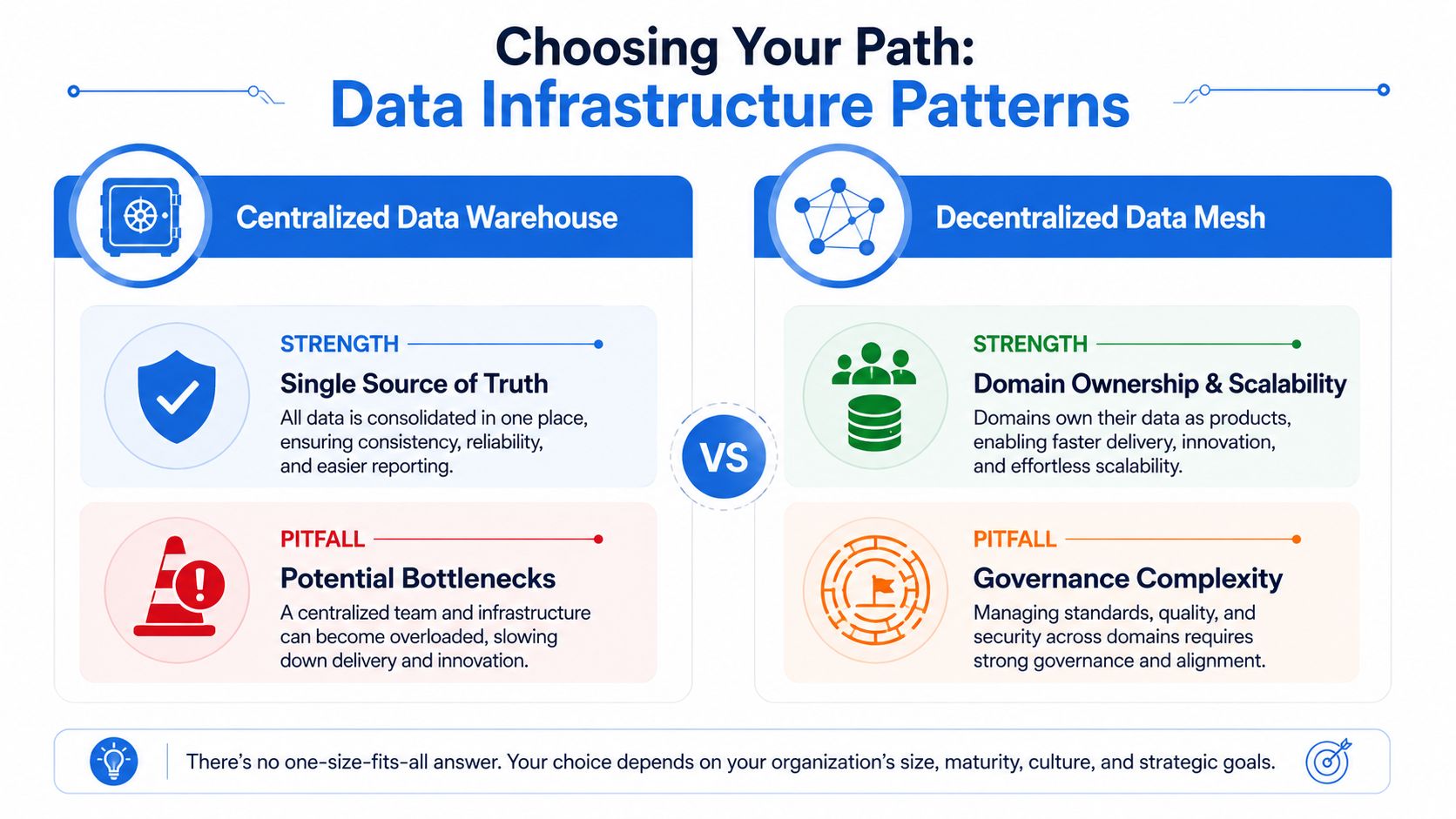
There isn't one correct way to build data infrastructure. The right pattern depends on company stage, technical depth, compliance needs, and how much flexibility you want later. Still, data infrastructure patterns generally resolve into a choice between a more centralized platform approach and a more composable approach.
The all-in-one platform route
This path appeals to teams that need speed and reduced operational burden. You adopt a platform with strong defaults around ingestion, storage, transformation, and governance. You accept opinionation in exchange for faster setup and fewer integration decisions.
This can work well when:
You need to move quickly: A small team can get to a functional system without stitching many tools together.
You have limited data engineering bandwidth: Managed workflows reduce maintenance overhead.
You value consistency: Fewer vendors often means fewer moving parts.
The downside is reduced freedom. As needs become more specialized, the platform's boundaries become more visible. Integrations, pricing models, and feature gaps can shape your roadmap more than you'd like.
The composable route
This pattern gives teams more control. You choose best-of-breed tools for ingestion, transformation, orchestration, storage, and access. It's attractive when you want flexibility or already have strong internal data capability.
The benefits are clear:
You can tailor the system: Different teams and use cases can use the tools that fit best.
You avoid putting everything in one vendor's model: That can help if your needs evolve quickly.
You can swap components over time: The system can mature in pieces rather than all at once.
The cost is complexity. Integration work doesn't disappear. Your team owns more architectural decisions, more contracts between tools, and more operational debugging.
For leaders evaluating whether to standardize on a vendor or assemble capabilities incrementally, this breakdown of buy versus build decisions for data systems is a useful planning aid.
Pitfalls that slow teams down
Most infrastructure mistakes are not technical failures. They're sequencing failures.
Common ones show up early:
Overbuilding before the business needs it: A seed-stage company doesn't need a grand architecture for hypothetical scale.
Ignoring governance until trust breaks: Teams often postpone ownership, definitions, and access controls until confusion is already expensive.
Buying based on hype: A tool that sounds advanced may solve a problem you don't have.
Optimizing for elegance over usability: If business users still need specialists for every question, the design isn't delivering the intended value.
Letting every team define metrics independently: That creates local convenience and company-wide confusion.
Choose the simplest architecture that gives your team reliable answers and room to grow. Complexity should be earned, not imagined.
Another practical distinction matters here. A centralized warehouse model can create a clean single source of truth, but it may bottleneck if one central team has to mediate every change. A more decentralized pattern can scale domain ownership, but governance becomes harder. The right answer often isn't ideological. It's operational.
The End Goal Migrating to Self-Service Analytics
The point of building data infrastructure isn't to own impressive diagrams. It's to let more people answer more questions safely, without turning the data team into a ticket desk.
That's what self-service analytics really means.
When the foundation is weak, self-service becomes an illusion. People can click around in BI tools, but they don't know which data is current, which definitions are approved, or whether they're allowed to access sensitive fields. The result is faster confusion.
A more effective model fixes that upstream. A strong data infrastructure incorporates automated data quality checks, role-based access control, and data lineage, while consolidating diverse sources through ETL/ELT into a single source of truth. That structure reduces the “human API” bottleneck and lets non-technical users query data directly while maintaining integrity, according to Domo's explanation of governed self-service data infrastructure.
Self-service needs guardrails
The phrase “self-service” sometimes sounds like “everyone does whatever they want.” In practice, the opposite is true. It works only when guardrails are strong.
The core guardrails look like this:
Quality checks: Users need confidence that broken pipelines or malformed records will be caught.
Access controls: Sensitive revenue, payroll, or customer data should be available only to the right roles.
Lineage: If someone questions a metric, they should be able to trace how it was produced.
Shared semantics: Teams need common business definitions before they need prettier dashboards.
That same pattern shows up outside core product analytics too. HR and talent teams, for example, also benefit when governed data can answer operational questions quickly. If that's relevant in your organization, this practical look at how to improve tech recruiting with analytics shows the broader value of reliable internal reporting.
A short demo helps make the end state more concrete:
When self-service works, data teams stop spending their week reproducing the same charts. They shift toward maintaining models, quality, documentation, and guardrails. That's a much healthier use of scarce expertise.
Conclusion Your First Steps and Key Metrics
If someone asks what data infrastructure is, the clearest answer is this: it's the system that makes data usable at company speed. Not just stored. Not just collected. Usable.
For startups and product teams, that changes the conversation. Infrastructure isn't a line item to minimize. It's what determines whether decisions depend on long analyst queues or whether teams can explore trusted data on their own.
A simple action checklist helps:
Audit your bottlenecks: Note where teams wait for manual joins, exports, or analyst intervention.
List your critical unanswered questions: Start with the product, revenue, and retention questions that repeatedly stall decisions.
Map your source systems: Identify where the same customer or account appears under different IDs or definitions.
Pick one pilot workflow: Choose a high-value recurring question and make it reliable end to end.
Add guardrails early: Quality checks, access rules, and lineage shouldn't wait until after trust breaks.
Track progress with a few operating metrics:
Time-to-insight
Backlog of ad hoc data requests
Adoption of self-service workflows
Consistency of key business definitions across teams
Build that layer well, and the business gets faster without adding chaos.
If your team is trying to move from analyst bottlenecks to governed self-service, Querio gives technical and non-technical users a faster way to query, analyze, and build on warehouse data without waiting in line. It's built for companies that want their data team focused on infrastructure and impact, not acting like a human API.