Guide
Text to SQL: A Complete 2026 Guide
Learn how Text to SQL converts natural language into database queries. Discover the tools and best practices in our complete 2026 guide.
A finance analyst drops a Slack message into the data channel: “Can you pull churn by brand or invoice for customers with invoices this year, excluding anything marked test?” The request sounds simple until you translate it into business definitions, tables, joins, date filters, and exceptions. Someone on the data team now has a three-table query and a long ticket competing with higher-priority work.
Text-to-SQL promises a faster path. A user writes a question in ordinary language, a language model generates SQL, and a connected warehouse returns an answer. The useful part isn't the chat box. The difficult part is deciding which data the model can see, what each business term means, whether the joins are valid, and how the system proves that the result is trustworthy.
Table of Contents
- The Question Every Data Team Eventually Hears
- How a Natural Language Question Becomes a SQL Query
- Models and Architectures Powering Text to SQL
- Prompt Strategies and Real Generated SQL Examples
- Why Benchmark Accuracy Does Not Equal Production Readiness
- Integration, Security, and Schema Awareness for Data Teams
- The Operating Model That Makes Text to SQL Actually Work
The Question Every Data Team Eventually Hears
Text-to-SQL is the practice of translating a natural-language request into executable SQL for a warehouse, lake, or relational database. A user might ask, “Which brands had the highest churn among customers invoiced this year?” The system must turn that sentence into a query that identifies the right customer records, interprets “churn,” connects invoices to brands, excludes test data, and aggregates at the intended grain.
That's a long way from autocomplete. Autocomplete predicts text from nearby text. A text-to-SQL system has to infer intent from a question and map that intent onto a database structure the user may not know.
The request hides several decisions
Take the Slack request apart:
- “Churn” might mean cancellation, a failed renewal, a customer with no recent activity, or a metric already defined in a semantic layer.
- “By brand or invoice” could refer to brand-level revenue, invoice-level status, or two separate reporting dimensions.
- “Customers with invoices this year” requires a date field and a decision about invoice status.
- “Excluding anything marked test” requires the system to find the correct test flag and apply it consistently across related tables.
A human analyst resolves these questions by consulting documentation, checking familiar models, and asking follow-up questions. A language model may make a plausible choice without telling the user that it guessed.
Practical rule: A query that executes successfully can still answer the wrong question.
The original promise of self-service BI was to let business users explore data without submitting every request to analysts. Text-to-SQL continues that effort, but it moves the bottleneck. Instead of manually writing every query, the data team must maintain the context and controls that help a model write appropriate queries.
Why the warehouse context matters
The model doesn't understand a warehouse merely because it has seen SQL before. It needs descriptions of tables and columns, relationships between entities, representative values, metric definitions, and rules about which records count. Without that context, it may invent a table, select a similarly named column, or join two datasets through a technically available but logically incorrect key.
The historical progression of the field makes this challenge clear. The Spider benchmark, released in 2018, moved evaluation beyond narrow table querying toward cross-domain database reasoning. It contains 10,181 natural-language questions, 5,693 unique complex SQL queries, and 200 relational databases spanning 138 domains, including education, government, entertainment, and clubs. The benchmark evaluates systems on schemas they haven't seen during training, and its queries include joins, nested queries, grouping, ordering, and set logic. The Spider research paper records that the strongest reported model achieved only 12.4% exact-match accuracy in the database-split setting.
That design still resembles the problem a data team faces when a warehouse changes, a new business unit is added, or a model encounters unfamiliar naming conventions. Text-to-SQL is therefore less like asking a chatbot for an answer and more like operating a translation layer between human intent and structured systems.
How a Natural Language Question Becomes a SQL Query
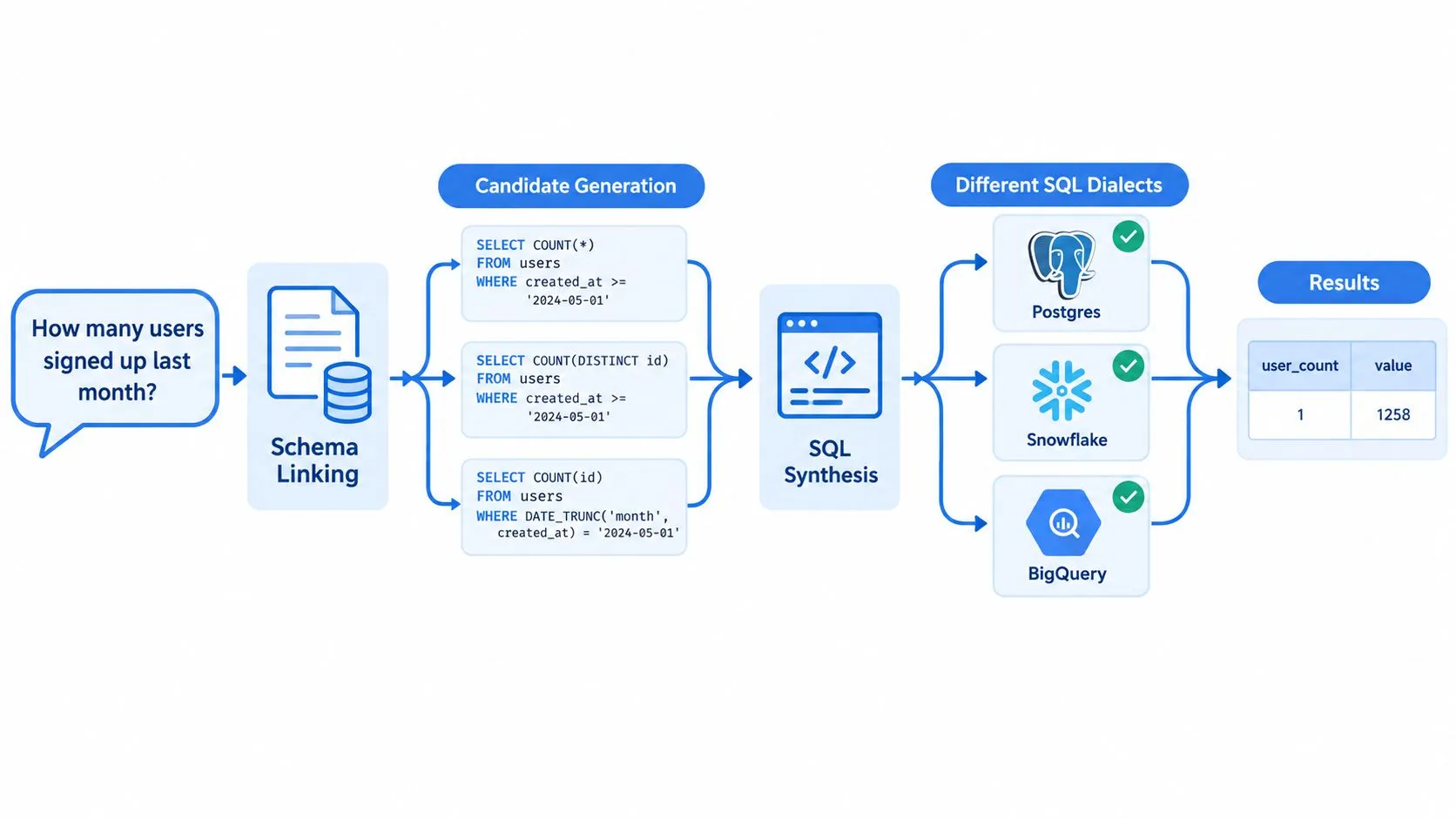
A reliable text-to-SQL workflow has several stages. The model's generation step is only one of them.
Input establishes intent
The user starts with a question such as, “How many users signed up last month?” The system first identifies the requested measure, entity, time period, and likely output shape. “How many” suggests a count. “Users” suggests an entity table. “Signed up” suggests a registration timestamp, and “last month” requires a precise calendar interpretation.
This stage fails when the request is underspecified. “Last month” may mean the previous calendar month or the trailing period. “Users” may mean registered accounts, paying customers, or active profiles. A good interface asks for clarification when the ambiguity could materially change the result.
Schema linking narrows the search
Schema linking maps language to database elements. The system might connect “signed up” to users.created_at, “users” to dim_users, and an account identifier to user_id. It then identifies relevant relationships, such as a join between a user dimension and an event table.
Database metadata makes a practical difference here. Research on text-to-SQL finds that foreign-key information improves schema mapping, while code-specialized models benefit from preprocessing that identifies relevant schema elements before generation. Research on schema linking and preprocessing supports passing table descriptions, column definitions, primary and foreign keys, and representative values instead of sending an undifferentiated warehouse schema.
A stale catalog creates stale reasoning. If a column was renamed, the model may produce a query that looks reasonable but cannot execute. If both created_at and signup_date exist, it may choose the wrong one.
Candidate generation and synthesis produce SQL
The system can generate several possible interpretations, then select or combine them into a SQL statement. It has to choose tables, columns, filters, aggregations, join paths, and syntax appropriate to the target warehouse.
Dialect matters. PostgreSQL, Snowflake, and BigQuery support overlapping SQL, but their functions, date expressions, identifier rules, and performance behavior differ. The integration must tell the model which dialect applies and should validate the result before execution. A dry run or an EXPLAIN plan can catch invalid syntax and expensive scans, but neither proves that the business meaning is correct.
For a practical overview of how meaning is parsed before SQL generation, see this guide to semantic parsing for text-to-SQL in BI.
Execution and presentation complete the loop
The platform sends the validated query to the warehouse with the user's permissions. It then returns a table, chart, or narrative summary. This final step can introduce another failure: silent truncation, hidden filters, rounding, or a summary that omits the assumptions behind the result.
The data team owns the boundaries around every stage:
- Context access: Which schemas, columns, values, and definitions can the model retrieve?
- Dialect control: Which warehouse engine and SQL rules apply?
- Validation: Must the query pass syntax, permission, cost, and semantic checks?
- Clarification: Which ambiguous terms require the user to choose a definition?
- Transparency: Can the user inspect the SQL, filters, joins, and source tables?
The model proposes a query. The surrounding infrastructure determines whether anyone should trust its result.
Models and Architectures Powering Text to SQL
Teams generally choose among three architectural patterns. The choice affects cost, flexibility, schema management, and how much engineering work sits outside the model.
Fine-tuned SQL models
A fine-tuned encoder-decoder model learns to map questions and schema representations to SQL patterns. Models trained on datasets such as Spider or BIRD can be efficient when the task resembles their training setup. They often work well with compact, carefully formatted inputs and explicit schema preprocessing.
The trade-off is rigidity. A model that performs well on known structures may struggle when a company changes naming conventions, introduces a new warehouse dialect, or adds domain-specific concepts. Fine-tuning also doesn't automatically teach the model a company's definitions of “active,” “qualified,” or “net revenue.”
General-purpose language models
A general LLM can reason across varied language and adapt to unfamiliar questions when the prompt contains useful context. The prompt might include serialized table definitions, relationship metadata, glossary entries, examples of approved queries, and instructions about the warehouse dialect.
This flexibility comes with prompt sensitivity. Too little context causes guessing. Too much irrelevant schema increases the search space and can distract the model. The system also has to manage inference cost, sensitive metadata, context limits, and changing model behavior.
Retrieval-augmented generation
A retrieval-augmented system first searches a catalog or index for relevant tables, columns, metric definitions, and sample values. It passes only that selected context to the generation model. This approach can adapt to changing warehouses without retraining the model, but retrieval quality becomes a critical dependency.
A retrieval index needs more than table names. It should rank business terms, synonyms, foreign-key relationships, certified metrics, and examples of successful questions. If a user asks for “renewals,” the index should know whether that term maps to subscriptions, invoices, contracts, or an approved metric.
| Architecture | How It Works | Schema Handling | Best Fit |
|---|---|---|---|
| Fine-tuned SQL model | Learns question-to-query patterns from structured training examples | Usually expects a defined schema format and preprocessing | Stable workloads with controlled schemas |
| Prompted general LLM | Generates SQL from instructions, schema context, and examples | Uses serialized definitions, relationships, glossary terms, and demonstrations | Broad language variation and fast experimentation |
| Retrieval-augmented generation | Retrieves relevant metadata before SQL generation | Relies on a maintained index of tables, columns, relationships, and definitions | Evolving enterprise warehouses with many domains |
The practical middle ground often combines retrieval with a general model. It takes more work than calling an API, because the data team must test retrieval, version metadata, handle permissions, and measure failures by cause.
For broader research workflows that combine natural-language investigation with source discovery, a 1chat research assistant can sit alongside, but it doesn't replace, a governed warehouse query layer. Text-to-SQL needs live schema and permission context, not only language understanding.
Architecture also changes the right prompt. A fine-tuned model may need a terse question and structured schema input. A general LLM benefits from explicit definitions and few-shot examples. A retrieval system needs clear ranking rules and a fallback when no relevant schema context is found. Teams evaluating agent patterns can also compare how AI agent architecture separates retrieval, reasoning, execution, and oversight.
Prompt Strategies and Real Generated SQL Examples
A prompt improves SQL quality when it reduces interpretation. Consider a small e-commerce schema with orders, customers, and line_items. Assume orders.customer_id joins to customers.customer_id, and line_items.order_id joins to orders.order_id.
Example one with a well-scoped request
Prompt:
Return monthly revenue by customer brand for the current calendar year. Use
orders.order_datefor the date filter,orders.status = 'paid', excludecustomers.is_test = false, and calculate revenue as the sum ofline_items.quantity * line_items.unit_price. Join on the documented foreign keys. Return month, brand, and revenue, ordered by month and revenue descending.
Generated SQL:
SELECT DATE_TRUNC('month', o.order_date) AS month, c.brand, SUM(li.quantity * li.unit_price) AS revenue FROM orders o JOIN customers c ON o.customer_id = c.customer_id JOIN line_items li ON o.order_id = li.order_id WHERE o.order_date >= DATE_TRUNC('year', CURRENT_DATE) AND o.status = 'paid' AND c.is_test = FALSE GROUP BY 1, 2 ORDER BY 1, 3 DESC;
The prompt names the grain, date field, status rule, test exclusion, revenue formula, and join keys. It doesn't guarantee correctness, but it removes several opportunities for silent guessing.
Example two with an undefined metric
Prompt:
Show active customers by brand.
Generated SQL:
SELECT c.brand, COUNT(DISTINCT c.customer_id) AS active_customers FROM customers c JOIN orders o ON c.customer_id = o.customer_id WHERE o.order_date >= CURRENT_DATE - INTERVAL '30 days' GROUP BY c.brand;
The SQL is executable, but the prompt never defined “active.” The model invented a trailing time window and an activity proxy based on orders. Another team might define an active customer as one with a paid invoice, a login, or a subscription that hasn't ended.
The repair is not “use a smarter model.” Add the definition:
Treat a customer as active when they have at least one paid order in the selected calendar quarter. Use
orders.order_date,orders.status, andcustomers.is_test. Count distinct customers bycustomers.brand.
Example three with a grain and join problem
Prompt:
Which products generated the most revenue from repeat customers in the previous calendar month? Return one row per product.
A first query may join orders, customers, and line_items, then count order rows to identify repeat customers. That can inflate results if the system applies the customer-level condition after joining to multiple line items.
A safer repair states the grain and separates the customer qualification step:
WITH repeat_customers AS (SELECT o.customer_id FROM orders o WHERE o.status = 'paid' GROUP BY o.customer_id HAVING COUNT(DISTINCT o.order_id) > 1) SELECT li.product_id, SUM(li.quantity * li.unit_price) AS revenue FROM orders o JOIN repeat_customers rc ON o.customer_id = rc.customer_id JOIN line_items li ON o.order_id = li.order_id WHERE o.status = 'paid' AND o.order_date >= DATE_TRUNC('month', CURRENT_DATE - INTERVAL '1 month') AND o.order_date < DATE_TRUNC('month', CURRENT_DATE) GROUP BY li.product_id ORDER BY revenue DESC;
| Example scenario | Prompt intent | Generated SQL outcome | Key annotation |
|---|---|---|---|
| Revenue by brand | Explicit metric and filters | Joins the three relevant tables and aggregates line-item revenue | Name the grain, fields, and exclusions |
| Active customers | Undefined business term | Produces a plausible but guessed activity window | Ask for the approved definition |
| Repeat-customer products | Multi-step qualification | Needs a separate customer-level condition | Validate grain before aggregating |
The pattern is reusable: state the business definition, identify the date boundaries, name the intended output grain, and provide the columns that carry meaning. If the system still lacks enough information, it should ask rather than fill the gap.
Why Benchmark Accuracy Does Not Equal Production Readiness
A benchmark score measures one thing: whether a system produces an acceptable query for the benchmark's own tasks and databases. Your metric definitions, permissions, warehouse dialect, soft-delete rules, and changing schemas sit outside that measurement.
The contrast between Spider and BIRD is instructive. On the controlled Spider cross-domain benchmark, reported execution accuracy rose from 53.5% in 2020 to 85.3% in 2023. BIRD contains 12,751 question-SQL pairs across 95 databases, 37 professional domains, and 33.4 GB of data. ChatGPT recorded 40.08% execution accuracy, compared with 92.96% for humans, according to the EMNLP evaluation of text-to-SQL performance.
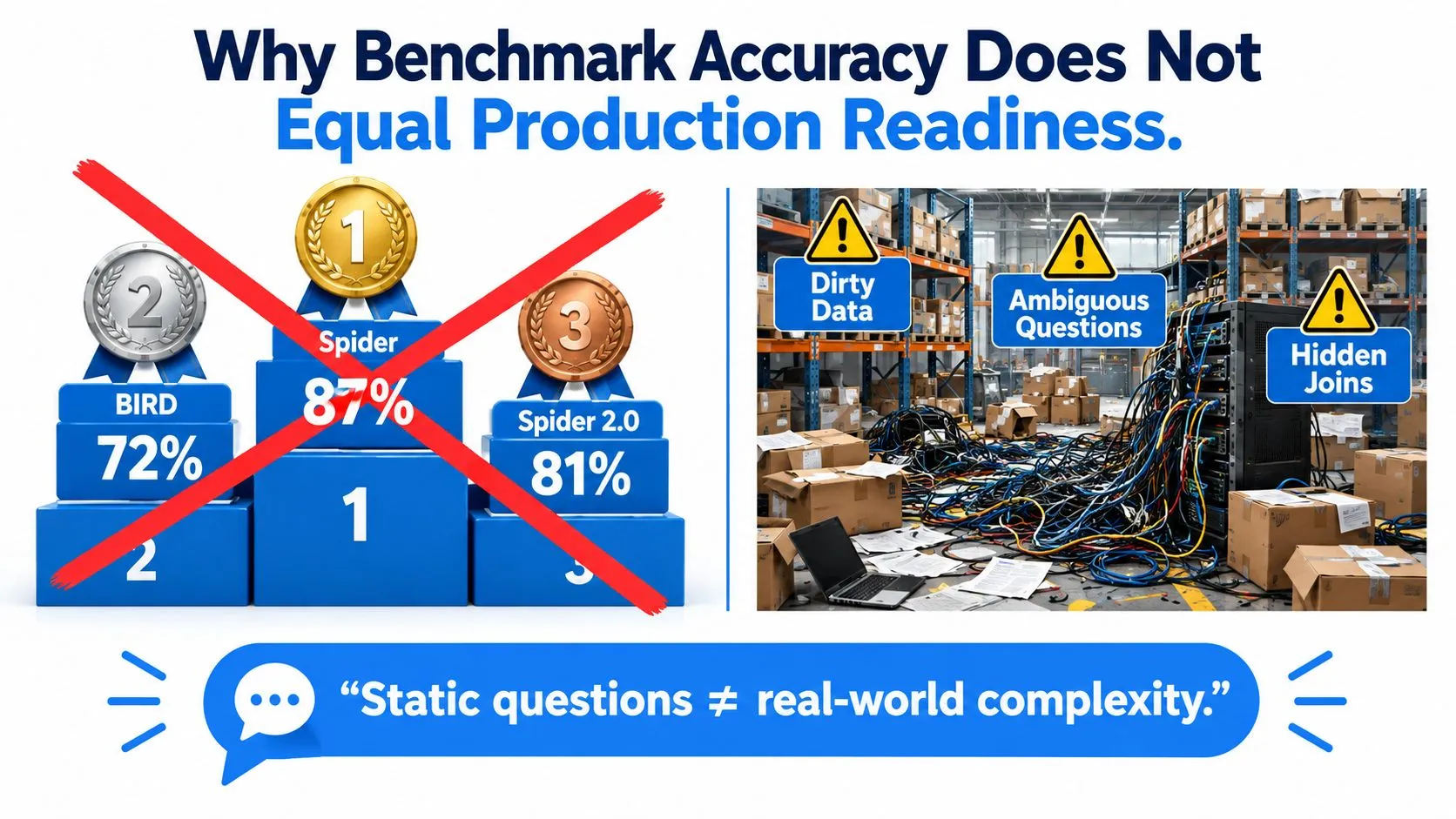
BIRD is harder because it includes larger, messier databases, domain terminology, external knowledge, ambiguous columns, execution correctness, and efficiency. A query may differ from the reference SQL while returning the right result. Clean execution can also hide a wrong join or time window.
Production readiness depends on infrastructure around the model: useful schema context, evaluation on your own data, and governance over what reaches the warehouse. A production evaluation should include the checks below. For a fuller treatment of accuracy metrics and benchmark design, see measuring text-to-SQL accuracy: metrics and benchmarks.
- Golden questions: Collect real requests reviewed by analysts and business owners.
- Result validation: Compare normalized result sets and approved metric values, not just SQL text.
- Failure labels: Separate schema retrieval, join selection, business interpretation, and execution failures.
- Safety outcomes: Measure useful refusals and clarification questions.
- Release gates: Test a held-out set before changing prompts, retrieval, models, or schema representations.
A separate 2025 benchmark study covering 146 high-complexity tasks in 11 domains found average zero-shot accuracy of 41.65% to 51.23% across several leading models, with a best reported peak of 78.08%. Prompting improved results by up to 4.78%, while domain-adaptation and interpretation errors remained, as recorded in the study record at MIT. Syntax checks still leave the executive question: is the result correct under your business definitions?
Integration, Security, and Schema Awareness for Data Teams
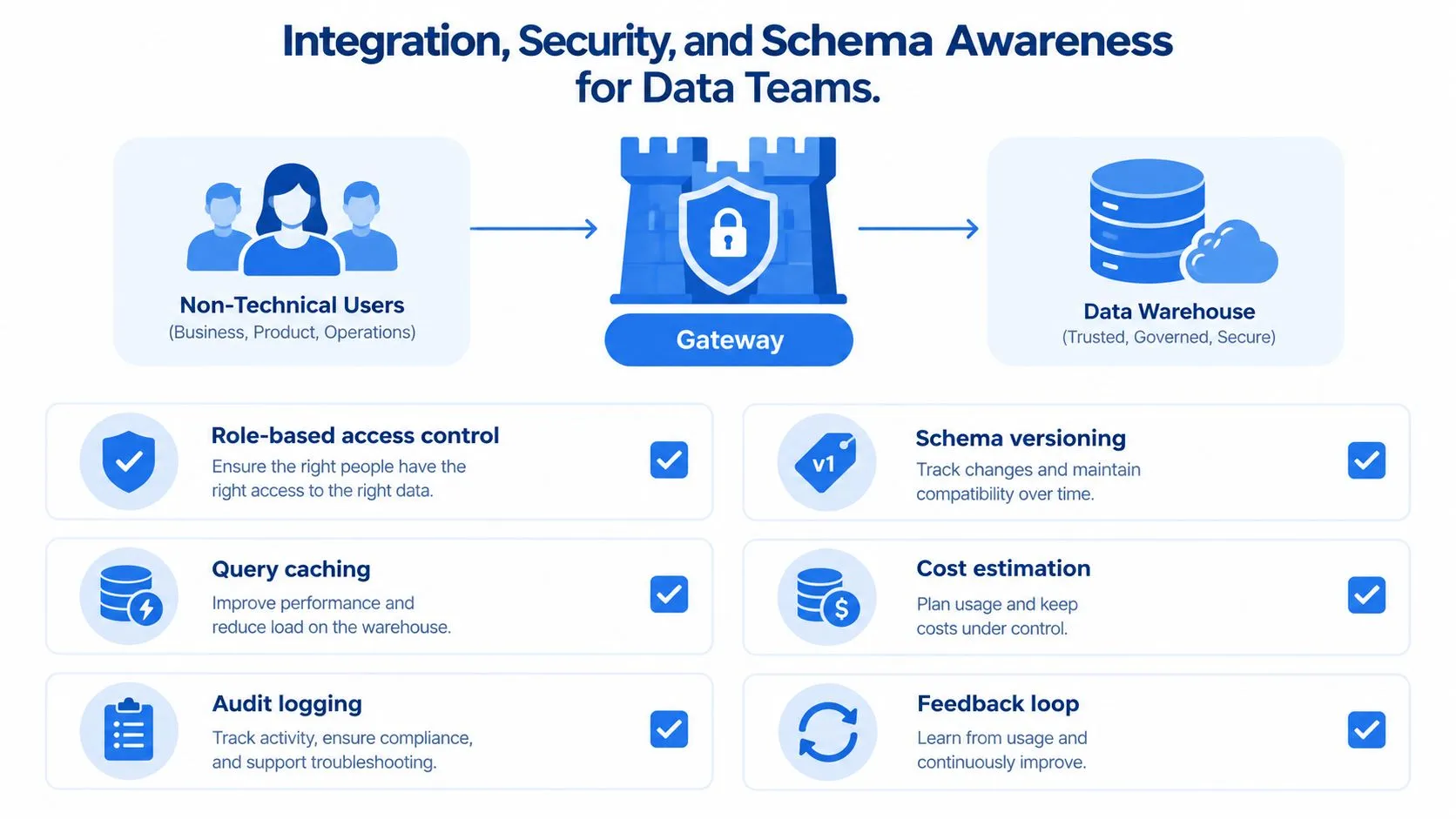
A text-to-SQL interface is a governed gateway between people and sensitive systems. Treating it as a chatbot encourages teams to focus on conversation quality while leaving permissions, metadata, and auditability behind.
Start with a curated context layer. Provide certified table and column descriptions, approved metric definitions, primary and foreign keys, representative values, and documented exclusions. Retrieval should pass only relevant context to the model, and it should remove or mask sensitive schema fragments when the requesting user isn't authorized to see them.
Integration changes the operating risk
A warehouse-native copilot can access execution metadata directly, but it still needs policy enforcement and logging. An embedded analytics surface can preserve product context, while a Slack or Teams bot may be convenient but needs especially clear identity propagation and response controls. A reverse-ETL workflow can push approved outputs into operational tools, but that turns query mistakes into downstream business actions.
Use least-privilege credentials for each user or service. Enforce row-level and cell-level policies in the warehouse or gateway, not inside the prompt. The model should never be trusted to hide records just because an instruction says to do so.
Security boundary: The model may suggest SQL. The execution layer must decide what the user is allowed to run.
Teams should log the original question, retrieved schema context, generated SQL, validation results, user identity, execution status, and returned data classification. Versioned schema snapshots make it possible to explain why a query changed after a column or metric definition changed. Semantic diffs can flag alterations to joins, filters, and calculation logic before deployment.
Operational controls also include read-only credentials, query allowlists where appropriate, cost estimation, cardinality alerts, and human review for write operations. Organizations exploring how governed data products reach users can review examples of Data as a Service as a broader integration context.
A useful implementation pattern is to separate retrieval, generation, validation, and execution into services with independent logs and permissions. Safe NL2SQL at scale describes the permission-model question directly, which is often more important than the choice of model.
The Operating Model That Makes Text to SQL Actually Work
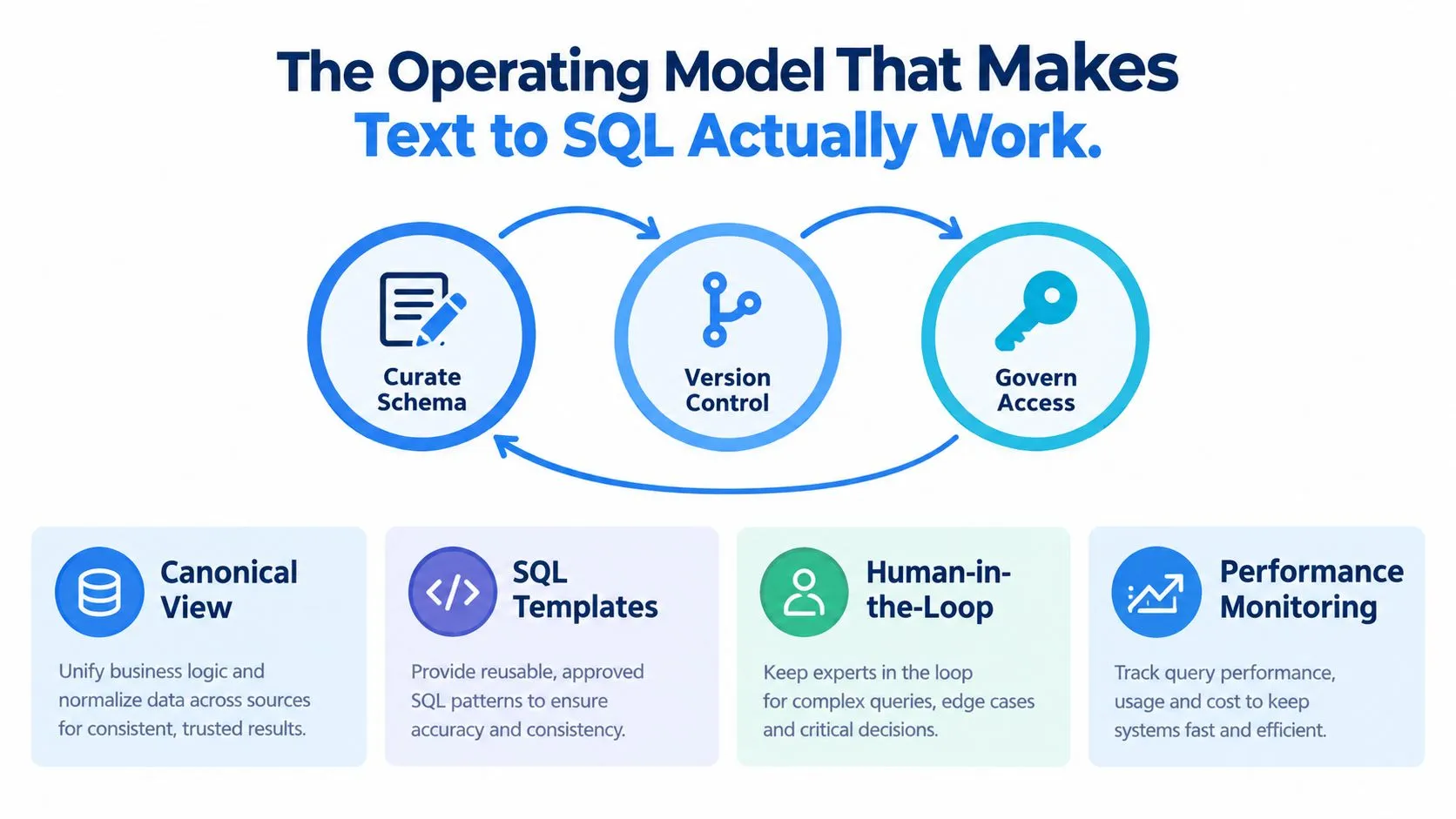
The dependable operating model is a lifecycle, not a single prompt. Curate a canonical schema view, version it, and route questions through approved tables instead of exposing the entire warehouse. Maintain reusable SQL templates for recurring metrics, then let the system adapt them only within defined boundaries.
Run an evaluation harness against real business questions reviewed by analysts. Track correctness, latency, clarification, rejection, and permission outcomes. Before execution, a semantic validator should inspect filters, join cardinality, time boundaries, units, and metric definitions. Server-side permissions must apply regardless of what the model generates.
A small data platform team may need help building the retrieval service, validator, audit trail, or warehouse integration. When internal capacity is limited, Hire developers mexico is one possible route for sourcing engineering support, provided the team can meet your security and data-governance requirements.
Querio provides a workspace where plain-English questions can be converted into SQL and run against connected live warehouses, with an AI context layer for joins, business definitions, and glossary terms. It also exposes generated SQL for inspection and reuse, which fits an operating model that treats text-to-SQL as inspectable data infrastructure rather than an invisible answer engine.
If your data team is losing time to repetitive warehouse questions, visit Querio to evaluate a governed workflow for natural-language analytics. Start with a small set of real business questions, connect the relevant warehouse context, and require every generated query to remain visible, testable, and permission-aware.