Business Intelligence
Why AI Analytics Is a Game Changer for Enterprises
AI analytics delivers real-time insights, boosts forecast accuracy, cuts costs, and scales enterprise data with NLP, predictive models, and live warehouse queries.
AI analytics is transforming how businesses make decisions by delivering faster, more accurate insights. Traditional methods often rely on outdated reports and manual workflows, but AI-powered tools like Querio provide real-time data analysis through natural language queries. This shift allows teams to move from reactive to predictive decision-making, improving efficiency, reducing costs, and increasing revenue.
Key Benefits of AI Analytics:
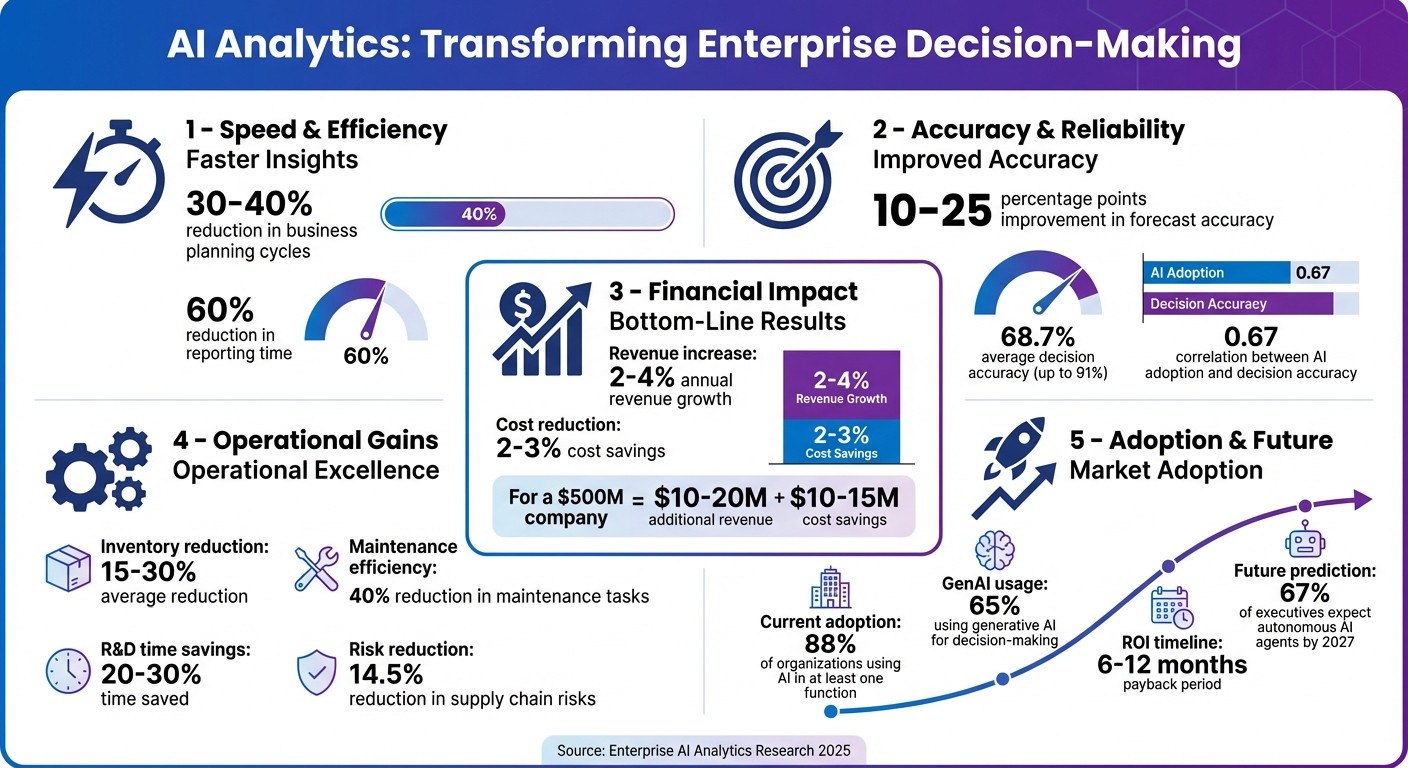
Speed: Insights delivered in seconds, cutting planning cycles by 30–40%.
Accuracy: Consistent metrics and data cleaning improve forecasts by 10–25 percentage points.
Cost Savings: Businesses report 2–4% revenue growth and 2–3% cost reductions.
Scalability: Handles growing data volumes without proportional infrastructure increases.
Accessibility: Natural language processing enables non-technical users to analyze data.
Querio, an AI-native platform, connects directly to live data warehouses like Snowflake and BigQuery. It ensures consistent metrics, automates repetitive tasks, and provides actionable insights without duplicating data. By integrating AI analytics, enterprises can stay ahead in a competitive landscape while streamlining decision-making processes.
AI Analytics ROI: Key Performance Metrics and Business Impact Statistics
AI Data Analyst: How AI Is Transforming Data Analytics Explained | FutureForward Ep. 26 Techcanvass
Why Enterprises Need AI Analytics
AI analytics brings unmatched speed, precision, and scalability to decision-making. Traditional manual workflows often leave decision-makers relying on outdated data, slowing their ability to act. With AI analytics, insights are delivered in seconds, enabling enterprises to respond to market shifts while they still matter.
Faster Insights and Better Decisions
There’s a clear link between AI adoption and the accuracy of strategic decisions. Research highlights a 0.67 correlation between the two [4].
"The degree of AI adoption is the strongest predictor of decision accuracy: a one-standard-deviation increase in adoption leads to ~0.56 standard-deviation increase in accuracy." - Nimesh Gupta, Associate Professor, JECRC University [4]
The speed advantage AI offers is transformative. Companies that transition to self-serve AI analytics platforms can cut business planning cycles by 30–40% [5]. For example, finance teams that once spent weeks on quarterly forecasts can now create multiple scenarios in just a few hours. Marketing teams can test campaign strategies against historical data before allocating budgets. Meanwhile, operations teams can quickly identify bottlenecks and adjust resources ahead of time.
AI also excels at uncovering hidden patterns in massive datasets, shifting decision-making from reactive to proactive [3].
However, speed alone isn’t enough - data quality plays a critical role in ensuring reliable insights.
Improved Data Accuracy and Reliability
Fast insights are only useful when the underlying data is trustworthy. Inconsistent metrics can lead to confusion and wasted time. For example, if two departments report different revenue figures, decision-makers spend valuable time reconciling the data instead of acting on it. AI analytics solves this issue with governed semantic layers that enforce consistent definitions across the organization.
The results are striking. AI-powered business planning can boost forecast accuracy by 10 to 25 percentage points [5]. Additionally, systematic data cleaning can improve model accuracy by at least 10 percentage points [5]. These gains can be the difference between missing quarterly goals and consistently hitting them.
AI also automates data cleaning, reducing human error. It flags anomalies during data ingestion, preventing issues from contaminating the analysis [2][5]. External data sources, like weather or economic indicators, are seamlessly integrated, enriching forecasts with additional context.
Lower Costs and Better Scalability
The performance improvements from AI analytics directly impact the bottom line. AI-driven business planning can deliver an annual 2% to 4% revenue increase and a 2% to 3% cost reduction [5]. For a $500 million company, this translates to an additional $10–$20 million in revenue and $10–$15 million in cost savings.
Inventory management also sees significant improvements, with companies reducing inventory levels by 15% to 30% on average [5]. Predictive staffing models, powered by AI, can cut overtime costs in half by aligning workforce supply with demand fluctuations [6].
Scalability becomes less of a challenge as data volumes grow. By 2025, advancements like synthetic data and transfer learning are expected to reduce the need for real data by over 50% [2]. This allows businesses to expand their analytics capabilities without requiring proportional increases in storage or processing infrastructure. At the same time, smaller data teams can manage larger workloads as AI automates repetitive tasks like cleaning and visualizing data [3][5].
Key AI Analytics Capabilities Changing Business Intelligence
Three main features are transforming how businesses leverage data: natural language processing (NLP), predictive analytics, and live data access. NLP removes the need for technical expertise like SQL, predictive analytics shifts decision-making from reactive to proactive, and live data access eliminates delays caused by outdated processes like data exports. Together, these tools make analytics accessible to everyone while delivering the speed and precision that today’s businesses demand. Tools like Querio are built to integrate these advancements seamlessly.
Predictive Analytics for Forward Planning
Predictive analytics takes strategic planning to the next level by enabling businesses to act before problems arise. Using machine learning, these tools analyze massive datasets in real time to identify anomalies - like internal fraud or security risks - and uncover patterns that reveal opportunities and threats [1][11].
The results speak for themselves. A study of 125 companies found that AI adoption significantly boosts decision accuracy, with firms achieving an average accuracy rate of 68.7% and some reaching as high as 91% [4]. Additionally, organizations using predictive analytics reported a 14.5% reduction in risks like supply chain disruptions [4]. Beyond risk management, these tools help teams allocate resources more effectively by forecasting demand, identifying bottlenecks, and optimizing operations.
"AI analytics builds on traditional analytics practices by using machine learning to help uncover trends, find anomalies, and make predictions." - Oracle [1]
For example, finance teams use predictive models to stress-test budgets under various market conditions. Marketing teams simulate campaign outcomes based on historical data, while operations teams adjust staffing to meet anticipated demand spikes. The key is reducing the time between gaining insights and taking action - because even the most accurate predictions lose value if they aren’t acted on quickly [4].
Natural Language Processing for Easier Analysis
NLP removes technical hurdles, allowing anyone to analyze data without needing coding skills. Instead of writing complex SQL queries, users can now ask simple questions in plain English, like “Which regions had the highest sales growth last quarter?” and receive clear, actionable answers [7][10].
This shift is catching on fast. A reported 65% of organizations are already using generative AI for decision-making, and 53% say it has improved their ability to gain insights [12][13]. Modern NLP tools do more than just translate queries - they provide context-aware insights that go beyond raw data, making analytics more meaningful and actionable [12].
Live Data Access Without Copying
Live data access revolutionizes how businesses interact with their data. Instead of relying on slow exports or waiting for batch updates, AI-powered platforms directly query data warehouses like Snowflake or BigQuery in real time [9][10]. This eliminates delays caused by caching or outdated data, ensuring that insights always reflect the latest business conditions.
The advantages are immediate. Real-time querying removes the need to reconcile multiple data exports, streamlines analysis, and enforces existing access controls automatically. Teams can explore trends instantly, without wasting time on manual data preparation.
This approach also strengthens security and governance. Since data stays within the enterprise’s existing infrastructure, access controls set in the warehouse are automatically applied to AI-generated queries. Additionally, live data access aligns with flexible, usage-based pricing models. For instance, Google Cloud offers $300 in free credits for new BigQuery customers to try out its AI analytics features [9].
"This chatbot … has been a game changer for Siemens Energy. The ability to unlock and democratize the data hidden in our data treasure trove has given us a distinct competitive edge." - Tim Kessler, Head of Data, Models & Analytics, Siemens Energy [8]
This real-time capability is a cornerstone of integrated analytics platforms like Querio, streamlining workflows and enhancing decision-making across the board.
How Querio Powers AI Analytics for Enterprises
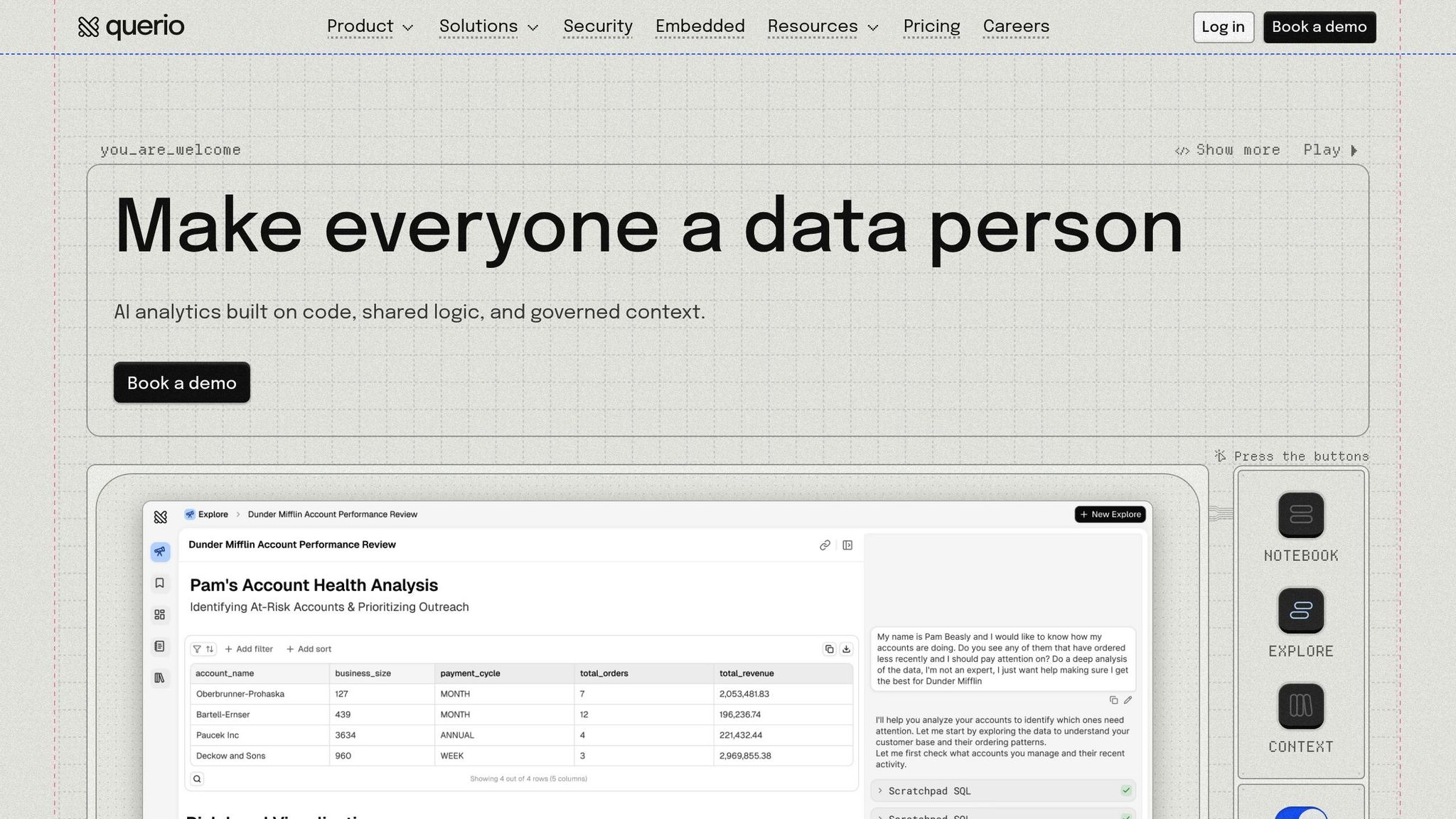
Querio connects directly to your data warehouse - whether it's Snowflake, BigQuery, Amazon Redshift, or ClickHouse - without requiring any data duplication. Users simply type their queries in plain English, and Querio transforms them into SQL or Python code to query live data. The output is fully auditable, ensuring transparency. The platform handles the entire analytics lifecycle, from natural language BI to reactive notebooks, dashboards, scheduled reports, and embedded analytics. Plus, it's built with SOC 2 Type II compliance and standard SSO integrations, making it a seamless, secure solution for enterprise analytics.
Complete Analytics Workflow
Querio combines querying, analysis, visualization, and integration into a single, secure workspace. Insights generated by AI flow through reactive notebooks for deeper exploration, then move to dashboards for monitoring, and can even be embedded into customer-facing applications via APIs or iframes. By keeping data securely in your warehouse and automatically enforcing access controls, Querio eliminates the need for data copying. This approach can reduce reporting time by up to 60% and minimize the time spent on manual data preparation. The platform also ensures consistent data definitions, creating a more efficient workflow.
Governed Semantic Layer for Consistent Metrics
Querio's governed semantic layer ensures that metrics and business definitions remain consistent across the organization. Acting as a single source of truth, this shared context layer standardizes joins, metrics, and other definitions. Data teams define these rules once using versioned YAML files, and they are applied automatically across all queries, dashboards, and embedded analytics. This eliminates the common discrepancies that arise when teams calculate metrics differently. Poor data quality and inconsistent metrics can be costly for businesses, making standardized definitions a critical feature.
Built for Analysts and Business Users
Querio bridges the gap between technical data teams and business users. Analysts maintain full control by reviewing the SQL and Python code behind every AI-generated response, ensuring accuracy and reliability. Meanwhile, business users can access insights without needing to know SQL - plain English queries are all they need. This self-service capability empowers teams without compromising precision. With text-to-sql tools achieving about 90% accuracy, analysts can focus on more complex tasks while routine requests are handled automatically [14].
Business Impact and Future of AI Analytics
Efficiency Gains and Better Operations
Companies adopting AI analytics are seeing major improvements in their daily operations. For instance, in March 2025, a global heavy-industry manufacturer introduced a technician maintenance copilot, cutting maintenance tasks by 40% and boosting equipment effectiveness by 3% [18]. Around the same time, a European automotive supplier automated code generation and quality assurance in R&D using AI, saving 20%–30% of their time while enhancing code quality [18].
These advancements are translating into faster returns on investment, with AI projects paying off within 6–12 months. Areas like finance, procurement, and customer operations have reported workflow accelerations of 30%–50% [15][17][18]. These aren't just minor tweaks - they represent a fundamental shift in how businesses operate. And it's not just one industry; similar results are being seen across the board, paving the way for companies to gain a stronger competitive edge.
Driving Innovation and Competitive Advantage
Some companies focus on refining processes, while others use AI to transform their capabilities entirely. Organizations excelling in areas like cybersecurity, ethical practices, and small language model deployment are 32 times more likely to achieve top-tier performance [16]. A prime example: in August 2025, a global pharmaceutical firm used AI to verify supplier invoices against complex contracts. The system extracted line items from PDFs with 95% accuracy and uncovered over $10 million in value leakage - equivalent to 4% of the analyzed spend - in just four weeks [15].
"Critical thinking skills become even more important in the age of AI. We're seeing it now as people use gen AI and are advancing with agentic AI." - Senior Vice President, Demand & Digital Transformation, Multinational Consumer Products Corporation [16]
The real game-changer isn't just speed - it's about redefining decision-making processes. AI-driven Integrated Business Planning is already delivering major results, such as improving forecast accuracy by up to 25 percentage points and cutting planning cycle times by 30%–40% [5].
What's Next: Agentic Analytics and Embedded Tools
Building on these successes, the next step for the industry is building AI agents and agent-driven systems that reduce human involvement and minimize errors. Platforms like Querio are already driving efficiencies, using AI tools like conversational agents and AutoML, but the future lies in agentic analytics - autonomous systems that not only analyze data but also execute actions. By 2027, 67% of executives expect AI agents to operate independently within their organizations, a sharp rise from 24% today [16]. These systems could cut low-value work time by 25%–40% and significantly reduce human errors [17]. In pilot projects, autonomous finance and risk monitoring agents have already reduced risk events by 60% [17].
Another emerging trend is multi-agent systems, where specialized agents collaborate across departments. For example, a supply chain agent might detect a disruption and automatically trigger a finance agent to revise forecasts - all without human input [17][19]. AI is also becoming deeply embedded in business tools, with agents integrated into platforms like Salesforce Einstein, SAP, and ServiceNow [17]. The future isn’t about running reports; it’s about systems that think, learn, and act on your behalf.
"78% of C-Suite executives say achieving maximum benefit from agentic AI requires a new operating model." - IBM Institute for Business Value [16]
Conclusion: Transform Enterprise Analytics with Querio
AI-driven analytics is reshaping how enterprises make decisions. With 88% of organizations already integrating AI into at least one business function [20] and 65% utilizing generative AI for smarter, data-backed decision-making [12], the shift from outdated reporting to predictive, intelligent operations is no longer a question of "if" - but "when."
The key to success lies in trust, speed, and governance. Querio addresses these critical needs by connecting directly to your existing data warehouse - whether it’s Snowflake, BigQuery, Amazon Redshift, or PostgreSQL - and querying live data in real time. By eliminating the delays of traditional batch processing, Querio ensures your teams have access to the insights they need, exactly when they need them. This capability underscores the real-time advantages discussed earlier.
Querio also includes a governed semantic layer, ensuring consistent definitions across all insights. Every recommendation is backed by inspectable SQL and Python code, giving you the transparency to validate the logic behind the results. This level of accountability is essential, especially when data breaches can cost companies an average of $4.88 million per incident [22].
"If you don't transform, you're out of here." – Marco Iansiti, Professor at Harvard Business School [20]
With 90% of companies already reporting profitability boosts from digital transformation [21], The question isn’t whether to adopt AI analytics platforms for enterprises - it’s how quickly you can make it happen. Querio provides the platform to scale insights across your organization, safeguard your data, standardize metrics with an AI semantic layer, and ensure every decision is auditable.
Take the leap today. Transform your enterprise analytics with Querio and create a decision-making environment equipped for the future.
FAQs
How does AI analytics make business decisions faster and more accurate?
AI analytics transforms decision-making by leveraging tools like predictive analytics, natural language processing (NLP), and real-time data analysis. These technologies empower businesses to extract insights quickly and effortlessly, even without deep technical know-how. For instance, AI-driven dashboards can interpret questions phrased in plain English, forecast trends, and trigger automated alerts - allowing teams to respond swiftly to new opportunities or challenges.
What sets AI analytics apart is its ability to process massive datasets with precision. It uncovers hidden patterns, updates predictions in real time, and ensures decisions are grounded in the most current and trustworthy data. This dramatically reduces the risk of errors tied to manual analysis or outdated information. By simplifying complex data and making it accessible across departments - not just to IT professionals - AI analytics enables smarter, faster decision-making at every level of an organization.
How does natural language processing (NLP) enhance AI analytics?
Natural language processing (NLP) is reshaping how we interact with data by making it simpler and more intuitive. Instead of needing technical skills like SQL, users can ask questions in plain English and get insights quickly. This eliminates barriers and speeds up the process of turning raw information into meaningful answers. Plus, NLP excels at analyzing unstructured data - think emails, social media posts, or reports - and converting it into insights that can drive action.
NLP-powered tools, such as conversational analytics platforms and virtual assistants, make exploring data feel natural. For example, platforms like Querio use NLP to deliver instant, detailed answers to complex queries. This not only reveals hidden trends but also helps improve decision-making and streamline operations. By breaking down access barriers, NLP allows teams to use data effectively, making smarter decisions without the need for specialized knowledge.
How does AI analytics help businesses save money?
AI analytics helps businesses cut costs by simplifying data workflows, boosting decision-making, and automating repetitive tasks. For instance, tools like Querio use natural language processing (NLP) to let users ask complex questions in plain English. This speeds up the process of gaining insights and reduces reliance on specialized IT teams, saving both time and money.
AI-driven analytics also excels at spotting data quality issues and anomalies early on, helping businesses avoid expensive mistakes and achieve more accurate insights. Features like predictive analytics and real-time dashboards enable companies to fine-tune operations, make better forecasts, and uncover cost-saving opportunities quickly. By integrating AI into their strategies, businesses can improve efficiency and reduce expenses across multiple areas.
Related Blog Posts