Business Intelligence
AI Powered Business Intelligence Explained
AI-powered BI uses machine learning, NLP, and predictive analytics to unlock unused data, deliver real-time governed insights, and democratize analytics.

AI-powered business intelligence (BI) is reshaping how businesses analyze data and make decisions. By combining machine learning, natural language processing (NLP), and predictive analytics, AI tools simplify data analysis, deliver faster insights, and make BI accessible to everyone - not just data experts.
Key Takeaways:
- 68% of business data goes unused, and only 15% of employees in most companies use BI tools. AI changes this by allowing plain-English queries and instant answers.
- 45% of large enterprises already use AI for BI, with up to 90% planning adoption within two years.
- AI automates tasks like data cleaning, identifies trends, and predicts future outcomes, saving time and improving decision-making.
Querio, an AI-powered BI platform, demonstrates these advancements by:
- Translating plain-English questions into accurate SQL/Python code.
- Using a semantic layer to ensure consistent, governed insights.
- Offering secure, scalable integrations with popular data warehouses.
This guide explores how AI tools like Querio simplify analytics, improve decision-making, and enable companies to stay competitive in industries like fintech and e-commerce.
Business intelligence in the age of AI - what's the future of BI??
::: @iframe https://www.youtube.com/embed/SCgGVw5ABLg :::
sbb-itb-284a532
Core Technologies Behind AI in Business Intelligence
Modern AI-driven BI systems rely on three key technologies: machine learning for identifying patterns, natural language processing (NLP) for user-friendly queries, and predictive analytics for anticipating future trends. When used together, these technologies provide faster and more accurate analysis than any single approach could achieve on its own [5][6].
Machine Learning for Pattern Recognition
Machine learning (ML) algorithms excel at analyzing massive datasets, identifying patterns, relationships, and anomalies, and even generating reports automatically. They can handle data ranging from megabytes to petabytes with ease [4][5]. For example, Premier, a healthcare organization, saw a tenfold improvement in SQL query creation speed after adopting ML-powered BI tools in 2025 [8]. This dramatic time savings allowed their teams to integrate data more effectively and make critical decisions faster.
Natural Language Processing for Data Queries
Natural language processing (NLP) bridges the gap between technical data systems and everyday users. Instead of relying on SQL queries or waiting for IT assistance, users can simply type or speak questions in plain English - like "What were our top-selling products last quarter?" - and receive instant answers. The system translates these conversational prompts into precise database queries, making it easier to add natural-language analytics to existing workflows [2].
The AA, a UK-based insurance and roadside assistance company, implemented NLP-powered queries through Microsoft Teams. This integration led to a 70% boost in efficiency for handling routine data inquiries in 2025 [8].
"Our experience using AI/BI Genie has been transformative... The natural language query functionality has made complex data queries effortless" [8].
Predictive Analytics for Future Planning
Predictive analytics enables businesses to prepare for the future by forecasting trends and identifying potential risks. These systems analyze historical data to support tasks like sales forecasting, inventory management, and risk assessment. Virgin Atlantic, for instance, cut its booking analysis time from weeks to just hours by leveraging AI-driven predictive insights in 2025 [8]. By combining predictive models with natural language queries, the airline was able to analyze booking trends and make more informed operational decisions.
"AI has the potential to democratize BI through natural language, closing the gap between data availability and decision-making velocity." – Databricks [2]
The effectiveness of these technologies depends heavily on data modeling best practices. AI systems need to understand your business's unique context - such as how terms like "revenue", "customer", or "conversion" are defined - to deliver meaningful insights. Without this understanding, even the most advanced AI tools risk producing irrelevant or misleading results [7]. These foundational technologies are paving the way for faster, more precise decision-making, as explored in the next section.
Benefits of AI-Powered Business Intelligence
::: @figure 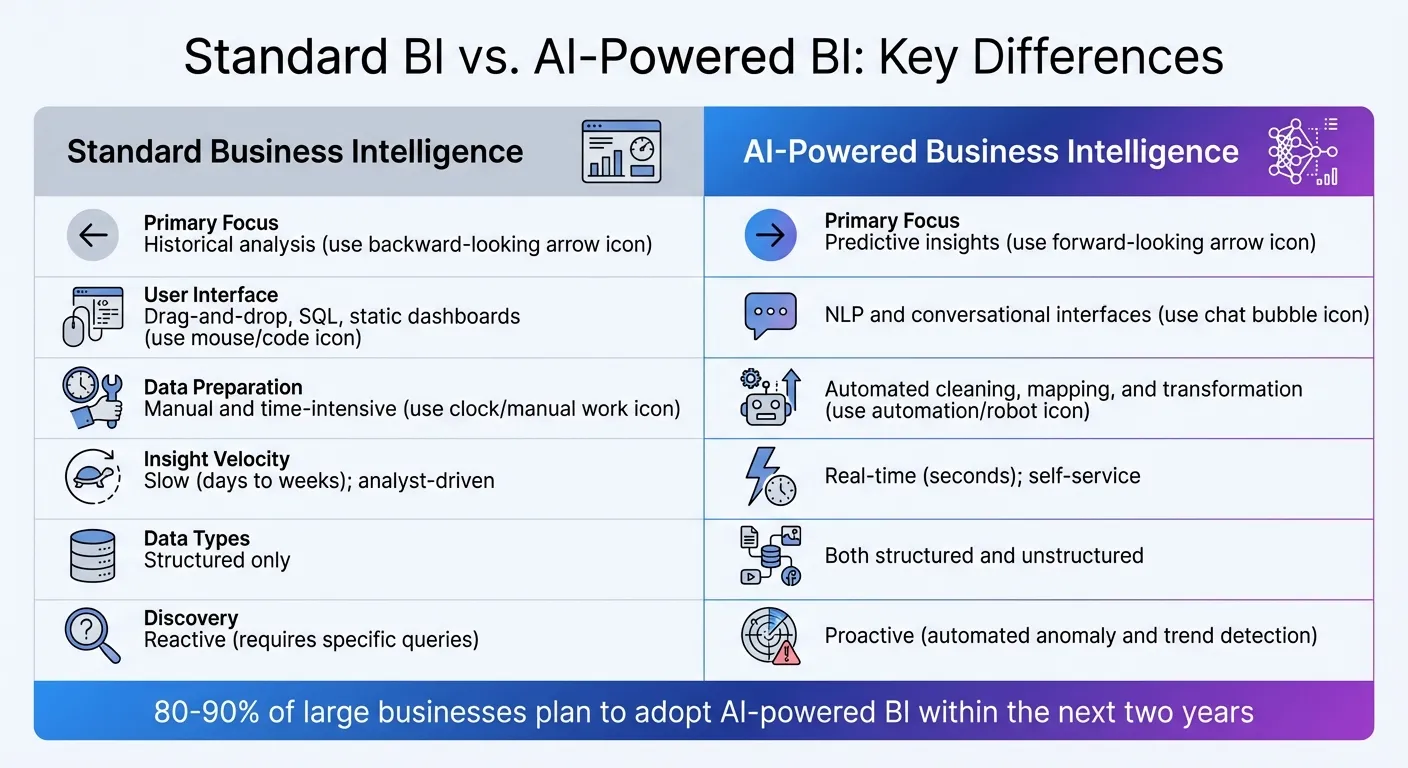 {Standard BI vs AI-Powered BI: Key Differences Comparison}
:::
{Standard BI vs AI-Powered BI: Key Differences Comparison}
:::
AI-powered business intelligence (BI) leverages advanced machine learning (ML), natural language processing (NLP), and predictive analytics to transform raw data into actionable insights. Unlike traditional tools, which often focus on reporting past events, AI-driven BI takes a proactive approach - forecasting trends and suggesting next steps. This evolution is significant, with 79% of corporate strategists emphasizing that AI and analytics will play a critical role in their organization's success over the next two years [9]. Let’s explore how AI's speed, competitive edge, and integrated analytics are reshaping the BI landscape.
Faster and More Accurate Decision-Making
AI removes inefficiencies by automating tedious tasks like data cleaning and report generation - activities that typically consume 60% to 70% of employees' time [9]. With AI, these processes are streamlined, delivering real-time insights in seconds. In fact, 59% of executives say AI helps them extract more actionable insights from their analytics [9], enabling teams to react to market shifts while they still matter.
Another key advantage is AI's ability to process massive datasets instantly, identifying trends and anomalies that would take human analysts weeks to uncover. It’s not just about speed - AI also reveals strategic insights that conventional tools often overlook, giving businesses a sharper edge in decision-making.
Competitive Advantages Through AI
AI-powered BI uncovers opportunities that traditional systems miss, especially when it comes to unstructured data. This type of data - emails, social media posts, customer reviews, call center transcripts - makes up 80–90% of enterprise information. AI analyzes these sources, revealing insights into customer sentiment, operational inefficiencies, and emerging market trends.
Another game-changer is the democratization of data. In most organizations, only 15% of employees use traditional BI tools [3], creating knowledge silos where insights are confined to technical specialists. AI, with its natural language processing capabilities, makes data analysis accessible to everyone. With 73% of U.S. companies already incorporating AI into their operations [9], early adopters are gaining a head start that will be tough for competitors to catch up with.
"AI enables more complex data handling with higher performance, making real-time business intelligence much more effective." – Donald Farmer, Data Strategist, TreeHive Strategy [10]
Standard BI vs. AI-Powered BI
The contrast between traditional and AI-powered BI is stark, especially when considering key aspects of business performance:
| Feature | Standard Business Intelligence | AI-Powered Business Intelligence |
|---|---|---|
| Primary Focus | Historical analysis | Predictive insights |
| User Interface | Drag-and-drop, SQL, static dashboards | NLP and conversational interfaces |
| Data Preparation | Manual and time-intensive | Automated cleaning, mapping, and transformation |
| Insight Velocity | Slow (days to weeks); analyst-driven | Real-time (seconds); self-service |
| Data Types | Structured only | Both structured and unstructured |
| Discovery | Reactive (requires specific queries) | Proactive (automated anomaly and trend detection) |
The shift from descriptive to predictive analytics is transformative. Traditional BI explains what happened and why, while AI-powered BI predicts what’s next and suggests actionable steps. This forward-thinking capability is why 80–90% of large businesses plan to adopt AI within the next two years [1]. These advancements pave the way for platforms like Querio, designed to empower organizations with data-driven decisions.
Querio: AI-Powered Business Intelligence Platform
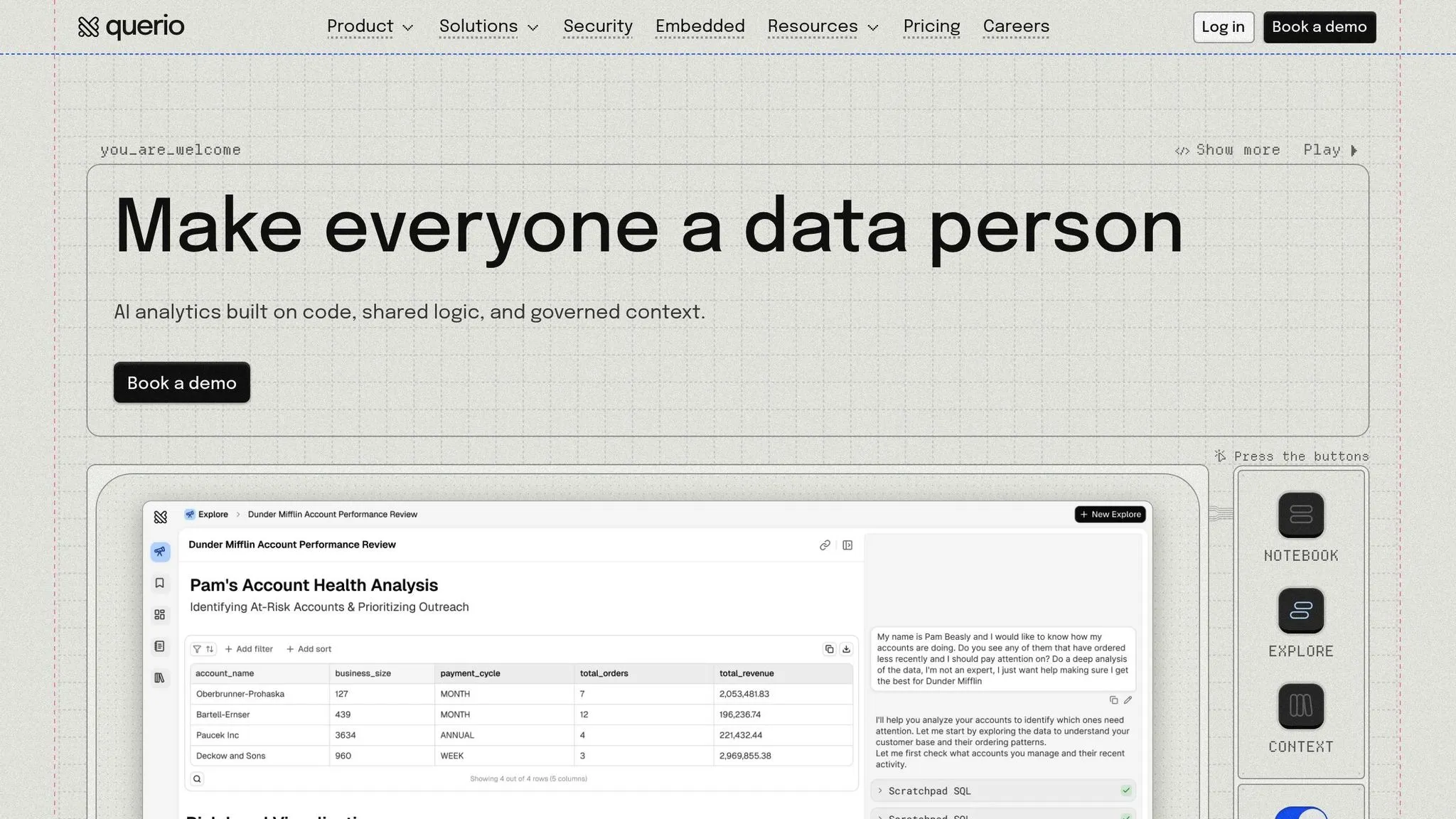
Querio is an analytics workspace powered by AI, designed to turn natural language questions into clear data insights. It integrates directly with your existing data warehouse - whether it’s Snowflake, BigQuery, Amazon Redshift, ClickHouse, or PostgreSQL - and generates real SQL and Python code that you can review and verify. The platform ensures that every answer is derived from your data, offering both transparency and reliability.
Querio is tailored for teams that need easy-to-use analytics tools without compromising on accuracy or control. It allows data teams to define business rules once, enabling other users to ask questions in plain English while ensuring consistent, governed insights. This setup supports natural language analytics, standardized metrics, and secure deployments.
Natural Language Analytics with Querio
Querio translates plain English queries into verified SQL and Python code, making the process fully transparent. For instance, if you ask, "What were our top-performing products in the USA last quarter?", the system processes your question by classifying it, extracting key features, and generating SQL code that reflects your business context [11].
The platform’s semantic layer bridges the gap between everyday business language and technical database structures. It assigns descriptive names, synonyms, and business logic to database terms. So when you say "USA", Querio knows exactly which fields and filters to apply [11].
All results are accompanied by the underlying code, presented in a reactive notebook environment. This setup ensures the code evolves with your business logic and remains easy to inspect and audit.
Governed Metrics and Semantic Layer
Querio’s semantic layer centralizes key definitions - like customers, orders, and revenue - ensuring consistency across all departments. By standardizing these metrics, the platform eliminates discrepancies and ensures everyone works from the same dataset.
More than just a query engine, Querio enforces consistency through its unified semantic layer. As Cube explains, "The semantic layer provides the governed data foundation that makes agentic analytics possible. It organizes data from your cloud data warehouses into centralized, consistent definitions that AI agents can reliably query, explore, and reason about" [13].
The system also validates every request to prevent errors or fabricated queries from affecting your data [13]. This validation ensures that every question - no matter who asks it - yields accurate, consistent answers. Improvado puts it this way: "AI processes the data to deliver a clear answer, ensuring consistent results no matter who querying the data or how many times" [12]. This reliability supports faster, more informed decision-making.
By maintaining business logic as versioned code, Querio allows data teams to collaborate using familiar tools like version control, automated testing, and peer review [13].
Deployment, Security, and Scalability
Querio connects to your data warehouse using encrypted, read-only connections, keeping your data securely in-house. It meets SOC 2 Type II compliance standards and includes enterprise-level security features like role-based access controls and SSO integrations. Row-level and column-level security rules defined in the semantic layer are automatically applied to all AI-generated queries [13].
The platform is designed to scale efficiently, using intelligent caching and pre-aggregation to avoid overloading your data infrastructure [13]. Organizations can choose between cloud-based or self-hosted deployments, giving them full control over their data environment.
Implementation Guide and Use Cases
How to Implement AI-Powered BI
You can get Querio up and running in just 8–12 weeks. Start by connecting your data warehouse - whether you're using Snowflake, BigQuery, Amazon Redshift, ClickHouse, or PostgreSQL. Use encrypted, read-only credentials to ensure security during this integration.
Next, set up shared metrics and business logic within the semantic layer. Your data team will handle this part, defining joins, standardizing key terms like "customer" or "revenue", and creating rules that guarantee consistent answers. Once this foundation is ready, anyone on your team can ask questions in plain English - no SQL required.
Enable natural language queries so users can ask things like, "What was our average order value in California last month?" and get precise, code-backed answers. Build real-time KPI dashboards, configure access controls for secure operations, and track governance through audit trails and versioned logic. These steps ensure a seamless setup and pave the way for tailored, industry-specific applications.
Industry Applications: Fintech and E-Commerce
Once implemented, Querio has powerful applications across industries. Here’s how it can make an impact:
In fintech, AI-powered BI helps monitor transaction patterns, detect anomalies, and ensure regulatory compliance - all in real time. For example, a fraud detection team could ask, "Show me transactions over $10,000 from new accounts in the last 48 hours", and instantly get results that follow pre-set security rules and business logic. This reduces delays between identifying suspicious activity and taking action.
In e-commerce, AI-driven analytics can transform operations by optimizing inventory, personalizing customer experiences, and forecasting demand. A merchandising manager might ask, "Which products had the highest return rates in the Northeast during Q4?" and receive immediate, actionable insights. This kind of speed and accuracy allows for quick adjustments to pricing, marketing, and supply chain strategies - without waiting on IT teams or manually pulling reports.
Conclusion
AI-powered business intelligence is reshaping how decisions are made. Instead of waiting days for manual reports or relying on dashboards that only explain past events, it offers predictive insights and conversational analysis that reveal the origins of trends and predict future outcomes. This evolution from reactive to proactive intelligence equips teams with the speed and precision needed to maintain a competitive edge.
The efficiency improvements are hard to ignore. Traditional BI often leaves much of your data untapped, while AI steps in to automate repetitive tasks [3][1]. This shift frees your team to focus on strategic initiatives instead of struggling with complex SQL queries or inconsistent metrics.
"This chatbot … has been a game changer for Siemens Energy. The ability to unlock and democratize the data hidden in our data treasure trove has given us a distinct competitive edge." - Tim Kessler, Head of Data, Models & Analytics, Siemens Energy [14]
Querio takes these advancements a step further by delivering these capabilities with ease. Through its natural language queries and governed metrics, Querio enables instant, accurate, and code-validated answers. Whether you're in fintech analyzing transactions or in e-commerce fine-tuning inventory, Querio ensures you have the insights you need, exactly when you need them.
FAQs
::: faq
How does AI make business intelligence easier to use for non-technical users?
AI is making business intelligence easier to use, even for people without technical expertise. Thanks to AI-powered tools, users can ask questions in plain English - no need to know SQL or have a background in data science. These tools take natural language queries and turn them into actionable insights, making data analysis feel more intuitive and approachable for everyone.
Beyond simplifying queries, AI takes over repetitive tasks like creating reports, spotting trends, and flagging anomalies. This not only saves time but also helps users make quicker, more informed decisions. By automating these processes, AI helps build a workplace where data insights are available to everyone, regardless of their technical skills. :::
::: faq
How does natural language processing (NLP) enhance AI-powered business intelligence?
Natural language processing (NLP) takes AI-powered business intelligence (BI) to the next level by allowing users to interact with data using plain English. With this technology, even those without technical know-how can ask straightforward questions and get meaningful insights - no coding or data analysis skills required. This opens up data access across the entire organization, helping teams make quicker, well-informed decisions.
NLP also makes working with complex data much easier by delivering real-time, conversational insights. From spotting trends to creating reports or forecasting outcomes, users can accomplish these tasks with simple language commands. This not only speeds up workflows but also reduces the need to rely on technical experts. For businesses of all sizes, NLP is a game-changer, making AI-powered BI tools more intuitive and effective. :::
::: faq
How does AI-driven predictive analytics improve operations in industries like fintech and e-commerce?
AI-powered predictive analytics is transforming how fintech and e-commerce businesses operate by enabling smarter and quicker decision-making. In the fintech world, it plays a key role in assessing credit risks, spotting fraudulent activities, and forecasting market trends. These insights help businesses manage risks more effectively while enhancing customer engagement. Meanwhile, in e-commerce, predictive analytics is used to anticipate customer behavior, deliver personalized marketing, and fine-tune inventory management - all of which drive sales and improve customer satisfaction.
What makes this technology so impactful is its ability to analyze massive datasets in real time. This allows companies to stay ahead of trends and make proactive decisions. The results? Greater efficiency, lower costs, and increased revenue potential. For example, fintech firms can instantly determine a customer's creditworthiness, while e-commerce platforms can provide tailored product suggestions or adjust pricing dynamically. These advanced capabilities ensure businesses remain competitive in today’s fast-paced markets. :::