Business Intelligence
Warehouse-First vs Direct API Integrations for AI Analytics
Prefer the warehouse for governed metrics and historical analysis; use direct APIs only for live, time-sensitive checks or hybrid cases.

If you want AI answers people can use across the company, start with the warehouse. If you need a live status check, use the source API.
That’s the whole rule in one line.
I’d keep it this simple:
- Use the warehouse for ARR, NRR, CAC, board reports, trends, and any question that joins data from more than one system.
- Use direct APIs for live checks like a Stripe payment status, a Shopify order update, or a Salesforce field that changed a few minutes ago.
- Use both when you need history and the latest source record in the same answer.
The tradeoff is clear: warehouse-first gives you one set of metric definitions, one permission layer and governance model, and one place to audit SQL. Direct APIs give you lower lag, but they also add rate limits, OAuth work, schema issues, and higher upkeep. In the example from the article, the cost gap is stark: about $12,000/year for warehouse-first vs. about $150,000/year for direct API or siloed setups.
Quick Comparison
| Pattern | Best Use | Data Delay | Main Upside | Main Downside |
|---|---|---|---|---|
| Warehouse-first | Shared metrics, history, cross-system analysis | Minutes to hours | Stable definitions and central access control | Data may lag behind source systems |
| Direct API | Live status checks in source systems | Near real time | Current source-state answers | More connector work and higher usage costs |
| Hybrid | Questions that need both history and current status | Mixed | Gives context plus live checks | More routing logic to maintain |
My takeaway is simple: don’t let source apps become your reporting system. Keep governed metrics in Snowflake, BigQuery, Redshift, or Postgres, model them in dbt, and only call APIs when the warehouse cannot show the latest state yet.
That split keeps AI answers cleaner, cheaper, and easier to trace.
Warehouse-first AI analytics: the right default for governed metrics, historical analysis, and secure self-serve
The warehouse is where data from different systems gets cleaned up, joined together, and shaped into something teams can trust. That makes it the default setup for AI analytics when the goal is governed metrics and historical analysis. It matters most when AI needs one clear definition of revenue, pipeline, or spend.
Why Snowflake, BigQuery, Redshift, and Postgres produce more consistent results
When revenue data from Stripe, pipeline data from Salesforce, and ad spend from Google Ads flow into the warehouse and get modeled in dbt, teams define things once and use that same logic everywhere. So metrics like ARR or NRR stay aligned across a Looker dashboard, a Hex notebook, and a ThoughtSpot report because each one pulls from the same semantic layer.
That consistency is a big deal. Without it, one team’s “revenue” can quietly turn into another team’s “revenue, but minus refunds” or “revenue, but only for closed-won accounts.” Version-controlled definitions help stop that kind of metric drift before it turns into a mess.
When an agent queries a governed warehouse, it works from the same definitions analysts already use and trust. That makes the output traceable, repeatable, and consistent. Just as important, the same modeling layer gives teams one place to apply access rules.
Why permissions and auditability are easier to manage in the warehouse
Snowflake, BigQuery, Redshift, and Postgres let teams handle access control at query time from one central place. A finance analyst can view revenue figures, while a sales rep can view only their own pipeline rows. That setup is much easier to manage than trying to rebuild permission logic in every app or agent.
For healthcare and finance teams, that central control also makes it easier to line up with internal governance and compliance requirements. And with live, read-only warehouse connections, the warehouse permission layer stays in charge. You still get inspectable SQL and clear auditability, which matters when someone asks, “Where did this number come from?”
Where warehouse-first falls short
The main tradeoff is latency. Warehouse data can lag behind the source by 15 minutes to 24 hours, and ingestion failures or schema drift can hide recent changes [1].
That gap matters when the question is operational and the answer can change from one minute to the next. If a team needs to know what’s happening right now, warehouse-first can feel a step behind. That’s the point where direct APIs make more sense.
Direct API analytics: the right call for near-real-time monitoring and source-native workflows
Use direct APIs when the answer changes faster than your warehouse can refresh. That's the sweet spot.
They're a fit for live status checks, not governed reporting. And that distinction matters more than it might seem at first glance. If the question is changing minute by minute, the API is often the right place to look. If the goal is shared reporting that people across the business rely on, the warehouse should carry that load.
Stripe and Shopify: when live transaction checks matter more than modeled reporting
Some situations can't wait.
A payment failure happening right now, a fraud review blocking a customer order, or an inventory hold that needs a quick check before fulfillment - if you wait for the next warehouse sync, you're working with stale information. In those moments, Stripe and Shopify APIs are doing exactly what they were built to do: answer live operational questions.
Here's the clean line: keep live transaction checks on the API, and keep revenue reporting, cohort LTV, and reconciliation in the warehouse. [1]
That same rule holds across other systems too. Use the API for live status. Don't use it as the main source for shared metrics.
Google Ads and Salesforce: where minute-level freshness helps and where it does not
Google Ads is a good example. If a campaign is chewing through its daily budget by noon, you want that answer now, not after the next warehouse refresh.
Salesforce works the same way. If a rep just changed a close date or updated a deal amount, a sales manager checking that record in real time has a solid reason to query the API directly.
But once you move into quarter-to-date pipeline analysis, revenue reporting, cohort LTV, and reconciliation, the warehouse should take over. Google Ads and Salesforce can answer their own live questions, but only the warehouse can join that data into a single cross-channel view. [1]
The maintenance costs of direct APIs
Direct APIs help, but they come with ongoing upkeep.
Every connector needs:
- OAuth scope management
- Rate limit handling
- Retry logic
- Monitoring for schema changes
And here's the hard part: source platforms update their APIs without notice. Fields appear, disappear, or get renamed. [1]
As AI agents and users of self-service analytics platforms start hitting a connector, OAuth, retries, rate limits, and schema checks turn into steady maintenance work. That's why each new API needs to justify itself. If it doesn't solve a live, time-sensitive problem, the overhead usually isn't worth it.
The tradeoffs stand out most when you compare freshness, cost, and maintainability side by side.
Comparison table: warehouse-first vs. direct API across accuracy, latency, permissions, freshness, cost, and maintainability
::: @figure 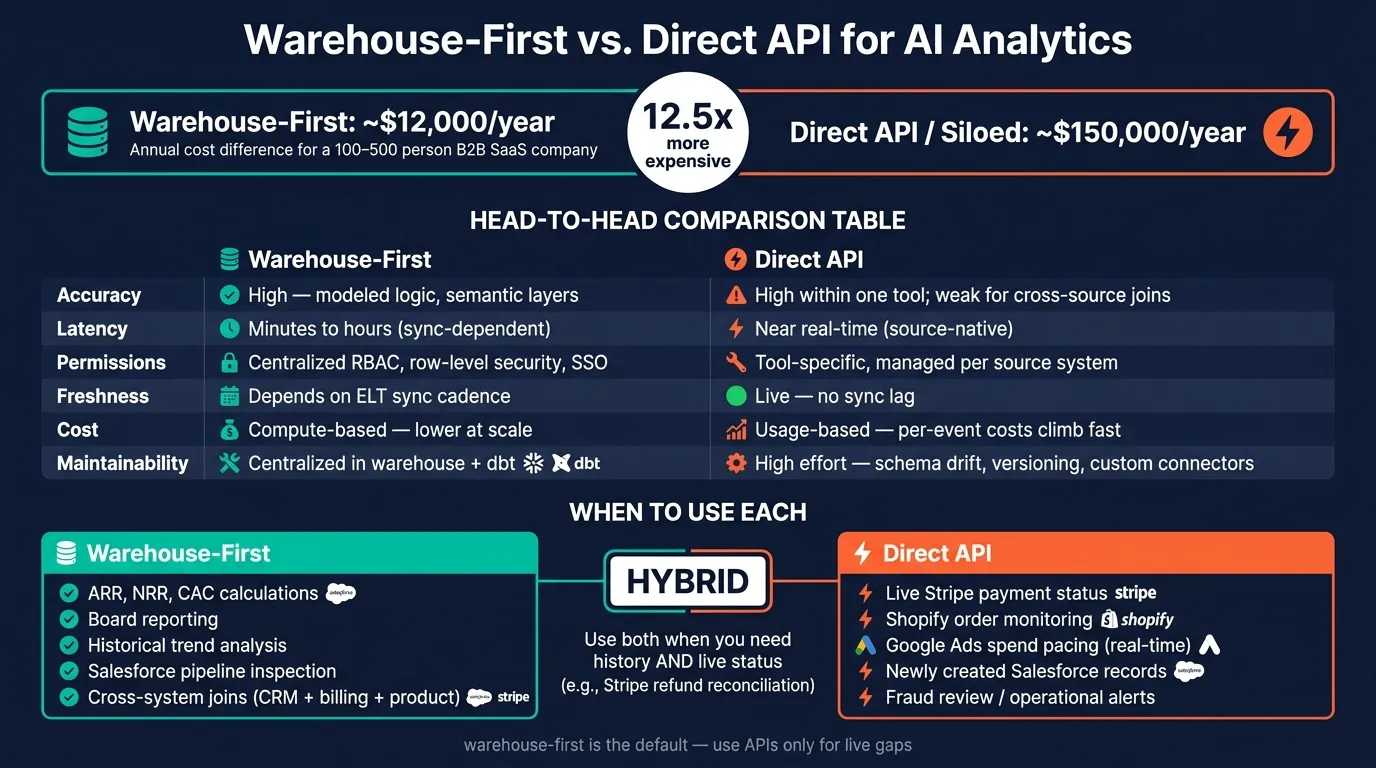 {Warehouse-First vs Direct API: Cost, Latency & Use Cases Compared}
:::
{Warehouse-First vs Direct API: Cost, Latency & Use Cases Compared}
:::
For AI analytics, warehouse-first should be the default when you're working with governed metrics. Direct APIs fit a narrower job: live operational checks where timing matters more than shared metric logic.
That difference gets a lot clearer when you put both options side by side:
| Dimension | Warehouse-First | Direct API |
|---|---|---|
| Accuracy | High - driven by modeled logic and semantic layers in dbt or similar | High within one tool's native logic, but weaker when questions require cross-source joins |
| Latency | Sync-dependent - usually minutes to hours behind source data | Near-real-time - answers reflect the current state of the source |
| Permissions | Centralized - inherits warehouse RBAC, row-level security, and SSO | Tool-specific - managed in each source system |
| Freshness | Depends on ELT sync cadence | Source-native live data - no sync lag |
| Cost | Compute-based - generally lower at scale | Usage-based - per-event costs can climb fast |
| Maintainability | Centralized in the warehouse and dbt - one place to update logic | Higher ongoing effort - versioning, schema drift, and custom connector code |
The big idea is simple. A warehouse gives your team one place to manage logic, access, and reporting rules. Direct APIs can answer what's happening right now, but they also bring more moving parts. Once you start stitching together many sources, the work piles up fast.
Decision table for common analytics scenarios
Use this table to pair each use case with the right setup:
| Scenario | Recommended Pattern | Reason |
|---|---|---|
| Stripe refund reconciliation | Hybrid | Live API check for current status plus warehouse context for historical analysis |
| Shopify order monitoring | Direct API | Needs minute-level freshness for operational alerts |
| Google Ads spend pacing | Direct API | Real-time monitoring of daily budget caps |
| Salesforce pipeline inspection | Warehouse-first | Requires joining CRM data with product usage and billing |
| Board reporting | Warehouse-first | Must use governed, audited metrics like ARR, NRR, and churn |
| Historical trend analysis | Warehouse-first | Leverages long-term storage and modeled historical data |
A good rule of thumb: if the question depends on shared business definitions or data from more than one system, lean warehouse-first. If the question is operational and time-sensitive - like checking a budget cap or a just-submitted order - direct API access often makes more sense.
What the tradeoffs look like in dollars and team time
The cost gap in the source examples is hard to ignore: about $12,000/year for warehouse-first versus roughly $150,000/year for direct API or siloed setups [2].
That's why direct APIs should usually be the exception, not the rule. If the warehouse can meet the freshness need, stick with the warehouse. If it can't, use the API for that narrow live check instead of turning the whole stack into a patchwork of one-off connections.
The next question is where hybrid routing belongs.
Recommended architectures: default to warehouse-first, add direct APIs selectively, and use hybrid routing when needed
The rule here is pretty simple: treat the warehouse as the system of record and use APIs only when you need live data the warehouse can’t show yet.
So the default is the warehouse. Then, if there’s a live gap, add a direct API call for that specific case.
A simple routing framework for AI agents and analysts
Send requests to the warehouse for governed metrics, historical trends, and cross-system joins like ARR, NRR, booked revenue, and attribution.
Use a direct API only when data freshness matters more than modeled consistency. Think of cases like a live Stripe payment status, a just-submitted Shopify order, or a newly created Salesforce record. These are tight operational checks, not broad analysis.
Use hybrid routing when someone needs both views at once. Say a sales manager asks, “Is pipeline down today, and did anything change in the last hour?” The assistant should start with the warehouse trend, then check Salesforce for deals that changed recently. If the numbers don’t match, show both and label them clearly: one as governed reporting, the other as the live source.
Example hybrid architecture for a modern data stack
That rule maps neatly to a modern stack.
For a 100–500-person B2B SaaS or healthcare company, a reference setup uses Snowflake or BigQuery as the analytics backbone, dbt for transformations and metric logic, and selective direct API access to systems like Stripe or Salesforce only where documented freshness gaps exist.
| Layer | Primary Systems | Role |
|---|---|---|
| Storage | Snowflake, BigQuery, Redshift, Postgres | Governed data backbone and compute engine |
| Transformation | dbt | Modeling raw data into analysis-ready tables with shared metric logic |
| Semantic context | dbt Semantic Layer or a Querio context layer | Defining metrics once, reused across dashboards and AI responses |
| AI layer | Querio | SQL/Python generation with inspectable outputs and permission inheritance |
| Delivery | Slack, Teams, Claude, reactive notebooks | Secure self-serve access for analysts and business users |
Querio sits in the AI layer. It applies a governed context layer and live warehouse connections so every answer includes inspectable SQL or Python. That makes the layer easier to trust because it isn’t a black box. For live checks, Querio’s MCP integration lets agents in Claude or other assistants query the warehouse with the user’s existing OAuth permissions.
FAQs
::: faq
How fresh does data need to be before I should use a direct API?
Use a direct API instead of a warehouse-first approach only when the business needs sub-second visibility and can't wait for your current ingestion cadence.
For most analytics needs, a centralized warehouse like Snowflake or BigQuery is still the better choice for consistent metrics, security, and data integrity. Direct API access makes more sense for high-frequency operational monitoring, where immediate, approximate data matters more than fully reconciled historical accuracy. :::
::: faq
When does a hybrid warehouse-plus-API approach make sense?
A hybrid warehouse-plus-API approach makes sense when you need both a central warehouse for trusted, shared context and direct API access for immediate, granular data from source systems.
Use it when you need to combine governed metrics - like Net Revenue or churn modeled in dbt or a semantic layer - with live signals from Stripe, Shopify, or Salesforce that haven’t yet landed in Snowflake or BigQuery. :::
::: faq
How should I decide based on cost and maintenance?
Decide based on your tolerance for maintenance, cost swings, and governance needs.
Choose warehouse-first if you want a stable, long-term source of truth. It usually takes more work up front, but it can mean less maintenance over time and more predictable compute and storage costs.
Use direct API access for specific operational tasks that need near-real-time data. That can work well if you’re okay with API limits, variable usage costs, and less shared governance. :::