Business Intelligence
Speech-to-SQL: Future of BI Queries
Voice-driven SQL makes live, governed BI queries instant and accessible, boosting speed, consistency, and analyst productivity.
Want instant answers from your data? Speech-to-SQL lets you ask questions aloud and get SQL-powered results in seconds. It’s a game-changer for business intelligence (BI), especially for non-technical users. Instead of navigating dashboards or writing SQL, you can simply ask, “What’s our revenue by region for the last quarter?” and get live, accurate results - complete with charts.
Here’s how it works:
Voice commands are converted to SQL queries that run directly on live databases like Snowflake or BigQuery.
Semantic layers ensure consistent mapping of business terms like “revenue” or “last quarter” to your data model.
Real-time results mean decisions are based on the latest data, not outdated reports.
Challenges like background noise, domain-specific terms, and query complexity are being addressed by tools like Querio, which connects to live warehouses, maintains metric consistency, and provides full SQL transparency. Speech-to-SQL is reshaping BI by reducing delays, empowering non-technical users, and freeing up analysts for more strategic work.
Why it matters: Faster answers, easier access, and consistent data make speech-to-SQL a powerful tool for modern BI teams.
Text to SQL at 95% Accuracy. Do You NEED a Semantic Layer??
What Is Speech-to-SQL and How Does It Work?
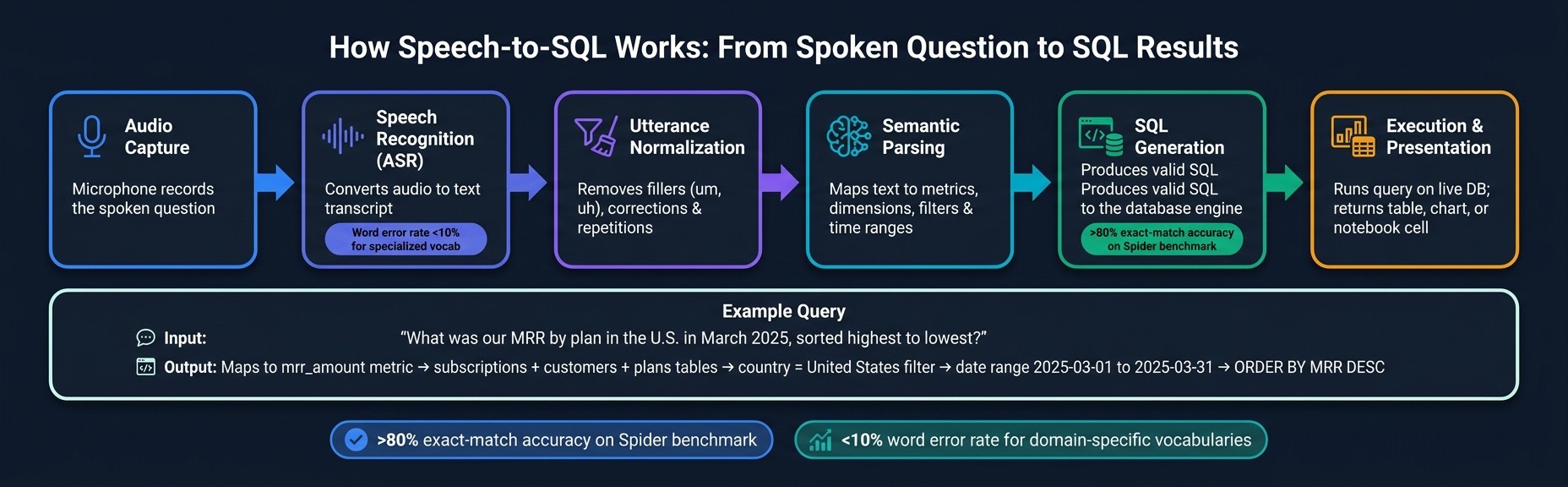
How Speech-to-SQL Works: 6-Stage Pipeline from Voice to Results
Speech-to-SQL is a system that takes a spoken business question, converts it into text, aligns it with your data model, and generates SQL queries that can directly run against a live database. The SQL it produces is tied to actual database tables and columns, ensuring accuracy and relevance.
From Spoken Question to Executed Query
The process involves six key stages, each transforming the user's spoken input into actionable database results:
Stage | What Happens | Key Consideration |
|---|---|---|
Audio capture | The microphone records the spoken question | Clear audio is crucial for accuracy |
Automatic Speech Recognition (ASR) | Converts audio into a text transcript | Must recognize domain-specific terms like "ARR" or "MRR" |
Utterance normalization | Removes fillers ("um", "uh"), corrections, and repeated words | Spoken language often needs more cleanup than typed input |
Semantic parsing | Maps text to schema elements like metrics, dimensions, filters, and time ranges | A well-defined semantic layer is essential |
SQL generation | Produces a valid SQL query tailored to the database engine | The query must align with the schema and perform efficiently |
Execution and presentation | Runs the query on the database and presents results as a table, chart, or notebook cell | Users should be able to review and modify the SQL if needed |
Here’s an example: Imagine a SaaS revenue leader asks, "What was our monthly recurring revenue by plan in the U.S. in March 2025, sorted from highest to lowest?" The system transcribes and normalizes the question, then maps terms like "monthly recurring revenue" to the mrr_amount metric in the subscriptions table, "plan" to the plan_name dimension, and "U.S." to a country = 'United States' filter. It generates SQL that joins the subscriptions, customers, and plans tables, applies the date range (2025-03-01 to 2025-03-31), and sorts results by MRR in descending order.
Modern Text-to-SQL models have achieved over 80% exact-match accuracy on benchmarks like Spider, showing they can reliably handle a wide range of business queries - not just simple ones.
Next, let’s look at how speech-to-SQL stands apart from its text-based counterpart.
How Speech-to-SQL Differs from Text-to-SQL
Although Text-to-SQL and speech-to-SQL aim to achieve the same outcome, spoken input brings unique challenges that typed text does not.
Typed queries are usually polished. For example, a user typing "Show me Q1 2025 revenue by region" has already structured their request. In contrast, a spoken version might sound like: "Uh, can you show me - actually, just Q1 this year - revenue, broken down by region?" The ASR system must transcribe this accurately, the normalization layer has to clean up fillers and mid-sentence corrections, and the semantic parser must reconstruct the user’s intent.
Spoken queries can also be incremental. A user might say, "Revenue by state last quarter", then follow up with, "Now just the East Coast", and later, "Drill into New York and California." Each follow-up refines the previous question, requiring the system to maintain session context. Words like "now" and "just" must be interpreted as adjustments to the existing query, not new standalone questions.
Another challenge is domain-specific vocabulary. Enterprise ASR systems need to correctly identify terms like "pipeline coverage", "SKU", or "net dollar retention", which generic voice models might misinterpret. Companies tackle this by fine-tuning ASR models with their own schema names and metric definitions, reducing word error rates to below 10% for specialized vocabularies.
In short, speech-to-SQL isn’t just Text-to-SQL with voice input. It demands a robust pipeline - from audio capture to semantic mapping - and a semantic layer that consistently interprets business terms, no matter how they’re phrased aloud.
Why Speech-to-SQL Matters for BI Teams
Speech-to-SQL isn’t just a flashy feature; it’s a practical tool addressing a key challenge in business intelligence (BI): the delay between asking a question and getting a data-driven answer. By translating voice commands into SQL almost instantly, it slashes decision-making time from hours - or even days - to mere seconds. This kind of speed transforms how BI teams operate.
Removing Barriers for Non-Technical Users
Business users like sales directors, operations managers, and finance leads often know exactly what they need to find out. What they usually don’t know is how to write complex SQL queries. Speech-to-SQL eliminates the need for technical expertise entirely.
Imagine a regional sales director during a morning meeting simply asking, "What’s the week-over-week revenue by region in dollars for the last eight weeks?" Instead of struggling with dashboards or filing a request with the data team, they get an answer in seconds. The system handles everything: transcribing the question, mapping it to the correct schema, and generating the SQL query. No need to understand syntax, date functions, or table joins.
This is what self-serve analytics should look like - accessible and fast. But it’s not just about ease of use; the timing of the data is just as important.
Querying Live Data in Real Time
The value of speech-to-SQL increases when it works with live data. After all, the usefulness of an answer depends on how fresh the data is. If the system pulls outdated information, it risks leading to poor decisions.
With speech-to-SQL, the SQL queries directly hit live data warehouses like Snowflake, Google BigQuery, or Amazon Redshift, ensuring the results reflect the latest updates and transformations. This is critical for decisions that require up-to-the-minute accuracy, such as managing same-day logistics, tweaking an e-commerce promotion, or monitoring revenue trends throughout the day.
Of course, querying live data comes with trade-offs. Running queries on live warehouses can be more resource-intensive, requiring strategies like materialized views, clustering, and aggregates to keep response times fast enough to feel natural. Cached or pre-extracted data may save on compute costs but risks being out of sync with the trusted dashboards finance and operations teams rely on.
Keeping Metrics Consistent with a Governed Semantic Layer
For speech-to-SQL to work effectively, it needs a governed semantic layer to ensure spoken terms map to consistent, standardized metrics. This layer connects business terms to predefined definitions, ensuring accuracy across all tools. For example, “monthly recurring revenue” will always resolve to the mrr_amount metric, complete with the correct filters, time settings, and U.S. dollar formatting. Similarly, “active customer” will follow the same logic whether it’s queried through a voice command, a dashboard in Looker, or a scheduled report.
A well-structured semantic layer should cover key entities like customers, accounts, and orders, along with standard metrics such as revenue, gross margin, and churn. It also needs to account for fiscal vs. calendar time and handle nuances like refunds or trial periods. With this foundation in place, speech-to-SQL can safely empower non-technical users without compromising the consistency and accuracy that the BI team has worked hard to establish.
Challenges and Opportunities in Speech-to-SQL
Technical Challenges: Noise, Schema Mapping, and Query Accuracy
Speech-to-SQL takes the issues of text-to-SQL models and layers on the complexities of voice input. Problems like background noise, accents, speech disfluencies, and industry-specific jargon can disrupt the process before any SQL is even created.
Even the best automatic speech recognition (ASR) systems struggle in less-than-ideal environments. In real-world enterprise settings - like open offices, conference rooms, or a sales rep using a phone - word error rates can jump to 10–20% or more. One misheard word can completely derail the accuracy of a query.
Another sticking point is the disconnect between natural speech and how data is structured. For instance, a user might say "revenue", but the database might store it as fact_orders.revenue_usd, complete with filters for refunds, trials, and currency adjustments. Similarly, saying "last quarter" could mean calendar Q3 or a company’s fiscal Q3, depending on the context. Resolving these mismatches requires more than simple pattern recognition - it demands a deep understanding of the data model.
Query complexity adds yet another layer of difficulty. Straightforward requests like "total sales this week" are easier to handle, but more intricate queries - think multi-table joins, nested logic, or precise time filters - often result in lower accuracy. Tackling these challenges requires not just technical solutions but also strong governance to ensure reliability.
Governance and Transparency in Enterprise Deployments
Technical accuracy alone isn’t enough. For speech-to-SQL to succeed in enterprise environments, transparency is critical. If a voice-generated query can’t be verified, it becomes a risk. To build trust, every answer must be traceable back to the exact SQL and business logic that produced it.
This is why inspectable SQL is a must in enterprise settings. For example, if a finance lead asks for gross margin by product line, they - or their analyst - should be able to review the generated query, confirm the metric definitions, and verify the joins. Without this, organizations risk making decisions based on data they can’t fully trust or audit.
Consistency is another key issue. If the term "active customer" is interpreted differently by the voice interface than it is in Looker dashboards or dbt metrics, it creates conflicting versions of the truth. A centralized semantic layer - where joins, metrics, and business definitions are standardized and reused across all interfaces - is essential. Without this, adding a voice interface to your BI stack could unintentionally introduce more inconsistencies than it resolves.
What Speech-to-SQL Opens Up for BI Teams
When these technical and governance challenges are addressed, the benefits of speech-to-SQL are hard to ignore. One of the biggest advantages is eliminating the ticket queue. Right now, if a business stakeholder needs a custom data cut, they submit a request, wait a day or two, and receive a static report. With speech-to-SQL connected to live warehouses like Snowflake, BigQuery, or Redshift, that same stakeholder could simply ask their question during a meeting and get an answer on the spot.
This shift doesn’t replace analysts - it repositions them. Instead of spending their time on repetitive query requests, analysts can focus on higher-value tasks like modeling and data interpretation. Routine questions become automated, self-serve, and governed, freeing up analysts for more impactful work. For data teams constantly stretched thin by growing analytics demands, this is a game-changer.
There’s also a major accessibility angle. Voice interfaces remove barriers for users who might struggle with dashboards, aren’t familiar with data tools, or are working in situations where typing isn’t practical - like field operations, executive discussions, or mobile workflows. When all it takes is speaking a question, accessing data becomes almost effortless.
How Querio Fits into a Speech-to-SQL BI Workflow
Addressing schema mapping, metric consistency, and transparent query output is essential for deploying speech-to-SQL systems effectively. These aren't just technical hurdles - they're foundational decisions that can make or break a system in production. Querio tackles these issues head-on, eliminating the need for a separate data stack. Here's how Querio makes it work.
Live Connections to Data Warehouses
Querio connects directly to major data warehouses like Snowflake, Google BigQuery, Amazon Redshift, ClickHouse, PostgreSQL, MySQL, MariaDB, and Microsoft SQL Server. This means it can query live production tables without requiring data extracts or duplication. With this setup, voice queries always pull real-time data instead of outdated snapshots.
For instance, if a sales leader asks, "What was our total revenue in USD last week by region?", Querio runs the SQL directly on Snowflake, respecting the warehouse's built-in features like time zones, row-level security, and access controls. This live connection eliminates delays and ensures that modern BI workflows meet real-time demands. Companies using Querio have reported reporting cycles that are 20 times faster compared to traditional BI setups [2].
A Shared Semantic Layer for Consistent Metrics
Consistency is key in speech-to-SQL systems, and Querio achieves this through a shared semantic layer. This layer defines joins, metrics, and business terms in one place, ensuring uniform logic across all outputs. Whether someone says "monthly active users", "MAU", or "active customers per month", Querio maps these variations to the same metric definition.
This shared layer also allows teams to encode U.S.-specific conventions, such as fiscal calendar definitions, revenue in USD, or regional hierarchies, as reusable, version-controlled logic. When a definition changes, Querio automatically applies the update to future queries, eliminating the metric fragmentation that often plagues BI tools. This ensures that reports are consistent and aligned across the board [3].
Inspectable SQL That Teams Can Trust and Edit
Transparency is another area where Querio shines. It doesn't just deliver results - it shows the exact SQL and Python logic behind every query. This is done through a reactive notebook interface [1]. For example, if a finance lead asks, "Show me year-over-year revenue growth in dollars for the last four quarters", Querio not only generates the visualization but also displays the SQL used, including joins, filters, and date logic.
This level of transparency allows analysts to verify, tweak, and save the code as reusable notebook cells or dashboard tiles. Instead of starting from scratch, teams can turn one-off voice queries into long-term analytic assets. This approach directly addresses governance and auditability, which are crucial for enterprise use [1][2].
Growdash co-founder Enver noted that switching to Querio from traditional BI tools saved the company over $200,000 annually while also reducing their reliance on data analysts [1][2].
Aspect | Standard Speech-to-SQL | Speech-to-SQL with Querio |
|---|---|---|
Data Freshness | Often relies on stale extracts/cubes | Executes live queries on Snowflake, BigQuery, and more |
Metric Consistency | Definitions may vary per query | Uses a shared context layer for uniform metrics |
Transparency | Results only, no query logic shown | Full SQL/Python code visible for every query |
Reusability | Produces one-off answers | Allows saving analyses as notebooks or dashboards |
Governance | Logic hidden in generated SQL | Versioned definitions managed by the data team |
Conclusion: Where Speech-to-SQL Is Headed in BI
Speech-to-SQL represents a major step forward in AI-powered, conversational analytics. It’s poised to become a key part of analytics workflows, especially for those spontaneous, on-the-fly questions that traditional dashboards often overlook. This growing trend depends heavily on real-time data access and a well-structured semantic framework.
Looking ahead, platforms that succeed in this space will likely share a few critical features:
Live connections to data warehouses like Snowflake, Google BigQuery, Amazon Redshift, and ClickHouse to ensure up-to-the-minute accuracy.
A governed semantic layer to align spoken terms with consistent metric definitions across the board.
Transparent SQL and Python outputs that analysts can easily review, modify, and repurpose.
Governance and transparency will set the leaders apart. As voice interfaces simplify querying, the sheer number and variety of queries will skyrocket. Without carefully managed, versioned metric definitions, identical spoken queries could lead to inconsistent results. Transparency is equally crucial - businesses need clear visibility from query to visualization for audits and compliance. Plus, mismatches between voice-generated results and live data could quickly lead to a loss of trust.
Querio is a strong example of where speech-to-SQL is heading. By integrating live warehouse connections with a governed semantic layer, Querio ensures reliable and consistent results. Its design - featuring AI agents that produce real SQL and Python, a shared context layer maintained by data teams, and a reactive notebook environment - positions it as a scalable and trustworthy solution for the future of BI.
FAQs
How accurate is speech-to-SQL in real BI use?
Speech-to-SQL accuracy in business intelligence relies heavily on a governed context layer that bridges natural language with business logic. Since roughly 20% of queries can be unclear, the best tools address this by asking follow-up questions to refine user intent. By predefining metrics, joins, and terminology, platforms such as Querio ensure SQL outputs are precise, consistent, and seamlessly linked to live data sources like Snowflake, BigQuery, and Postgres.
What is needed to deploy speech-to-SQL safely?
To roll out speech-to-SQL securely, it's crucial to build a controlled infrastructure prioritizing data security, consistency, and restricted access. Start by setting up standardized metrics, clearly defined business logic, and well-structured table relationships. Use read-only, encrypted database connections to protect your data, and implement role-based access controls that align with your existing warehouse permissions.
Additionally, choose platforms that are SOC 2 Type II compliant and offer enterprise-grade authentication. This ensures natural language queries remain secure, traceable, and meet compliance standards.
How do voice queries stay consistent with our metrics?
Voice queries in Querio operate within a structured business context layer. During setup, data teams establish standardized metrics, glossary terms, and table relationships, creating a unified framework that the AI adheres to. This setup ensures that natural language queries consistently align with these predefined rules. For example, terms like revenue or active customers are always interpreted the same way, removing any ambiguity and delivering reliable, consistent insights to all users.
Related Blog Posts