Business Intelligence
AI Powered Analytics for Better Business Strategy
Turn live data into faster, accurate decisions with AI analytics, natural-language queries, and a shared semantic layer for consistent, governed insights.

AI-powered analytics is changing how businesses make decisions. By turning complex data into real-time insights, companies can act faster, make better predictions, and improve efficiency. For example, Walmart used AI in 2024 to cut inefficiencies by 15% and reduce product shortages by 30%. Tools like Querio simplify this process by allowing anyone to query live data in plain English, without needing technical expertise.
Querio’s key features include:
- Natural Language Querying: Ask questions in plain English and get instant answers.
- Shared Semantic Layer: Ensures consistent metrics across teams.
- Live Data Connections: Access up-to-date information directly from data warehouses.
To succeed with AI analytics, businesses should:
- Assess current analytics processes and identify inefficiencies.
- Ensure data infrastructure is ready for AI.
- Align teams and define clear governance policies.
Querio helps businesses move from static planning to a continuous data-driven decision making process, improving accuracy, efficiency, and collaboration across departments.
AI for Business: Strategy and Planning
::: @iframe https://www.youtube.com/embed/c3jPp9VSqc8 :::
sbb-itb-284a532
Evaluating Your Business for AI Analytics
Before diving into AI analytics, it’s crucial to assess your current analytics capabilities. A staggering 96% of organizations encounter obstacles - mainly due to inadequate preparation - with 30% of generative AI projects being abandoned after the proof-of-concept stage by the end of 2025 [3][5].
However, companies that prepare thoroughly often reap impressive rewards. For instance, in 2023, a global beauty brand consolidated 14 data sources into an AI-powered demand planning system, boosting its annual bottom line by 2% [1]. Similarly, a multinational company with three primary product lines adopted an AI-driven business planning platform, leading to $50 million in additional revenue and a $100 million reduction in yearly working capital needs [1].
Reviewing Your Current Analytics Process
Start by mapping out your decision-making process. Look for inefficiencies in areas like query response times, dashboard updates, and decision cycles. If your planning team spends more time manually piecing together data than analyzing it, that’s a clear sign of trouble.
Take PwC’s example: In October 2025, the firm implemented SAP’s AI copilot, Joule, to optimize financial operations. This tool allowed natural language interactions with ERP data, streamlining tasks like invoice matching and account reconciliation. The result? A 30% efficiency boost in financial operations [6].
To assess your readiness, consider running a structured "Go/No-Go" workshop. Evaluate key factors such as data volume, variety, ethics, and quality [2]. Ensure your internal data is both accessible and relevant to your business challenges. If your team’s confidence in these areas is shaky, more groundwork is needed before AI can deliver value.
With a clear understanding of your current processes, the next step is to align your infrastructure and teams for AI adoption.
Requirements for Successful AI Integration
Integrating AI successfully hinges on three critical elements: a compatible data infrastructure, strong governance, and well-aligned teams.
First, confirm that your data warehouse can support the computational demands of modern AI analytics [3]. Outdated systems could hinder AI performance.
Second, audit your data quality. Feeding AI low-quality or unstructured data can lead to flawed outcomes [5]. As Michał Sadowski, Founder and CEO of Brand24, emphasizes:
"The biggest mistake is isolating AI within just technical departments. Instead, make AI everyone's responsibility" [5].
This requires clear governance policies and ensuring everyone understands how metrics are defined and used.
Finally, focus on team alignment. Data analysts should transition from writing endless SQL queries to defining metrics and semantic layers and managing AI model outputs. Meanwhile, business planners should shift from manual data aggregation to exception-based reviews and strategic risk management [1]. Consider DBS Bank’s approach: under CEO Piyush Gupta, the bank implemented 350 AI use cases between 2022 and 2024, doubling its economic impact from S$150 million to S$370 million, with projections surpassing S$1 billion by 2025 [4].
Once these foundations are in place, you can dive into how Querio’s core features can elevate your analytics.
Core Features of Querio for Business Analytics
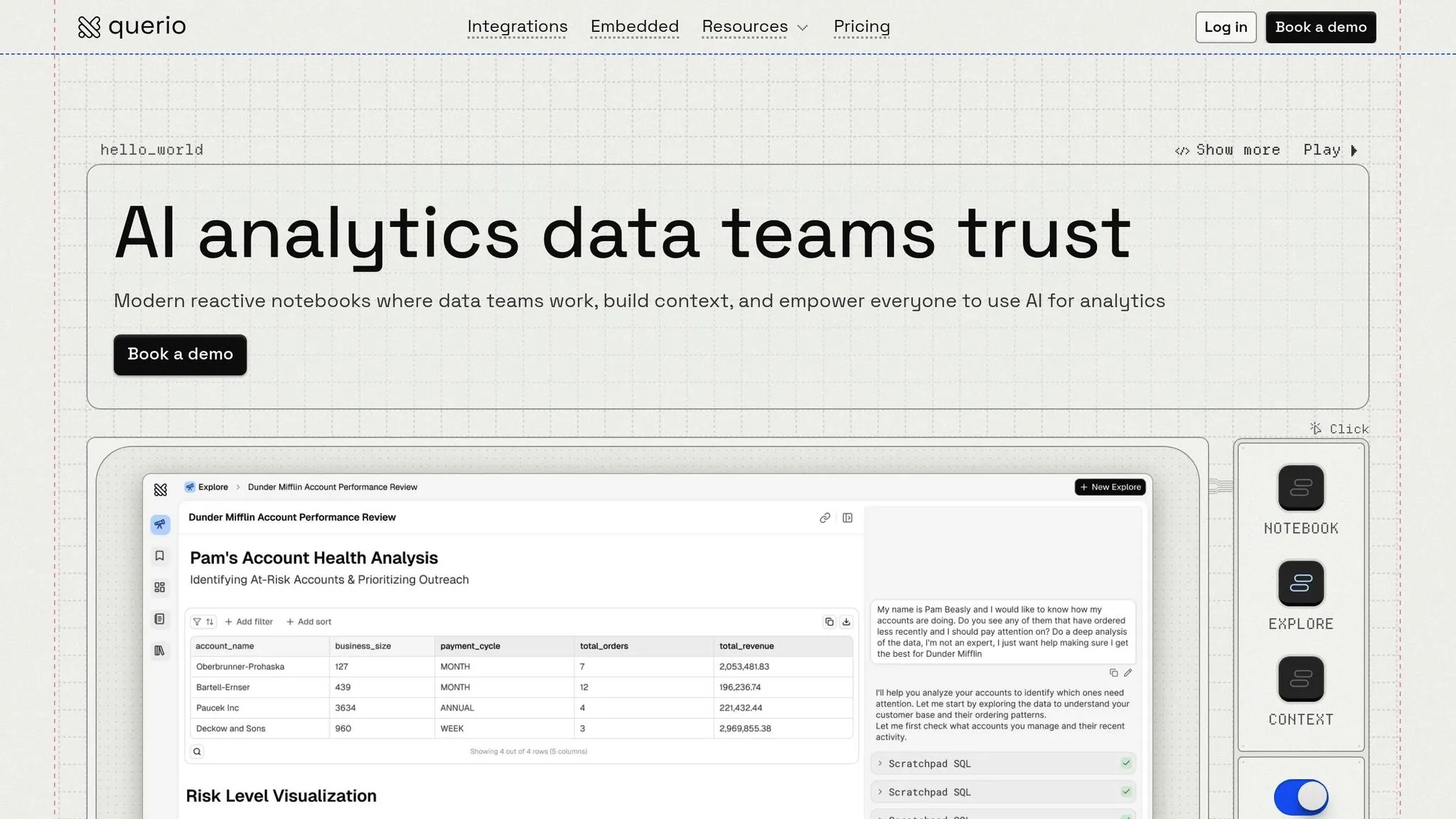
When your infrastructure and teams are ready, Querio acts as the bridge between business questions and analytical answers, all while maintaining data accuracy and governance. Let’s dive into how Querio’s standout features make this possible.
Natural Language Querying with AI Agents
Querio transforms plain English queries into precise SQL or Python code, eliminating the technical challenges that often slow decision-making. For example, frontline teams can ask, "Which customer segments have the highest lifetime value and are most likely to churn next quarter?" and instantly receive actionable insights. This kind of efficiency aligns with findings from McKinsey's 2025 AI Index, which notes that companies consistently retraining their models make operational decisions 28% faster [7].
What sets Querio apart is its transparency. Every query it generates is fully inspectable and reusable. You can review the exact SQL or Python code behind the results, ensuring trust in the process. By embedding this transparency into workflows, decision-making evolves from periodic manual analysis to continuous, data-driven actions.
Shared Semantic Layers for Consistent Metrics
Inconsistent metric definitions across teams can lead to conflicting strategies. Querio solves this by introducing a shared semantic layer that centralizes metric definitions, business logic, and data relationships. This ensures all teams rely on the same calculations, fostering alignment across the organization.
The semantic layer also enhances Querio’s AI agents by reducing query complexity. Pre-defined relationships and consistent logic help ensure analyses are accurate and aligned with company-wide standards, making it easier for teams to act confidently on the insights provided.
Live Warehouse Connections for Real-Time Data
Querio integrates directly with your existing data warehouse - whether it’s Snowflake, BigQuery, Amazon Redshift, ClickHouse, or PostgreSQL - using secure, read-only credentials. This setup allows teams to access up-to-date data without the need to duplicate environments, keeping governance centralized and security intact.
These live connections are particularly useful for time-sensitive decisions. For instance, marketers can adjust campaigns based on current customer behavior, or supply chain managers can optimize operations using real-time inventory data. By querying the warehouse directly, Querio reduces latency, enabling swift, informed responses when timing matters most.
Implementation Roadmap for Querio
::: @figure 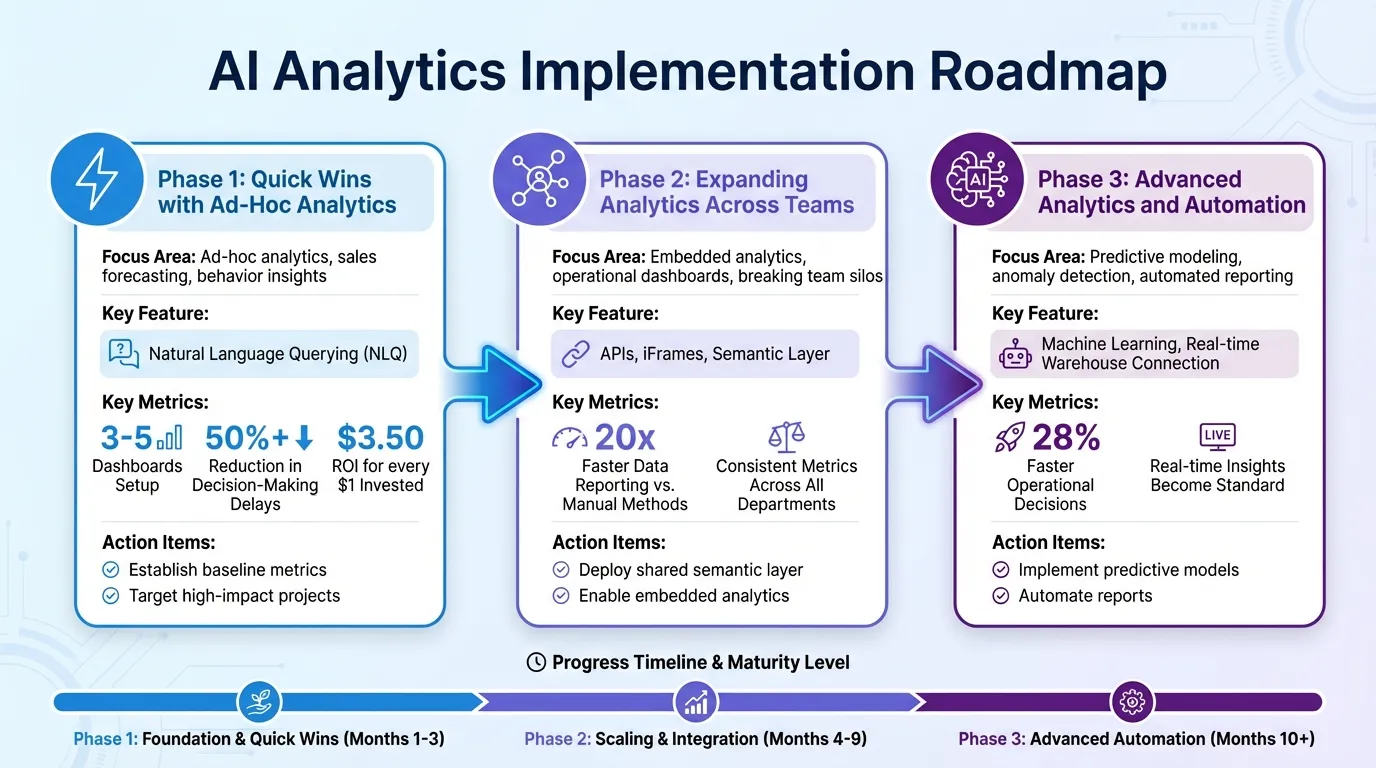 {3-Phase AI Analytics Implementation Roadmap}
:::
{3-Phase AI Analytics Implementation Roadmap}
:::
Rolling out AI-powered analytics doesn’t have to disrupt your current operations. By taking a phased approach, you can show results quickly, build confidence within your organization, and expand steadily. Here’s a breakdown of how to implement Querio effectively for the best results.
Phase 1: Quick Wins with Ad-Hoc Analytics
Start by targeting projects that are both high-impact and easy to execute. Focus on areas like sales, marketing, or customer service - teams that often face repetitive questions but lack direct access to data. Querio’s natural language querying removes the need for complex SQL, cutting query times from minutes to seconds. This empowers non-technical users to independently get the answers they need.
Set up 3–5 dashboards that address critical business questions. Use a scoring matrix to evaluate each project’s Business Impact and Technical Feasibility. For instance, automating tasks like sales forecasting can save significant time with live data connections. Companies using AI-enhanced dashboards have reported cutting decision-making delays by over 50%.
Before launching, it’s crucial to establish baseline metrics - such as the time currently spent on generating reports or customer acquisition costs. These benchmarks help measure ROI, with AI analytics typically delivering $3.50 for every $1 invested. Define a clear "North Star" metric for the pilot to keep everyone aligned on what success looks like.
Once these early wins are achieved, use them as a foundation to expand analytics across the organization.
Phase 2: Expanding Analytics Across Teams
After proving the value of Querio in the pilot phase, the next step is to extend its use across departments. This is where the shared semantic layer becomes essential. It ensures that all teams operate with consistent metric definitions and business logic, avoiding discrepancies like marketing and finance calculating customer lifetime value differently.
Querio also enables embedded analytics for external, customer-facing applications via APIs and iFrames. By reusing the governed logic from internal dashboards, you maintain accuracy while avoiding redundant work. This streamlines reporting and allows role-specific views, encouraging adoption and freeing teams to focus on more strategic initiatives.
With Querio, data reporting can be up to 20 times faster than traditional manual methods, giving analysts more time for high-value tasks.
Phase 3: Advanced Analytics and Automation
Once analytics are fully integrated across teams, you can move into predictive modeling and automation to deepen your insights and improve decision-making. Querio’s advanced capabilities allow for predictive modeling and enterprise-wide automation. For example, anomaly detection in BI dashboards can help your team proactively address issues, while machine learning can refine forecasts for demand planning or inventory management.
Real-time insights become the norm as reports and dashboards are automated with live data connections. As Peter Murphy, CEO of Track Spikes, puts it:
"AI doesn't take over instinct yet AI sharpens instinct and speeds it up" [5].
At this stage, Querio becomes an integral part of daily operations, helping you adapt strategies based on real-time conditions rather than outdated data snapshots.
| Implementation Phase | Focus Area | Key Querio Feature |
|---|---|---|
| Phase 1: Quick Wins | Ad-hoc analytics, sales forecasting, behavior insights | Natural Language Querying (NLQ) |
| Phase 2: Expansion | Embedded analytics, operational dashboards, team silos | APIs, iFrames, Semantic Layer |
| Phase 3: Advanced | Predictive modeling, anomaly detection, automated reporting | Machine Learning, Real-time Warehouse Connection |
How Querio Improves Business Strategy: Case Studies
These case studies show how Querio's real-time data connections and shared semantic layer directly impact business strategies in meaningful ways.
Case Study: Predictive Sales Forecasting
A fintech company was grappling with inaccurate sales forecasts, which led to missed revenue goals and inefficient resource use. Their analysts relied on spreadsheet models that became outdated even before forecasts were finalized. By adopting Querio, they connected their data warehouse to automated workbooks with live data updates, eliminating manual data pulls and reducing delays.
The impact was immediate. Forecast accuracy improved to 92%, cutting errors by 30%. Decision-making cycles became 25% faster, and the sales team experienced a 15% boost in conversions thanks to more dependable predictions. Additionally, smarter inventory planning - driven by better forecasts - helped the company significantly cut overstock costs. Querio's shared semantic layer also resolved long-standing inconsistencies in metrics, setting the stage for tackling broader operational challenges, as seen in the next case study.
Case Study: Supply Chain Optimization
An e-commerce company struggled with rising costs tied to inefficient supply chain operations. Data was scattered across procurement, inventory, and logistics teams, making it tough to identify inefficiencies or predict demand. Implementing Querio's semantic layer allowed the company to unify supply chain metrics and enable cross-departmental analysis for the first time.
The results were impressive: a 20% reduction in costs, 35% faster inventory turnover, and 15% fewer delivery delays. Querio’s anomaly detection flagged excess inventory early, while predictive demand forecasting streamlined routing and warehouse allocation. Teams that previously operated in silos began collaborating through shared dashboards powered by live warehouse data. This shift turned supply chain management from a reactive process into a proactive, strategic advantage.
Measuring and Scaling Your AI Analytics Strategy
Key Metrics for Tracking Success
When evaluating the ROI of AI-powered analytics, it’s essential to look beyond just cost savings. Focus on four primary areas of value: time savings, capacity expansion, new revenue generation, and shifting team efforts to strategic tasks [11]. Interestingly, organizations using AI-driven KPIs are five times more likely to align their incentive structures with business goals compared to those sticking with outdated metrics [10].
Start by establishing baselines - document current cycle times, error rates, and costs for high-volume workflows. Then, track both outcome metrics (like dollars saved or earned) and process metrics (such as query resolution time) [11][12]. For example, if your finance team spends 12 hours a week on sales reports, measure how tools like Querio reduce that time while improving forecast accuracy.
Don’t forget to calculate the Total Cost of Ownership (TCO), which includes ongoing expenses like data cleaning, cloud computing surges, and model retraining [12]. The most effective AI implementations measure across multiple dimensions: financial impact, customer satisfaction, operational efficiency, and team learning. This broader focus helps avoid tunnel vision on any single metric [9][12].
By tracking these metrics, you’ll create a feedback loop that drives consistent improvements in your analytics strategy.
Continuous Improvement with Querio
Once you’ve established clear metrics, the next step is ensuring continuous improvement. This means scaling your analytics from isolated successes to organization-wide adoption. Querio’s reactive notebooks and versioned logic make this seamless. For instance, when your data team updates a revenue calculation in the semantic layer, every downstream report is updated automatically. Querio’s shared semantic layer ensures that updates to core metric definitions immediately ripple through all connected analyses, reinforcing its role as a backbone for continuous improvement.
Start with high-impact, repetitive tasks like lead scoring or invoice processing to demonstrate ROI quickly [13][14]. Keep an eye on scalability KPIs, such as time to value, cost per model, and upskilling rates. Regular audits of your AI models are also crucial to address issues like model drift as market conditions change [13][14]. Establish governance policies early to manage data access, usage, and accountability. This is particularly important when using a semantic layer as a data interface for LLMs to ensure AI-generated insights remain accurate and secure. This helps prevent "shadow AI" and ensures compliance with regulations like GDPR or CCPA [13][14]. As Professor Iavor Bojinov from Harvard Business School puts it:
"Trust increases when people know there are protections in place" [13].
Treat analytics as an ever-evolving system rather than a one-time project. Querio’s shared semantic layer builds a foundation of trusted, reusable definitions. Over time, as more users interact with it, the collective knowledge base grows stronger. This transforms analytics from a bottleneck into a scalable strategic advantage for your business.
Conclusion: Building Better Business Strategy with Querio
AI-powered analytics is transforming the way businesses make decisions. By speeding up insight generation and enabling strategies that adjust to real-time market changes, companies are making operational decisions 28% faster and experiencing conversion rate improvements of 22-27% with AI-driven approaches [15][8][7].
To get started, focus on impactful use cases like predictive sales forecasting or optimizing supply chains. From there, expand analytics access across your teams while maintaining control through Querio's centralized semantic layer. This approach takes analytics from being a bottleneck to becoming a scalable advantage, where every team member can instantly access actionable insights.
Querio stands out by prioritizing transparency and control. Unlike opaque AI tools for data analysis, Querio generates real SQL and Python code that your data team can review, refine, and manage. Updates to metrics automatically ripple through all reports, ensuring consistency and accuracy across the board.
The key to success lies in turning data into action quickly. Querio's phased implementation roadmap helps you achieve early wins while working toward full-scale automation. Whether you're reallocating resources, identifying market trends, or fostering collaboration across departments, Querio lays the foundation for agile, data-driven decision-making.
Say goodbye to static planning and embrace continuous insights. Querio's live connections to your data warehouse and AI agents empower every team member with immediate access to accurate and consistent data - all while maintaining governance and precision.
FAQs
::: faq
How does Querio's natural language querying help teams make faster decisions?
Querio makes decision-making faster and easier by letting users ask questions in plain English - no technical skills, like SQL, required. This technology translates everyday language into database queries, providing quick access to insights that teams can act on.
By eliminating the need for IT support or complicated data tools, Querio empowers non-technical team members to explore data independently and get answers in real time. This not only cuts down on delays but also speeds up decisions and encourages a more flexible, data-focused way of working across organizations. :::
::: faq
How can businesses prepare to integrate AI-powered analytics into their operations?
To make the most of AI-powered analytics, businesses should focus on a few essential steps:
- Check your data readiness: Make sure your data is accurate, consistent, and secure. Strong data management practices are key to maintaining quality and meeting compliance standards.
- Set clear goals: Pinpoint the areas or processes where AI can add the most value. Align these objectives with your broader business strategy to ensure a cohesive approach.
- Pick intuitive tools: Choose platforms that make AI adoption straightforward. Look for features like natural language interfaces and automated workflows to ensure analytics are easy for everyone to use.
- Support your team: Provide training to help employees effectively use AI tools. Encourage a data-driven mindset by promoting tools that are simple and self-service friendly.
- Plan for growth: Create a roadmap for integrating AI into your existing systems, ensuring the solutions can grow alongside your business needs.
By following these steps, businesses can adopt AI analytics more smoothly, paving the way for smarter decision-making and unlocking more value from their data. :::
::: faq
How does Querio's shared semantic layer help teams stay aligned with consistent metrics?
Querio's shared semantic layer bridges the gap between raw data and clear, standardized business terms, making it easier for teams to stay aligned. By translating complex data into language everyone can understand, it clears up confusion caused by inconsistent metrics or isolated data sources. The result? A unified approach to reporting and decision-making that keeps everyone on the same page.
With data governance at its core, Querio provides a single source of truth, ensuring all departments rely on the same definitions and metrics. This not only encourages collaboration but also improves efficiency and enables teams to make decisions that are both quicker and more dependable. Plus, its intuitive tools empower users - whether they're tech-savvy or not - to access accurate insights effortlessly. :::