Spoke and Wheel Model: A Practical Guide for Data Leaders
Learn the spoke and wheel model, how it differs from hub-and-spoke, and how data teams can apply it to scale analytics without becoming bottlenecks.
https://www.youtube.com/watch?v=2Xf0ACFGdQk
published
Outrank AI
spoke and wheel model, hub and spoke, data architecture, analytics strategy, data teams
b7b0856e-9ede-4f4b-80f4-dcd18fc3ff46

You've got the Slack channel open, five tabs of dashboards are already pinned, and another team just asked for “a quick answer” before noon. The request sounds small, but the problem is familiar, your analytics function has become the human API for the company, and every new question makes the center feel heavier.
The spoke and wheel model is the cleanest answer I've seen when a data team is no longer struggling with analysis quality, but with analysis distribution. It shifts routine access outward, keeps shared logic in one place, and forces a hard question that most diagrams dodge, what belongs in the center, and what should never be there at all.
Table of Contents
Why Data Teams Adopt the Spoke and Wheel Model
A small data team can survive a lot of chaos. It can live in Slack, answer fast, and keep the business moving while the company is still figuring out what it needs. Then the company grows, dashboards multiply, and every department starts treating the analytics group like an always-on service desk.
That's where the spoke and wheel model starts to make sense. It gives the team a central place to own shared definitions, access rules, and reusable assets, while pushing repeated work outward so analysts aren't rebuilding the same answer for every caller. In practical terms, that means product, finance, growth, and operations can move faster without forcing every question through a person.
Practical rule: If your analysts spend more time translating the same business logic than improving it, your operating model is already wrong.
The attraction isn't just speed. It's the advantage gained. A self-serve structure reduces dependence on individual analysts and makes it possible to standardize the work that should be standard, while still leaving room for local context where teams need it. That's also why the model pairs naturally with self-serve business intelligence, especially when the center can serve governed data without turning every request into a ticket queue, as discussed in this self-serve business intelligence guide.
The trade-off is real, though. A spoke and wheel model gives up some freedom in exchange for consistency, and the central team has to design for reuse, not heroics. If the hub is only a staffed queue, the organization hasn't escaped the bottleneck, it's just given it a nicer diagram.
What the Spoke and Wheel Model Actually Is
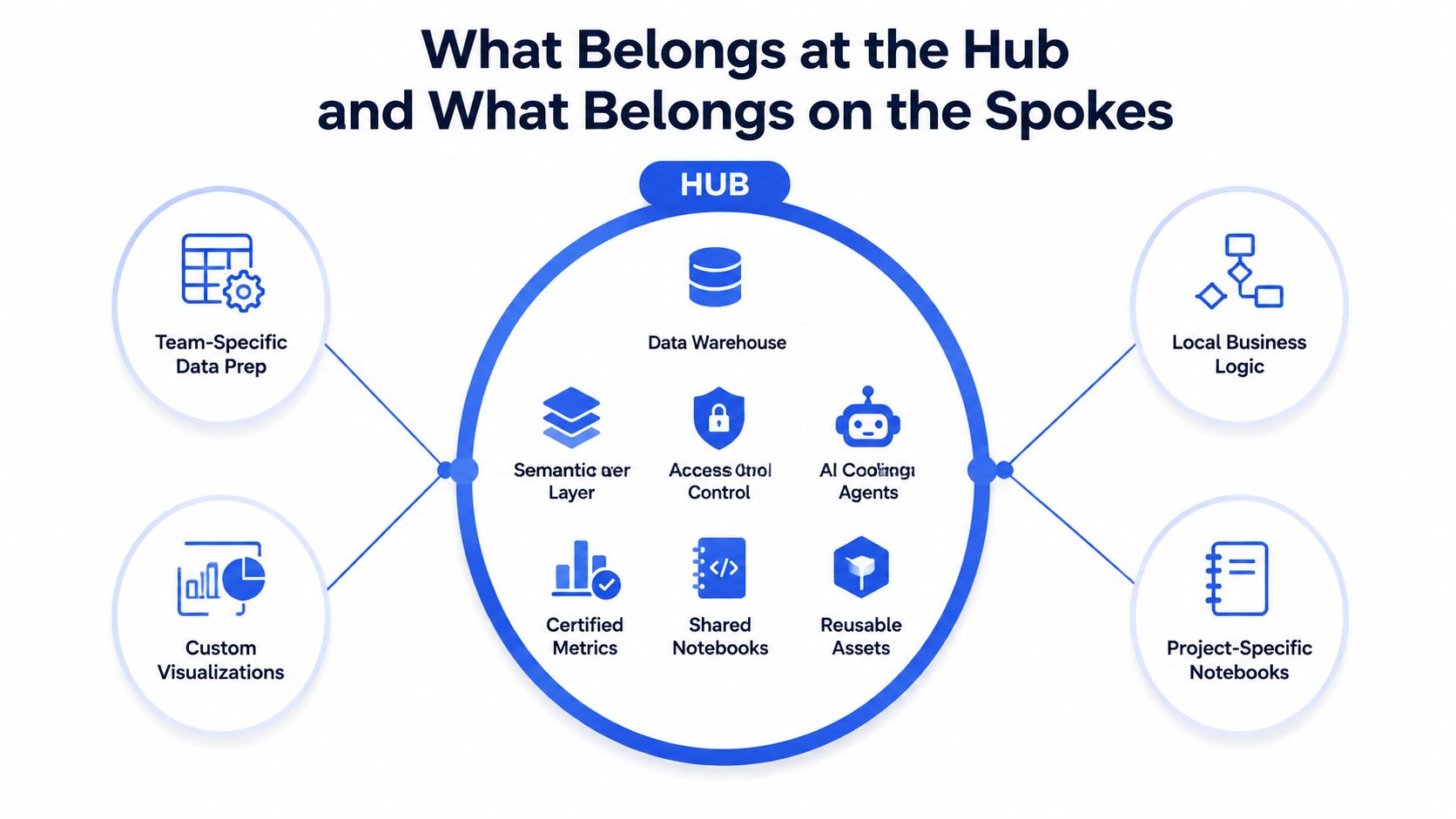
A spoke and wheel model starts with a simple distribution rule. The hub owns the shared core, and the spokes are the distributed users, teams, or surfaces that rely on it. In a data organization, the hub usually holds the warehouse, semantic layer, access control, certified metrics, and reusable assets. The spokes are the teams and products that consume those assets and add local context on top.
That core only works if it is a real point of shared truth. If the hub does not provide a common definition for metrics, access, and governed data, the model collapses into a loose coordination layer with a nicer diagram. For a closer look at what that kind of shared truth means in practice, see single source of truth in analytics.
The metaphor comes from a real engineering breakthrough. The spoked wheel emerged around 2000 BCE in Anatolia and Mesopotamia, and it replaced heavier solid wheels with a hub-and-rim structure connected by thin spokes, making vehicles lighter, faster, easier to repair, and more shock-absorbent than solid wheels. That design choice mattered because it did not just reduce weight, it changed how load moved through the structure, and that same logic still matters in data systems today. TyreSafe's history of the wheel captures that shift clearly.

The structure matters more than the shape
A wheel works because the rim, hub, and spokes each do different jobs. Spokes carry load primarily in tension, not compression, and a conventional bicycle spoke is typically about 2 mm in diameter and around 300 mm long. If a spoke goes into compression, the nipple at the rim can lift, which is why fatigue and periodic load cycling are central design constraints for reliability. Princeton's bicycle wheel design notes make that mechanical principle plain.
That is the useful lesson for data work. The hub should hold the load-bearing logic, the shared truth, and the controls that keep the system coherent. The spokes should not recreate that core, they should extend it into teams, products, and workflows that need it.
A wheel optimization study reinforces the same point. Geometry and material choices change performance, and the study lists spoke diameter, flange radius, rim and spoke elastic moduli, and spoke angle as key variables, with example moduli of 69,000 MPa for the rim and 193,000 MPa for the spoke. Keller's wheel optimization paper shows why this is not a decorative analogy. Load path, stiffness, and geometry determine whether the structure feels agile or fragile.
The wheel looks simple only after it has been engineered to absorb complexity.
Spoke and Wheel vs Hub and Spoke vs Mesh
These three topologies get mixed together constantly, but they don't behave the same way under pressure. In a hub-and-spoke setup, everything routes through the center. In a mesh, peers connect directly to one another with no dominant center. In a spoke and wheel model, the center coordinates the system, but execution is intentionally distributed so the center isn't doing all the work.
A useful way to compare them
Criterion | Hub and Spoke | Spoke and Wheel | Mesh |
|---|---|---|---|
Governance | Strong central control, but often manual | Strong central standards with distributed execution | Distributed, harder to standardize |
Latency to answer | Can be slower if the hub handles every request | Usually faster when the hub productizes access | Can be fast for peers, chaotic at scale |
Fault tolerance | Weak if the hub is overloaded | Better, because spokes can execute locally | High in theory, but coordination is expensive |
Scaling cost | Central staffing grows quickly | Shared assets scale better when designed well | Coordination cost rises across the network |
Ownership clarity | Clear at the center, fuzzy at the edge | Clear core ownership, clear edge ownership | Often ambiguous |
The old airline network is a good reminder that topology is strategy, not decoration. Delta Air Lines pioneered the modern hub-and-spoke model in 1955 with Atlanta at the center, and the model spread more broadly after U.S. airline deregulation in 1978. The spoke-hub distribution paradigm overview also notes that FedEx adopted the same idea in the mid-1970s for overnight package delivery, which is a strong clue that the pattern is about routing efficiency.
For data teams, the question is less “centralized or decentralized” and more “what kind of centralization are we buying?” A hub-and-spoke system can work when the center is the execution engine, but that usually becomes expensive as demand rises. A mesh can look elegant on paper, but it pushes coordination overhead onto every participant. The spoke and wheel model sits in the middle, which is why it's often the default for teams that need governance without turning the analytics group into the only place work can happen.
How the Model Works in Real Data Teams
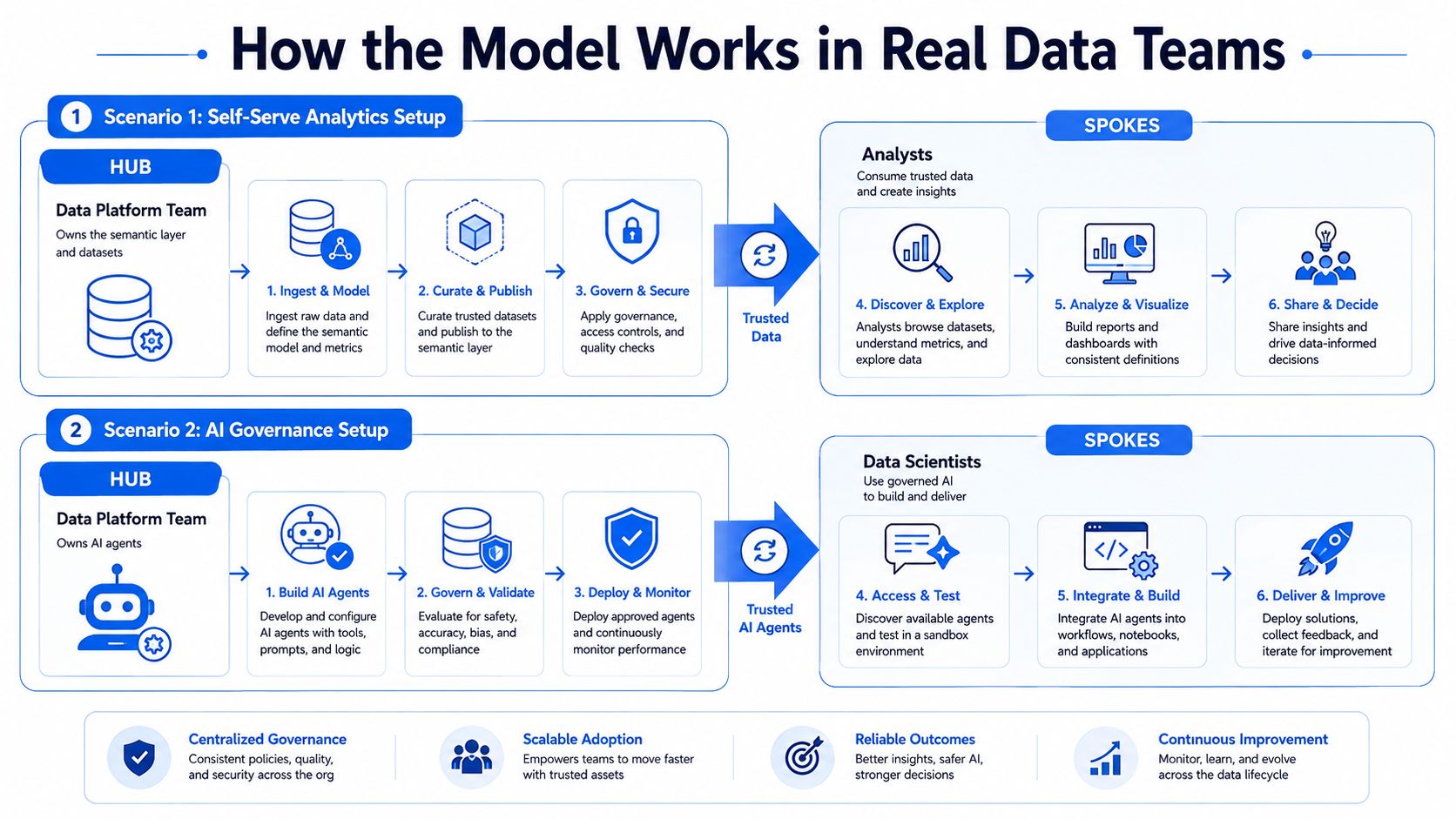
A self-serve analytics setup is the most visible version of the model in a modern data org. The hub owns the semantic layer, certified datasets, access rules, and the logic that keeps metrics consistent. Product, growth, finance, and operations become spokes, each with their own notebooks, dashboards, and analyses built on top of the same core.
The request flow matters. A product manager doesn't ask an analyst to rebuild the definition of activation every time. They use the shared layer, ask the question in their own context, and only escalate when the question requires new central logic. That distinction is what keeps the team from turning into a help desk.
Internal users are not the only spokes
The same pattern works for customer-facing data products. The hub can maintain a tenant-aware data layer, while spokes become the product surfaces that expose that data, onboarding views, embedded analytics, exports, and in-app reporting. In that setup, traffic spikes don't have to trigger a scramble in the analytics team, because the repeated work already lives in the center.
A good internal model also sets the company up for broader self-service, which is why many teams link the operating model to governance. A practical treatment of this balance is laid out in Querio's lean data teams and self-service analytics guide, and the distinction is important, the hub should create consistency, not dependency.
The core test is simple, who owns the logic, and who owns the last mile? If the hub does both, every new request becomes a queue. If the spokes do both, the company loses consistency and spends its energy reconciling definitions. The model works only when the center is deliberately narrower than the org chart.
What Belongs at the Hub and What Belongs on the Spokes
The hub should hold anything that creates a shared truth. That includes the data warehouse, the semantic layer, access control, certified metrics, reusable pipelines, shared notebooks, and AI coding agents that operate directly on the warehouse. Those components need to be centrally governed because duplication at that layer creates confusion faster than it creates autonomy.
The spokes should hold anything that depends on local context. Department-specific dashboards, one-off analyses, product experiments, customer-facing surfaces, and embedded analytics belong closer to the people who use them. They move faster there, and they don't need a central team to reauthor the same logic each time.
A decision rule that usually holds up
If a request changes how the company defines a metric, it belongs in the hub. If a request changes how a team uses that metric, it belongs on the spoke. That single distinction prevents a lot of wasted debate because it separates governance from presentation.
Operational rule: Pull shared logic toward the center, push contextual variation outward.
The bicycle analogy helps here. Since spokes carry load in tension, the hub should be designed to pull work toward it through defaults, tooling, and reusable assets, not through manual approvals. In practice, that means the best hub is one that makes the right path the easiest path. If a marketer can't self-serve a certified answer without filing a ticket, the center is still too weak.
This is also where geometry starts to matter, even for data teams that never touch a wheel. The engineering literature makes it clear that spoke angle and load transfer affect performance, which is a useful warning against overgeneralizing from a clean diagram. The more a team diverges from standardized data structures, the more carefully the hub has to manage dish angle, ownership boundaries, and reuse, or the model starts to wobble.
When the Hub Becomes the Bottleneck
The biggest lie in most architecture diagrams is that a central hub naturally improves access. In healthcare, that isn't always true. A review of hub-and-spoke care in rural India describes a model where local spokes handle basic care and the hub handles specialized care, but it also makes clear that the whole structure depends on whether the hub can absorb referrals, and whether transport and coordination work well enough to let patients move through the system. The rural healthcare review is the right source for this caution because it focuses on what happens when the center can't keep up.
That maps directly to data teams. If the hub is overloaded, the system doesn't feel centralized, it feels stuck. New spokes wait longer for access, analysts spend more time on governance than enablement, and teams start building parallel stacks because the official route is too slow.
Early warning signals
You don't need a fancy dashboard to spot the drift. The signs are usually visible in the work itself.
Ticket volume rises: The central team keeps getting the same request in different forms.
Shadow analytics appears: Spokes start maintaining their own definitions because the hub is too slow.
Parallel stacks emerge: Teams duplicate logic, even when they'd prefer not to, because speed beats consistency in the moment.
Escalations become routine: New work can't enter the system without a human gatekeeper.
The fix is not always to hire more analysts. Sometimes the right move is to push logic outward, productize the hub, or cap the number of spokes one hub is expected to serve. In other cases, the answer is more structural, split the hub, or create a second center for a different domain so the network doesn't overload one core.
If the center can't absorb demand, the company will route around it.
The contrarian point matters because many teams celebrate the existence of a hub without checking whether it reduces friction. A hub can improve standardization and triage even when it doesn't reduce total movement, but that only helps if the org measures the right thing. The key question is not whether a hub exists, it's whether referrals, answers, and escalation paths are reliable enough to make the model worth maintaining.
Implementing the Spoke and Wheel Model in Practice
Start by consolidating the semantic layer and access model. If every team has a different definition of revenue or activation, the rest of the model won't hold, no matter how pretty the interface looks. This is the moment to write down the shared metrics, centralize permissions, and decide which assets are certified.
Next, give spokes a way to work without waiting on an analyst. That means self-serve tooling, notebooks, and query agents that sit close to the warehouse and let technical and non-technical users answer their own questions within guardrails. A practical guide to the control side of that work is the self-service analytics governance guide, because governance isn't a review queue, it's the condition that makes self-service safe.
Phase the rollout instead of forcing a big bang
Stabilize the center. Make the warehouse, semantic layer, and access policy the authoritative source.
Enable the spokes. Give teams tools to analyze without requesting a one-off build each time.
Instrument the load. Track whether the hub is speeding up the org or just absorbing more work.
Rebalance the geometry. If one hub is serving too many teams, split the center or move more logic outward.
The engineering literature on wheel design is a useful reminder that spoke count, crossing pattern, and angle all affect performance. The same logic applies to a data organization. A single hub can only serve so many teams before clarity and response time both start to degrade, and the right response is often structural, not motivational.
For leaders thinking about operating model more broadly, it helps to read the startup org structure guide with this lens. The useful question isn't just how many managers or teams you have, it's which work needs a shared center and which work should live closer to the edge.
A Quarterly Checklist for Data Leaders
Ask four questions next quarter. Is the hub doing coordination or execution? Are spokes running on shared infrastructure, or building parallel stacks? Is time-to-first-answer for a new spoke going down? And what is hub saturation, before the center becomes the bottleneck?
If you can't answer those clearly, the model is already drifting. If you can, you'll know whether the spoke and wheel structure is still giving the business an advantage, or whether it's time to split, simplify, or move more work outward.
Querio helps data teams move from being the human API to owning self-service infrastructure on top of the warehouse. If you're trying to keep the hub lean while giving spokes faster access to governed data, explore Querio and see how AI coding agents and file-system workflows can reduce the bottleneck without losing control.