Business Intelligence
Will AI Replace Data Analysts? What Actually Changes (2026)
AI automates routine analytics but won’t replace analysts—humans still own metric definitions, QA, and judgment.

No - AI is not replacing data analysts in 2026. What I see instead is a job shift: AI now handles about 30%–40% of routine analyst work, like first-draft SQL, repeat reports, anomaly flags, and metric write-ups. But people still own the work that affects decisions: defining metrics, checking logic, adding business context, and making the final call.
If you work with Snowflake, BigQuery, Redshift, or Postgres, here’s the short version:
-
AI is good at first drafts
- SQL generation
- dashboard setup
- trend summaries
- anomaly detection
-
Analysts still own
- metric definitions
- review and QA
- business context
- stakeholder guidance
-
The main risk
- AI can return answers that look right but use the wrong joins, wrong logic, or the wrong metric meaning
-
What changes for BI teams
- lock core metrics in a shared semantic layer
- review AI output before it goes to leaders
- spend less time building and more time checking and advising
A few numbers make this clear. In examples from the article, SQL drafting time dropped from 10 minutes to 3 minutes, one team saw a 35% SQL-writing lift, and one 2026 pilot cut report work from 3.5 hours to 0.5 hours with human review still in place.
| Area | AI in 2026 | Analyst in 2026 |
|---|---|---|
| SQL | Drafts queries | Checks joins and logic |
| Reports | Builds first pass | Reviews before sharing |
| Metrics | Suggests formulas | Sets the company definition |
| Anomalies | Flags issues | Decides what they mean |
| Decisions | Supplies evidence | Recommends action |
So if you’re asking, “What work is left for analysts?” the answer is simple: the part that needs judgment. The article below explains where AI helps, where it fails, and how teams should change their BI process now.
::: @figure 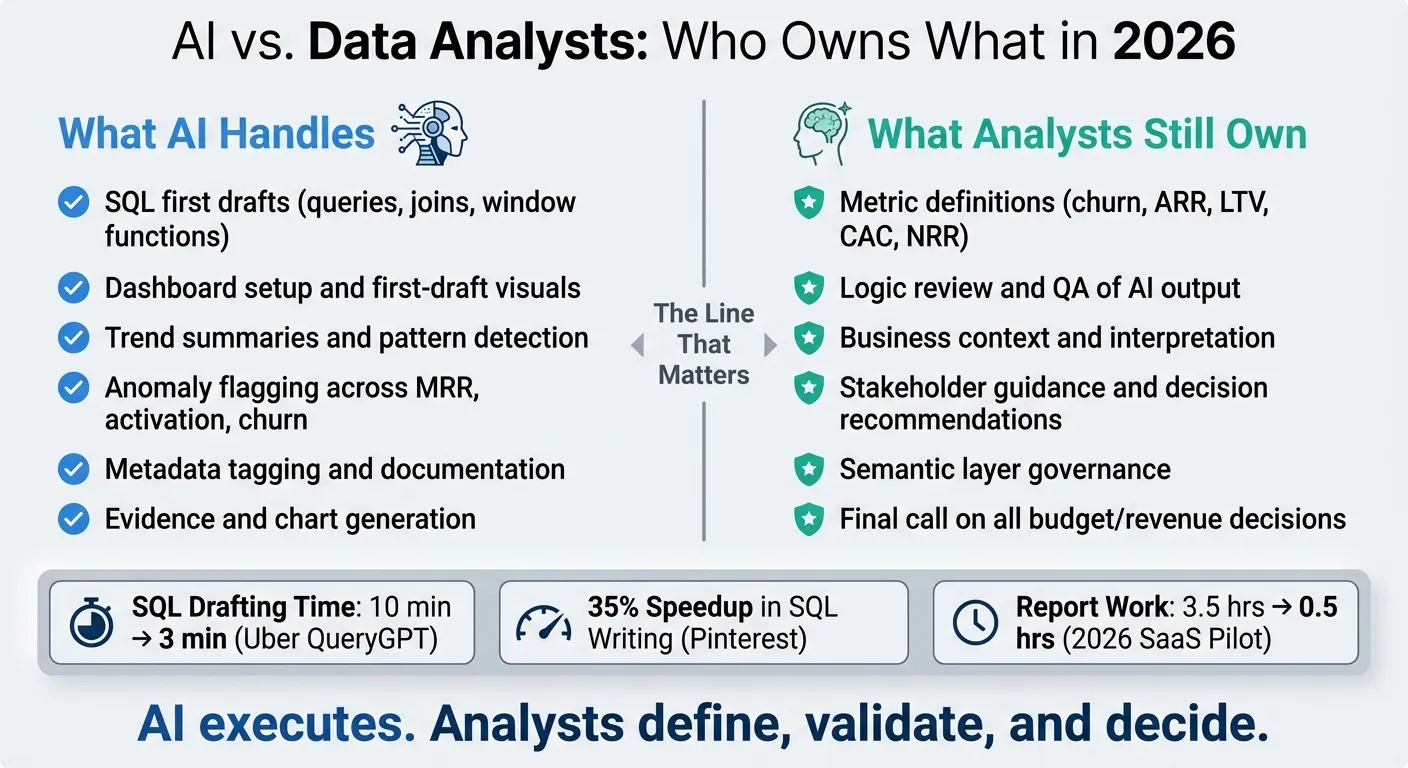 {AI vs. Analyst: Division of Labor in 2026 Data Teams}
:::
{AI vs. Analyst: Division of Labor in 2026 Data Teams}
:::
How AI Is Changing Analytics Workflows Today
What AI Can Already Do In Snowflake, BigQuery, Redshift, And Postgres Workflows
AI is changing analyst workflows by automating execution, not ownership.
In warehouse-native workflows, it can turn plain-English questions into SQL, including multi-join queries with window functions and aggregations. It can also draft dashboards, write metric summaries, flag anomalies across MRR, activation, and churn, and, in AI-driven workflows, profile a dataset, run queries, build charts, and return a narrative summary in one pass. The big win is time saved on query drafting.
The numbers make that pretty clear. Uber's QueryGPT cut query authoring from about 10 minutes to 3 minutes [1]. Pinterest's engineering team reported a 35% speedup in SQL writing after rolling out AI-assisted authoring [1]. In a Q1 2026 pilot at a mid-market SaaS company, weekly pipeline reports fell from 3.5 hours of manual work to 0.5 hours spent reviewing AI-generated output [2].
So the analyst's job starts to shift. Less time goes to building from scratch, and more time goes to checking, refining, and signing off on the output.
That speed only works when the model underneath it is clean.
Why AI Outputs Depend On Your Data Model
The limiting factor is the data model.
When schemas are messy or metric definitions aren't locked down, AI outputs can fail in quiet, risky ways. The model might pick the wrong join, use business logic that doesn't match the team's standards, or summarize a metric in a way that clashes with how the company defines it. Instead of saving time, analysts end up fixing the output.
That's where semantic drift creeps in: one metric, different meanings across teams.
AI also can't tell growth from a billing change unless the business context is baked in. If the system doesn't know how your company thinks about revenue, usage, or churn, it can produce answers that look right on the surface and still be off.
That is why the governance layer matters as much as the AI layer.
Where Querio Fits In An AI-Driven Analytics Stack
Querio is built to speed up self-serve analysis without taking control away from analysts.
It connects live to Snowflake, BigQuery, Redshift, and Postgres. It also shows the SQL or Python behind every answer, so people can inspect what the system did instead of taking the result on faith. On top of that, it uses a semantic context layer to keep definitions, joins, and business terms aligned across notebooks, dashboards, and ad hoc analysis.
That setup helps teams move faster without letting core metrics drift from one surface to another.
The next question is which tasks AI can own outright, and which still need an analyst.
sbb-itb-284a532
What AI Automates And What Analysts Still Own
Tasks AI Can Reliably Handle In 2026
By 2026, AI is good at the first pass.
It can write first-draft SQL, spin up dashboards, summarize trends, and flag anomalies. That’s the routine execution work - the stuff that eats up time but doesn’t call for much judgment.
But there’s a line it shouldn’t cross. Any analysis tied to budget, revenue, or customer-facing decisions still needs a human review. That line changes the analyst’s job in a big way. It’s not just about doing less manual work. It’s about spending more time checking, shaping, and deciding.
Work That Still Belongs To Analysts
The part AI still can’t own comes down to three things: problem framing, metric governance, and interpretation in context.
In a B2B SaaS company, that means taking a fuzzy business concern and turning it into a question you can measure. It also means deciding what terms like churn, product activation, or sales-qualified pipeline mean inside your business. Those definitions don’t appear out of thin air. Product, Sales, and Finance often see them differently, and someone has to work through that tension. AI can suggest language. It can’t settle the agreement.
Analysts also own the interpretation layer.
If a metric jumps, AI can spot it in seconds. What it can’t do is tell you, with confidence, whether that jump reflects actual growth or some shift in operations that bent the numbers. That’s where human judgment matters. Context changes the story.
The simplest way to put it is this: AI executes; analysts define, validate, and decide.
AI Role vs. Analyst Ownership In 2026: Side-By-Side Breakdown
Here’s the clearest way to split the work in 2026.
| Task | AI's Role In 2026 | Analyst's Role In 2026 | Risk If Left To AI Alone |
|---|---|---|---|
| SQL Generation | Writes boilerplate and standard joins | Reviews joins, validates business logic, and debugs edge cases | Syntactically correct but logically wrong joins |
| Dashboard Creation | Suggests chart types and generates first-draft visuals | Refines for stakeholder-ready narrative | Misleading chart types or lack of business context |
| Metric Summaries | Flags trends and summarizes recurring patterns | Interprets causes and determines action | Missing external context that explains data shifts |
| Anomaly Detection | Flags outliers across large datasets | Validates causes and determines action | False positives or ignoring known operational shifts |
| Metric Design | Suggests formulas based on existing documentation | Negotiates and locks definitions across departments | Definition drift; inconsistent numbers across departments |
| Semantic layer and governance | Automates documentation and metadata tagging | Owns the source of truth and governance | Multiple conflicting versions of core metrics or data privacy gaps |
| Executive decisions | Provides evidence and charts | Owns the final recommendation and strategic trade-offs | Decisions made without institutional context or ethical oversight |
That’s the real division of labor. AI handles more of the build work, while analysts move further into review and advisory work.
How The Data Analyst Role Is Shifting At Mid-Market SaaS Companies
At a mid-market B2B SaaS company, the data team is usually small compared with the number of people asking for answers across Product, Sales, Finance, and Customer Success. AI doesn't change that basic setup. What it does change is where analysts spend their time. In mid-market SaaS, you can already see that shift in the week-to-week work.
From Report Builder To Decision Partner
The biggest change is simple: analysts are spending less time building reports and more time explaining what the numbers mean. In mid-market SaaS, that matters a lot. Analysts are doing less output production and more thinking about how those outputs should shape a decision.
The bottleneck has moved from writing queries to interpreting results. That's a big deal. When SQL and dashboard work take less time, the hard part becomes judgment. Strong analysts use that space to explain why a metric moved, frame experiments, and show trade-offs before a team commits to a choice. In practice, judgment now matters more than raw production speed.
The Skills That Matter More In 2026
The skills gaining weight are the ones that stop bad analysis before it spreads and help teams stay aligned. On small data teams, the highest-value skills are audit literacy, metric governance, and stakeholder translation.
That means analysts need to:
- catch bad logic before it turns into a bad call
- lock metric definitions so teams aren't arguing over whose number is right
- turn analysis into a decision, not just a slide or chart
In other words, the job is less about pulling numbers and more about making sure those numbers can be trusted and used.
How Querio Keeps Analysts In Control As Self-Serve Expands
The big risk in self-serve analytics has always been definition drift. Two teams pull what looks like the same metric and end up with two different answers. AI can make that problem worse, not better, when it generates SQL on demand for non-technical users.
Querio keeps analysts in control with a governed semantic layer, editable SQL, and live warehouse connections to Snowflake, BigQuery, Redshift, or Postgres. So teams can still self-serve, but shared definitions stay consistent. That cuts down metric drift across teams, and every query Querio generates is visible and editable, which lets analysts inspect the logic behind any AI-generated result.
Once analysts own definitions and review, the BI process has to change with it.
How BI Teams Should Update Their Process In 2026
Start With A Governed Semantic Layer And Live Warehouse Access
Once AI starts drafting analysis, the bottleneck moves from production to governance.
So before you plug AI into your analytics stack, lock down your core metric definitions. ARR, NRR, CAC, LTV, and churn should live in a shared semantic layer. When those definitions are fixed, AI-generated answers stay consistent across teams and reporting cycles.
dbt is one way to define and version that logic. Querio lets teams define joins, metrics, and business terms once, then reuse them across ad hoc analysis, notebooks, dashboards, and AI-generated answers.
Add A Review Step For AI-Generated Analysis
AI should cut repetitive work, not remove analyst responsibility. Teams that handle this well add a light review step before any AI-generated analysis goes to leadership.
Before sharing a result, analysts should:
- check SQL lineage and row counts
- confirm that the metric definition matches what the business approved
- verify data freshness
- look for edge cases that could change the result
In one Q1 2026 mid-market SaaS pilot, analyst hours for recurring reports and ad hoc investigations dropped from 42 hours to 14 hours per month after adopting a hybrid agent model, with the saved time redirected to data quality projects. [2]
Querio makes that review step easier because every AI-generated answer shows the underlying SQL. Analysts can inspect it, edit it, and see what happened directly. No black box. No guessing what the tool did.
That’s the process shift BI teams need to plan for.
Traditional BI Workflow vs. AI-Augmented Workflow: What Changes
The biggest workflow shifts show up at intake, review, and distribution.
| Workflow Step | Traditional BI | AI-Augmented BI | New Analyst Responsibility |
|---|---|---|---|
| Intake | Email back-and-forth to clarify a report request | Goal framing: translating business intent into an executable goal | Negotiating precise metric definitions and comparison baselines |
| Modeling | Manual dbt/SQL modeling for every new request | Agent references pre-defined metrics in the semantic layer | Maintaining the source of truth and locking definitions |
| Distribution | Scheduled reports sent without context | AI drafts a summary of findings and anomalies | Adding business context AI can't know |
| Decision Review | Stakeholders interpret charts on their own | Human-validated insights delivered with clear provenance | Communicating what was automated vs. what was manually verified |
FAQs
::: faq
How much analyst work can AI automate today?
AI won’t replace data analysts in 2026. It can automate about 30%–40% of the repetitive, mechanical work that used to eat up analysts’ schedules.
Right now, AI does a good job with tasks like:
- writing standard SQL for known patterns
- cleaning and formatting data
- drafting recurring reports, visualizations, and summaries
But analysts still handle the parts that need human judgment. That includes business context, stakeholder communication, audit literacy, metric governance, and decision support. :::
::: faq
What mistakes should analysts watch for in AI-generated SQL?
Analysts should watch for bad joins, wrong row counts, filters that don’t belong, and schema mismatches that can produce results that look right but aren’t.
AI also tends to miss company-specific business logic, like revenue recognition rules or custom segmentation. And because it can hallucinate, human review still matters. Someone needs to check that the query matches the business as it actually works - not just a technical artifact. :::
::: faq
Which skills matter most for data analysts in 2026?
In 2026, the skills that matter most are judgment and accountability.
That means knowing how to ask the right question, make sense of fuzzy results in a business setting, check AI-generated output against what’s actually happening, and explain findings in a way that helps people make decisions.
Technical skills still matter. But now they matter more as a way to guide automation than to do every step by hand.
That includes:
- writing and reading SQL
- cleaning and reshaping data
- audit literacy for reproducibility
- AI tool fluency
- statistical reasoning :::