Business Intelligence
Querio.ai Raises Seed to Bring Generative BI to Non-Technical Teams
Querio.ai's innovative platform simplifies business intelligence for non-technical teams, utilizing generative AI for instant insights.

Querio.ai just secured $1.92 million in seed funding to simplify business intelligence (BI) for non-technical teams.
The platform uses generative AI to turn plain-English questions into instant insights, eliminating the need for coding or technical expertise. It connects directly to major data warehouses like Snowflake and BigQuery, enabling teams to access real-time data.
Key Highlights:
-
Funding: $1.92 million to expand features and integrations.
-
Team Size: 6 employees.
-
Pricing: Starts at $14,000/year with add-ons available.
-
Features: Natural language queries, real-time insights, drag-and-drop dashboards, and built-in data governance.
-
Target Users: Product managers, finance teams, and other non-technical professionals.
Querio.ai aims to remove BI bottlenecks, empowering teams to build a data-driven culture without relying on IT or data specialists.
Back to Basics: Generative BI Pattern for Self-Service Analytics
::: @iframe https://www.youtube.com/embed/5F4OgLq1igc :::
How Generative AI Works in Business Intelligence
Generative AI is changing the way teams interact with data. Instead of relying on technical skills to extract insights, this technology allows anyone to ask questions in plain English and get immediate answers. This marks a major shift from traditional business intelligence (BI) workflows, which often depend on technical teams to generate insights. Understanding how this technology works and its practical applications is key to seeing its potential in BI.
What Generative AI Brings to BI
Generative AI in BI uses natural language querying to bridge the gap between human language and complex database queries. For instance, if someone asks, "What were our top-performing campaigns last quarter?" the AI translates this plain-language question into the SQL needed to pull the answer from a data warehouse.
This approach makes data accessible to more people across an organization. According to McKinsey, NLP in BI can speed up insight generation by as much as 50% [2]. But it’s not just about speed - it’s also about accessibility. Gartner reports that organizations using NLP-powered BI tools see a significant boost in adoption, with 70% of users saying they’re more likely to engage with analytics tools when a conversational interface is available [2]. Forrester adds that NLP can also improve accuracy, with 60% of companies reporting fewer errors in their data analysis [2].
How Querio Uses Generative AI
Querio takes advantage of generative AI to turn everyday questions into actionable insights. Its system revolves around a natural-language agent that converts plain questions into precise SQL queries. For example, if a user asks, "Show me revenue trends by region for the past six months", Querio instantly interprets the request, generates the necessary query, and displays the results as visual charts.
The platform connects directly to major data warehouses, ensuring insights are always based on up-to-date information without duplicating data. Data teams can set up table relationships, business metrics, and glossaries just once, creating a structured framework the AI uses to interpret queries accurately. This means that when someone from the finance team asks about "monthly recurring revenue", the system knows exactly which data points and calculations to pull.
Querio also includes a pre-query validation step to ensure data accuracy and SQL relevance, further enhancing the system’s reliability.
Breaking Down Technical Barriers
One of Querio’s biggest advantages is eliminating the need for SQL or coding skills. Data scientists often spend over half their time preparing data - a task generative AI can significantly reduce [1]. By automating much of this process, teams can shift their focus to strategic decisions instead of data prep.
Traditional BI workflows often create bottlenecks, where business teams depend on technical specialists to fulfill data requests. Querio removes this dependency. Product managers can check user engagement metrics, finance teams can analyze spending trends, and marketing teams can evaluate campaign performance - all without needing IT or data science involvement.
The platform also has built-in error-handling, prompting users for clarification if a query is unclear rather than delivering incorrect results. Feedback from users helps fine-tune the system, ensuring it continues to adapt to the organization’s evolving needs [3]. By removing these technical roadblocks, Querio empowers team members across all departments to access and act on data insights quickly.
| Feature | Traditional BI | Generative BI |
|---|---|---|
| User Interaction | Requires technical skills | Uses natural language prompts |
| Task Automation | Manual processes | Automates cleaning, integration, and visualization |
| Insights | Focused on historical data | Enables real-time exploration and dynamic insights |
| Flexibility | Limited customization | Supports customizable workflows |
| Scalability | Limited | Scales with growing data volumes |
| Accessibility | Restricted to experts | Allows non-technical users to perform advanced analyses |
This shift from technical complexity to conversational simplicity is transforming how organizations use their data. It empowers every team member to act as a data analyst, unlocking the full potential of their data resources within their respective roles.
Key Features Built for Non-Technical Teams
Querio is designed to make data analysis feel as intuitive as a conversation. By leveraging its advanced generative AI capabilities, Querio introduces features that simplify complex processes, breaking down technical barriers while maintaining the precision and governance standards that data teams rely on.
Plain English Queries and Dashboard Creation
Querio’s natural language interface is at the heart of its user-friendly design. Users can ask straightforward questions like, “How did our online sales perform this month?” The AI then translates these queries into SQL, instantly generating visualized results.
On top of that, Querio offers drag-and-drop tools for building dashboards. This means teams can create KPI tracking dashboards or data storytelling presentations without writing a single line of code. For instance:
-
Finance teams can set up monthly revenue dashboards.
-
Product managers can monitor user engagement metrics.
-
Marketing teams can track campaign performance.
All of this happens within a single, intuitive platform. Additionally, Querio’s dynamic notebook environment encourages collaboration. Non-technical users can explore data freely, while data teams retain oversight to ensure accuracy and governance.
Direct Data Warehouse Connections
Querio simplifies access to real-time insights by connecting directly to major data warehouses like Snowflake, BigQuery, and Postgres. These read-only connections eliminate the need for duplicating data, ensuring seamless integration.
For example, when a user asks about current sales figures, Querio delivers real-time data - not outdated snapshots. This capability empowers teams to make timely decisions, whether they’re monitoring daily active users, tracking inventory levels, or analyzing campaign performance.
Context Layer for Data Governance
Querio’s context layer ensures consistency and accuracy across the organization. Data teams can define table relationships, business metrics, and glossaries once, creating a structured framework that the AI uses to interpret queries correctly.
This governance layer standardizes business definitions, helping everyone stay aligned. For instance, when someone from finance asks about “monthly recurring revenue,” the system automatically applies the correct calculations and joins the necessary tables. This eliminates the risk of misinterpreting metrics and ensures reliable results.
| Feature | Querio Capability |
|---|---|
| AI-Driven Querying | Natural language interface enabling users to interact with data effortlessly. |
| Real-Time Analytics | Direct database connections provide up-to-the-minute insights. |
| Collaboration Tools | Dynamic notebook environment fosters teamwork between business and data teams. |
| Deployment Options | Easily integrates with major databases, skipping lengthy technical setups. |
| Technical Requirements | Designed for non-technical users, requiring no specialized training. |
| Cost Structure | Competitive pricing for advanced AI capabilities. |
sbb-itb-284a532
Solving Common BI Problems for Non-Technical Teams
Non-technical teams often face challenges with traditional business intelligence (BI) tools. These tools tend to slow down decision-making and force teams to rely on technical experts for even basic data insights. Querio aims to eliminate these obstacles, making data analysis more accessible and efficient across organizations.
Problems with Current BI Tools
Traditional BI tools are notorious for creating bottlenecks, as Mitul Vadgama, Data Science and Advanced Analytics Chapter Lead at Lloyd's Banking Group, explains:
"Traditional BI creates bottlenecks. Business users submit requests for reports, then wait for IT or data teams to build them. This process often takes days or weeks, during which business conditions may change." [4]
These tools demand technical expertise, leaving marketing managers, finance teams, and product managers dependent on IT for even routine reports. Porter Thorndike, principal product manager at Cloud Software Group's IBI division, highlights another issue:
"Traditional BI typically involves curated data and applications driven by IT." [5]
This reliance on IT limits access to those with advanced technical skills, creating a frustrating gap for non-technical users. Soumya Bijjal, vice president of product management at Aiven, points out another challenge:
"Data quality is one of the most crucial aspects of BI that is often overlooked." [5]
Without strong governance, self-service BI can lead to conflicting metrics across teams, making decision-making even harder. Querio.ai tackles these challenges head-on by simplifying data querying and ensuring consistency across analyses.
How Querio Simplifies Data Analysis
Querio.ai leverages its generative AI capabilities to transform how data analysis is done. It reduces analysis time dramatically - from six hours to just 30 minutes (a 75% time savings) [7]. Users can connect to multiple data sources and clean unstructured data using straightforward, plain-English instructions, eliminating the need for complex technical processes [7]. This empowers professionals across various fields to generate insights independently.
The platform also focuses on delivering clear, actionable outputs. Instead of presenting raw query results, Querio generates advanced visualizations, including graphs and charts, directly from user input [7]. Its governance layer ensures consistency by letting data teams define business metrics and relationships once, applying them uniformly across all analyses. Porter Thorndike underscores the importance of this approach:
"We've found that the key to enriching the self-service experience is to expose these tools to curated data and content, which users can leverage to create much better data flows and mashups." [5]
Comparison: Current BI Tools vs. Querio.ai
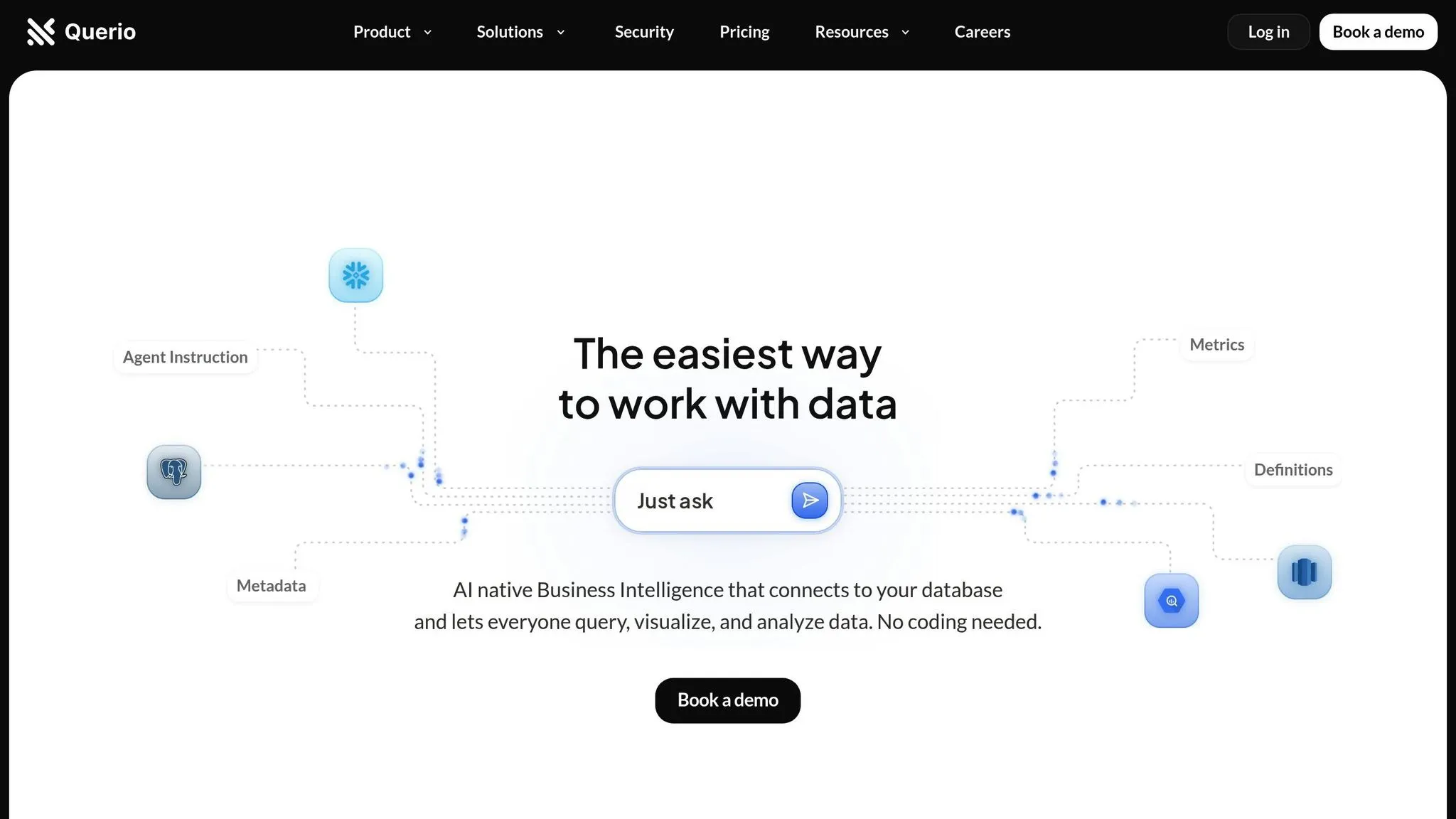
Here’s a side-by-side look at the differences between AI BI and traditional BI tools:
| Dimension | Traditional BI | Querio.ai |
|---|---|---|
| Access | Limited to technical users with SQL/database skills | Open to anyone, regardless of technical expertise |
| Speed of Insight | Takes days or even weeks | Delivers results in minutes or hours |
| Flexibility | Relies on static reports and pre-built dashboards | Enables dynamic exploration and real-time analysis |
| IT Dependency | High - IT handles report creation and updates | Low - IT manages the platform while users perform their own analyses |
| Data Literacy Required | Requires advanced technical skills | Minimal technical skills needed, basic analytical thinking suffices |
| Update Frequency | Scheduled, periodic updates | Real-time or on-demand updates |
| Customization | Limited to pre-designed elements | Highly customizable, user-driven options |
This shift in accessibility and efficiency explains why companies using advanced visualization and reporting tools experience a 26% boost in sales [6]. By empowering teams to work independently and make faster decisions, Querio eliminates the bottlenecks that have long plagued traditional BI systems.
Improving Decision-Making Across Organizations
Querio.ai's generative BI platform is transforming how organizations make decisions by bridging the gap between technical and non-technical teams. By opening up access to data, the platform fosters better collaboration, speeds up the delivery of insights, and boosts overall business performance. This approach lays the groundwork for smarter, faster decision-making across every department.
Making BI Available to All Teams
Querio.ai makes data accessible to everyone, empowering team members - from product managers to finance specialists - to generate actionable insights using natural language queries. This capability allows employees to make faster, independent decisions without relying on technical expertise.
Business Benefits of Generative BI
With easy access to data, Querio.ai delivers benefits of AI-driven business intelligence. Teams become more productive, decisions are made faster, and collaboration across departments improves. Moe, Querio's CTO, highlights this transformation:
"The team is a lot more self-sufficient, more than I assumed they could be, and our engineering team has a much closer relationship to the business. Querio changed how we work with our data and each other!" [8]
The platform's impact is evident in real-world scenarios. For instance, in 2024, Lumen used Querio's AI-driven analysis to cut the time needed to summarize sales interactions from 4 hours to just 15 minutes per seller. This efficiency translated into projected annual savings of $50 million in time costs.
These time savings allow teams to respond more quickly to market demands and customer needs. By ensuring everyone operates with the same data-driven mindset, strategic planning becomes more agile, and IT teams can dedicate their efforts to larger initiatives rather than routine reporting tasks.
Deployment Options and Growth Capacity
Querio.ai provides flexible deployment options to accommodate organizations of all sizes. The Core Platform is priced at $14,000 annually, which includes one database connection, 4,000 prompts per month, and unlimited viewer users. For advanced reporting and visualization, the Dashboards Add-On can be added for $6,000 per year. Additional database connections cost $4,000 each per year, and data pipeline functionality is available through the Data-Pipelines Subscription for $10,000 annually (supporting up to three pipelines).
For organizations with specific security or compliance needs, a Self-Hosted Deployment option is available. This option comes with a 50% increase in recurring fees and requires an annual revenue commitment of at least $60,000. Monthly billing is also offered, with a 10% premium on the annual rate, providing added flexibility.
This scalable pricing model ensures that organizations can expand their use of Querio.ai as they grow, making data-driven insights accessible to everyone and embedding generative business intelligence into their operations.
Conclusion: Querio.ai's Impact on Business Intelligence
Querio.ai’s seed funding represents a pivotal moment in making business intelligence more accessible. By tackling long-standing challenges, the platform ensures that valuable insights are no longer confined to technical teams, opening up new possibilities for decision-making across organizations.
Key Highlights
Querio.ai simplifies complex data analysis by turning plain-English questions into actionable insights. It connects directly to data warehouses and uses a powerful context layer to deliver results quickly and effectively. The impact is evident in real-world use cases. Jennifer Leidich, Co-Founder & CEO, shares:
"Querio has revolutionized how we handle data. What used to be a weeks-long process now takes minutes, and our teams feel empowered to follow a data-driven decision making process on their own. The impact on our efficiency and accuracy is unparalleled." [9]
Companies using Querio have seen their teams gain independence in handling data while fostering stronger collaboration between business and technical departments. These benefits set the stage for a new era in business intelligence.
Looking Ahead
Querio.ai is poised to reshape how organizations leverage data. By breaking down technical barriers without compromising on security or governance, the platform is primed for widespread adoption across industries.
Its flexible deployment options and scalable pricing make advanced AI-driven tools accessible to businesses that previously found traditional BI solutions too costly or complex. Enver, Co-Founder & CTO, highlights:
"Querio has transformed our approach to data. It's not just about saving time and money; it's about making data accessible and actionable for every team member." [9]
In the long run, AI tools like Querio.ai will bridge the gap between human curiosity and data, making data literacy a universal skill. This evolution promises to drive faster innovation, enhance strategic planning, and help organizations respond more effectively to market shifts and customer demands.
FAQs
::: faq
How does Querio.ai ensure accurate and secure data analysis with natural language queries?
Querio.ai prioritizes precise and secure data analysis by leveraging AI-powered data validation and automated governance tools. These capabilities work together to uphold data integrity, ensure compliance, and reduce the risk of errors during the analysis process.
With its advanced natural language processing (NLP) technology, Querio.ai interprets user queries with exceptional accuracy, providing actionable insights without the need for technical know-how. This approach empowers users to make informed, data-driven decisions while keeping accuracy and security at the forefront. :::
::: faq
What makes Querio.ai a better choice for non-technical teams compared to traditional BI tools?
Querio.ai makes data analysis simple and accessible for non-technical teams, removing the need for coding or advanced technical expertise. Thanks to natural language processing (NLP), users can ask questions in plain English and get the answers they need, making the process intuitive and user-friendly.
The platform simplifies data access, accelerates decision-making, and promotes teamwork across departments. By cutting through the complexity and high costs tied to traditional BI tools, Querio.ai ensures that anyone can access insights and make informed decisions with ease and confidence. :::
::: faq
How does Querio.ai connect to major data warehouses, and what are the benefits of these integrations?
Querio.ai integrates seamlessly with major data warehouses using secure, read-only, and encrypted connections. This setup ensures real-time access to your data without the delays typically caused by scheduled exports. The result? Up-to-the-minute insights, available whenever you need them.
What makes this even better is the ability to interact with your data through natural language queries. This means even non-technical teams can dive into data analysis without needing specialized knowledge. By streamlining workflows and speeding up decision-making, Querio.ai helps organizations tap into their data with greater ease and precision. :::