Business Intelligence
Forrester Wave Augmented Analytics 2024 2025 2026
Compare Querio, Snowflake, and BigQuery across AI features, governance, scalability, and pricing to choose an augmented analytics platform that delivers ROI.

The Forrester Wave reports for 2024–2026 focus on evaluating analytics platforms that integrate advanced AI capabilities, such as natural language querying (NLQ), natural language generation (NLG), and retrieval-augmented generation. These reports help organizations identify tools that align with their business needs and analytics strategies.
Key findings include:
- Querio: Specializes in converting natural language into SQL and Python, ensuring transparency and governance. It integrates with major data warehouses and has a free plan and no per-seat pricing.
- Snowflake: Introduced AI tools like Intelligence and Cortex AISQL, enabling multimodal data processing and secure, governed AI innovation. It excels in multi-cloud collaboration but may require additional tools for conversational analytics.
- Google BigQuery: Known for scalability, it supports AI-powered analytics with tools like Gemini and direct LLM inference. It also excels in multimodal analytics and data governance but may have a learning curve for new users.
Quick Comparison:
| Platform | Key Strengths | Challenges |
|---|---|---|
| Querio | Transparency, strong governance, no per-seat pricing | Limited flexibility for multimodal analytics |
| Snowflake | Multi-cloud sharing, AI integrations | Requires additional tools for conversational analytics |
| Google BigQuery | Scalability, AI tools, multimodal analytics | Learning curve for optimization and cost management |
Conclusion: Each platform offers unique strengths depending on your priorities - Querio for governed self-service, Snowflake for multi-cloud collaboration, and BigQuery for large-scale processing. The focus for 2026 and beyond is on trends shaping the next generation of analytics platforms that deliver measurable ROI through AI-powered analytics.
::: @figure 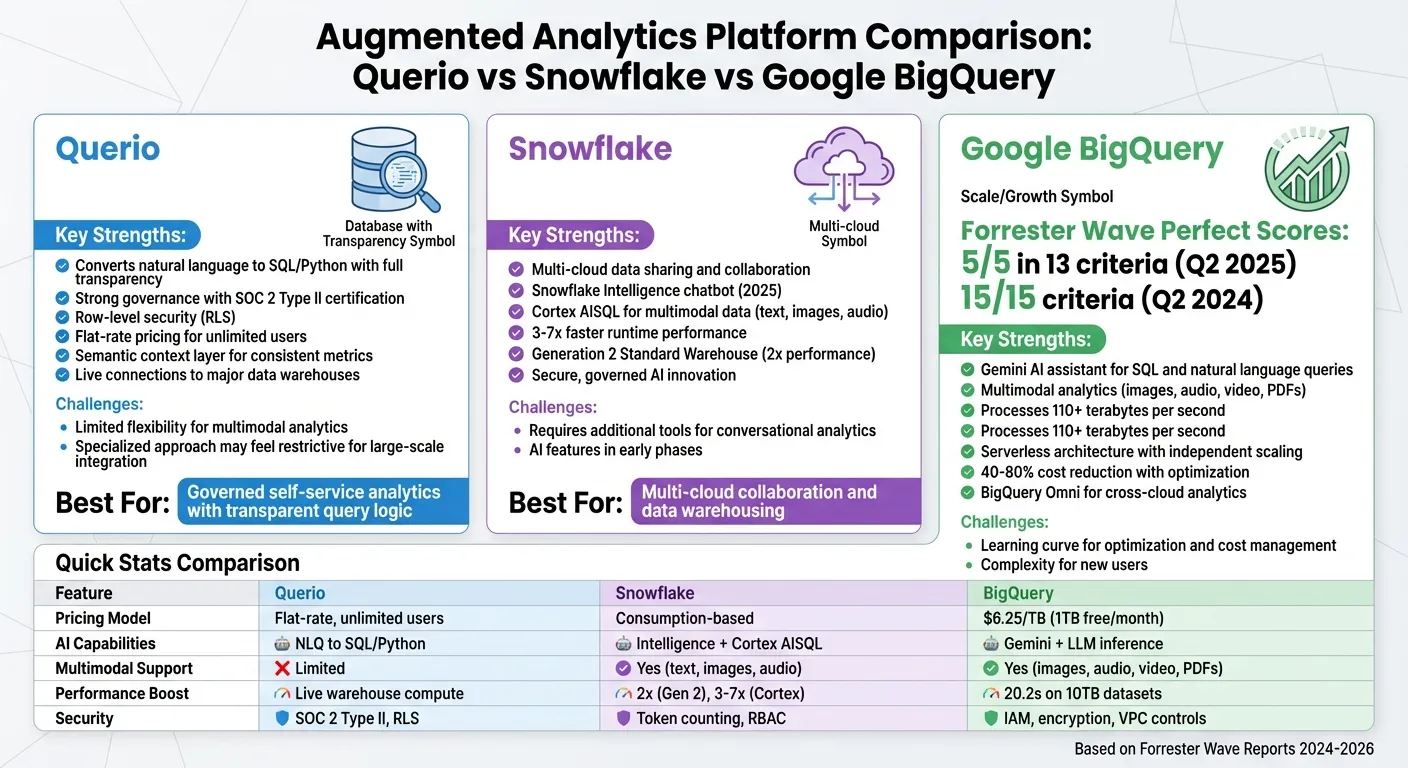 {Querio vs Snowflake vs Google BigQuery: Analytics Platform Comparison 2024-2026}
:::
{Querio vs Snowflake vs Google BigQuery: Analytics Platform Comparison 2024-2026}
:::
1. Querio
AI and Natural Language Capabilities
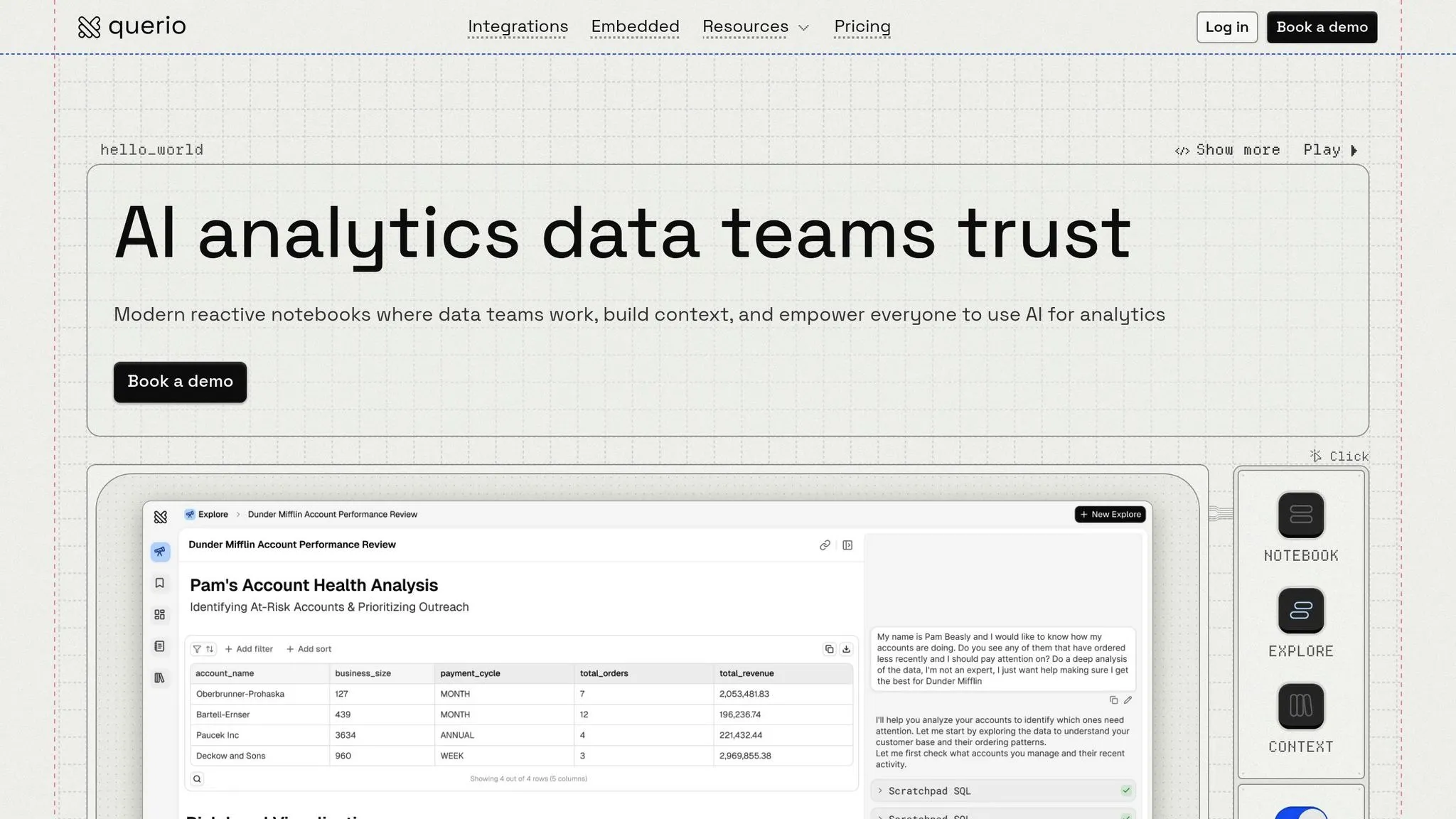
Querio transforms natural language inputs into SQL or Python queries that users can view, edit, and reuse. Unlike platforms that generate results without showing their workings, Querio ensures every answer is accompanied by the underlying code. This transparency builds trust and gives users control. Its semantic context layer bridges the gap between raw data and business terms, so metrics like MRR or churn rate are consistently calculated across teams. This consistency eliminates the confusion caused when different departments interpret the same metric in conflicting ways.
The platform also features AI-driven Python notebooks with automated updates, meaning results stay current whenever the underlying logic changes. By combining accessibility with technical precision, Querio addresses the challenges that traditional BI tools often face when trying to balance ease of use with analytical rigor.
This approach to query generation, combined with strong governance, ensures data accuracy and reliability.
Governance and Security
Querio prioritizes security and governance with SOC 2 Type II certification and row-level security (RLS), ensuring users can only access data they’re authorized to see. This level of granular control is particularly important for multi-tenant SaaS environments. Data connections are established using encrypted, read-only credentials, ensuring no accidental changes are made to the source data during analysis.
The semantic layer enforces consistent business logic across all dashboards, further enhancing reliability.
Data Warehouse Integration
With robust security and governance in place, Querio seamlessly integrates with leading data warehouses.
The platform offers live connections to Snowflake, BigQuery, Postgres, Amazon Redshift, and ClickHouse. Queries run directly on the warehouse, leveraging its compute power and built-in security features. This approach avoids the delays and synchronization issues that can arise with extract-based tools.
Additionally, Querio has no per-seat pricing: every plan includes unlimited users, and AI usage comes from included monthly credits with spending caps. For teams already invested in modern data infrastructure, this pricing model provides predictable costs while supporting thousands of simultaneous users.
Scalability and Future-Readiness
By tapping into the compute power of connected warehouses, Querio easily scales to handle growing analytics needs. This design is particularly effective in multi-tenant environments where customer workloads can vary widely. The platform’s semantic layer includes versioned logic, allowing data teams to update definitions without disrupting existing dashboards or embedded analytics. This ensures governance and functionality can scale alongside user demand.
2. Snowflake
AI and Natural Language Capabilities
In 2025, Snowflake introduced Intelligence, a chatbot designed to let non-technical employees explore data using plain language [4]. Alongside this, the platform launched Cortex AISQL, which processes multimodal data - like text, images, and audio - directly within the data warehouse. This eliminates the need for separate pipelines and opens up a variety of new use cases [4]. Snowflake has also strengthened its partnership with OpenAI, enabling smoother deployment of AI-powered applications. The company is preparing for the next wave of AI, focusing on features like agent orchestration and semantic model optimization [4]. By leveraging large language models, Snowflake aims to make AI-powered analytics more accessible while maintaining transparency in query logic. Unlike other platforms, Snowflake prioritizes secure, governed AI innovation, with its advanced capabilities backed by strong security measures.
Governance and Security
Snowflake pairs its AI advancements with rigorous governance protocols. Both Snowflake Intelligence and Cortex Agents operate within a secure environment, ensuring enterprise data remains within Snowflake during AI processing [6]. The platform integrates cost governance through token counting, role-based access controls, and automated cost guardrails [6]. Cortex AISQL delivers runtime performance that’s 3 to 7 times faster than traditional manual pipelines, all while adhering to strict governance standards [6]. Snowflake’s unified machine learning governance allows teams to build and manage models directly on governed data without the need for data to leave the platform. Even when using external models from repositories like Hugging Face, data security is maintained. Additionally, Snowflake incorporates agentic AI to automate key governance tasks, such as data classification, policy enforcement, and issue resolution [5][2].
Scalability and Future-Readiness
Snowflake’s Generation 2 Standard Warehouse offers double the performance for real-time workloads [4]. The acquisition of Crunchy Data has brought PostgreSQL support into the fold, allowing Snowflake’s AI Data Cloud to handle transactional and operational tasks alongside traditional analytics. The platform’s SnowConvert AI tool uses generative AI to automate the migration of legacy data warehouses, ETL processes, and BI workloads, complete with automated validation through test case generation [4]. At the 2025 Snowflake Summit, which attracted over 20,000 data and AI professionals, the company highlighted its transition from experimental to operational AI [4]. While these advancements set the stage for increased automation, some analysts view them as being in the early phases [4].
3. Google BigQuery
AI and Natural Language Capabilities
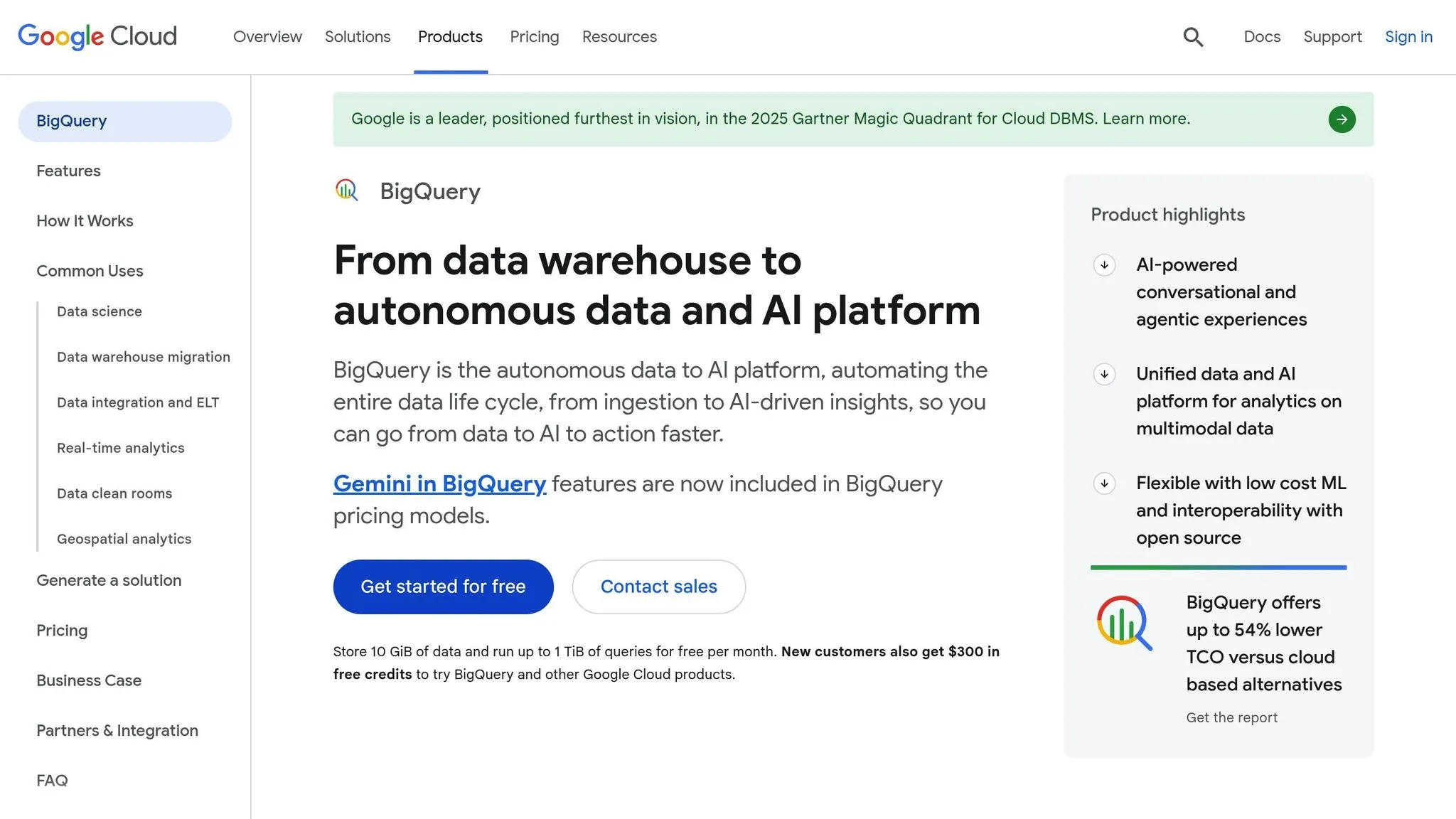
BigQuery introduces Gemini in BigQuery, an AI assistant designed to simplify data exploration. It helps users write SQL queries, interpret them, and interact with data using natural language commands [8]. The platform also supports direct large language model (LLM) inference within SQL, using functions like AI.GENERATE and AI.GENERATE_TEXT. These work seamlessly with models such as Gemini, Claude, Mistral, and Llama [7]. Beyond query assistance, BigQuery offers AI-powered tools for automating common tasks: AI.IF filters data based on natural language instructions, AI.SCORE ranks data by sentiment or quality, and AI.CLASSIFY automatically categorizes data [7].
BigQuery excels in multimodal analytics, enabling it to process unstructured data types like images, audio, video, and PDFs alongside traditional data formats [7][3]. For example, users can generate text descriptions for images or transcribe audio files directly within the platform. It also offers AI.EMBED, which creates high-dimensional vectors for semantic search and recommendation systems. This feature supports Retrieval-Augmented Generation (RAG), enhancing the factual reliability of AI-generated responses [7]. BigQuery is moving toward "agentic experiences", where specialized agents handle tasks such as data preparation, pipeline creation, and anomaly detection [3].
Governance and Security
BigQuery employs the Dataplex Universal Catalog to manage all data assets in one place, covering technical, business, and operational metadata across data lakes and warehouses. Security features include IAM roles, column- and row-level access controls, automatic encryption (both at rest and in transit), and data masking to safeguard sensitive information.
The platform automates data stewardship with features like data profiling, which identifies key statistical characteristics, and quality scans that apply predefined or custom rules. It also offers end-to-end lineage tracking at both table and column levels. BigQuery's Sensitive Data Protection scans for personally identifiable information (PII), financial data, and health records, while VPC Service Controls establish security perimeters to prevent unauthorized data transfers. Additionally, Data Clean Rooms enable secure collaboration, allowing teams to analyze data together without moving raw datasets.
Data Warehouse Integration
BigQuery Omni extends analytics capabilities across multiple clouds, enabling users to analyze data stored in AWS and Azure without relocating it. This feature supports regions such as US East, US West, and Frankfurt [10]. The platform is compatible with open formats like Apache Iceberg, Delta, and Hudi, simplifying the integration of structured and unstructured data [3]. Its modern data warehouse architecture separates storage and compute, allowing each to scale independently [10].
Google's infrastructure processes over 110 terabytes of data per second, demonstrating BigQuery's immense capacity [10]. In TPC-DS benchmarks, the platform achieved a 20.2-second geometric mean query time on 10TB datasets [10]. Features like partitioning and clustering can reduce query costs by 40–80% [10]. Additionally, storage costs for tables or partitions that remain unchanged for over 90 days are automatically cut by 50% [10]. This flexibility and efficiency make BigQuery a powerful tool for advanced analytics.
Scalability and Future-Readiness
BigQuery has earned top marks in multiple Forrester Wave™ reports. In the Forrester Wave™: Data Management for Analytics Platforms, Q2 2025, Google scored 5/5 in 13 criteria [3]. Similarly, in the Forrester Wave™: Data Lakehouses, Q2 2024, the platform received a perfect score across 15 criteria [9]. Forrester highlighted Google's approach, stating:
"Google's distinctive and forward-thinking vision is to provide a unified, agentic, intelligent, and seamlessly integrated data platform that blends data management, advanced analytics, and AI capabilities at scale." [3]
BigQuery ML empowers data analysts to create machine learning models - such as Linear Regression, XGBoost, and K-Means - directly using SQL [10]. The platform also supports high-throughput streaming for real-time applications like fraud detection and operational monitoring [3]. For interactive dashboards, BigQuery BI Engine delivers sub-second query response times [10]. Pricing begins at $6.25 per terabyte of data processed, with the first 1 TB per month available at no cost [10].
sbb-itb-284a532
Accelerating Insights-Driven Decision Making w/ Augmented BI : Boris Evelson of Forrester Research
::: @iframe https://www.youtube.com/embed/LG8LWSK78Jw :::
Advantages and Disadvantages
Each platform has its own strengths and trade-offs when it comes to AI capabilities, governance, integration, and scalability. These differences can shape how you approach your analytics strategy. Here's a quick breakdown of the main pros and cons of each platform:
Querio stands out for its user-friendly and precise analytics. Its AI agents convert plain English questions into SQL and Python, providing answers that are fully inspectable and based on live warehouse data. The platform also features a dynamic notebook environment, which facilitates in-depth and governed analysis. This reinforces its focus on transparency and governance. However, for teams requiring extensive multimodal analytics or large-scale data integration, Querio’s specialized approach might feel restrictive. Its emphasis on live data ensures consistent metrics but may lack the flexibility some teams need.
On the other hand, Snowflake excels in multi-cloud data sharing, making it a strong choice for collaboration across cloud environments. However, it may fall short in providing true conversational analytics without the help of additional tools. Its core strength lies in data warehousing, but teams seeking best conversational AI analytics tools may need to invest in supplementary solutions.
Google BigQuery is recognized for its scalability and powerful analytics features. In fact, it earned a perfect score across 15 criteria in the Forrester Wave™: Data Lakehouses, Q2 2024 [9]. Its serverless architecture makes it a leader in handling massive-scale processing. That said, newcomers may face a learning curve when it comes to optimizing performance and managing costs effectively.
Ultimately, the best platform for your needs will depend on your team’s priorities - whether that’s governed self-service with Querio, multi-cloud collaboration with Snowflake, or BigQuery’s unmatched scalability for large-scale processing.
Conclusion
Augmented analytics is no longer about flashy demos - it’s about delivering measurable ROI and clear business value. By 2026, the focus will be on platforms that provide tangible results CFOs can confidently justify, as enterprises shift their priorities toward practical functionality over aesthetic appeal [11].
The three platforms discussed here cater to different needs. Querio shines in governed self-service analytics, using AI agents to convert plain English queries into inspectable SQL and Python, all while maintaining consistent metrics through a shared context layer. Snowflake stands out for its multi-cloud data sharing and warehousing capabilities, though it may require supplementary tools for conversational analytics for any warehouse. Meanwhile, Google BigQuery offers unparalleled scalability and has been recognized as a leader in the Forrester Wave for Data Management for Analytics Platforms, earning a perfect score (5 out of 5) across 13 criteria [3]. Its serverless architecture and strong AI integration make it a standout choice for large-scale, autonomous data operations.
The best platform for your team will depend on your priorities. If governed self-service analytics is your focus, Querio provides a tailored solution. For handling massive datasets and diverse data types, BigQuery’s scalability and architecture are hard to beat. And if seamless cross-cloud collaboration is critical, Snowflake’s data-sharing strengths make it a compelling option.
Generative AI isn’t here to replace traditional business intelligence - it’s here to enhance it [1]. Success lies in how well these tools integrate AI into governance, manage both structured and unstructured data, and automate processes securely. With enterprises expected to delay 25% of planned AI investments into 2027 due to uncertain ROI [11], selecting a platform that clearly demonstrates business value will be more important than ever.
FAQs
::: faq
What makes Querio's natural language querying stand out?
Querio's natural language querying (NLQ) turns the often-intimidating world of data analysis into something as simple as having a conversation. By leveraging advanced large language models (LLMs), it lets users ask questions about their data in plain English - no technical know-how required. Forget SQL or data science expertise; Querio makes data access and interpretation quick and straightforward, helping teams make informed, data-backed decisions with ease.
What makes Querio stand out is its versatility. It handles both structured and unstructured data - think spreadsheets, emails, or even social media - and delivers instant, visually engaging answers to complex questions like "What were our top-performing products last quarter?" Its user-friendly design ensures that anyone in the organization can access insights tailored to their specific needs, positioning Querio as a game-changer in AI-powered business intelligence. :::
::: faq
How does Snowflake protect data when using AI tools?
Snowflake protects your data while incorporating AI tools by implementing strong security and governance measures. One key feature is role-based access controls (RBAC), which restrict data access based on user roles. This ensures that only authorized individuals can view or modify sensitive data, keeping confidentiality intact.
Snowflake also emphasizes secure API integrations, allowing AI tools to access and interact with data without unnecessary exposure to risks. These combined efforts maintain data security and integrity while enabling powerful AI-driven analytics. :::
::: faq
What makes Google BigQuery a great choice for processing large-scale data?
Google BigQuery is a go-to tool for handling large-scale data processing, thanks to its speed, scalability, and cost-effectiveness. It allows you to run fast queries on live data without waiting or duplicating datasets, making it ideal for real-time analytics. Plus, its serverless design means you’re only charged for the storage and compute resources you actually use, helping keep expenses under control as your data grows.
It also works effortlessly with the Google Cloud ecosystem, simplifying data management and enabling AI-powered analytics. On top of that, BigQuery offers enterprise-grade security and adheres to standards like SOC 2, ensuring your data stays safe. These capabilities make it a dependable and adaptable choice for businesses looking to gain insights from massive amounts of data. :::