Business Intelligence
Best AI SQL tools in 2026
Overview of top AI SQL tools in 2026 with live schema awareness, accurate query generation, multi-warehouse support, and governance.

AI-driven SQL tools in 2026 have transformed how developers and analysts work with databases. These tools now connect directly to live database schemas, interpret complex relationships, and generate highly accurate SQL queries in seconds. Key advancements include schema awareness, workflow automation, and support for multiple SQL dialects. Here's what you need to know:
- Querio: A feature-rich platform with live schema integration, a shared semantic layer, and support for major data warehouses like Snowflake and BigQuery. It delivers high accuracy (up to 95%) and robust governance tools.
- dbForge AI Assistant: A desktop add-on for dbForge Studio, tailored for Microsoft SQL Server and Azure SQL Database. It excels at T-SQL code completion and optimization but is limited to the Microsoft ecosystem.
- Sequel AI: A cloud-based solution focused on teamwork, with Slack integration and dashboard sharing. It supports multiple databases, including PostgreSQL, MySQL, and Oracle.
::: @figure 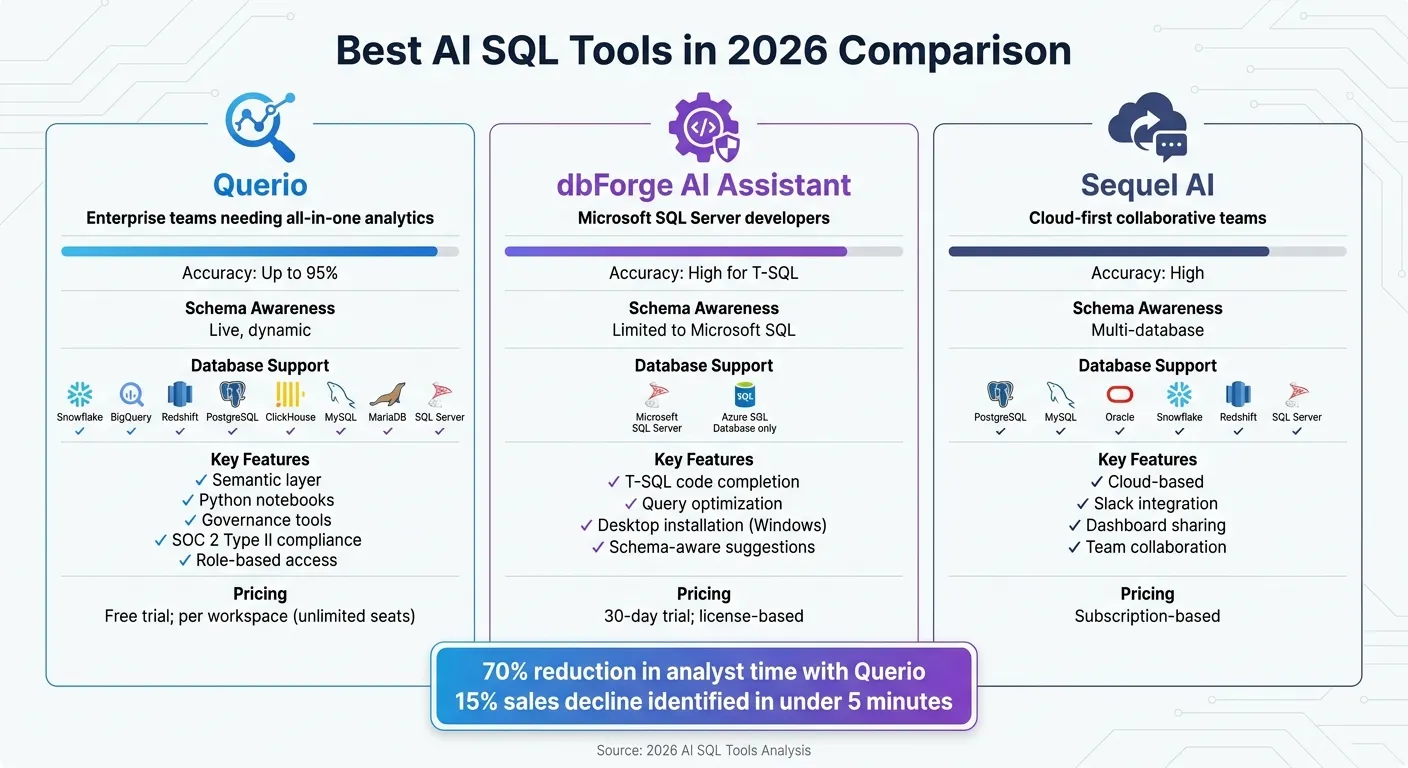 {AI SQL Tools Comparison 2026: Querio vs dbForge vs Sequel AI}
:::
{AI SQL Tools Comparison 2026: Querio vs dbForge vs Sequel AI}
:::
Quick Comparison
| Tool | Accuracy | Schema Awareness | Database Support | Key Features | Pricing |
|---|---|---|---|---|---|
| Querio | Up to 95% | Live, dynamic | Snowflake, BigQuery, Redshift, PostgreSQL, etc. | Semantic layer, Python notebooks, governance | Free trial; per workspace |
| dbForge AI | High for T-SQL | Limited to Microsoft SQL | Microsoft SQL Server, Azure SQL Database | T-SQL focus, local installation | 30-day trial; license-based |
| Sequel AI | High | Multi-database | PostgreSQL, MySQL, Oracle, Snowflake, Redshift | Cloud-based, Slack integration, dashboards | Subscription-based |
Each tool offers unique strengths, from Querio's all-in-one analytics to dbForge's Microsoft-specific optimizations and Sequel AI's collaboration features. Choose based on your database environment and team needs.
sbb-itb-284a532
1. Querio
Querio is an AI-driven analytics workspace designed to connect directly to live data warehouses. It translates plain English into reviewable SQL and Python code, streamlining the process of querying and analyzing data. At its core is a semantic layer, where data teams establish table relationships, define business metrics, and standardize terminology. This ensures that queries and dashboards across the platform remain consistent and reliable.
Accuracy
In 2026, a finance team using Querio with Snowflake reported a 70% reduction in analyst time needed to generate compliant financial forecasts. In another case, a retail business uncovered the cause of a 15% sales decline in under five minutes by leveraging the platform’s ability to automatically analyze and correlate inventory and marketing data[3].
Querio’s accuracy stems from its context layer, which allows data teams to pre-define how tables relate and clarify business terms. By referencing these predefined rules, the platform minimizes errors in multi-table queries. Every result includes SQL or Python code, giving users full visibility into the data sources and columns used. This precision is further bolstered by Querio’s dynamic schema awareness.
Schema Awareness
Unlike tools that rely on static schema uploads, Querio connects to live data warehouses using read-only credentials and reads real-time DDL and metadata. This ensures that it always reflects the most current table structures and relationships. With its versioned semantic layer, any updates to business logic or schema definitions automatically propagate across all dashboards and reports, removing the need for manual query refreshes.
For more advanced analyses, Querio provides AI-powered Python notebooks that operate within the same governed context layer. This allows data scientists to conduct in-depth studies while adhering to the standardized metrics and joins defined by the data team.
Warehouse Support
Querio integrates with leading cloud data warehouses, including Snowflake, Google BigQuery, Amazon Redshift, and ClickHouse, as well as relational databases like PostgreSQL, MySQL, MariaDB, and Microsoft SQL Server. All connections are encrypted and read-only, with no need for data duplication or extraction.
Governance Features
The platform includes robust governance tools such as role-based access controls, standard SSO integrations, and SOC 2 Type II compliance. The shared context layer ensures that all users - whether running ad-hoc queries, creating dashboards, or embedding analytics - work with consistent business definitions. Data teams retain control over which metrics and joins are accessible, reducing the risk of unauthorized or inconsistent analysis.
Pricing
Querio provides a free trial and offers flexible per-workspace pricing, which includes unlimited usage and seats. While positioned as a premium option, it maintains competitive flexibility and includes a money-back guarantee for enterprise customers.
2. dbForge AI Assistant
The dbForge AI Assistant is a desktop add-on designed for dbForge Studio on Windows. It caters specifically to Microsoft SQL Server and Azure SQL Database environments, offering tools to support database developers and administrators in writing T-SQL code. By leveraging AI, it aims to make query writing faster and more efficient through features like code completion and optimization suggestions. This tool highlights how AI can streamline SQL workflows, which ties into the broader themes of our 2026 analysis. Here's a closer look at its key features:
Accuracy
This tool focuses heavily on improving query efficiency. It provides instant code suggestions by referencing the active database schema, helping users with syntax, table names, and column references. It can even generate more complex SQL structures, such as stored procedures and multi-table joins, based on the database's technical layout. However, it's worth noting that it doesn't include a semantic or governance layer for standardizing business definitions.
Schema Awareness
One of the standout features of dbForge AI Assistant is its ability to integrate with SQL Server and Azure SQL Database, offering real-time suggestions tailored to the active schema. It analyzes queries to suggest performance improvements, such as optimized joins or index recommendations. That said, its schema awareness is confined to the Microsoft ecosystem, and it requires a local Windows installation to function.
Warehouse Support
This tool is built exclusively for Microsoft SQL Server and Azure SQL Database environments. It operates as part of the dbForge Studio desktop application, with no web-based or cloud-hosted options available. Additionally, it lacks features like a shared query library or version control integration, meaning each user works within their own local instance.
Pricing
dbForge AI Assistant provides a 30-day trial, but there’s no permanent free tier available. Pricing is based on individual licenses, making it a good fit for teams working within the Microsoft SQL Server ecosystem. The trial period is a great opportunity to test its compatibility with your workflow before committing.
3. Sequel AI
Sequel AI steps into the spotlight as a cloud-focused solution for teams managing SQL tasks across multiple database environments. Designed to be web-based, it eliminates the hassle of local installations and prioritizes accessibility and teamwork. With features like Slack integration and dashboard embedding, it makes sharing insights a breeze, ensuring your team stays connected and productive.
Accuracy
Sequel AI leverages your database schema to generate SQL queries with precision. By enabling teams to define business logic and standardize terminology, it ensures clarity and consistency for metrics such as "revenue" or "active users." Its built-in schema analysis adds another layer of reliability, reducing errors and misinterpretations in reporting.
Schema Awareness
This tool directly connects to your database, diving into schemas to offer context-aware suggestions tailored to complex setups. Whether you're working with PostgreSQL, MySQL, SQL Server, or Oracle, Sequel AI adapts to the specific architecture, helping users better understand table relationships and generate smarter queries.
Warehouse Support
Sequel AI is compatible with major data warehouses like Snowflake, BigQuery, and Redshift, alongside traditional databases such as PostgreSQL, MySQL, SQL Server, and Oracle. For enterprises with stricter compliance needs, its advanced plans include SSO and enhanced security measures.
Pricing
Sequel AI operates on a subscription model, offering various tiers to suit different needs, including enterprise options with added security features. While specific pricing isn't publicly available, interested users can reach out to the provider for detailed subscription plans.
Pros and Cons
Querio has set itself apart as a standout player among AI-powered SQL tools in 2026. Its high accuracy and real-time analytics have redefined data workflows, offering a platform that tackles the common challenges other solutions often face.
Pros:
- Exceptional Accuracy: Querio boasts an impressive 95% accuracy in converting natural language into SQL. Real-world examples, such as a 70% reduction in analyst time for financial forecasting, highlight its effectiveness[3].
- Real-Time Data Integration: It connects directly to data warehouses, providing live schema awareness without requiring manual updates or creating duplicate datasets.
- All-in-One Analytics Platform: From interactive dashboards to AI-powered Python notebooks and embedded analytics, everything operates within a single, streamlined workspace.
- Standardized Context Layer: A shared layer for business logic and terminology ensures consistent metrics across queries and reports, reducing confusion and misalignment.
- Enterprise-Grade Security: Features like role-based access controls, SSO integration, and SOC 2 Type II compliance ensure robust security measures.
- Scalability Without Limits: The per-workspace pricing model includes unlimited seats and queries, eliminating concerns about scaling costs.
- Multi-Warehouse Compatibility: Seamless integration with platforms like Snowflake, BigQuery, Redshift, ClickHouse, PostgreSQL, MySQL, and SQL Server ensures flexibility.
Cons:
- Higher Cost for Advanced Features: While its pricing is competitive for the enterprise-level features it offers, it may be more expensive than basic query generation tools. However, the extensive capabilities and a money-back guarantee help justify the investment.
- Initial Onboarding Required: Teams unfamiliar with semantic layers may face a short learning curve, but the long-term efficiency gains make this adjustment worthwhile.
"The key difference between good and bad tools isn't the LLM - it's how deeply the tool understands your database schema at query time." - James Kowalski, AI Benchmarks & Tools Analyst[2]
Querio strikes a balance that many tools fail to achieve. By combining a deep understanding of database schemas with high query accuracy and strong governance, it has become the go-to choice for teams seeking top-tier AI-powered SQL analytics. Its live data integration and dynamic schema awareness further solidify its position as a leader in the field.
Conclusion
Querio's ability to integrate live data, its awareness of complex schemas, and its focus on governance set a new standard for SQL analytics in 2026. Studies show that tools with direct connections to live database schemas consistently outperform those that depend on static uploads or generalized prompts [1][2]. As highlighted, Querio's advanced design ensures exceptional accuracy and performance.
FAQs
::: faq
How does live schema awareness improve SQL accuracy?
Live schema awareness improves SQL accuracy by enabling AI tools to understand the real structure and relationships within a database. This leads to more accurate query generation and reduces errors that come from misunderstanding the schema. :::
::: faq
What is a semantic layer, and do I need one?
A semantic layer acts as a bridge between raw data and end-users, transforming intricate data structures into a single, business-friendly format. This layer makes accessing data easier, enforces governance policies, and ensures consistency in analysis across the board. By 2026, its relevance has soared alongside advancements in AI and large language models, as it enhances both the precision and scalability of insights. For organizations aiming to leverage dependable, AI-powered analytics, adopting a semantic layer is a smart move. :::
::: faq
How can I roll out AI SQL safely with governance?
To ensure the safe deployment of AI SQL, it's crucial to have governance measures in place that tackle risks such as unreviewed AI-generated queries. Start by implementing automated approval processes, policy enforcement mechanisms, and continuous monitoring systems. By weaving governance into your overall data strategy - including features like schema awareness and change management - you create a secure framework. This approach helps maintain data integrity, aligns with regulations, and supports the principles of responsible AI use. :::