Guide
What Is Data Governance: A Startup's Guide to Success
What is data governance? Learn its core components, roles, & how to implement a framework for startups to enable self-service analytics.
Data governance is the control layer that defines who can do what, with which data, and under what standards so data stays trustworthy, secure, and usable as a company scales. In 2024, more than 65% of data leaders said governance was their top priority, ahead of data quality at 47%, AI at 44%, self-service analytics at 32%, and DataOps at 19%, which tells you this has become core operating infrastructure, not a niche compliance task (data governance market and priority data).
If you're at a fast-growing company, you usually feel the need for governance before you have a name for it. Revenue has one number in Finance, another in Product, and a third in the board deck. Analysts keep answering the same questions in slightly different ways. Someone builds a useful dashboard, then confidence in it fades because nobody knows which tables fed it or whether the definitions changed last quarter.
That's the point where what is data governance stops being an academic question and becomes an operating one. Done badly, governance adds forms, gates, and frustration. Done well, it creates clear rules, clear ownership, and enough structure for teams to move faster without breaking trust.
Table of Contents
- Why Every Fast-Growing Company Hits a Data Wall
- The Pillars of a Modern Data Governance Framework
- Assembling Your Data Governance Team
- How to Measure Data Governance ROI
- Governance That Accelerates Not Obstructs
- Starting Your Data Governance Program Pragmatically
Why Every Fast-Growing Company Hits a Data Wall
The early stage version of analytics feels deceptively efficient. A few people know the warehouse, a few dashboards answer most questions, and when something breaks, everyone knows who to message. That works until usage spreads beyond the data team.
Then the wall shows up. Growth teams pull numbers directly from one source, Product uses another, and Operations has a spreadsheet layer nobody wants to admit exists. Each team thinks it's moving fast, but the company is slowing down because every important decision starts with an argument about the data.
A common startup pattern looks like this:
- Dashboards multiply faster than definitions: Teams create reports for their own use cases, but terms like active customer, qualified lead, or net revenue drift over time.
- Access gets handled ad hoc: One person grants permissions manually, another shares extracts in Slack, and sensitive data starts showing up in places it shouldn't.
- Trust erodes: Analysts spend more time reconciling than analyzing, and business users stop acting on insights because they're unsure which version is right.
Practical rule: If your analysts have become a help desk for metric definitions and access requests, you already have a governance problem.
This is why governance matters. It gives a company rules of the road for data. Not abstract principles, but working norms for ownership, definitions, access, quality, and change management.
The mistake is treating governance as a heavyweight corporate project. At a startup, it should be narrower and more practical. You don't need a committee for every table. You need a system that answers basic questions quickly: who owns this metric, where did it come from, who can access it, and what should happen when it breaks?
When those answers are easy to find, self-service becomes credible. Teams stop waiting on one overloaded analyst to approve every query. Leaders spend less time debating reports. Engineers stop firefighting data requests that should have been standardized months ago.
That's the core job of governance. It replaces ambiguity with operating clarity.
The Pillars of a Modern Data Governance Framework
Why governance needs structure
A useful way to think about governance is city planning. A city isn't functional because one building looks good. It works because roads, zoning, utilities, addresses, and enforcement all fit together. Data governance works the same way.
If you only focus on one layer, such as permissions, you don't have governance. You have security settings. If you only define terms in a spreadsheet, you don't have governance either. You have documentation that may or may not reflect reality.
Modern programs depend on operating mechanisms like access controls, audit trails, metadata standards, data sharing agreements, and privacy-by-design approaches so data remains usable and accountable across its lifecycle (modern data governance components). That's the difference between a policy binder and a working system.
The core pillars in practice
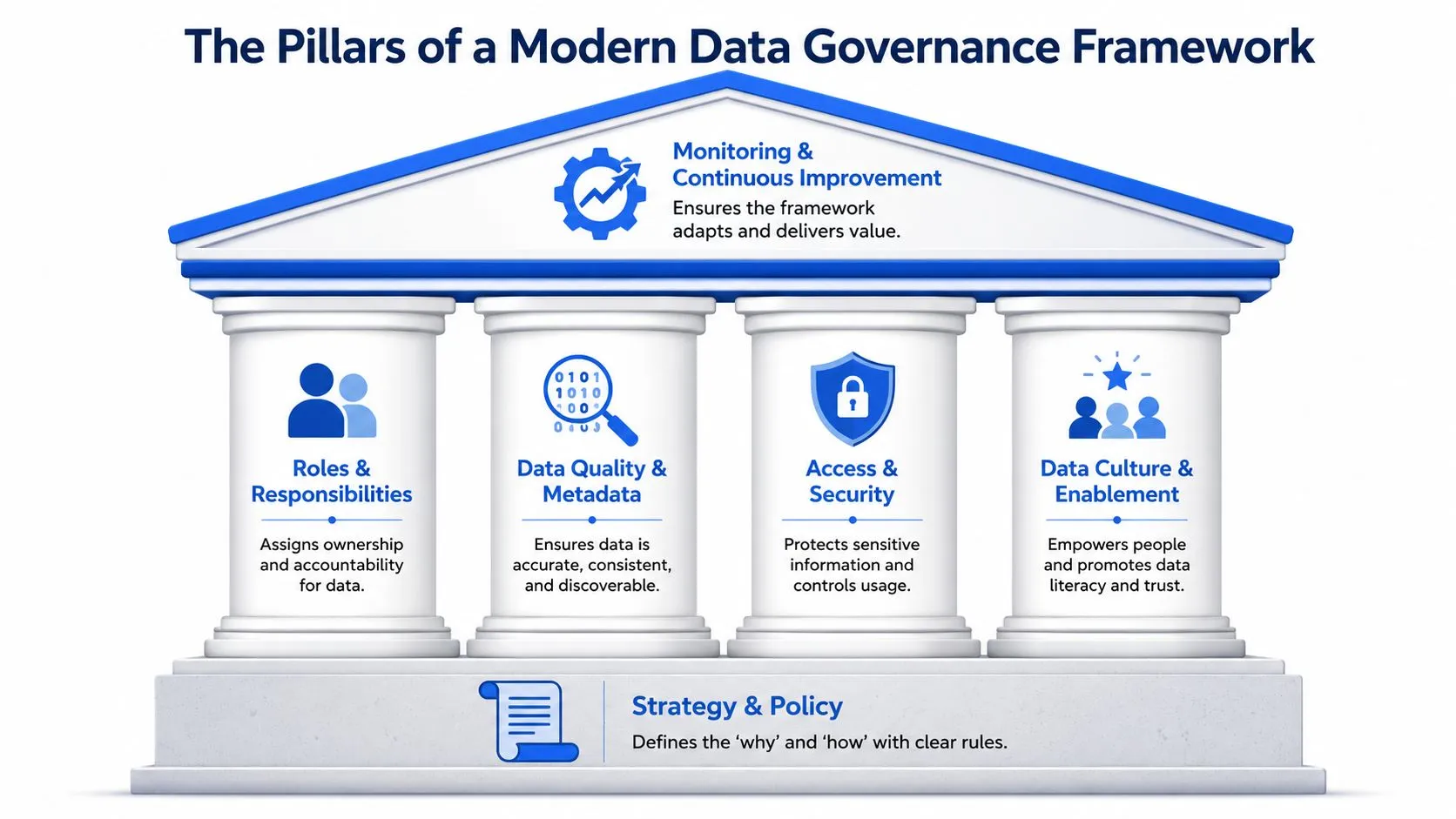
The foundation is strategy and policy. A company uses this foundation to decide what it is trying to protect and enable. For a startup, that usually means a short set of rules on metric definitions, sensitive data handling, retention, and approval paths for changes that affect reporting or models.
Next comes roles and responsibilities. Cities have planners, inspectors, and operators. Governance needs equivalent roles. Somebody owns the customer domain. Somebody maintains the pipelines. Somebody decides who should have access to support tickets or payroll data. Without named accountability, governance turns into group chat debate.
A third pillar is data quality and metadata. Quality without context isn't enough, and context without quality isn't useful. Teams need to know whether a table is current, what each field means, which assets are trusted, and who to contact when something looks wrong. That's why a data catalog matters. If you want examples of how companies structure these patterns, these data governance framework examples are a practical starting point.
Then there's access and security. This is the part many companies over-index on because it feels concrete. It matters, but mature governance doesn't default to “deny everything.” It defines role-based access, approval logic, and usage boundaries so the right people can work without exposing data unnecessarily. On the infrastructure side, some teams also pair governance efforts with broader security reviews like internal network vulnerability assessments to make sure technical controls and policy controls don't drift apart.
Finally, there's monitoring and continuous improvement. Governance only works if teams can see whether rules are being followed and whether the process is helping or hurting. That means tracking adoption, incident patterns, documentation gaps, and recurring access bottlenecks.
Governance isn't a single purchase. It's a set of decisions about standards, ownership, and enforcement that tools help operationalize.
A practical framework usually includes these components:
| Component | What it does | What good looks like |
|---|---|---|
| Policy and standards | Defines naming, classification, retention, and approval rules | Teams can explain the rules in plain language |
| Ownership and stewardship | Assigns accountability for domains, metrics, and assets | Every critical asset has a clear owner |
| Metadata and lineage | Shows meaning, origin, and dependencies | Users can find trusted data and understand changes |
| Access and security | Controls usage based on role and sensitivity | Access is fast for approved use, restricted for risky use |
| Monitoring | Tracks adoption, incidents, and exceptions | Governance gets adjusted based on evidence |
What doesn't work is building all of this as an isolated data-team initiative. Governance succeeds when policy, tooling, and team habits line up.
Assembling Your Data Governance Team
A familiar startup failure mode looks like this. Revenue is up, more teams are in the warehouse, AI pilots are spreading, and every dashboard seems to answer a different version of the same question. Product wants self-service. Finance wants control. Security wants tighter access. The data team gets pulled into every disagreement because nobody has clear authority.
That is a team design problem as much as a tooling problem.
Governance breaks down when ownership stays vague. Early-stage companies often push all of it onto the head of data or a senior engineer. That creates a bottleneck fast. The people closest to the business process need to own definitions and acceptable use. The teams running the platform need to implement access, retention, monitoring, and recovery. If one group tries to do both, self-service slows down and trust erodes.
Who should own what
A workable model starts small. One person may cover multiple roles for a while, but the roles themselves still need to be explicit. Clear decision rights are what let teams ship dashboards, grant access, and support AI use cases without reopening the same debate every week.
If you're also setting policies for model access, prompt data, and internal review paths, this guide on managing AI risk effectively fits well beside a data governance program because the operating questions are often the same.
A practical role map
Here's a version that works for many startups and mid-market teams.
| Role | Typical Holder | Core Responsibility |
|---|---|---|
| Data Owner | Business leader such as VP of Sales, Head of Product, or Finance lead | Decides what the data means, who should use it, and what quality level is acceptable |
| Data Steward | Analytics manager, operations lead, or senior analyst close to the workflow | Maintains definitions, coordinates issue resolution, and keeps documentation current |
| Data Custodian | Data engineer, platform engineer, or warehouse admin | Implements storage, access controls, backups, and operational safeguards |
| Governance Council | Small cross-functional group with business, data, security, and legal input when needed | Resolves conflicts, approves standards, and prioritizes governance work |
Titles matter less than behavior. The important part is keeping business meaning, operational maintenance, and technical enforcement distinct enough that decisions do not stall.
A few patterns consistently hold up under growth:
- Data owners should sit in the business: The person defining pipeline coverage in Sales or churn logic in Customer Success needs the authority to settle disputes and accept trade-offs.
- Stewards need proximity to usage: A steward who sees incoming requests, broken dashboards, and recurring definition questions can remove friction before teams stop trusting self-service.
- Custodians should not define business meaning: Engineers can enforce policy and automate controls, but they should not be the final authority on what counts as an active user or recognized revenue.
- Councils should stay small: Four or five accountable people can decide. Ten people create delay, side channels, and exceptions that become the actual process.
Good governance teams remove ambiguity so analysts, operators, and AI builders can move faster without creating new risk each week.
At a startup, one person may act as both owner and steward for a domain. That can work for a while. The trade-off is concentration risk. If that person leaves or gets overloaded, definitions drift and every issue turns into archaeology. Write down the role assignments early, even if they are temporary.
I usually test this with one critical dashboard or model input. Can the team answer, in minutes, who owns the metric definition, who maintains the pipeline, who approves access, and who gets pulled in when the number looks wrong? If the answer depends on Slack history, governance is still informal.
That same test applies to AI and BI workflows. Before expanding self-service, set ownership for the datasets and metrics those systems rely on, then track whether that clarity reduces rework and approval delays. Teams that want a practical way to tie governance work to delivery speed can use these AI and BI ROI metrics that connect trust to business outcomes.
How to Measure Data Governance ROI
A lot of governance work gets approved on faith and then questioned on cost. That happens because teams launch a program without deciding how success will be measured. If the only outcome is “better control,” leadership will hear “more process.”
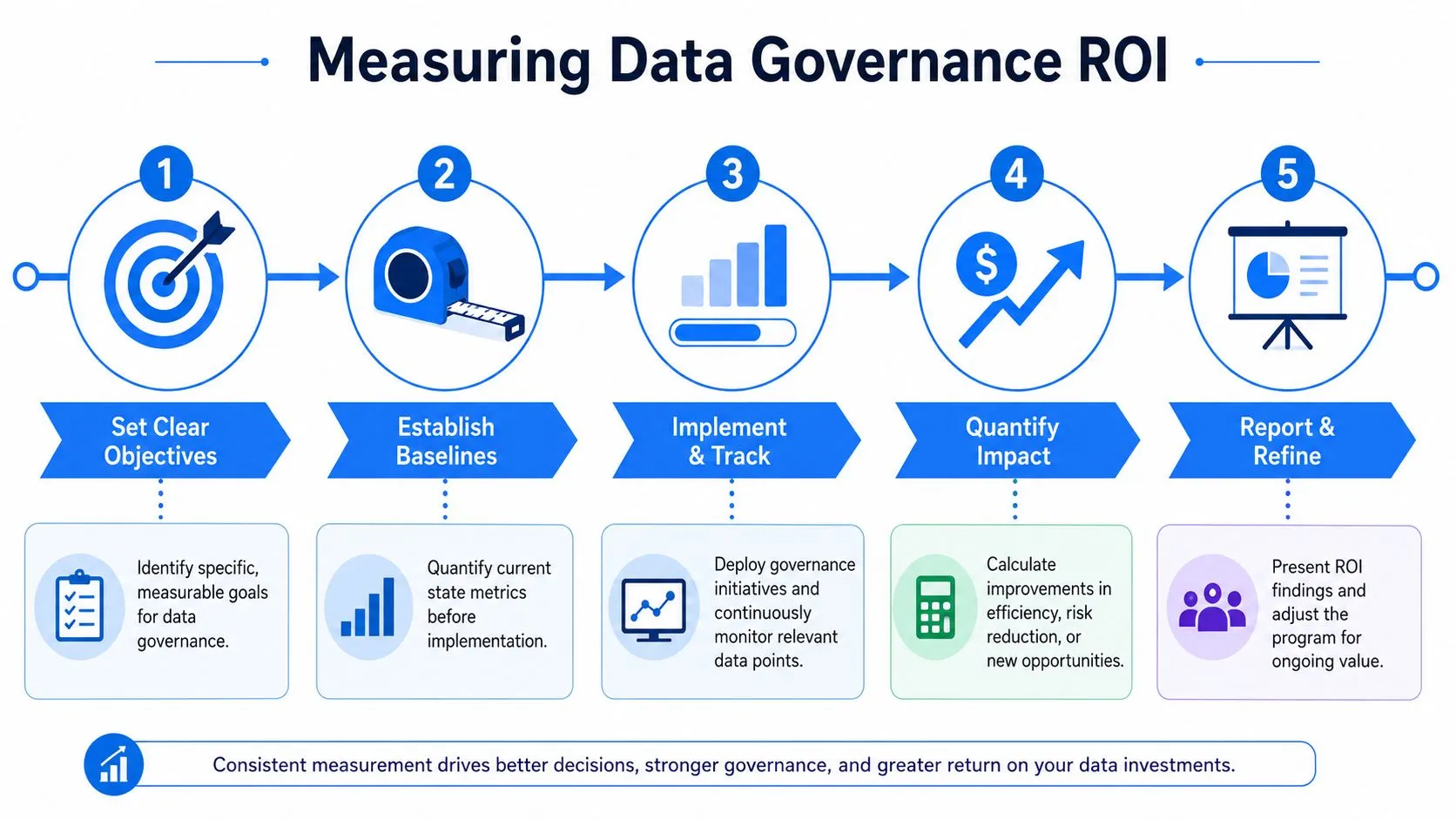
The better approach is to treat governance like any other operating investment. Set a baseline, instrument the work, and show where it changes speed, trust, and risk.
Start with baselines, not slogans
Most companies can describe their pain. Fewer can quantify the current state. Before rolling out policies or tooling, write down what's happening now.
Track things like how long access requests sit before approval, how often metric disputes reach leadership, and how much analyst time goes into validating reports before they're shared. You don't need a perfect model. You need a before state that's credible enough to compare against later.
A simple maturity lens helps:
- Ad hoc: Definitions live in people's heads, access is manual, and issue handling is reactive.
- Managed: Core datasets have owners, a few standards are enforced, and incidents follow a known path.
- Operationalized: Governance is embedded in workflows, documentation is current, and monitoring catches issues early.
- Optimized: Teams improve the system continuously based on usage, incidents, and adoption patterns.
If you want a practical reference for tying governance work to business outcomes in analytics, this piece on measuring ROI for AI and BI initiatives is useful because it pushes the conversation toward decisions and time-to-value.
KPIs that actually show progress
Dataversity recommends tracking data accuracy, issue-resolution time, and policy-adoption rates, noting that mature governance reduces the time teams spend validating data and improves decision latency and trust (data governance KPIs and measurement). Those are the right categories because they connect governance to daily work.
In practice, I'd group governance KPIs into three buckets:
| KPI bucket | What to track | Why it matters |
|---|---|---|
| Trust | Data accuracy, recurring data issues, confidence in certified assets | Shows whether people believe the data enough to use it |
| Speed | Access request cycle time, issue-resolution time, time spent validating data | Shows whether governance removes friction or creates it |
| Adoption | Policy-adoption rates, usage of governed assets, completeness of ownership and metadata | Shows whether the program is actually becoming part of operations |
Some signals are especially telling.
- Issue-resolution time exposes whether ownership is real. If incidents linger because nobody knows who should act, your governance model is decorative.
- Policy-adoption rates show whether teams can follow the rules in practice. A policy nobody uses isn't governance. It's documentation.
- Validation time before analysis is one of the clearest efficiency measures. When analysts stop rechecking the same tables every week, governance is paying for itself.
A strong ROI story doesn't start with savings claims. It starts with fewer disputes, faster access, and less analyst time wasted on verification.
What doesn't work is measuring only completion tasks, such as “number of policies written” or “catalog pages created.” Those can be useful internal activity metrics, but they don't prove business value. Leadership cares whether teams can move with more confidence and less rework.
Governance That Accelerates Not Obstructs
The biggest misconception about governance is that it slows teams down. That can be true if governance is designed as a sequence of approvals layered on top of already clumsy analytics workflows. It's not true when governance is built as infrastructure for self-service.
That distinction matters more now because the main pressure isn't just reporting. It's BI, exploration, AI-assisted analysis, and internal tools built by people who aren't data specialists. IBM frames the challenge well: the issue isn't just defining governance, but figuring out how teams can govern fast-moving data for BI and AI use cases without creating bottlenecks, while still controlling who can do what with data (governing data for BI and AI without bottlenecks)).
The gatekeeper model breaks self-service
In the old model, governance often meant central control. Every new dataset, every definition change, every access request, every dashboard review ran through a small team. That does reduce some risk. It also turns the data team into a human API.
At a startup, that model collapses quickly. The business asks more questions than a central team can answer. People work around the queue. They export CSVs, build shadow logic, or prompt AI tools with whatever context they happen to have. The result looks fast for a week and fragile for a year.
You can usually tell the gatekeeper model is failing when these patterns show up:
- Analysts spend their week in Slack: Work arrives as interruptions, not as reusable systems.
- Business users avoid the warehouse: They don't trust the semantics or don't know what they can safely touch.
- AI outputs vary wildly: The model is only as reliable as the definitions, permissions, and source context behind it.
Guardrails are what scale
Modern governance works better as a guardrail system. Set definitions once. Assign ownership once. Classify data by sensitivity once. Then enforce those decisions in tools and workflows so everyday usage doesn't require a meeting.
That's where platform design matters. Tools should expose business definitions, lineage, and access boundaries directly in the analysis flow. A product like Querio, for example, is designed around warehouse-native self-service with business context, documentation, and governed access patterns so both technical and non-technical users can work on data without waiting for an analyst to mediate every request. The model only works if the governance layer underneath is clear. If the definitions and permissions are sloppy, self-service just scales confusion. For teams designing that kind of operating model, these data governance best practices are a useful reference.
A healthy setup usually has these characteristics:
- Certified paths for common questions: Teams know which datasets and metrics are approved for operational use.
- Fast access with clear boundaries: Users can get what they need without broad, permanent permissions.
- Visible lineage and context: If a metric changes, the impact is traceable.
- Embedded checks: Quality rules and alerts catch issues before trust collapses.
Good governance feels like a well-marked road, not a locked gate.
What slows teams down isn't governance itself. It's unclear governance. If people don't know which data is trusted, who owns it, or what they're allowed to do, they move cautiously or create workarounds. Clear standards reduce that hesitation.
This is why the best governance programs don't start from compliance language alone. They start from workflow friction. Where do teams wait? Where do they duplicate logic? Where do access requests pile up? Where do AI and self-service introduce new ambiguity? Solve those points with policy and operational controls, and governance becomes part of speed.
Starting Your Data Governance Program Pragmatically
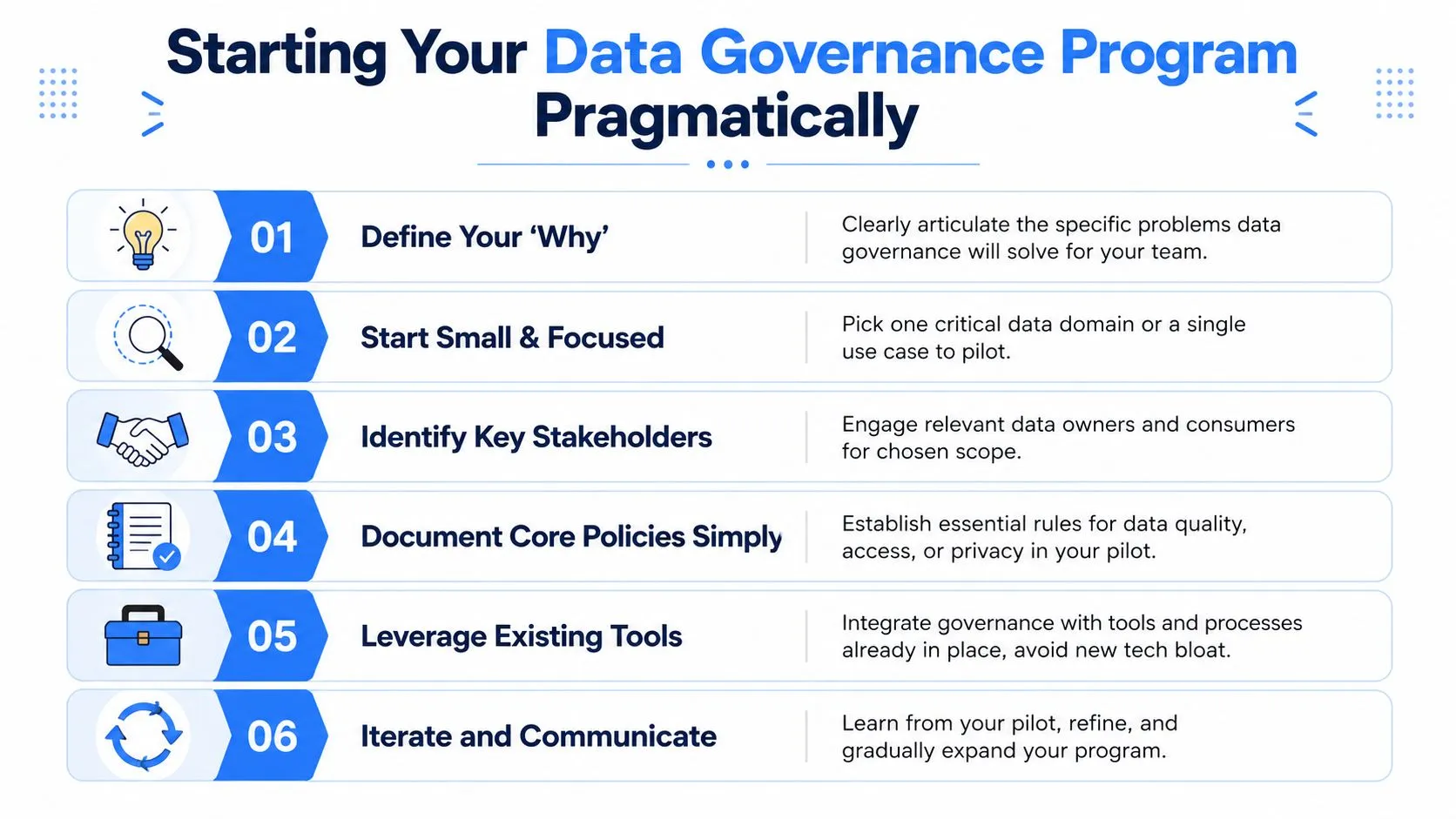
Most startups don't need an enterprise governance program. They need a working one. The difference is scope.
The fastest way to lose momentum is to treat governance like a platform migration. Months of design, long policy documents, and broad tool evaluations usually produce low adoption. A pragmatic rollout starts with one painful domain and fixes it end to end.
Pick one domain and make it work
A good first domain is one with frequent usage and frequent disagreement. Customer, revenue, and product usage data are common candidates. Start where trust problems are visible.
Use a short checklist:
- Define the problem clearly: Write down the operational pain. Conflicting metrics, unclear access, poor discoverability, or recurring data incidents.
- Name the owner and steward: Don't launch without explicit accountability.
- Document core definitions: Your top metrics need plain-English definitions that business users can understand.
- Set a few enforceable rules: Focus on access, quality expectations, and change approvals for the pilot domain.
- Use what you already have: Don't buy three new platforms before the process works.
This is also where founders tend to over-rotate into tooling. Good tools help, especially if you're already evaluating broader workflows around analytics and automation. A list like these top AI tools for entrepreneurs can be useful for context, but governance only sticks when operating rules are clear first.
Many explainers stop at frameworks and never answer the buyer's question: which KPIs show that governance reduced risk or improved usability instead of adding process? Microsoft's Azure overview highlights that gap around ROI and adoption, which is why every rollout should define its outcome measures up front (why governance needs practical outcome metrics).
Here's a practical implementation resource for teams that want a tighter rollout plan: data governance implementation.
A short walkthrough can also help teams align on the basics before they formalize anything:
What to avoid in the first stretch
Three mistakes show up constantly.
- Trying to govern everything at once: Broad scope kills follow-through.
- Writing policies nobody can operationalize: If teams can't apply a rule during actual work, it won't matter.
- Separating governance from usage: Documentation that isn't connected to dashboards, models, access flows, or issue handling gets ignored.
A stronger first ninety days looks simpler. Pick one domain. Assign the people. Define the terms. Clean up access. Track a handful of KPIs. Then expand once the team can point to visible improvement.
That's how governance becomes real. Not by announcing a framework, but by making one part of the business easier to trust and easier to use.
If your data team is overloaded, the next step isn't more dashboard sprawl. It's a governed self-service layer that gives business users context, boundaries, and trustworthy access to the warehouse. Querio is built for that model, helping teams move from ad hoc request handling to scalable analytics infrastructure without turning governance into bureaucracy.