Guide
Natural Language Processing for Business a Practical Guide
Discover how natural language processing for business transforms operations, from automating support to unlocking deep data insights. Your complete NLP guide.
At its heart, Natural Language Processing (NLP) is the technology that finally lets computers make sense of human language. Think of it as a subfield of artificial intelligence focused entirely on bridging the gap between how we talk and how machines process information. For businesses, this means turning messy, unstructured data—like customer emails, support chats, and social media comments—into clear, usable insights.
What Is Natural Language Processing in a Business Context

Let's use an analogy. Imagine your company’s data is a massive library, packed with millions of books written in hundreds of different languages. Without an expert librarian who can read them all, finding anything specific would be a nightmare. NLP is that super-powered librarian. It reads everything, understands the context, and organizes all that knowledge so you can ask a simple question and get the right answer in seconds.
Essentially, NLP translates our everyday communication into the structured language computers need to work with. It's the magic behind chatbots that actually grasp what you're asking for, and it's the engine that lets analytics tools dig through thousands of reviews to spot a new trend. This isn't science fiction anymore; it’s a fundamental business tool.
The Driving Force Behind NLP Adoption
So, why is everyone talking about NLP now? It comes down to one thing: the explosion of unstructured data. An estimated 90% of all business data is now unstructured text. This is the stuff that doesn't fit neatly into a spreadsheet.
- Customer Feedback: Think emails, support tickets, and open-ended survey answers.
- Social Media: All those public comments, brand mentions, and DMs.
- Internal Communication: Slack channels, meeting notes, and internal knowledge bases.
- Market Intelligence: News articles, industry reports, and competitor press releases.
Trying to analyze this firehose of information manually is not just slow—it's impossible. NLP automates the heavy lifting, turning all that noise into a clear signal you can act on. This isn't a niche trend; the global NLP market is on track to hit $26.82 billion by the end of 2025 as more companies realize it's a competitive necessity.
Natural Language Processing empowers businesses to stop guessing and start knowing. It unlocks the "why" behind customer behavior, market shifts, and operational hiccups by analyzing what people are actually saying, in their own words.
From Raw Text to Business Value
At the end of the day, natural language processing for business is all about extracting value from words. It allows teams to go far beyond basic keyword searches and achieve a genuine understanding of text, but at a massive scale.
By making enterprise data accessible through natural language, organizations can make smarter decisions much faster, without needing a data scientist for every little question. This is a huge shift. It puts powerful data analysis into the hands of product managers, marketers, and support leads, letting them ask complex questions and get immediate, data-backed answers.
Understanding Core NLP Capabilities for Your Business

To really see the value of natural language processing for business, you don't need to be a data scientist. You just need to understand what it can do. Forget the dense technical jargon for a moment; let's frame these capabilities around the actual business problems they solve.
Think of each NLP function as a specialized tool in your company's analytics toolkit. You wouldn't use a hammer to saw a board, and similarly, you apply specific NLP techniques to extract specific kinds of insights from all that text data you're sitting on.
These tools are built to operate at a scale and speed no human team could ever hope to match. They form the foundation for almost every impactful NLP application, from automating customer support to conducting deep market analysis.
Gauging Customer Emotion with Sentiment Analysis
At its core, Sentiment Analysis is your company’s built-in emotion detector. It reads a piece of text—a customer review, a social media post, a support ticket—and instantly figures out if the feeling behind it is positive, negative, or neutral.
Imagine you just launched a new feature. Instead of having someone manually sift through thousands of App Store reviews, Sentiment Analysis can digest them all in minutes. It can give you a real-time dashboard showing that 75% of feedback is positive, but a vocal 15% is negative, specifically complaining about the new user interface.
This moves you from guesswork and anecdotes to hard data. You can instantly measure customer happiness, track how your brand is perceived after a marketing push, and prioritize which product bugs to fix based on the most passionate negative feedback.
Extracting Key Facts with Named Entity Recognition
If Sentiment Analysis understands emotion, Named Entity Recognition (NER) understands facts. Think of NER as an intelligent highlighter that automatically scans text and pulls out the critical pieces of information—the "entities" that matter.
These entities are the nouns that drive your business:
- People: Customer names, sales reps, key contacts.
- Organizations: Competitor names, partner companies.
- Locations: Cities, countries, or specific store addresses.
- Products: Your product models, SKUs, or feature names.
- Dates and Times: Deadlines, appointment schedules, or complaint timestamps.
For a support team, this is a game-changer. NER can automatically scan an incoming ticket, identify the product model, customer name, and location, then tag it for the right agent without a person ever touching it. This slashes triage time and gets customers to a resolution much faster. It turns a messy wall of text into a structured, actionable list. To fully grasp NLP's potential, it's essential to understand underlying technologies such as AI video translator technology, which integrates multiple NLP capabilities for global communication.
By automatically identifying and categorizing key information, Named Entity Recognition transforms unstructured support tickets and customer feedback into structured, analyzable data, cutting down manual processing time and accelerating response cycles.
Uncovering Hidden Themes with Topic Modeling
While NER is great at finding specific facts, Topic Modeling is all about seeing the bigger picture. It dives into a huge collection of documents and automatically identifies the main themes or topics running through them. It’s like having a machine read every piece of customer feedback you've ever received and then organize it into neat piles based on recurring subjects.
Let's say you see a sudden spike in customer churn. You could run Topic Modeling on all the cancellation surveys and support chats from the last month. The algorithm might come back and show you the top three themes are "confusing pricing," "missing integration with X software," and "slow performance."
This is how you discover the "unknown unknowns." You aren't searching for specific keywords you already know about; you're letting the data itself tell you what your customers are really talking about. When these topics are organized, they often form the basis of a semantic layer, a business-friendly map of your data. You can learn more about how a semantic layer organizes your data in our detailed guide. These core capabilities work together to build a complete understanding of your business landscape.
Putting NLP to Work: High-Impact Business Use Cases
Knowing what Natural Language Processing is capable of is one thing, but seeing it drive real business results is something else entirely. The true power of natural language processing for business comes alive when you apply it to solve specific, high-value problems across your company. This is where theory meets execution and starts delivering a measurable return.
From supercharging your customer support to uncovering market trends your competitors miss, NLP isn't some far-off concept. It's a practical tool you can use right now to gain a serious advantage. Let's dig into some of the most impactful ways businesses are putting it to work.
Supercharging Customer Support and Experience
Customer support is often the first and most obvious place to apply NLP. Why? Because most support teams are buried under a mountain of repetitive questions, which creates frustrating delays for everyone. NLP-powered tools can jump right on this problem by automating the front lines of communication.
- Intelligent Chatbots: Forget the clunky, keyword-based bots of the past. Modern chatbots use NLP to genuinely understand a customer's intent. They can instantly resolve common issues like "Where's my package?" or "How do I reset my password?" around the clock. This alone can automate up to 40% of routine inquiries, freeing up your human agents to focus on the tricky, high-value problems where they're needed most.
- Automated Ticket Routing: NLP can read an incoming support ticket, email, or social media message and instantly figure out what it's about. Using techniques like Named Entity Recognition, it identifies the product, issue, and urgency, then automatically sends the ticket to the right person or department. It's a simple step, but it drastically cuts down on triage time and gets customers to the right expert, faster.
Gaining a Competitive Edge with Market Intelligence
Every single day, your competitors, customers, and the market itself generate a tidal wave of text online—news, press releases, social media chatter, and industry reports. Trying to keep up manually is a losing battle. With NLP, however, you can turn all that public data into your own strategic weapon.
By applying sentiment analysis and topic modeling to this firehose of information, you can:
- Track Brand Perception: Get an instant read on how people feel about your brand versus the competition. For example, advanced language models can dramatically improve ChatGPT-powered brand monitoring in e-commerce.
- Spot Emerging Trends: Catch wind of new features, pricing changes, or marketing campaigns from competitors the moment they hit the web.
- Analyze Customer Feedback at Scale: Find out exactly what people love or hate about competing products by sifting through thousands of reviews on forums and social media.
This kind of proactive market intelligence lets you react to market shifts in near real-time, anticipate what your competitors will do next, and simply make smarter strategic bets.
NLP turns the public web into your own personal market research firm. It systematically analyzes what everyone is saying about your industry, giving you a real-time feed of threats and opportunities without the manual labor.
Unlocking Deeper Insights with Enhanced Business Intelligence
Perhaps the most game-changing application of natural language processing for business is its fusion with Business Intelligence (BI) and data analytics. Traditionally, getting answers from company data meant you needed to know how to write complex SQL or navigate labyrinthine dashboards. NLP shatters that barrier.
Today, modern BI platforms allow anyone on the team to simply ask their data a question in plain English. A product manager can now type, “What was our user retention rate for customers who signed up in Q2, broken down by acquisition channel?” and get back a perfect chart in seconds.
This conversational approach to analytics is drawing huge investment. The NLP market in the United States alone is valued at a massive $15.21 billion in 2025 and is projected to explode to $58.25 billion by 2031. This growth is fueled by businesses that have seen NLP boost customer experience scores by 25% and deliver 3-5x ROI from efficiency gains. You can dive deeper into these natural language processing statistics on ElectroIQ.
To give you a clearer picture, here's how these use cases map across different departments and the value they bring.
NLP Use Cases and Business Impact by Department
This table outlines common applications of Natural Language Processing across different business functions, detailing the primary benefit and potential ROI for each.
| Department | Use Case Example | Primary Business Benefit | Potential ROI |
|---|---|---|---|
| Customer Support | AI chatbots for instant query resolution | Reduced agent workload, 24/7 support | 20-40% reduction in support costs |
| Marketing | Sentiment analysis of social media mentions | Real-time brand perception tracking | 15-25% improvement in campaign effectiveness |
| Sales | Automated lead scoring from email interactions | Prioritization of high-potential leads | 10-20% increase in conversion rates |
| Product | Topic modeling of customer feedback | Faster identification of feature requests | Quicker product improvements, higher retention |
| HR | Resume screening and candidate matching | Reduced time-to-hire, better candidates | 30-50% reduction in manual screening time |
| BI & Analytics | Natural language querying of databases | Data democratization, faster insights | 3-5x ROI through operational efficiency |
As the table shows, the applications are broad and the impact is substantial, making NLP a powerful tool for nearly every part of the business.
These self-serve analytics tools, often driven by sophisticated AI agents, empower every team—from finance to operations—to make decisions backed by data, on their own. You can see more examples in these top use cases for AI agents in data analytics. This "democratization of data" doesn't just save countless hours of report-pulling; it builds a more curious and data-fluent culture. By connecting directly to your databases, these systems ensure every answer is grounded in truth, turning simple curiosity into immediate, actionable insight.
Picking the Right NLP Implementation Strategy
Deciding to bring natural language processing into your business is a great first step, but what comes next is just as important: how are you actually going to do it? There’s no single right answer here. The best path for you depends entirely on your team's skills, your budget, how fast you need to move, and what you’re trying to accomplish.
Choose the wrong path, and you could end up with a stalled project and wasted money. To get it right, you need to understand the three main ways to implement NLP: using ready-made APIs, fine-tuning an existing model, or building a custom solution from scratch. Each one has a different mix of speed, cost, and control.
This decision tree gives you a good visual map of how NLP can be applied to solve real problems in customer support, marketing, and business intelligence.
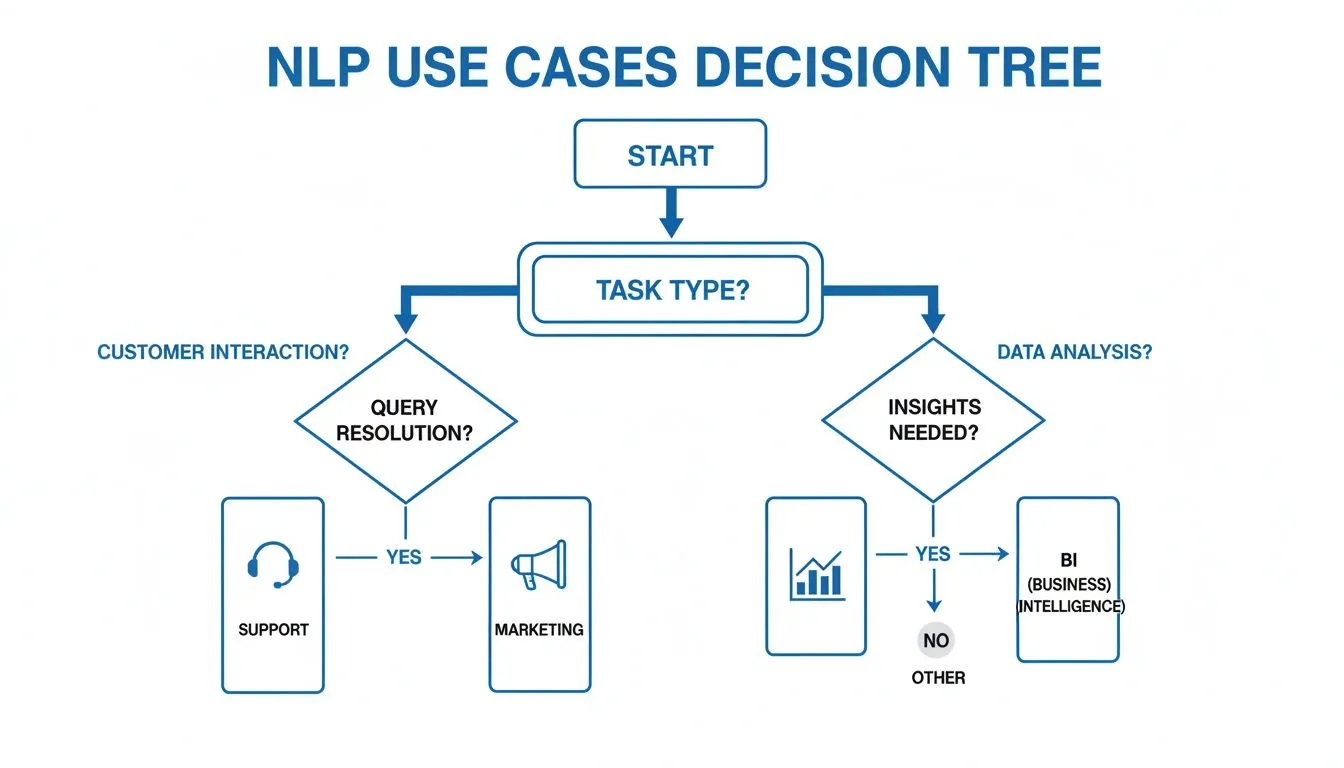
As you can see, even though the applications are different, the goal is always the same—turning messy human language into something a business can act on.
The Plug-and-Play Path: Off-the-Shelf APIs
The quickest way to get started with NLP is to use a pre-built API from a major provider like Google Cloud AI, Amazon Comprehend, or a specialized AI company. Think of it like renting a powerful NLP engine that’s already been trained. You send your text, and it sends back what you need, whether that's sentiment scores, key topics, or translations.
This approach is perfect for common, well-defined tasks. If you just need to analyze the sentiment of standard product reviews or translate your website, an API can have you up and running in a matter of hours, not months. The big wins here are speed and low upfront investment, since you usually just pay for what you use.
But that convenience comes with a trade-off: a lack of customization. These models are trained on gigantic, general datasets, so they won't understand the unique jargon, acronyms, or context of your specific industry.
The Balanced Approach: Fine-Tuned Models
What if a generic API isn't quite accurate enough for you? Fine-tuning is an excellent middle ground. This is where you take a powerful, pre-trained model and then train it a little more using your own company data.
Let's say you're in healthcare and need an NLP model to make sense of complex medical terms. A general-purpose API would probably get confused. But by fine-tuning a model with thousands of your own anonymized patient records and lab reports, you can teach it to accurately identify specific conditions, treatments, and drug names.
This takes more work and some data science know-how, but the payoff is a solution that’s truly dialed in to your business needs—without the massive cost of starting from zero.
Fine-tuning is the sweet spot for many businesses. It gives you the raw power of a huge, pre-trained model but with the precision that only comes from your own proprietary data. The result is a system that's both powerful and contextually smart.
The Custom-Built Solution: Maximum Control
Building an NLP model from the ground up is the most demanding route, but it gives you complete control and can become a serious competitive advantage. This path is really for companies tackling unique, complex problems that off-the-shelf tools simply can't handle.
This isn’t a small undertaking. You'll need a dedicated team of data scientists and machine learning engineers, access to massive, well-labeled datasets, and a lot of computing power. The process can take months, sometimes years, and comes with significant upfront and ongoing costs.
But for mission-critical applications where top-tier accuracy is everything—like building a novel fraud detection system based on communication patterns or a specialized text-to-SQL engine for your analytics—a custom build is the only way to get the job done right. When building something that specific, a structured evaluation is critical. For instance, you can find a helpful checklist for evaluating text-to-SQL models in BI to make sure it meets your precise business needs.
Comparing NLP Implementation Approaches
Making the right choice comes down to understanding the trade-offs. The table below breaks down the three main paths to help you decide which one aligns best with your team's resources and goals.
| Approach | Best For | Cost | Time to Implement | Required Expertise |
|---|---|---|---|---|
| Off-the-Shelf APIs | Standard tasks, proofs-of-concept, and teams with limited ML skills. | Low (Pay-as-you-go) | Very Fast (Hours/Days) | Low (Basic coding) |
| Fine-Tuned Models | Industry-specific needs where context and accuracy are key. | Medium | Moderate (Weeks/Months) | Medium (Data science skills) |
| Custom Models | Unique, mission-critical problems that create a competitive advantage. | High | Long (Months/Years) | High (Expert ML/engineering team) |
Ultimately, your choice should tie directly back to your business case. Are you running a quick pilot to test an idea? Start with an API. Do you need to deeply understand customer feedback filled with industry slang? Fine-tuning is probably your best bet. Are you building a core product feature that will define your company? It might be time to invest in a custom model. By weighing these factors, you can pick the strategy that sets you up for success.
Avoiding Common Pitfalls on Your NLP Journey
It's easy to get excited about what NLP can do for your business, but the road from concept to a successful rollout is often trickier than it looks. A sophisticated algorithm is just one ingredient. Without high-quality data and a clear plan, even the most powerful NLP models can fall flat, failing to deliver the results you're after.
The real challenge isn't just about the tech. Things like poor data quality, overlooking user privacy, or unintentionally building biased models can quietly sabotage your project. Let’s walk through some of the most common traps and how you can steer clear of them.
The "Garbage In, Garbage Out" Problem
This is the golden rule of any data-driven project, and it's especially true for NLP. Your model is a student, and it only knows what you teach it. If you feed it messy, inconsistent, or irrelevant data, you're going to get messy, inconsistent, and irrelevant outputs. It’s that simple.
Think about it: if you're building a model to analyze customer sentiment, it needs clean examples of actual customer feedback. If your dataset is cluttered with typos, spam comments, or internal support agent notes, the model will get confused and never learn the real patterns. Making sure your data is clean, relevant, and properly structured isn't just a preliminary step—it's the foundation of your entire project.
Navigating Data Privacy and Governance
These days, handling user data is a massive responsibility. Regulations like GDPR in Europe and CCPA in California have teeth, and they lay down strict rules for how personal information is collected, stored, and processed. Since NLP models often chew on customer conversations, emails, and reviews, you're almost certainly dealing with sensitive data.
Flying blind here is not an option. You need a solid data governance plan before you write a single line of code.
- Anonymize Everything: Strip out Personally Identifiable Information (PII) like names, email addresses, and phone numbers from your training data wherever you can.
- Set Clear Policies: Lock down who has access to the data and document exactly what they're allowed to do with it.
- Stay Compliant: Your legal team should be your best friend here. Make sure your data practices are fully compliant with every regulation in the regions where you do business.
A privacy misstep can result in huge fines, but the real cost is the loss of customer trust—something that’s incredibly hard to get back.
A successful NLP strategy is built on a foundation of trust. Prioritizing data privacy and governance isn't just a legal requirement; it's a commitment to your customers that you will handle their information responsibly.
The Hidden Danger of Algorithmic Bias
An NLP model doesn't form its own opinions, but it's a master of mimicry. It will faithfully learn and even amplify any biases hiding in its training data. If your data reflects historical prejudices, whether conscious or not, your model will bake those prejudices right into its logic. The fallout can be serious.
Imagine an HR team using an NLP tool to screen résumés. If it was trained on historical hiring data that favored candidates from a certain background, the model will learn to do the same, automatically filtering out perfectly qualified people. You have to actively audit your data for these hidden biases and work to build a balanced dataset. It's the only way to create fair and ethical AI.
When Good Models Go Bad
One of the biggest mistakes is thinking your work is done once the model is deployed. Language is always changing. New slang pops up, customer priorities shift, and what was accurate a year ago might be way off today. This slow decay in performance is called model drift.
For example, a sentiment analysis model built pre-pandemic might completely misinterpret new phrases or cultural references that have emerged since. The model's accuracy slowly erodes without anyone noticing. To fight this, you need a feedback loop.
- Monitor Performance: Keep a close eye on your model's accuracy using fresh, real-world data.
- Collect Feedback: Give users an easy way to flag when the model gets something wrong.
- Retrain Regularly: Use all that new data and feedback to periodically retrain and update your model.
Your NLP system isn't a one-and-done project. Treat it like a living product that needs ongoing maintenance to stay sharp, relevant, and valuable.
Your First Steps with Natural Language Processing
Getting started with natural language processing for business doesn't have to be a massive undertaking. You don’t need a giant budget or a room full of data scientists right away. The trick is to start smart, pick one tangible problem, and score a clear win to build momentum.
This practical roadmap will show you exactly how to get going. The first, and most important, step is to find a single, high-impact business problem. Forget trying to solve everything at once. Instead, zero in on a specific point of friction where understanding language at scale would make a genuine difference.
Define Your Pilot Project
Once you’ve identified a problem, shrink it down into a small, manageable pilot project. The goal here isn't perfection; it’s about proving the value of NLP quickly. A successful pilot gives you the hard evidence you need to get stakeholders excited for bigger things.
Here are a few ideas for a focused pilot project:
- Customer Support: Automatically tag the top 10 most common support ticket topics. This will give you a much clearer picture of what your customers are struggling with.
- Marketing: Analyze the sentiment of social media mentions for just one product line over the next 30 days.
- Product: Classify all the open-ended feedback from your latest user survey to pinpoint the most requested new features.
Each of these goals is specific, measurable, and totally achievable with the tools available today.
The most successful NLP initiatives begin with a laser focus on one well-defined business challenge. A small, early victory provides the proof and momentum needed to justify broader investment and adoption across the organization.
Evaluate Modern Tools and Measure Results
With a clear pilot in mind, it's time to look at modern business intelligence platforms that already have NLP features built-in. Many tools now offer "ask your data" functions, which means anyone on your team can get insights without needing to write a single line of code. Platforms like Querio have these powerful AI agents integrated, opening up sophisticated analysis to your entire organization.
Finally, measure your results. Did you solve the problem you set out to fix? Maybe you drastically cut down on manual analysis time or uncovered a critical customer insight much faster than before. Document the outcome, share the win with your team, and use that momentum to tackle your next high-impact challenge. This step-by-step approach is the smartest way to unlock the power of NLP.
Answering Your Top NLP Questions
As teams start to get serious about natural language processing, a few practical questions always pop up. They’re usually less about the technology itself and more about what it actually takes to get it running and prove its worth.
Let's tackle the big ones.
Do I Need a Team of Data Scientists to Use NLP?
Not like you used to. A few years ago, the answer was a definite "yes." Building anything useful with NLP meant you needed a team of specialists to create models from scratch.
Today, that barrier has largely vanished. Many modern business intelligence platforms now come with powerful NLP features baked right in. This means anyone, from a product manager to a finance analyst, can simply ask questions in plain English and get answers on the fly. This self-serve model puts the power of NLP directly into the hands of the people who need it, without the massive overhead of a dedicated data science team.
How Much Data Do We Need to Get Started?
This really depends on what you’re trying to accomplish.
If you're using an off-the-shelf feature—like a "ask your data" function in a BI tool—you can start with the data you have right now. These systems come pre-trained on enormous datasets, so they're already equipped to understand language.
However, if you're aiming to train a custom model for a very specific task, like classifying your company's unique support tickets, you’ll need to provide it with labeled examples. A few thousand examples is a solid starting point for a robust model, but don't let that number scare you. You can often prove the concept and show real value with a much smaller pilot project.
The best way to start is to pick a specific business problem first. Use the data you have on hand to demonstrate a quick win, then build from there. This iterative approach almost always beats waiting for the "perfect" dataset.
How Do We Measure the ROI of an NLP Project?
You can't manage what you don't measure. The return on investment for any natural language processing for business project has to be tied to a concrete business metric. If you start with a fuzzy goal, you'll end up with a fuzzy result.
Here’s how to think about it for different use cases:
- Customer Support: If you're launching a chatbot, the metrics are clear. Look for a reduction in human agent response times, a drop in overall ticket volume, and hopefully, a lift in customer satisfaction scores (CSAT).
- Sales Intelligence: Using NLP to sift through sales call transcripts or prospect emails? Track the increase in conversion rates or the reduction in time your reps spend on manual research.
- Internal Analytics: For tools that let your team query data directly, measure the hours saved on pulling manual reports. You can also track how much faster your teams are able to make decisions.
Nail down your key metric before you kick things off. It's the only way to definitively prove the project was worth it.
Ready to unlock the insights hidden in your data? Querio’s AI-powered platform lets your entire team ask questions in plain English and get accurate, visualized answers in seconds. Learn how you can turn curiosity into action at https://www.querio.ai.