Business Intelligence
Why AI Driven Analytics Is Replacing Traditional BI
AI analytics provides real-time predictions, automates data workflows, and replaces slow BI dashboards with scalable, accurate insights for faster decisions.

AI-powered analytics is replacing older BI systems because it provides faster, smarter, and more actionable insights. Traditional BI tools rely on historical data and static dashboards, often requiring technical expertise and causing delays. AI analytics, on the other hand, delivers real-time predictions, automates workflows, and simplifies data access with natural language queries.
Key reasons for the shift:
- Real-Time Insights: AI processes streaming data instantly, unlike BI's batch updates.
- Predictive and Prescriptive Analytics: AI forecasts outcomes and suggests actions, while BI focuses on past performance.
- Ease of Use: Non-technical users can interact with AI systems directly, bypassing IT bottlenecks.
- Scalability: AI handles massive datasets and integrates seamlessly across systems.
- Automation: Routine tasks like data preparation and anomaly detection are automated.
Businesses using AI analytics can respond faster to market changes, reduce errors, and make better decisions without waiting for outdated reports. With 80-90% of large enterprises planning to adopt AI analytics by 2027, this shift is becoming essential for staying competitive.
::: @figure 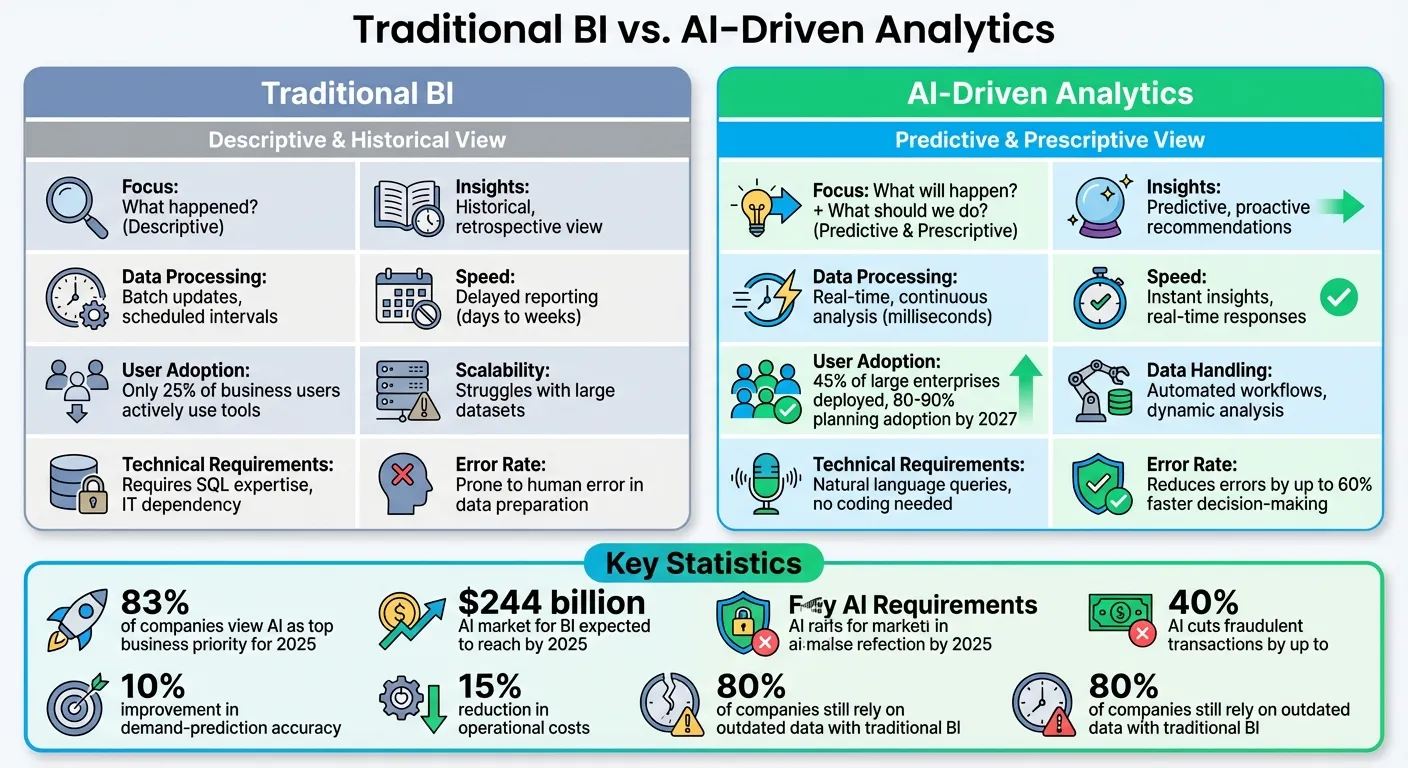 {Traditional BI vs AI-Driven Analytics: Key Differences and Capabilities}
:::
{Traditional BI vs AI-Driven Analytics: Key Differences and Capabilities}
:::
Why Generative BI Is Replacing Dashboards | The Future of Business Intelligence with AI
::: @iframe https://www.youtube.com/embed/qnLkkZ_RIO0 :::
How AI Transforms the Analytics Model
The difference between traditional business intelligence (BI) and AI-powered analytics lies in how they process data and the insights they deliver. Traditional BI systems focus on answering "What happened?" Meanwhile, AI-driven platforms take it further by addressing "What will happen?" and "What should we do about it?" This shift from descriptive to predictive and prescriptive analytics is reshaping how businesses operate, meeting the growing demand for forward-looking, actionable insights instead of outdated historical reports [6][3].
Consider this: while 83% of companies view AI as a top business priority for 2025, only 25% of business users actively use traditional BI tools. Why? Because these tools are often too complex for non-technical users [5][4]. On the other hand, 45% of large enterprises have already implemented AI solutions, and 80-90% plan to adopt them within the next two years [2]. The global AI market for business intelligence is expected to reach $244 billion by 2025 [5]. These numbers reflect the limitations of traditional BI and highlight the transformative potential of AI-driven analytics.
Traditional BI: Stuck in the Past
Traditional BI tools provide a retrospective view, showing past performance rather than future possibilities. These systems rely heavily on manual data processing, with batch updates and static dashboards that demand SQL expertise to create and interpret. When business teams need reports, they often face delays. By the time the data is ready, market conditions may have already shifted.
The workflow is rigid and rule-based, requiring analysts to know the exact questions to ask beforehand. These questions are then translated into technical queries, which can only be executed by someone with the right skills. If the required data isn't already available on a dashboard, it means waiting in line for IT to build it. This creates what experts call "IT bottlenecks", slowing down decision-making and causing businesses to miss time-sensitive opportunities [3][4].
AI-Driven Analytics: A Smarter, Faster Approach
AI-driven analytics removes these roadblocks by delivering real-time, proactive insights. These systems analyze data continuously, forecast outcomes, and recommend actions - all without requiring technical expertise. Users can ask questions in plain English and receive clear answers. Instead of focusing solely on past trends, AI identifies patterns, predicts future scenarios, and suggests actionable steps.
"AI's ability to quickly process large volumes of data, identify patterns and generate predictive insights offers a significant competitive edge." - Cole Stryker, Staff Editor, IBM Think [3]
AI systems handle both structured and unstructured data at scale, uncovering anomalies and correlations that human analysts might overlook. This is a game-changer because humans are limited by the questions they know to ask, while AI algorithms can proactively surface insights. For example, AI can alert teams to emerging risks or opportunities before they become apparent. The result? Faster decisions, fewer missed opportunities, and analytics that grow with your business - no additional headcount required.
Speed and Automation: Removing Delays from Data Workflows
AI's ability to predict outcomes is impressive, but its power to speed up and automate data workflows is what truly sets it apart.
The gap between traditional business intelligence (BI) and AI-driven analytics becomes glaring when you look at response times. Traditional BI systems depend on batch processing - data gets updated during scheduled intervals, often overnight or weekly. By the time reports are ready, the data is already outdated. Shockingly, 80% of companies still rely on outdated data for critical decisions, leading to missed opportunities and inefficiencies [10].
AI-driven analytics changes the game by analyzing massive amounts of streaming data in real time, delivering insights in milliseconds [9][10]. This real-time speed is a game-changer for time-sensitive operations like fraud detection, supply chain management, or responding to sudden shifts in customer behavior. For instance, AI-powered anti-fraud systems can cut fraudulent transactions by up to 40% by identifying suspicious activity instantly [9]. This shift from reactive to proactive decision-making highlights AI's ability to not only forecast but also act immediately, paving the way for smoother, automated workflows.
"Without real-time data, AI is like a GPS running on last week's traffic updates - it leads you straight into a traffic jam." - Chandni Sinha, Product Marketing Manager, IBM [10]
Real-Time Insights vs. Delayed Reporting
Traditional BI workflows are slow and cumbersome. They require extracting, cleaning, and reporting data - a process riddled with delays. If a business user needs a custom report, they must request it from IT or analytics teams, wait for someone to write the query, and hope the findings are still relevant when they arrive. Depending on the workload, this process can take days or even weeks.
AI-driven analytics flips this script by enabling instant reactions to critical events like customer churn, equipment malfunctions, or market shifts. This immediacy is crucial for high-stakes functions such as fraud prevention and supply chain management [10].
Automation Cuts Down Manual Effort
AI-driven analytics doesn’t just speed things up - it also reduces the amount of manual work required. Tasks like data preparation, cleansing, categorization, and modeling are automated through machine learning and large language models [8][9]. Analysts no longer need to spend hours combing through spreadsheets or crafting complex queries. Instead, they can focus on interpreting insights and making strategic decisions.
"Instead of spending hours editing spreadsheet data line-by-line... AI in BI does the tedious work of preparing data for analysis, freeing up people to make more productive use of their time." - Daniel Palmer, Author, IBM [2]
AI also makes data more accessible. With plain English queries, business users can ask questions and get instant answers [8][4]. This ease of use is one reason why traditional BI tools are underutilized - only 25% of employees use them because they are often too technical [4].
Platforms like Querio exemplify this transformation. By connecting directly to data warehouses and automating routine tasks, Querio provides real-time, actionable insights without the delays of traditional BI workflows. This empowers teams to focus on what really matters: making informed, strategic decisions.
Accuracy and Depth: How AI Finds Better Insights
AI doesn't just promise speed and automation - it also brings a new level of precision and depth to data analysis.
By eliminating human error and uncovering patterns that manual processes often miss, AI-driven analytics ensures more reliable insights. Traditional BI methods, like cleaning spreadsheets, matching records, and merging datasets, are prone to errors such as typos, incorrect formulas, and overlooked anomalies. AI automates these tedious tasks, streamlining the ETL (Extract, Transform, Load) process and delivering cleaner data from the start [8][13]. The result? Insights you can trust.
How Accuracy Enhances Insights
AI's ability to use machine learning algorithms like classification models, regression analysis, and clustering allows it to process massive datasets and uncover complex relationships that would take human analysts far longer to identify [13]. Industries like aviation showcase how accurate analytics can directly improve operations. For instance, companies like Airbus and Delta Airlines use AI platforms such as Skywise and Predictive Maintenance Services to analyze historical flight and sensor data. These tools predict maintenance needs before failures occur, cutting down on flight delays and enhancing passenger safety [14].
Reducing Human Error in Data Analysis
AI doesn't just handle data preparation; it also continuously monitors data streams to detect anomalies [12][13]. Unlike traditional BI tools that rely on periodic manual checks, AI systems learn and adapt over time. Machine learning models refine themselves with each new dataset, improving accuracy and reducing false alarms [11][13]. This ongoing refinement leads to measurable benefits: demand-prediction accuracy improves by nearly 10%, decision-making speeds up by 60%, and operational costs drop by up to 15% [11][13].
Spotting Hidden Patterns and Anomalies
AI goes beyond the surface to uncover insights that traditional methods often miss.
While conventional BI dashboards provide answers to specific queries, they can overlook hidden trends and anomalies. AI, however, proactively scans datasets to identify patterns, trends, and outliers in real time. Anomaly detection algorithms can flag potential fraud or unexpected spikes instantly - tasks that would take analysts weeks to complete manually.
AI also excels at finding hidden groupings within data. Using unsupervised learning, it identifies clusters and natural segments that manual analysis might miss entirely. For example, in market research, clustering algorithms can reveal customer segments that traditional BI tools fail to detect. Moreover, Natural Language Processing (NLP) uses in BI enable AI to translate conversational queries into precise database searches, understanding complex business contexts and synonyms.
Platforms like Querio highlight this transformation. Querio connects directly to data warehouses and uses AI agents to convert plain English queries into SQL and Python. This approach delivers accurate, transparent results without the risks of a "black box" system, making data analysis both accessible and reliable.
Scalability and Integration: Supporting Business Growth
With real-time insights and automation as a foundation, scalable analytics emerge as a critical driver for business growth. As companies expand, their data multiplies at an even faster pace. The problem? Traditional BI systems struggle to keep up. They weren't built to handle rapid data growth and often demand manual updates or expensive upgrades. On the other hand, AI-powered analytics naturally grow alongside the business, adapting to increased demands without breaking a sweat.
How AI Handles Large Datasets Better Than Traditional BI
When data volumes surge, traditional BI systems start to falter. Processes that handle thousands of rows can buckle under the weight of millions - or even billions. AI-driven analytics solve this problem with modular, cloud-based architectures designed to distribute workloads across multiple servers. This eliminates the bottlenecks that plague older BI tools [15]. Plus, these systems dynamically adjust computing power, scaling up during busy periods and scaling down when things are quieter. The result? Consistent performance and optimized costs [15].
Take this for example: AI systems can process millions of simultaneous requests, such as adjusting fares or allocating resources in real time. Traditional BI tools simply can't keep up with this level of complexity.
Consider this staggering fact: 90% of the world's data was created in just the last two years [16]. This explosion of information has rendered manual analytics methods nearly obsolete. Despite 91% of companies investing in AI in 2023, only 22% managed to scale those efforts across multiple business functions [15]. The solution lies in semantic layers - tools that translate complex data into clear, consistent business terms. These layers ensure accuracy even as data volumes and complexity grow [17]. They also make it easier to unify data from different sources.
Connecting Data Across Teams and Systems
As businesses grow, so does the challenge of fragmented data. Sales teams rely on CRMs, finance teams use ERPs, and operations track IoT devices. Each system operates in its own silo, creating a language barrier between teams. Traditional BI tools often require analysts to manually piece together these disparate data sources, which can lead to inconsistent metrics - like different definitions of customer acquisition cost.
AI-driven analytics tackles this issue by creating a "Single Source of Truth" through semantic layer integration [17]. This layer acts as a bridge between raw data and the end users, simplifying technical complexities into shared business definitions. For example, when someone in finance or sales asks about revenue, the answer is consistent - whether it's pulled from a dashboard, a notebook, or a natural language BI interface.
Governance and Trust: Maintaining Accuracy in AI Systems
As AI systems scale and integrate into business processes, ensuring the accuracy and reliability of their insights becomes crucial. Teams increasingly depend on AI for critical decisions, which naturally prompts questions like: How reliable are these AI-generated results? Why do different departments sometimes get conflicting data? Traditional BI tools provided predictable and consistent query outputs. AI-driven analytics must achieve that same level of reliability while offering greater speed and adaptability. This necessity underscores the importance of implementing strong governance frameworks.
The Role of a Governed Semantic Layer
At the heart of reliable AI analytics is a governed semantic layer - a centralized framework of business definitions that ensures consistency across teams. For example, when both the sales and finance teams ask about "customer acquisition cost", they should arrive at the same result. However, AI systems don’t inherently guarantee this consistency. Without governance, the same query posed to different AI agents could lead to varying interpretations, creating confusion and eroding trust.
Querio addresses this challenge with a shared context layer, where data teams define joins, metrics, and business terms once, ensuring all AI-generated outputs are based on the same foundation. This governance approach combines expert curation - where analysts establish and refine metrics - with agent coaching, where AI responses are continuously reviewed and improved over time [18]. By embedding human expertise into the system, AI becomes a collaborative tool rather than an isolated entity.
A practical step in this process is the use of "verified answers" for commonly asked questions [18]. Analysts can pre-validate responses to frequently posed queries, such as "What was last quarter's revenue?" Once verified, these answers act as benchmarks, enabling the AI to provide consistent and accurate outputs for similar questions in the future. This human-in-the-loop model not only enhances trust but also preserves the efficiency of automated systems.
Transparency in AI-Generated Results
Fast results lose their value if users can't understand or verify how those insights were produced. With traditional BI tools, users could inspect the SQL queries behind the results, offering a clear path to debug and validate the data. AI systems must provide a similar level of transparency to avoid becoming opaque "black boxes" that teams are reluctant to trust.
Querio ensures transparency by generating actual SQL and Python code for every response. When the AI delivers an answer, users can review the exact code that ran against their data warehouse. This isn’t a simplified summary - it’s the precise query that produced the result. Data teams can inspect, modify, and fully understand how the AI interpreted their question. By combining automation with this level of visibility, teams can get answers quickly without sacrificing control or accuracy. Every insight remains firmly rooted in clear, inspectable data logic, eliminating the need for blind trust.
Conclusion
The move from traditional business intelligence (BI) to AI-powered analytics isn't just about answering questions faster - it's about changing the way decisions are made. Traditional BI often left teams waiting on outdated data, creating delays that slowed down progress. AI-driven analytics eliminates these roadblocks by delivering real-time insights, predictive capabilities, and automated workflows that grow alongside your business. With 45% of large enterprises already deploying AI and 80-90% planning adoption within the next two years [2], embracing AI analytics has become a necessity for staying competitive.
The benefits are clear: faster processes, greater accuracy, scalability, and forward-looking insights. Yet, there's a gap between ambition and readiness - only 4% of IT leaders believe their data is truly "AI-ready" [7]. The challenge isn’t just adopting AI but doing so in a way that maintains trust, consistency, and control. The key lies in platforms that balance AI's capabilities with operational governance.
This is where Querio steps in, bridging the gap by combining AI's power with transparency and governance. As discussed earlier, ensuring data consistency is essential. Querio integrates directly with your existing data warehouse, producing inspectable SQL and Python code for every answer. It also maintains a shared context layer, ensuring consistent definitions across teams. This approach tackles the "black box" problem that has historically slowed AI adoption [1][4].
If your organization is still relying on traditional BI, the best way forward is to start small. Pilot projects in critical areas like sales pipeline analysis or supply chain monitoring can demonstrate immediate value [1]. Querio’s natural language interface removes the technical hurdles that have limited BI adoption to just 25% of employees [4]. By democratizing data access without compromising accuracy or control, Querio makes it easier for organizations to take the first step. Its flexible deployment options and pay-as-you-go pricing make it accessible for teams of all sizes.
The future of analytics is already here, driven by AI that complements your team instead of replacing it. Querio ensures that speed and automation go hand in hand with trust and accuracy through verified answers, transparent code generation, and governed semantic layers. It’s not just about adopting AI - it’s about doing it the right way.
FAQs
::: faq
How does AI-driven analytics deliver real-time insights better than traditional BI?
AI-powered analytics offers real-time insights by continuously processing both structured and unstructured data. It spots patterns, detects anomalies, and highlights trends as they happen, cutting out the lag time typically seen with traditional business intelligence (BI) systems. Unlike older methods that rely on static, historical reports and manual data handling, this approach keeps businesses ahead of the curve.
Using machine learning and natural language processing, these tools deliver dynamic, up-to-the-minute information. Users can simply ask questions in plain English and get instant, actionable answers. This makes analytics not only faster but also more user-friendly and accessible to a wider range of people. With real-time insights, businesses can make quicker, smarter decisions, boosting their agility and efficiency far beyond what traditional BI systems can achieve. :::
::: faq
How does AI analytics make data easier to use for non-technical users?
AI analytics makes working with data much easier for those without technical expertise, thanks to natural language processing (NLP) and conversational interfaces. In simple terms, users can ask questions or explore data using plain English - no need for specialized skills like SQL or programming. For instance, AI-powered tools can handle typed or spoken queries instantly, providing clear and straightforward insights without requiring manual effort.
Beyond simplifying queries, AI takes care of complex tasks like data preparation, spotting anomalies, and running predictive analyses. With features such as real-time insights, automated reporting, and trend forecasting, users can quickly access actionable information. By breaking down technical barriers, AI analytics enables everyone - from executives to managers - to make well-informed decisions with confidence and ease. :::
::: faq
Why is scalability essential in AI-driven analytics?
Scalability plays a key role in AI-driven analytics, allowing systems to expand seamlessly as an organization’s data and business needs grow. Unlike traditional business intelligence (BI) tools - which often falter with static reports and manual updates - AI-powered analytics handles massive data volumes in real time. This ensures that speed and accuracy remain intact, even as data sources and user demands multiply.
What’s more, scalable AI solutions open the door for wider adoption across teams. They make it possible for employees, regardless of technical expertise, to tap into actionable insights. This flexibility helps businesses stay nimble, operate more efficiently, and make quicker, data-driven decisions, no matter how complex their operations become. With AI’s predictive tools and automation, organizations can confidently scale while keeping a step ahead in a rapidly evolving market. :::