Embedded Artificial Intelligence Explained
A complete guide to embedded artificial intelligence. Learn how on-device AI drives business value, key use cases, and best practices for implementation.
https://www.youtube.com/watch?v=QXuvUW4B7jU
published
Outrank AI
embedded artificial intelligence, embedded ai, edge ai, iot analytics, on-device ai
af2e9984-b624-4be3-b216-11626092162b

When you hear "Artificial Intelligence," you probably picture massive data centers humming away in the cloud. But what if the intelligence wasn't in a distant server farm? What if it was right inside the device you're using? That’s the core idea behind Embedded AI.
Think of it as giving a device its own brain. Instead of sending information to the cloud to be processed, Embedded AI runs directly on the hardware itself—a camera, a car sensor, or even a factory machine. This allows the device to think and act on its own, instantly, without needing an internet connection. It's why your smart speaker can still understand you when the Wi-Fi goes out.
Understanding On-Device Intelligence

For years, AI has been a cloud-centric affair. You ask a question, your request zips across the internet to a powerful server, a complex model figures out the answer, and sends it back. This works fine for a lot of things, but it’s a non-starter in situations where speed, privacy, and reliability are everything.
Embedded AI completely flips that script. It brings the intelligence to the source, a concept often called “edge computing” because the real work happens at the "edge" of the network, right where the data is born.
This isn't magic; it's the result of two major advancements. First, we now have specialized, low-power computer chips built for AI. Second, software engineers have figured out how to create highly efficient AI models that can run on these tiny chips. Together, they deliver serious computational power without draining a battery or generating a ton of heat.
The Core Components of Embedded AI
At its heart, an embedded AI system is a perfect pairing of lean hardware and smart software. Getting these two pieces to work together in a constrained environment is the name of the game.
Here’s what’s under the hood:
Specialized Hardware: You won't find a standard computer processor here. These systems rely on things like microcontrollers (MCUs), Field-Programmable Gate Arrays (FPGAs), or even custom-designed Application-Specific Integrated Circuits (ASICs). They’re all designed from the ground up to handle AI tasks efficiently with minimal power.
Optimized AI Models: You can't just cram a giant cloud-based AI model onto a tiny chip. Developers use clever techniques like quantization and pruning to shrink these models down, making them smaller and faster without losing too much of their accuracy.
Local Data Processing: From start to finish, everything happens on the device. Data is collected, analyzed, and acted upon right there. This self-contained approach is what delivers the killer benefits of speed and security, since sensitive information never has to leave the device.
Why On-Device Processing Matters
The difference between cloud AI and embedded AI is like calling a customer service hotline versus having an expert standing right next to you. One involves waiting on hold and potential misunderstandings, while the other gives you immediate, context-aware help. This on-device capability is more than just a technicality—it changes the game.
By embedding intelligence directly at the source, organizations can reduce latency, lower bandwidth costs, and improve security, especially in settings where milliseconds and data privacy are paramount.
This local-first mindset is showing up in other areas, too. For example, as this overview of embedded analytics explains, bringing data insights directly into business applications helps people make better decisions on the spot.
Embedded AI takes that a huge step further. Instead of just showing you information, it integrates the decision-making power right into the hardware. It allows a device to not only understand its environment but to act on that understanding all by itself, paving the way for truly smart and responsive technology.
The Business Value of Integrating Embedded AI
It's one thing to understand the technology behind embedded artificial intelligence, but it’s another thing entirely to grasp how it creates a real competitive advantage. The true power of on-device AI isn't just a technical curiosity; it’s about how it directly improves your user experience, operational efficiency, and, ultimately, your bottom line.
When you move intelligence from a distant cloud server to the device itself, you're not just changing where the processing happens—you're fundamentally changing what your products can do. This shift leads to products that are more responsive, reliable, and secure, unlocking huge operational wins for your business.
Revolutionizing the Product Experience
For product teams, embedded AI is the key to building smarter, more engaging products. Your devices stop being passive tools and become active partners that learn, adapt, and respond in real time, even without an internet connection.
Think about a medical wearable that monitors vital signs. With embedded AI, it can spot an irregular heartbeat and alert the user instantly. In that scenario, a few seconds of cloud latency could make all the difference. Or consider a smart home appliance that learns your family’s habits to optimize its energy use on the fly—providing real value without sending your private data to a server.
These capabilities build a powerful competitive moat around your product by:
Improving Responsiveness: On-device processing kills network lag, so interactions feel immediate.
Strengthening Privacy: Keeping sensitive user data on the device is a huge selling point in our privacy-focused world.
Increasing Reliability: Your product continues to function intelligently even when it's offline, which is essential for any mission-critical application.
This relentless focus on a better, more secure user experience is a direct path to customer loyalty and setting yourself apart in the market.
Boosting Operational Efficiency
Operations teams are always on the hunt for ways to cut costs and prevent downtime. Embedded AI offers a direct route to both. By embedding sensors with on-device AI into industrial machinery, companies can finally achieve true predictive maintenance.
Instead of waiting for a machine to fail, the embedded system analyzes vibration, temperature, and other data right on the factory floor to predict failures before they happen. This localized intelligence enables proactive repairs, which dramatically reduces expensive, unplanned downtime and extends the life of critical assets.
The business case for embedded artificial intelligence is becoming crystal clear. It's no longer just a trend but a major economic driver. The global embedded AI market was valued close to $10 billion in 2024, with manufacturing, healthcare, and automotive sectors leading the charge to enable real-time, on-device decision-making. Discover more insights on the embedded AI market from Grand View Research.
Let's look at how these benefits translate across different teams.
Embedded AI Value Across Business Functions
The impact of embedded AI isn't confined to a single department. It creates a ripple effect of value across the entire organization, from the engineers building the product to the teams supporting it.
Team | Primary Benefit | Example Use Case |
|---|---|---|
Product | Enhanced User Experience & Stickiness | A smart camera with on-device person detection that works instantly, even offline. |
Analytics | Deeper, Real-Time Insights | In-app analytics that track user behavior locally to provide instant feedback and personalization. |
Operations | Reduced Downtime & Lower Costs | Industrial sensors that predict machine failures before they occur, scheduling proactive maintenance. |
Engineering | Reduced Cloud Dependency & Costs | Processing user data locally to minimize expensive cloud API calls and data transfer fees. |
As you can see, each team gains a specific, tangible advantage, contributing to a more efficient, innovative, and profitable business overall.
Creating New Revenue Streams
Beyond just making existing products better, embedded AI unlocks entirely new business models and premium features. Product and analytics teams can work together to create AI-powered capabilities that customers are happy to pay more for. You can see a similar dynamic when exploring the ROI of AI-powered analytics tools, where advanced features command higher value.
For instance, a standard security camera becomes a premium smart security system when you add embedded AI features like person detection, package recognition, and pet monitoring—all processed locally. A software company can launch a premium tier with an AI co-pilot that offers intelligent suggestions and automates complex tasks right inside the application.
This strategy lets you monetize intelligence, turning a one-time product sale into an ongoing service relationship built on delivering continuous, AI-driven value. By integrating embedded AI, you aren't just making your products smarter; you're building a more resilient, efficient, and profitable future for your company.
Real-World Applications of Embedded AI
The real power of embedded AI isn't some far-off, abstract concept—it’s in the practical, everyday problems it’s solving right now. When you take artificial intelligence out of a distant data center and place it directly on a device in your hand, on a factory floor, or inside your car, you open up a whole new world of possibilities. These on-device "reflexes" are what make our tech faster, more dependable, and a lot more private.
Let's look at some fascinating, real-world examples of embedded AI in action and see how its core strengths—near-zero latency, rock-solid reliability, and built-in privacy—are making a difference.
Automotive Safety in Milliseconds
In the world of cars, a fraction of a second can be the difference between a close call and a serious collision. This is precisely where embedded AI proves its worth. Modern vehicles equipped with Advanced Driver-Assistance Systems (ADAS) use an array of cameras and sensors to constantly monitor the road.
These systems rely on computer vision models running directly inside the car to identify pedestrians, other vehicles, and lane markings in real-time. There's simply no time to send a video stream to the cloud for analysis and wait for a response. The AI has to process the visual data and trigger the emergency brakes in milliseconds, all on the car's own hardware. This is embedded AI at its most critical, acting as a safety net that operates at the speed of thought.
Predictive Maintenance in Industrial Settings
For any manufacturer, unexpected downtime is a massive headache, costing companies a fortune in lost production and emergency repairs. Embedded AI is flipping the script by powering smart industrial sensors that anticipate problems before they happen.
Think about a critical motor on an assembly line. An embedded sensor can continuously analyze its vibrations, sounds, and temperature right at the source. The AI model, running directly on that sensor, is trained to spot tiny, almost imperceptible patterns that indicate a failure is on the horizon—long before a human technician could.
Instead of waiting for a catastrophic breakdown, the system flags the issue and allows maintenance to be scheduled during planned downtime. This shift from reactive repair to predictive maintenance is a complete game-changer for operational efficiency.
Building intelligent systems that can forecast outcomes requires a solid foundation in the models themselves. Many of these industrial applications depend on various predictive modeling techniques to accurately predict equipment health and prevent costly failures.
Consumer Electronics and Instantaneous Responses
Ever wonder why your smart speaker or TV remote responds instantly to a voice command, even when your Wi-Fi is acting up? You can thank embedded AI. The first generation of voice assistants had to send everything you said to the cloud, which often led to frustrating delays.
Now, many devices handle common commands like "turn up the volume" or "set a timer" locally. A super-efficient speech recognition model runs right on the device’s small, low-power chip. This gives you near-instant responses, works more reliably, and—importantly—keeps your voice data private by never sending it over the internet for simple requests. It’s a perfect example of how embedded AI creates a smoother, more secure user experience.
Revolutionizing Healthcare at the Point of Care
In medicine, getting a fast, accurate diagnosis is crucial for effective treatment. Embedded AI is moving powerful diagnostic tools out of the laboratory and directly to the patient's bedside.
Take portable ultrasound machines or digital stethoscopes, for example. These devices can now come equipped with embedded AI models trained to analyze medical images or sounds right on the spot.
On-the-spot analysis: A paramedic in an ambulance can use an AI-powered device to get a preliminary reading of a cardiac event, without having to wait for a specialist at the hospital.
Accessible diagnostics: In remote clinics with spotty internet, portable tools can help healthcare workers instantly identify conditions like pneumonia from a chest X-ray.
Enhanced privacy: Since patient data is analyzed directly on the device, the security risks of transmitting sensitive health information are drastically reduced.
This on-device intelligence helps clinicians make faster, better-informed decisions. It shows that embedded AI isn't just a tech convenience; it's a vital tool for improving patient outcomes. As more organizations explore this space, they often find inspiration in the broad range of use cases of AI in data-driven decision-making that apply across all business functions.
2. Core Architectures and Integration Models
So, how do you actually bring embedded AI to life? It’s not just about having a smart chip; it's about building a thoughtful architecture that dictates how a device thinks, communicates, and learns. Getting this right is crucial for creating products that are fast, secure, and ready to scale.
Think of it like designing the nervous system for your product. Will it have a self-contained brain that works entirely on its own, or will it be connected to a larger network to learn and grow? The path you choose will define everything from real-time performance to how you'll push updates down the road.
On-Device vs. Hybrid Cloud Models
At a high level, the "thinking" in embedded AI can happen in two main places. Each approach comes with its own set of trade-offs around speed, power, and connectivity, making one a better fit than the other depending on what you're building.
Fully On-Device (Autonomous): In this setup, the AI model lives and runs entirely on the hardware itself. Every bit of data processing—from sensor input to the final decision—happens locally, no internet required. This is the gold standard for speed and privacy, perfect for things like a car's collision avoidance system or an offline voice assistant.
Hybrid Cloud-Edge Model: This is a powerful "best of both worlds" approach. The device handles the immediate, time-sensitive tasks locally (that’s the "edge" part), but it also connects to the cloud. This connection can be used for heavy-duty computations, to download updated AI models, or to send anonymized data back to a central brain to train even smarter models.
You can see these models at play across a ton of different industries.
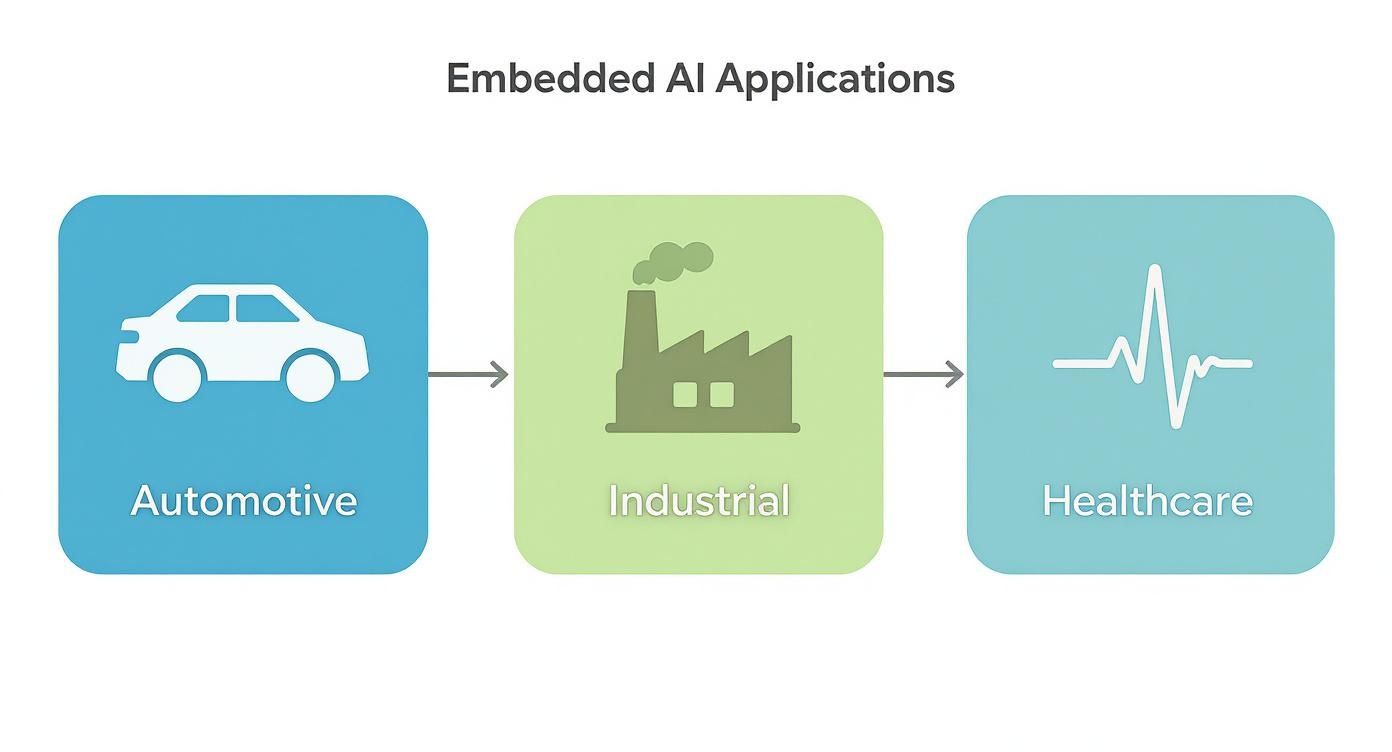
This diagram really drives home how critical on-device intelligence is in sectors like automotive, industrial automation, and healthcare—places where real-time decisions and rock-solid reliability are absolutely non-negotiable.
Streamlining Development with SDKs and Embeds
If you're a product team looking to weave AI features into your SaaS platform, building everything from scratch is rarely the smart move. This is where Software Development Kits (SDKs) and embeds become your best friends. An SDK hands you a pre-packaged set of tools, libraries, and code that makes plugging AI functionality directly into your application much, much simpler.
For example, an analytics platform could offer an SDK that lets you drop a natural language "Ask a question of your data" search bar right into your product's UI. It's a game-changer that saves you countless development hours and gets powerful AI features into your customers' hands faster.
This buy-vs-build decision is a common one when teams evaluate AI-native vs. AI-enhanced BI platforms. Getting the integration right is everything, and looking into proven system integrations for AI solutions can give you a roadmap for what works.
The demand for these integrated solutions is absolutely exploding. The global embedded AI market is forecast to hit $10.9 billion in 2025 and is projected to skyrocket to $41.3 billion by 2035—that's a compound annual growth rate of 14.2%. This surge is all about the massive need for real-time AI in our growing world of IoT and smart devices.
Essential Patterns for Enterprise Security
When you embed AI into a product that will be used by multiple customers, security instantly becomes your number one job. You have to guarantee that every customer's data is completely walled off and that users can only see the information they're supposed to. This takes some serious architectural planning.
A few key patterns are simply non-negotiable for any modern SaaS or analytics application:
Multi-Tenant Isolation: Think of this as building digital walls between each of your customers (or "tenants"). Even though they might share the same underlying software, their data is strictly segregated. One tenant can never see another's information. Period.
Single Sign-On (SSO): Integrating SSO (using standards like SAML or OIDC) lets users log in to your embedded AI features with their existing company credentials. It makes life easier for them and ensures their organization's security rules are automatically enforced.
Row-Level Security (RLS): This is a much more granular control. RLS ensures that even people within the same company can only see the specific rows of data relevant to their role. A sales rep in California, for instance, would only see sales figures for their region—not the whole country.
Practical Implementation Strategies
Getting an embedded AI project off the ground is more than just having a brilliant idea—it demands a solid plan and a series of tough, strategic decisions. Bringing intelligence to the edge means carefully navigating critical choices in hardware, software, and overall system design. The real goal is to build something that hits your performance targets without blowing your budget or your timeline.
It all starts with picking the right "brain" for your device. Your hardware choice is the foundation for everything that follows, setting the limits for your device's power, cost, and physical size. Each option strikes a different balance, so you need to know the landscape before you commit.
Choosing the Right Hardware Foundation
The world of embedded hardware is incredibly diverse, with each component built for a specific job. There's no magic bullet here; the best choice depends entirely on your product's specific needs for performance, power consumption, and of course, cost.
Your main options fall into a few key categories:
Microcontrollers (MCUs): These are the humble workhorses of the embedded world—they're small, cheap, and unbelievably power-efficient. MCUs are perfect for simpler AI jobs like keyword spotting or basic sensor analysis where every drop of battery life counts.
Field-Programmable Gate Arrays (FPGAs): FPGAs offer a powerful mix of flexibility and raw performance. You can reconfigure them after they're manufactured, letting engineers create custom hardware circuits perfectly tuned for their AI models. This makes them ideal for specialized, high-speed tasks that need a custom touch.
AI Accelerators (ASICs/TPUs): When you need maximum horsepower, nothing beats specialized AI chips like Application-Specific Integrated Circuits (ASICs) or Google's Tensor Processing Units (TPUs). They are built from the ground up for one thing: running AI calculations at incredible speeds. Think real-time video analysis and other complex tasks.
This hardware decision is pivotal. In fact, the soaring demand for software and tools to support these devices is what’s driving much of the market’s growth. Between 2020 and 2025, the embedded AI market grew at a CAGR of roughly 17.8%, largely thanks to the explosion of IoT devices. The software side is expected to grow the fastest as more companies need help building and deploying models on this kind of specialized hardware. You can explore more about these market trends and growth factors for a deeper dive.
Performance vs. Cost Tradeoffs in Embedded AI Hardware
Choosing the right hardware is a classic balancing act. Each option offers a unique profile when it comes to performance, power draw, and cost. Here’s a quick comparison to help you weigh the tradeoffs.
Hardware Type | Key Strengths | Best For | Relative Cost |
|---|---|---|---|
Microcontroller (MCU) | Extremely low power consumption, very low cost, small physical footprint. | Simple, always-on tasks like keyword detection, basic anomaly detection on sensor data. | $ |
FPGA | Highly customizable, can be reconfigured for specific models, excellent for parallel processing. | Specialized applications needing custom logic, like industrial automation or advanced driver-assistance. | $$$ |
AI Accelerator (ASIC/TPU) | Highest performance, best energy efficiency for complex AI workloads. | Demanding tasks like real-time object recognition, natural language processing, or complex robotics. | $$$$ |
System-on-Chip (SoC) | Integrates CPU, GPU, and other components on a single chip, offering a good balance. | Consumer electronics like smartphones, smart cameras, and drones where space and integration matter. | $$ |
Ultimately, this table shows there's no single "best" choice. The right hardware is the one that best fits your specific product's constraints and performance goals.
Optimizing AI Models for the Edge
You can't just take a massive, cloud-trained AI model and stuff it onto a tiny, low-power chip. It just won't fit. For embedded artificial intelligence to work in the real world, those models have to be put on a serious diet to shrink their size and computational demands. This is where smart software techniques save the day.
Two of the most common methods for making models "edge-friendly" are:
Quantization: This process is all about reducing the precision of the numbers the model uses. By converting massive 32-bit floating-point numbers into lightweight 8-bit integers, for example, you can slash memory usage and processing needs with only a tiny hit to accuracy.
Pruning: Think of this as trimming away the dead weight from your neural network. Pruning intelligently removes connections or parameters that don’t really contribute to the final answer, making the model significantly smaller and faster.
The art of embedded AI implementation lies in finding the sweet spot where the model is small and fast enough for the device, yet still accurate enough to deliver real value.
Balancing Performance, Cost, and Accuracy
At the end of the day, every embedded AI project is an exercise in managing tradeoffs. A beefier AI accelerator will give you blazing-fast inference speeds, but it will also drive up your unit cost and chew through your battery. In the same way, a heavily quantized model will be super efficient but might shave a few points off your accuracy.
The key is to define your "good enough" threshold early on. For a smart-home gadget, a model that’s 95% accurate and responds instantly is infinitely better than a 99% accurate model that leaves the user waiting for several seconds. Making these informed decisions about hardware, model optimization, and performance targets is what separates a successful project from a frustrating one.
Navigating Security and Compliance

Putting AI directly onto a hardware device flips the traditional security script on its head. Cloud-based AI lives in heavily fortified data centers, but embedded systems are out in the real world. They're physically accessible. This closeness to the data source is their superpower, but it also opens up a whole new can of worms when it comes to security.
When we talk about security for embedded artificial intelligence, we're not just talking about software vulnerabilities. We have to think about the entire system, from the physical device itself to the AI model running on it. Someone could literally try to tamper with the hardware to steal your model or the data it processes. That’s why you need a security plan that covers both the physical and digital fronts right from the start.
Fortifying On-Device Defenses
A solid security strategy for an embedded device is all about layers, starting from the second it powers on. The aim is to create a trusted environment where everything—the hardware, the software, and the AI model—can run safely without constant supervision.
To get there, teams need to put a few core practices in place:
Secure Boot Processes: Think of this as a digital bouncer at the door. It checks the ID of every piece of software trying to run at startup, ensuring only authentic, signed code gets in. Anything unauthorized is stopped cold.
Data Encryption: Any data on the device should be scrambled and unreadable. This applies whether it’s just sitting there (at rest) or being sent somewhere else (in transit). Without the right keys, it's just gibberish.
Model Integrity: Your AI model is your secret sauce, so you have to protect it. Using techniques like digital signatures and integrity checks makes sure the model hasn't been swapped out for a malicious version or messed with in any way.
But it doesn't stop there. We also have to worry about adversarial attacks. These are clever tricks designed to fool an AI model, like a tiny, specially designed sticker that could make a self-driving car’s camera misidentify a stop sign. Defending against these requires some serious model testing and specialized programming.
By processing sensitive information locally, embedded AI significantly reduces the attack surface exposed during data transmission. This decentralized approach is a powerful tool for safeguarding operations and ensuring continuity, even if network connectivity is lost.
Meeting Modern Compliance Standards
One of the biggest wins for embedded AI is how it handles privacy. When you process personal information right on the device, it becomes much easier to build systems that meet tough data privacy laws like the General Data Protection Regulation (GDPR) and the California Consumer Privacy Act (CCPA).
This on-device approach keeps sensitive data from being sent across the internet, which lines up perfectly with the idea of data minimization—a core concept in today’s privacy regulations. For us at Querio, building products with security and privacy baked in is non-negotiable. Keeping data local gives users more control and helps create a product that is truly secure by design.
Your Questions About Embedded AI, Answered
As embedded AI starts showing up in more and more products, it's only natural for teams across product, analytics, and operations to have questions. You’re probably wondering how it all works and what it really means for your business. Let's clear up some of the most common questions.
What’s the Main Difference Between Cloud AI and Embedded AI?
The biggest difference comes down to one thing: location.
Cloud AI crunches data in huge, centralized data centers far away. This means it always needs an internet connection to work. Think of it like calling an expert for advice—you need a good signal, and there's always a bit of a delay before you get your answer.
Embedded AI, on the other hand, does its thinking right on the device itself—whether that's a sensor, a camera, or a piece of machinery. This is like having that same expert standing right beside you, giving you instant feedback without needing to phone anyone. This on-device processing is the secret sauce behind the speed, privacy, and reliability of embedded systems.
Does "Embedded" Mean It's Less Powerful Than Cloud AI?
Not necessarily, but it’s definitely more specialized. Cloud AI has the luxury of using gigantic models with what feels like infinite computing power. Embedded AI models have to be lean and efficient to run on hardware with limited resources.
How do they pull this off? Through clever optimization techniques like quantization and pruning, which shrink the AI model's size without sacrificing its accuracy for one specific job. So, while an embedded model probably won't write a Shakespearean sonnet, it can be incredibly good at its dedicated task—like spotting a keyword in a conversation or identifying a tiny defect on a fast-moving assembly line. And it often does that job much faster than a cloud-based model ever could.
The point of embedded AI isn’t to mimic the massive scale of the cloud. It’s about delivering precise, efficient intelligence right where it's needed, at the exact moment it's needed.
Can an Embedded AI System Still Connect to the Cloud?
Absolutely. In fact, combining the two is often the smartest way to build a product. This hybrid cloud-edge model lets a device handle urgent tasks locally while tapping into the cloud for the heavy lifting or for software updates.
A great example is a modern security camera. It can use its built-in, on-device AI to detect motion in real time. Once it spots something, it can send just that small, relevant video clip to the cloud for deeper analysis (like facial recognition) or for simple long-term storage. This hybrid approach gives you the best of both worlds: the instant responsiveness of the edge and the immense power of the cloud.
Ready to bring powerful, self-serve analytics to your team and customers? Querio makes it simple to embed AI-powered dashboards and natural language queries directly into your application. Discover how to turn your data into answers in seconds.