Business Intelligence
best AI-powered self-service analytics 2026
Compare six AI-driven self-service analytics platforms, their AI features, governance, connectivity, and ideal use cases for 2026.

AI-powered self-service analytics tools have drastically improved how businesses interact with data. By 2026, these platforms have evolved into autonomous analytics systems that go beyond manual data exploration, offering proactive insights, anomaly detection, and KPI monitoring without user intervention.
Despite the market growing to $14.01 billion with an annual growth rate of 18.4%, adoption remains low at 25%, primarily due to challenges like data literacy. Leading platforms now focus on delivering answers rather than requiring users to explore data, addressing this gap.
Here’s a quick look at six standout platforms reviewed in the article:
- Querio: Transparent AI with inspectable code, live data querying, and no per-seat pricing.
- ThoughtSpot: Search-driven analytics with conversational AI agents and real-time insights.
- Lumenore: Multi-agent AI for advanced queries and dashboard automation.
- Qlik Sense: Associative engine for free data exploration and anomaly detection.
- Power BI: AI tools like Copilot for report generation and interactive dashboards.
- Looker: Strong governance with a semantic layer and Google Cloud integration.
These platforms are shaping the future of analytics by combining AI, governance, and user-friendly interfaces to deliver actionable insights for businesses of all sizes.
How AI Tools can Finally Solve the Self-Service Analytics Problem?
::: @iframe https://www.youtube.com/embed/spGrwChIcPc :::
sbb-itb-284a532
1. Querio
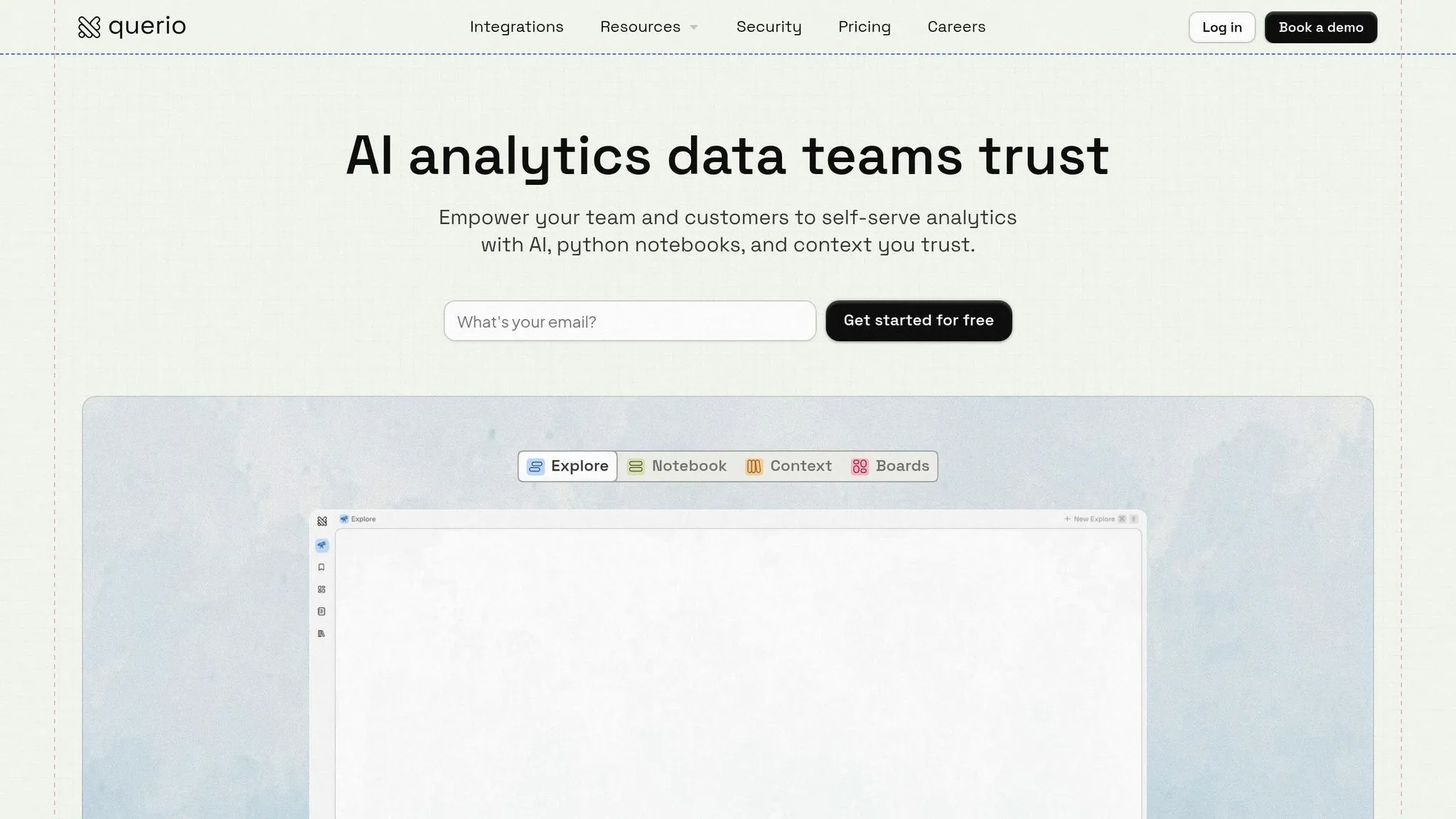
Querio is an AI-native analytics workspace designed to connect data teams and business users seamlessly. It integrates directly with your existing data warehouse - whether you use Snowflake, BigQuery, Amazon Redshift, ClickHouse, or PostgreSQL. What sets Querio apart is its transparency: every answer is inspectable, meaning users can review the query logic instead of relying on opaque processes.
Here’s a closer look at Querio’s standout features, covering its AI capabilities, connectivity, governance, flexibility, and practical applications.
AI Capabilities
Querio leverages AI to translate natural language questions into executable code that interacts with live warehouse data. As the platform explains:
"Analytics should work like software that your team and AI can operate on" [4].
This approach has transformed reporting for many organizations, cutting analysis cycles from weeks to just 30 minutes - a 20× improvement [4]. Additionally, its Reactive Notebooks automatically update dependent cells, much like spreadsheet formulas, making iterative workflows faster and more efficient [4].
Data Connectivity
Querio’s zero-copy architecture ensures it queries live data directly from your warehouse using encrypted, read-only connections. This eliminates the need for data duplication, keeping insights fresh and reducing synchronization delays. The platform supports all major cloud warehouses and relational databases, including PostgreSQL, MySQL, and SQL Server, making it compatible with most modern data infrastructures.
Governance
The platform’s shared context layer is a game-changer for consistency. Data teams can define joins, metrics, and business terms once, creating a unified framework that ensures reliable insights. These definitions are applied across various tools - whether it’s ad-hoc queries, notebooks, dashboards, or embedded analytics. This approach minimizes discrepancies in KPI calculations, even as business requirements evolve.
Deployment Flexibility
Querio provides both cloud-hosted and self-hosted deployment options, catering to different organizational needs. It integrates with standard SSO for secure access and meets SOC 2 Type II compliance standards. Role-based access controls, scheduled reporting, and the ability to embed analytics into customer-facing applications via APIs and iframes add to its versatility. Plus, with unlimited viewers pricing, it’s designed to be budget-friendly for organizations requiring broad access.
Ideal Use Cases
Querio’s technical strengths translate into real-world benefits. It’s particularly suited for companies with modern data warehouses and growing analytics demands. By offering self-service access without compromising accuracy, Querio has helped businesses save up to $120,000 annually and reduce employee workloads by 10 hours [4]. It serves both technical analysts who prefer notebook-based workflows and business users who want to query data in plain English.
2. ThoughtSpot
ThoughtSpot stands out as a search-driven analytics platform, making business intelligence feel as simple as a Google search. Instead of relying on dashboards or writing SQL queries, users can type natural language questions and get instant answers from massive datasets. In 2026, ThoughtSpot earned a 4.6/5 rating for its natural language query accuracy, surpassing other platforms in the market [3].
AI Capabilities
ThoughtSpot takes its intuitive search functionality to the next level with AI-powered tools that simplify data analysis. Its AI agent, Spotter, acts like a virtual analyst, interpreting conversational queries and delivering insights automatically. In 2026, the platform introduced its "Team of Agents" approach, featuring SpotterModel, SpotterViz, and SpotterCode. These agents handle tasks like data modeling, creating dashboards, and generating analysis code [7]. Another standout feature, SpotIQ, works in the background to uncover anomalies and highlight trends without requiring manual input [6]. Companies using ThoughtSpot report a 60% drop in their data request backlog, as business users can independently handle their queries [6].
Data Connectivity
ThoughtSpot is designed to handle massive datasets, delivering sub-second response times even when working with billions of rows [6]. The platform integrates effortlessly with cloud data warehouses like Snowflake, though it performs best with proper data modeling and metadata setup [6]. For more advanced workflows, the Analyst Studio supports SQL, Python, and R, enabling complex data preparation [6].
Deployment Flexibility
ThoughtSpot offers flexible pricing options tailored to different business sizes. The Essentials plan starts at $25 per user per month for 5–50 users and supports up to 25 million rows of data. The Pro plan, at $50 per user per month, includes the Spotter AI Agent and accommodates up to 250 million rows [6]. For businesses with unpredictable workloads, there's usage-based pricing at $0.10 per query [6]. ThoughtSpot also meets stringent compliance standards, holding certifications like SOC 1/2/3, ISO 27001, HIPAA, GDPR, and CCPA [6].
Ideal Use Cases
ThoughtSpot shines in scenarios that demand quick, ad-hoc data exploration and real-time analysis, making it particularly popular in fintech and retail [3][5]. Its ThoughtSpot Everywhere API and SDK allow developers to embed analytics directly into customer-facing applications [6]. Based on feedback from 384 verified users, its search-first interface is frequently praised for empowering non-technical users. However, administrators often mention the steep learning curve associated with setting up the ThoughtSpot Modeling Language (TML) [6][7]. This focus on intuitive, real-time insights highlights ThoughtSpot’s role in shaping the future of AI-driven analytics in 2026.
3. Lumenore
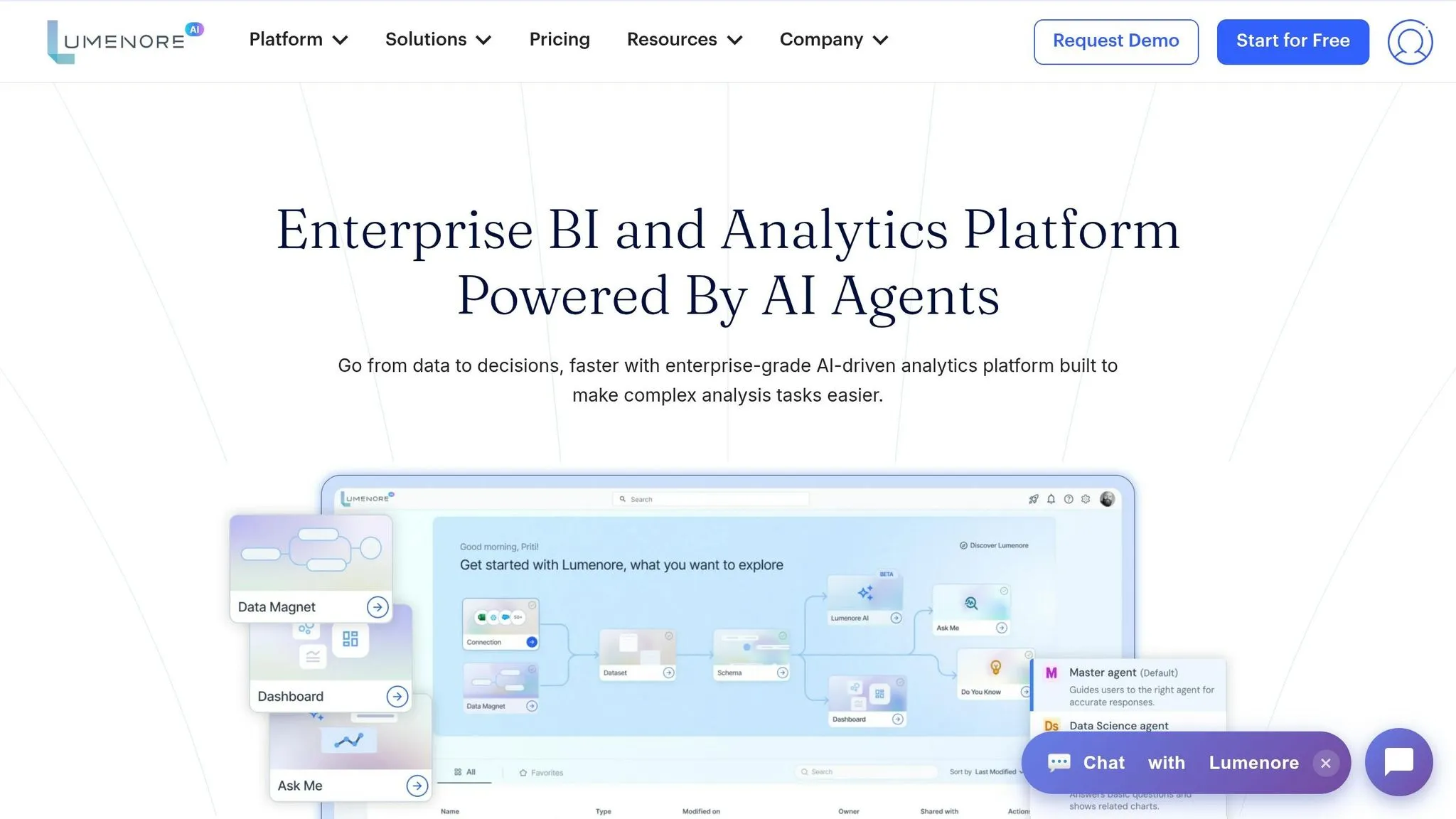
Lumenore takes a unique approach to analytics with its multi-agent architecture, where a Master Agent coordinates sub-agents focused on tasks like root cause analysis, data science, and visualization. This setup aligns with the growing trend of autonomous analytics. Instead of relying on a single AI assistant, Lumenore deploys specialized agents that collaborate to handle complex analytical challenges. The result? Non-technical users can ask intricate questions and get detailed answers without needing to grasp the system's inner workings [8][9].
AI Capabilities
Lumenore's "Ask Me" interface makes querying data as simple as speaking or typing, even supporting Alexa commands for instant insights [9][11]. It can create entire dashboards from straightforward text prompts, removing the need for manual chart creation [9]. Additionally, the platform incorporates RAG (Retrieval-Augmented Generation) to process unstructured data - like PDFs and Word documents - alongside standard datasets [10].
An example of its impact comes from the Department of Digital Ajman, which adopted Lumenore in November 2025 to address reporting delays. According to Sara Mohammad Alblooshi, Application Head, the platform streamlined processes, delivering 30% faster reporting cycles and reducing manual workloads across departments [10].
"Lumenore helped us overcome these issues by providing a unified analytics platform with automated dashboards... we have achieved 30% faster reporting cycles, improved the accuracy of our decision-making, and reduced manual workloads across departments." - Sara Mohammad Alblooshi, Application Head, Department of Digital Ajman [10]
Data Connectivity
Lumenore supports connections to over 100 data sources, including popular databases, CRMs, ERPs, and real-time streams like Kafka [9][10]. Its Data Magnet ETL tool simplifies data integration with low-code automation, consolidating information from spreadsheets, APIs, and isolated systems into a unified data lakehouse [10]. This setup ensures a single source of truth while maintaining real-time synchronization. With over 20,000 users across 100+ enterprise teams, Lumenore’s extensive connectivity forms the backbone of a cohesive data strategy [10].
Governance
Data integrity is a top priority for Lumenore, achieved through features like metadata intelligence, lineage tracking, and role-based access controls [8][10]. For organizations with stringent security needs, the platform offers local LLM integration, allowing companies to keep sensitive data in-house while still using natural language querying [10]. This approach balances privacy concerns with the convenience of conversational analytics.
Ideal Use Cases
Lumenore’s blend of AI, connectivity, and governance makes it a powerful tool for non-technical teams tackling advanced analytics. For instance, manufacturing companies like THK Rhythm Automotive rely on the platform to monitor production downtime and throughput in real-time, uncovering inefficiencies in scattered data [10]. Its specialized Root Cause Analysis Agent goes beyond identifying metric changes to explain the underlying reasons [9]. Vicente Ciampa, CEO of Xonit.net, highlighted how the no-code platform democratized data access, enabling teams to spot hidden trends without needing technical skills [10].
4. Qlik Sense
Qlik Sense stands out for its associative analytics engine, which allows users to explore data freely rather than sticking to predefined query paths. Unlike traditional BI tools, which depend on preset queries, Qlik Sense uncovers hidden relationships across entire datasets. Impressively, the platform can process over 40 million records in about one minute [12]. This approach aligns with the growing trend of using AI to generate insights without relying on rigid query structures.
AI Capabilities
In 2026, Qlik introduced Qlik Answers, a generative AI assistant that supports natural language queries across both structured and unstructured data sources [12]. It also provides citations and explanations for its findings, addressing concerns about trust in AI-driven analytics. Drew Clarke, Executive Vice President of Product and Technology at Qlik, highlighted this focus:
"Teams do not just want another chat interface. They want systems that can reason across analytics and documents, keep permissions intact and explain what they did" [13].
Additionally, Qlik Sense includes Discovery Agents, which track metrics for anomalies and uncover competitive opportunities. This reflects a shift toward AI systems that deliver autonomous, real-time insights. The AI Splits feature within the Decomposition Tree further enhances analysis by pinpointing the most impactful factors in a dataset, enabling insights to be identified 35% faster [12].
For example, an automotive manufacturer using Qlik Sense achieved a 12% boost in production efficiency and cut scrap costs by 25%, yielding a 165% ROI over 30 months [12]. Similarly, a sales team eliminated manual reporting tasks, recovering $18,000 weekly in revenue and achieving a 100% ROI in just two weeks on a $30,000 investment [12].
Data Connectivity
Qlik Sense supports over 100 native connectors for platforms like SAP, Salesforce, AWS, Azure, Google Cloud Platform, and Databricks [12]. Updates in 2026 added native JSON file loading and regular expression support in load scripts, simplifying the integration of IoT and web data. Integration with Qlik Talend Cloud expanded its capabilities with over 40 specialized connectors for tools such as HubSpot, Looker, and Amplitude [12]. These features ensure seamless integration and data integrity across diverse sources.
Governance
In July 2025, Qlik launched the AI Trust Score to help organizations evaluate the readiness and reliability of their data for AI applications [13]. The platform also includes role-based access controls and data lineage tracking, ensuring that permissions remain intact even when AI agents handle sensitive information. Commenting on this, Mike Leone, Analyst at Omdia, said:
"The real value is likely how they are layering this on top of the foundation they built with Qlik Answers. By ensuring the data feeding those agents is grounded in that same governance and lineage, they are tackling the trust gap" [13].
Deployment Flexibility
Qlik offers both cloud and on-premises deployment options, along with multi-cloud support for AWS, Google Cloud, and Microsoft Azure [12]. This flexibility allows organizations in regulated industries to keep sensitive data on-premises while leveraging cloud scalability. Open APIs make it possible to embed interactive analytics into operational apps, and native mobile apps support offline analysis. A Forrester Total Economic Impact study reported a 209% ROI over three years for Qlik Cloud Analytics, with organizations cutting BI analysis time by 30% [12]. Pricing starts at $30 per user per month for the Business tier (billed annually), with the Standard tier at $825 per month for 20 full users and the Premium tier at $2,700 per month for 20 full users plus 10,000 basic viewing licenses [12].
Ideal Use Cases
Qlik Sense shines in scenarios requiring flexible data exploration across large, complex datasets. Its associative engine is particularly effective at identifying relationships that traditional query-based tools might overlook. This makes it a strong choice for manufacturing operations, revenue analysis, and large-scale BI projects. Whether managing over 40 million records or seeking hidden patterns without predefined queries, Qlik Sense delivers fast, actionable insights. It exemplifies how AI-powered analytics are reshaping business intelligence in 2026 [12].
5. Power BI

Power BI has evolved into a robust analytics tool with integrated AI capabilities [14]. By 2026, its Copilot for Power BI has become a game-changer, capable of generating multi-page reports, creating DAX measures, and documenting semantic models - all from natural language descriptions [14]. Users can simply describe their needs in plain English, and Copilot takes care of the technical details. With advanced AI, Power BI transforms traditional dashboards into interactive, conversational experiences.
AI Capabilities
Power BI's AI features allow users to create comprehensive reports, define DAX measures, and document models using plain-language prompts. The Translytical Task Flows, introduced in March 2026, enable users to update records, annotate reports, or trigger workflows directly within dashboards [15][16]. Other AI-powered tools include:
- Key Influencers for identifying root causes.
- Decomposition Trees for guided drill-downs.
- Smart Narrative for dynamic summaries in natural language.
- Anomaly Detection for spotting and explaining outliers in time-series data [14].
For analysts without coding expertise, AutoML in Dataflows simplifies machine learning. It allows users to build, train, and deploy models for tasks like binary prediction and regression. The system evaluates multiple algorithms - such as gradient-boosted trees and neural networks - to determine the best fit for the data [14].
AI-driven tools for data preparation can reduce time spent on cleaning and transformation by 40–60% in enterprise settings [14]. Features include fuzzy matching to eliminate duplicates, example-based transformations, and AI-powered table detection from PDFs and Excel files. The Q&A feature lets users ask questions in plain English to instantly generate visualizations, supported by a customizable linguistic schema for accuracy [14].
Data Connectivity
Power BI's Direct Lake storage mode, available in 2026, uses Delta Lake and Parquet formats to deliver high-performance analytics on OneLake without duplicating data [18]. Microsoft highlights its benefits:
"Direct Lake storage mode accelerates data-driven decisions by unlocking incredible performance directly against OneLake, without the need to manage costly, time-consuming data refreshes" [18].
However, some older connectors, like QuickBooks Online and legacy Excel/CSV imports, are no longer supported. Users should plan for these changes [17][18].
Governance
Power BI ensures data integrity with tenant-level controls, row-level security (RLS), and sensitivity labels that persist even in AI-generated outputs [14]. Audit logs monitor usage, and Microsoft Information Protection sensitivity labels safeguard sensitive data, even when processed by AI [14].
Deployment Flexibility
Power BI offers multiple deployment options:
- Desktop: Local use.
- Service: Cloud hosting.
- Fabric: Integrated data solutions.
- Embedded: For customer-facing apps.
- On-Premises Data Gateway: Secure data transfer.
Licensing options range from shared capacity (Pro) to dedicated capacity (Premium/Fabric) and Premium Per User (PPU). Small teams can start with Pro licenses for basic sharing and scale up to PPU for advanced AI features or larger models (up to 100 GB). For enterprise-wide distribution, Fabric Capacity (starting at F64) provides a cost-effective alternative to individual licenses.
Ideal Use Cases
Power BI is particularly well-suited for organizations already using Microsoft tools like Azure, Office 365, and Dynamics 365. Its Copilot-driven analytics turn static dashboards into dynamic "ask-and-act" workflows, where AI selects relevant reports and data to answer user queries [17]. This makes it accessible to non-technical users, enabling them to trigger workflows and gain insights in real time.
The platform supports a gradual adoption of AI. Companies can start with pre-built AI visuals, advance to data enrichment with Cognitive Services, and eventually implement predictive modeling using AutoML or Azure ML [14]. With Direct Lake mode in Fabric, massive datasets can be analyzed directly from OneLake, eliminating lengthy refresh cycles and enabling real-time, large-scale decision-making.
6. Looker
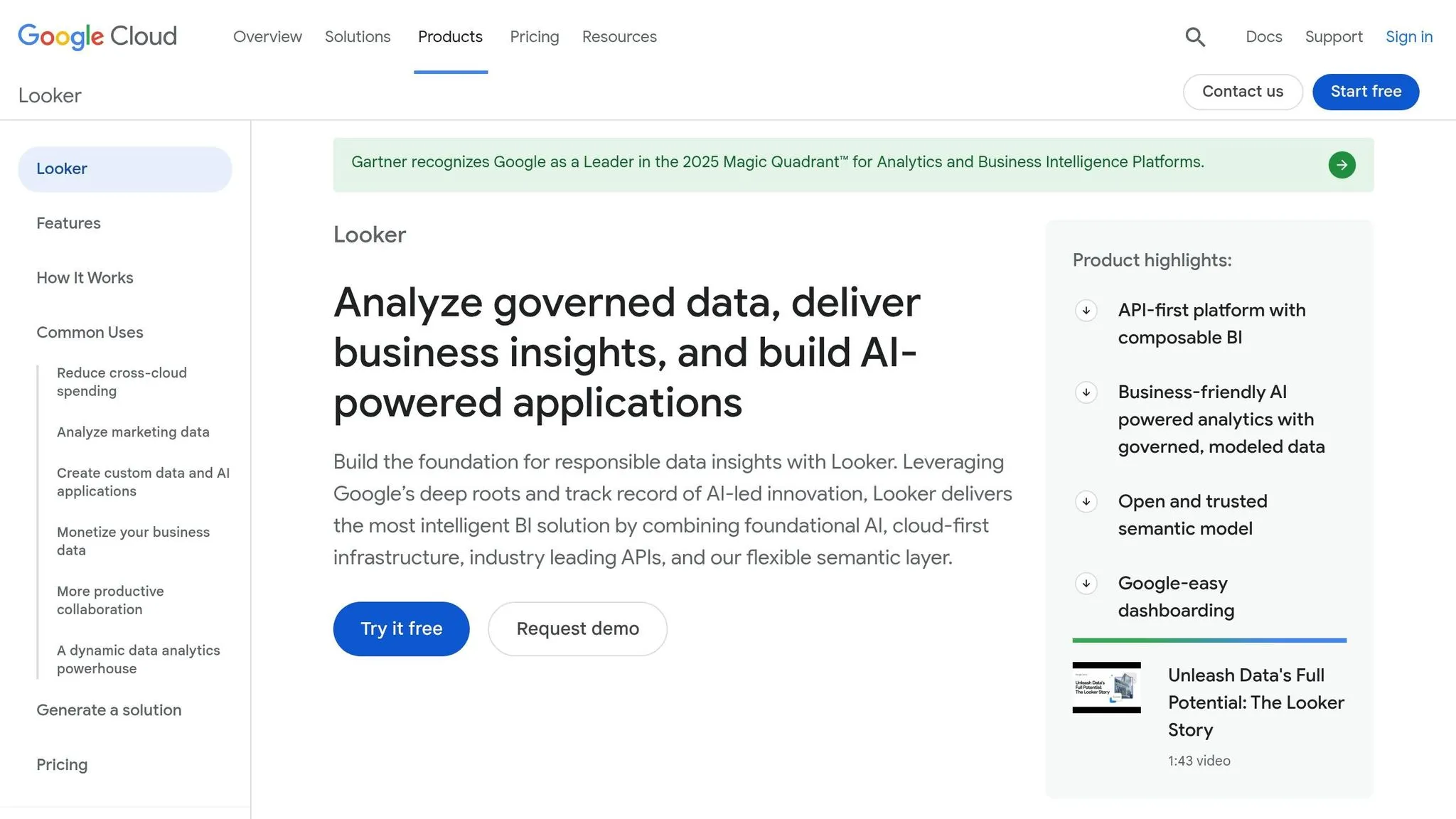
Looker is an analytics platform designed with a strong focus on governance, built on Google Cloud. Its integration with Gemini allows users to create visualizations using natural language without needing SQL expertise. The platform's LookML semantic layer ensures that AI-generated insights are based on accurate and reliable definitions, making it a strong choice for businesses dealing with complex data environments. By offering AI-driven automation and a centralized source of truth, Looker simplifies data exploration for non-technical users, addressing the growing need for autonomous analytics.
AI Capabilities
Looker’s AI tools cater to various user needs through specialized assistants:
- Conversational Analytics: Lets business users ask questions in plain English.
- Code Interpreter: Enables Python-based forecasting using natural language prompts.
- LookML Assistant: Helps generate data modeling code.
- Visualization Assistant: Allows users to customize chart JSON through conversational inputs.
A Reasoning Agent combines LookML with a Knowledge Graph and Retrieval Augmented Generation to create accurate SQL and Python code. Fine-tuned models further enhance this by translating simple language prompts into precise coding outputs. Additionally, the platform includes Automated Slide Generation, which transforms raw data into professional, AI-narrated presentations for executives.
Data Connectivity
Looker connects directly to major cloud data warehouses like BigQuery, Snowflake, Redshift, and Databricks, enabling live data querying to eliminate delays caused by ETL processes. For smaller datasets, it also supports Excel and Google Sheets.
Governance
The LookML semantic layer ensures consistent metrics across departments, acting as a single source of truth. In 2026, Google Cloud acquired Spectacles.dev to integrate automated CI/CD testing for SQL and LookML validation, boosting data reliability with continuous quality checks [19][20]. Git version control further enhances trust by tracking all changes to data models. These features have earned Looker positive reviews, with a 4.4/5 rating on AI:PRODUCTIVITY in January 2026, particularly for its reliable governance [20].
With these governance tools in place, Looker integrates smoothly into modern cloud ecosystems.
Deployment Flexibility
To access its AI features, Looker requires a Looker-hosted deployment. It integrates seamlessly with Google Workspace tools like Slides and Sheets, as well as Vertex AI and Slack. The platform offers two editions: Standard and Enterprise. The Enterprise edition includes unlimited user support and enhanced security features.
Ideal Use Cases
Looker shines in situations where strong data governance and embedded analytics are critical. Enterprises use it to standardize metrics across departments via the LookML semantic layer. SaaS companies leverage its tools to create white-labeled, AI-powered dashboards for their customers. Non-technical users benefit from its real-time querying and ad-hoc exploration capabilities, while operational teams use it for monitoring. Organizations already using Google Cloud infrastructure can maximize Looker’s potential through its seamless integrations with BigQuery and Vertex AI. These features highlight how Looker supports the trend toward AI-powered, self-service analytics for real-time business intelligence.
Platform Comparison: Strengths and Weaknesses
::: @figure 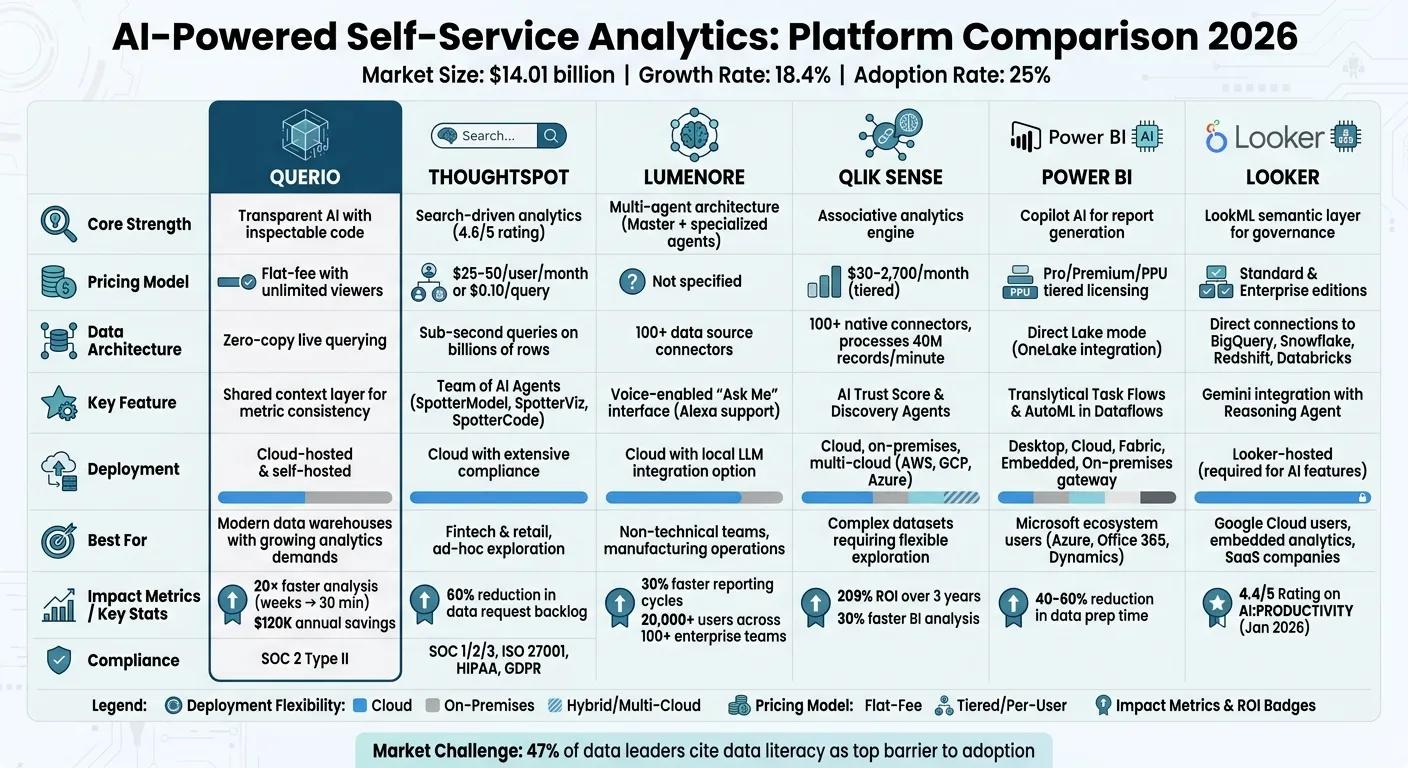 {AI-Powered Self-Service Analytics Platforms Comparison 2026}
:::
{AI-Powered Self-Service Analytics Platforms Comparison 2026}
:::
When it comes to AI-powered self-service analytics, Querio stands out with its transparent code and straightforward pricing with no per-seat fees, positioning itself as a leader in the space. Querio's architecture and governance framework empower teams to deliver inspectable, autonomous insights - capabilities that are hard to find elsewhere in the market.
Querio takes a fresh approach to analytics by offering transparent AI that produces inspectable SQL and Python code. This directly tackles the trust issues often associated with traditional self-service tools. Its pricing has no per-seat fees, with included AI credits and spending caps, which simplifies budgeting and avoids the unpredictability of per-user pricing. With a zero-copy architecture, Querio allows live data querying without duplication. Meanwhile, its shared context layer ensures consistent metrics across all workflows, from quick queries to embedded dashboards.
Adoption rates for traditional self-service analytics tools remain low at around 25%, and nearly half (47%) of data leaders cite data literacy as a top challenge [1]. Querio bridges this gap by combining an easy-to-use natural language interface with transparent, governed outputs. Business users can ask questions in plain English, while technical teams maintain full visibility into the query logic, balancing ease of use with accountability.
Querio also offers deployment flexibility, supporting both cloud-hosted and self-hosted environments. It meets enterprise-grade requirements with SOC 2 Type II compliance, role-based access controls, and unlimited viewer pricing. The platform integrates seamlessly with major cloud data warehouses like Snowflake, BigQuery, Amazon Redshift, ClickHouse, and PostgreSQL, providing the scalability and performance enterprises demand.
| Querio's Key Strengths | Market Challenges Addressed |
|---|---|
| Transparent, inspectable AI-generated code | Lack of trust in opaque AI systems |
| No per-seat pricing, with unlimited viewers | Unpredictable per-user costs |
| Zero-copy live warehouse querying | Data duplication and sync delays |
| Shared context layer for metric consistency | Inconsistent KPI definitions across teams |
| Both cloud-hosted and self-hosted deployment | Inflexible deployment options |
Conclusion
The self-service analytics market is projected to hit $14.01 billion by 2026, yet adoption rates remain surprisingly low at just 25% [1][3]. Why? Many tools create confusion rather than clarity, leaving users overwhelmed. This is where Querio steps in, offering a solution that genuinely empowers business users.
Querio tackles the critical issue of data literacy head-on. Its transparent AI generates SQL and Python code that users can inspect, letting business teams ask questions in plain English while technical teams retain full oversight of the query logic. Plus, with no per-seat pricing, unlimited viewers and spending caps on AI credits, organizations avoid budget surprises. Querio’s zero-copy architecture also ensures live warehouse data is queried directly, bypassing duplication and sync delays.
The move toward AI-driven analytics is undeniable. Gartner estimates that by the end of 2026, 40% of enterprise applications will feature task-specific AI agents [1][2]. Querio’s combination of user-friendly design and governed outputs bridges the gap between accessibility and precision, positioning it as a leader in the future of self-service analytics.
FAQs
::: faq
How does Querio keep AI answers trustworthy?
Querio builds confidence in AI-generated answers by offering transparency through SQL and Python inspection, implementing strong governance tools, and maintaining direct live data connections. Together, these features help ensure data accuracy, security, and compliance, giving businesses the confidence they need in their analytics. :::
::: faq
Can Querio query my warehouse without copying data?
Querio lets you work with your data warehouse directly, without needing to copy any data. By establishing live connections to platforms like Snowflake and BigQuery, it enables real-time analysis without requiring SQL knowledge. Plus, it comes equipped with strong governance and security tools to ensure data access remains safe and efficient. :::
::: faq
What does “no per-seat pricing with unlimited viewers” cover?
The term “no per-seat pricing with unlimited viewers” describes a pricing structure where a business pays the same plan price no matter how many users access the platform. This means an unlimited number of viewers can access reports and insights without the company facing extra seat charges. With Querio, that holds on every plan, from the free plan to Core at $2,499 a month; AI usage past the included credits is billed per credit, and admins can set a spending cap. :::