Business Intelligence
ThoughtSpot Pricing vs. Querio: Get More NLQ for Less
Compare pricing and features of NLQ technology for businesses and discover a more predictable, cost-effective solution.

Looking for a cost-effective way to access Natural Language Query (NLQ) technology? Querio offers a simpler, more affordable pricing model compared to ThoughtSpot, making it easier for businesses to use data without hidden fees or technical complexity.
Here’s the key takeaway: Querio’s annual cost starts at $14,000, while ThoughtSpot averages around $137,000 per year. Querio also provides unlimited viewer access and no per-query fees, while ThoughtSpot’s consumption-based pricing can lead to unpredictable expenses.
Quick Highlights:
- Querio: Fixed costs, unlimited viewers, no hidden fees, and easy-to-use NLQ tools.
- ThoughtSpot: Higher costs, per-user licensing fees, and variable expenses tied to usage.
If you want a predictable, straightforward solution for your data needs, Querio stands out as the better option for mid-sized businesses. Let’s dive deeper into the pricing and features.
What is ThoughtSpot and Search-driven Analytics?
::: @iframe https://www.youtube.com/embed/Uuiq2X6qN8s :::
ThoughtSpot Pricing Breakdown
ThoughtSpot's pricing structure, based on consumption, often introduces unexpected costs for U.S. businesses. Here's a detailed look at what their pricing entails.
Main Pricing Tiers and Features
ThoughtSpot offers two main categories: ThoughtSpot Analytics for internal reporting and ThoughtSpot Embedded for customer-facing applications. Each tier is designed to accommodate different data volumes and user needs.
- Essentials Plan: Starts at $1,250 per month (billed annually). It supports up to 20 users and 25 million rows of data [1][4].
- Pro Plan: Custom pricing applies, offering unlimited users and support for up to 500 million rows of data [1].
- Enterprise Plan: Removes all data row restrictions, providing unlimited data, users, and permission groups [1].
For ThoughtSpot Embedded, the options include:
- Developer Plan: A free one-year trial for up to 5 users [1].
- Pro Embedded Plan: Includes unlimited users and supports up to 5 billion rows of data [1].
- Enterprise Embedded Plan: Removes all limitations on users and data volume [1].
According to Vendr data, the average annual contract for ThoughtSpot is about $137,000 [1]. While the tiered pricing offers some flexibility, additional costs can make budgeting a challenge.
Extra Costs and Hidden Fees
ThoughtSpot's consumption-based pricing can lead to unexpected charges. Every query incurs a fee [3], which can result in fluctuating monthly expenses, especially when background queries run automatically without user initiation.
Critics have pointed out a lack of transparency in ThoughtSpot's pricing. Many core features require costly add-ons, and pricing details for the Pro and Enterprise plans are not publicly available [3]. Some businesses report spending $5–$6 per dashboard view per user [3], and enterprise customers may face annual costs exceeding $100,000. In some cases, expenses can climb as high as $1.23 million, depending on specific needs [2].
The consumption-based model ties costs directly to usage, meaning higher data utilization can significantly increase expenses. This approach can make it harder for businesses to fully leverage the broad data access that natural language query technology aims to provide.
Querio Pricing and What You Get
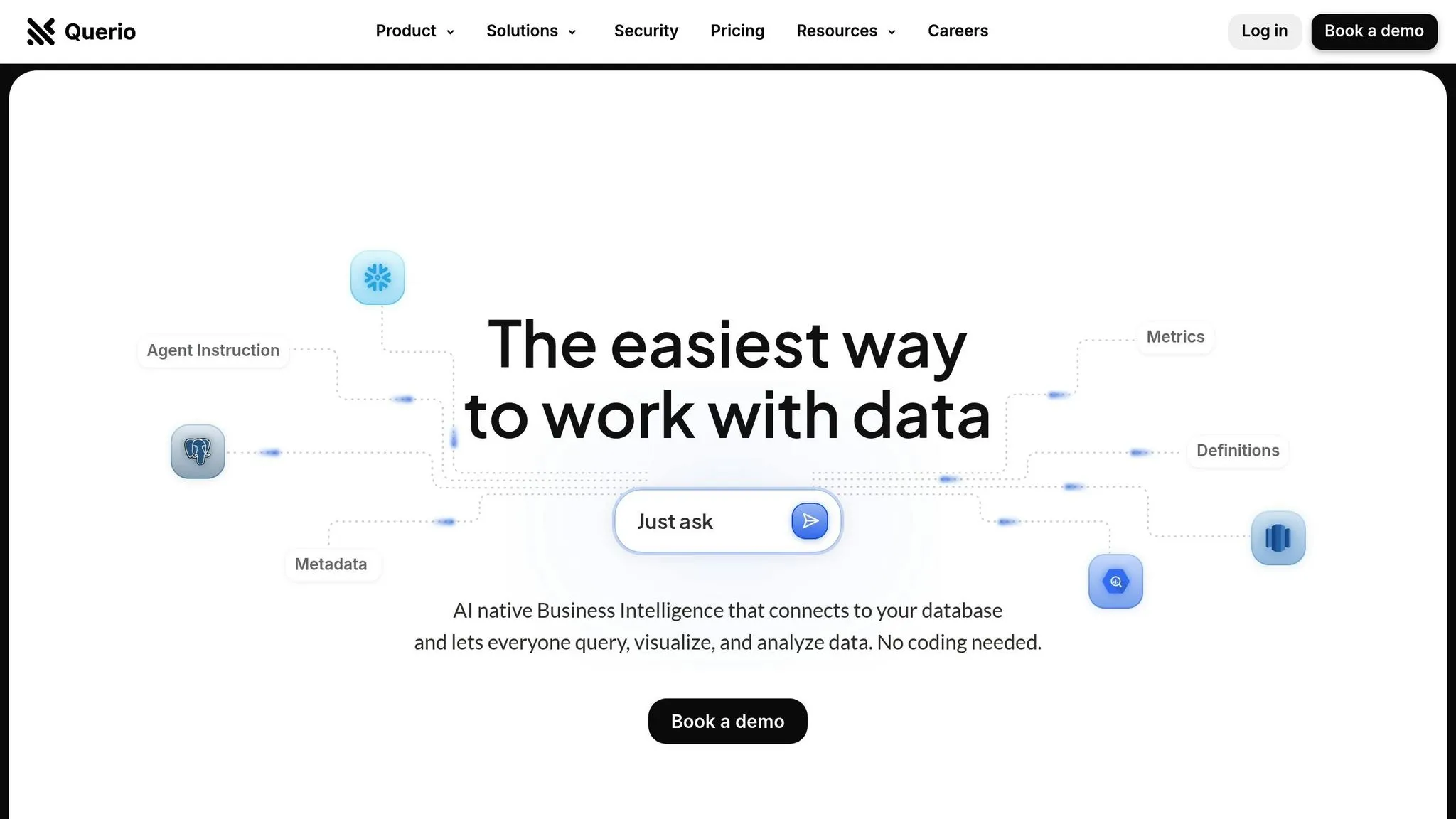
Querio offers a straightforward pricing model with annual subscriptions, fixed costs, and clear limits. For U.S. businesses, this approach provides access to advanced natural language querying (NLQ) without the worry of unexpected fees.
Transparent Pricing Plans
Querio’s pricing is designed to simplify budgeting by removing variable costs. It offers three main plans tailored to meet the needs of businesses at different stages.
The Standard Plan is priced at $1,100 per month and includes one production database connection with 1,000 monthly prompts [5]. This plan also features Slack support and custom context setup, making it a great choice for smaller teams exploring natural language analytics.
For organizations with growing data needs, the Pro Plan starts at $2,000 per month and supports up to three databases with 4,500 monthly prompts [5]. It includes dashboard migration during the pilot phase, priority support, and enhanced EC2 power for improved performance.
For larger enterprises, the Enterprise Plan offers custom pricing. This tier includes multiple database connections, unlimited prompts, and advanced features such as self-hosted deployment and 24/7 support from Site Reliability Engineers (SRE) [5].
| Plan | Monthly Cost | Databases | Monthly Prompts | Key Features |
|---|---|---|---|---|
| Standard | $1,100 | 1 production | 1,000 | Slack support, custom context setup [5] |
| Pro | From $2,000 | 3 | 4,500 | Dashboard migration, priority support, enhanced EC2 power [5] |
| Enterprise | Contact Sales | Multiple | Custom | Self-host deployment, SCIM, 24/7 SRE, SOC 2 Type II, custom LLM models [5] |
Features That Deliver Value
Querio ensures all plans come packed with powerful tools to make analytics accessible and effective. Every subscription includes integrated NLQ, enabling instant analysis through secure connections to data warehouses like Snowflake, BigQuery, and Postgres.
The platform’s drag-and-drop dashboard builder is included across all tiers, allowing teams to create custom visual reports and monitor KPIs without needing extra licenses. Plus, Querio provides unlimited viewer access at no additional cost, ensuring everyone in your organization can access insights without per-user charges.
Security is a priority, with SOC 2 Type II compliance built into the platform at no extra charge. Querio also guarantees a 99.9% uptime SLA, so your team can rely on uninterrupted access to analytics tools.
Another standout feature is the context layer, which lets data teams define table joins, business terms, and glossaries once and apply them consistently across all user interactions. This eliminates repetitive setup tasks and ensures uniformity in data usage across teams.
Predictable Costs, No Surprises
One of Querio’s biggest advantages is its no per-query fees policy. Your monthly cost stays the same no matter how many questions your team asks or how often they analyze data.
Viewer access is also unlimited, meaning whether your team has 50 or 5,000 members, the cost remains unchanged. This pricing structure encourages broader data access across departments like sales, marketing, and operations.
Querio also avoids background query fees, which can catch businesses off guard with other tools. Automated processes, like dashboard refreshes, incur no additional charges.
This clear and predictable pricing approach allows businesses to confidently expand data access, empowering smarter decisions across the board.
sbb-itb-284a532
Side-by-Side Comparison: Pricing and NLQ Features
When mid-sized U.S. companies evaluate business intelligence platforms, understanding both costs and features is essential. A closer look at ThoughtSpot and Querio reveals some striking differences in their pricing models and natural language query (NLQ) capabilities.
Feature and Cost Comparison Table
To highlight the differences, here's a breakdown of annual costs, NLQ features, and user policies for each platform:
| Feature | Querio | ThoughtSpot |
|---|---|---|
| Annual Cost | $14,000/year (Core Platform) | ~$137,000/year (average contract) |
| Database Connections | 1 included; $4,000 per additional | Multiple connections in enterprise packages |
| Monthly Prompts/Queries | 4,000 included | Usage-based pricing |
| Viewer Access | Unlimited at no extra cost | Per-user licensing fees |
| NLQ Accuracy | AI-driven, context-aware SQL | Good, but less business-specific |
| Query Speed | Instant results | Slower for complex queries |
| Learning Curve | Simple, intuitive interface | Steeper learning curve |
| Security Compliance | SOC 2 Type II, encrypted access | Standard security features |
| Deployment Options | Cloud-native (self-hosted available with +50% fee) | Hybrid: on-premises, private, and public cloud |
| Hidden Fees | None – transparent add-on pricing | Variable consumption costs |
Querio’s annual cost of $14,000 stands in stark contrast to ThoughtSpot’s ~$137,000, offering nearly 10 times the savings.
Which Platform Offers Better Value
For mid-sized businesses with smaller data teams, Querio emerges as the more practical choice. Its lower cost and user-friendly NLQ capabilities make it accessible to businesses that need insights quickly but lack extensive technical resources. Querio’s conversational AI simplifies data analysis by removing the need for SQL expertise, whereas ThoughtSpot’s automated pattern recognition often requires more technical know-how to unlock its full potential.
"At Querio, we understand the critical importance of data security in today's digital landscape and particularly in our industry. Our commitment to safeguarding your data is at the forefront of all our operations, offering you peace of mind when choosing us as your data co-pilot."
- Querio [6]
One standout feature of Querio is its unlimited viewer access, allowing organizations to share insights across all departments - without worrying about per-user fees. This approach encourages wider adoption in teams like sales, marketing, and operations, enabling data-driven decision-making across the board.
Querio’s context-aware AI also delivers more business-relevant responses compared to ThoughtSpot’s broader, less specialized approach. While ThoughtSpot is tailored for enterprise-scale deployments and complex integrations, Querio focuses on predictable costs and simplicity. Its cloud-native design, along with direct connections to Snowflake, BigQuery, and Postgres, removes much of the complexity that comes with larger systems.
For U.S. businesses, Querio’s straightforward pricing and fast deployment fit the needs of agile organizations. Its affordable NLQ capabilities make accessing accurate business insights faster and easier, helping companies act quickly and efficiently in today’s fast-paced environment.
How Querio Benefits US Businesses
Querio’s NLQ platform simplifies data access for businesses, offering a fixed-cost solution tailored for mid-sized companies looking to scale their analytics efforts efficiently.
Expanding Data Access Across Teams
Traditional BI tools often create bottlenecks, limiting who can access and use data. Querio changes this with unlimited viewer access and a natural language query interface, making it easy for every team member to find the insights they need. This approach encourages collaboration across departments and gives large teams instant access to data from multiple functions.
By enabling quick answers through its NLQ interface, Querio reduces the time it takes to move from data to decisions by up to 70% [7]. This faster turnaround helps teams react quickly to changing market conditions, creating a more agile and efficient decision-making process.
Predictable Costs for Data Queries
Unlike many enterprise BI tools that charge based on usage, Querio offers a flat annual fee of $14,000, with an additional $4,000 for extra database connections. This transparent pricing ensures businesses can budget effectively, even during periods of high demand, such as Black Friday or end-of-quarter reporting.
With this flat-rate model, businesses avoid the unpredictable costs associated with usage-based pricing. This consistency allows companies to focus on making quicker, smarter decisions without worrying about surprise fees.
Driving Business Decisions with Advanced Features
Querio’s advanced capabilities enable faster, data-driven decisions. The platform connects in real-time to databases like Snowflake, BigQuery, and Postgres, ensuring executives and teams always have access to the most current and actionable data.
| Feature | Traditional BI | AI-Driven BI (Querio) |
|---|---|---|
| Decision Speed | Hours to days | Real-time recommendations |
| User Accessibility | Technical users only | All users via natural language queries |
| Reporting Accuracy | Error-prone manual processes | 99.8% automated accuracy |
| Market Response Time | Delayed (days) | Instant (minutes) |
Querio also streamlines reporting and keeps leadership informed without requiring manual effort. For instance, CEOs might receive automated weekly revenue updates, while department heads get daily operational metrics sent directly to their inboxes. This automation frees up analysts to focus on strategic initiatives rather than routine tasks.
Security is another priority for Querio. The platform is SOC 2 Type II compliant, uses encrypted, read-only database connections, and includes granular access controls to manage data visibility effectively. As a cloud-based tool, Querio scales effortlessly with growing businesses, supporting both basic analytics needs and more complex demands - all while keeping costs predictable and administration simple.
Why Querio Wins on Pricing and NLQ
Querio stands out with its straightforward pricing and advanced natural language query (NLQ) capabilities. Starting at $14,000 annually, the flat-rate pricing model includes clear add-ons like a $6,000 Dashboards package and $4,000 for each additional database connection. This transparency allows businesses to plan their budgets confidently, avoiding unexpected charges.
The flat-rate approach eliminates the unpredictability of usage-based billing. This means companies can scale their analytics efforts without worrying about surprise costs. Teams can ask more questions, dig deeper into data, and make decisions faster. With this model, organizations are empowered to adopt data-driven strategies more broadly. Up next, we’ll explore how these pricing benefits translate into tangible business advantages.
Querio’s NLQ interface is another game-changer. It allows team members to ask data questions in plain English, delivering instant, accurate visualizations. This simplicity, paired with unlimited viewer access, ensures that data insights are accessible across the organization, breaking down traditional barriers to becoming truly data-driven.
On top of that, Querio offers enterprise-grade security with SOC 2 Type II compliance and encrypted, read-only database connections. For businesses using platforms like Snowflake, BigQuery, or Postgres, Querio delivers robust protection without driving up costs. This balance of affordability and security makes it a strong option for growing companies.
What Business Intelligence Buyers Should Know
When choosing a BI solution, buyers should focus on predictable costs and ease of use rather than flashy features that may not add real value. Querio’s transparent pricing - free of hidden fees or surprise charges - establishes trust from the start.
It’s also important to evaluate the total cost of ownership, not just software licensing. Querio’s natural language interface can reduce training costs, while its flat-rate pricing helps avoid budget overruns. With real-time connections and a 99.9% uptime SLA, Querio ensures that affordability doesn’t come at the cost of reliability or performance.
These features make Querio an excellent choice for businesses that want powerful analytics tools without unnecessary expenses or complexity.
FAQs
::: faq
What advantages does Querio's fixed-cost pricing offer for businesses?
Querio's fixed-cost pricing offers businesses a way to manage their finances with predictable and consistent expenses, simplifying budget planning and resource allocation. Unlike usage-based fees, this model eliminates surprises, allowing companies to confidently utilize advanced natural language query (NLQ) tools without the fear of unexpected charges.
This straightforward pricing approach enables businesses to prioritize quicker, data-driven decision-making while maintaining control over their costs. It’s a clear and accessible solution that ensures AI-powered insights remain within reach for organizations of all sizes. :::
::: faq
How does Querio make data more accessible for teams across different departments?
Querio’s natural language query (NLQ) interface makes accessing data as simple as asking a question in plain English. No technical skills? No problem. Querio understands the context, business logic, and connections within your data, making insights accessible to everyone - whether you’re an analyst or part of a non-technical team.
With its straightforward and intuitive design, Querio helps teams find insights quickly, simplify their workflows, and make decisions based on data faster. This means every department can easily tap into the information they need to thrive. :::
::: faq
What security measures does Querio use to protect data and ensure compliance?
Querio prioritizes data protection and compliance, employing strong security protocols to keep your information safe. This includes achieving SOC 2 Type II compliance, which upholds rigorous standards for security, availability, and confidentiality. Beyond that, Querio conducts regular internal vulnerability assessments and aligns with key privacy regulations like the CCPA and GDPR.
These measures work together to ensure your data stays protected and your business remains aligned with current regulatory requirements. :::